Don’t talk on trains. Don’t eat while walking. Don’t let your kids exist too loudly.
If you’ve researched a trip to Japan lately, you’ve likely been bombarded with these rigid “warnings,” shared across travel blogs, Reddit threads, and by past visitors trying to make sense of what they experienced.
Before moving to Japan, I spent years studying etiquette, worried about getting it wrong or standing out as a bad tourist. After three years of living here, I’ve realized that being a polite visitor is far less complicated than it’s often made out to be.
Japan does value harmony and public courtesy, which is part of what drew me to live here. But, as with anywhere else, most of these expectations come down to basic awareness of others, not perfection.
With viral videos of tourists behaving inappropriately and ongoing conversations about visitor behavior, it’s easy to come away with the impression that visitors aren’t always welcome.
In my daily life, I see a reality that is far more nuanced and far more human than any travel blog can capture.
Even locals bend the rules
It can be hard to perfectly follow every rule and social norm.
Dylan King
The internet would have you believe Japanese trains are completely silent. They aren’t. I’ve seen Japanese commuters chatting with friends, laughing together, and even taking phone calls.
On evening trains, it’s also not unusual to see men in tidy suits opening up a can of beer after a long day at work. If eating and drinking were strictly forbidden on trains, alcohol would likely be the first thing to go.
What I’ve come to understand is that many of these so-called rules are more about context than strict enforcement. Speaking loudly during rush hour might draw attention, but a quiet conversation between friends often goes unnoticed.
There are rules and guidelines posted throughout train stations and other spots in Japan.
Dylan King
It’s easy to become nervous about your behavior when visiting another country, especially when you’ve read so much about what not to do.
However, in practice, local expectations aren’t about being perfect. They’re about reading the room, following the general tone, and being considerate of the people around you.
Living here, it took me a while to come to terms with the fact that, as a foreigner, I naturally stand out, and so do my actions. At times, it can feel like that comes with a higher level of scrutiny, but I’ve come to see it as a fair trade-off for being able to build a life here.
Children are still children in Japan
Being a respectful visitor is important while you’re in Japan.
Dylan King
I’ve seen many Facebook posts from parents in travel-planning groups, worried about bringing their baby or young children to Japan, concerned they might be too loud or misbehave in public.
That anxiety is often shaped by the idea that if adults are quiet in public, children must be too. In reality, though, children in Japan still behave like children: They laugh, they get restless, and they have moments where they’re louder than expected.
I remember sitting on a local train, quietly asking my 7-year-old to wait five more minutes for a snack. I was convinced a single stray crumb would mark us as “disruptive foreigners.”
Then a Japanese mother and her son sat nearby and immediately began sharing snacks and chatting. The version of train etiquette I’d absorbed online didn’t quite match what I was seeing around me.
That’s not to say anything goes. It’s still important to be mindful of your surroundings. However, in my experience, locals are far more patient with a crying baby or a wriggly toddler than the “etiquette experts” on Instagram might suggest.
What matters most is how parents respond, not whether a child is perfectly quiet at all times.
Respect matters, but perfection isn’t required
Respect is the foundation of traveling to any country.
Dylan King
Japanese society is not a monolith of identical rule-followers. It’s a collection of people who have good days and bad days, just like anyone else.
If you make a visible effort to be respectful, you will almost always be met with grace.
So if you’re planning a trip to Japan, don’t let the fear of getting things wrong hold you back. Be considerate, follow the lead of those around you, and allow yourself to enjoy the experience.
Japan doesn’t expect perfection — it simply expects you to behave like a thoughtful guest.
I love showing my kids the world and learning alongside them. It’s one of my greatest joys as a parent, and the ability to do so is a privilege I don’t take for granted. So far, I’ve taken my children to 26 countries across six continents.
Over time, traveling with my kids has changed the way I parent, whether we’re at home or thousands of miles away. Here are six ways traveling has influenced the way I parent.
I realize how little my kids actually need
I used to be obsessed with getting my children the right type of toys to promote learning and development. I wondered if they had enough layers for playing in the snow and the best shoes for climbing at the playground. Through traveling, I saw firsthand how little children really need to be happy and thrive.
In Marrakesh, my son played soccer in the winding streets of the ancient medina with kids wearing worn, off-brand Crocs. They barely stayed on their feet, but the game went on, full of laughter. In India, I saw children in threadbare clothing happily playing with no special toys required.
I realized that, despite my incredible fortune to be able to get my children nearly whatever I wanted, they would be fine with the basics. I now know that my entire family is better off free from the pressures of always chasing more things and wanting more.
I’m not as hung up on what my children eat
Travel often involves unexpected cultural differences that require my family to adapt on the fly — especially when it comes to food. For breakfast in South Korea, we found ourselves with bowls of soup rather than cereal. In Egypt, we ate spaghetti mixed with lentils, rice, and chickpeas instead of meatballs. In Japan, our pizza came topped with honey.
Traveling has taught me that many of the food rules I once accepted as gospel are really arbitrary cultural practices. I no longer care if my children want grilled cheese for breakfast. If they want to experiment in the kitchen and mix items that don’t seem to go together, like putting jelly on samosas, I let them try it. I still care about nutrition, but I’m a lot less hung up on what they eat and when.
The author says that traveling internationally with her children helped her realize that her kids need fewer things to be content.
Courtesy of Jamie Davis Smith.
I’m more flexible with my children
I used to be hung up on strict bedtimes and mealtimes. While traveling, I witnessed parents around the world following very different rules than I did.
In Europe, I saw children out to dinner at 10:00 at night with even later bedtimes. These children were happy and thriving. I realized that the sky wouldn’t fall if I allowed my kids to stay up past their bedtime or if we didn’t eat lunch exactly at noon. Letting go of strict schedules has been incredibly freeing.
More on traveling with kids
I handle stress better
When it comes to travel, changes in plans are par for the course. Trains get canceled. Attractions may be sold out. Kids still get sick, even far from home. Traveling with my children has forced me to keep a level head as I navigate these challenges.
At home, I put these lessons into practice. If I have to deal with a last-minute change in plans because my son gets the flu or a playdate is called off, it’s no longer a big deal. When I am on the verge of panic, I remember the time I discovered the train I had planned on taking out of Venice wasn’t running. It could have been a catastrophe, but with some creative thinking, I got us to our next destination on time.
Once, I was told (incorrectly) that my son needed emergency surgery in Jamaica. I had to make sure he was well cared for in a country with a vastly different medical system than the one I am used to. He recovered in a couple of days with minimal intervention. Having the experience of navigating complex issues in countries where I don’t speak the language and must deal with cultural and administrative differences makes everyday problems easier to handle.
The author says that she’s learned to let traditional schedules go and embrace being in the moment.
Courtesy of Jamie Davis Smith.
I make more time for fun with my children
My role as a parent is often purely managerial. I drive my children to various activities and pick them up from school. I make their doctor’s appointments and feed them dinner.
When we travel, many of these responsibilities vanish. My children and I spend more time having fun and enjoying each other’s company. We play endless rounds of Uno and laugh at inside jokes. It can be challenging to find time to create joy amid the relentless pressures of everyday life. However, traveling has shown me that doing so is essential to building a strong, lasting relationship with them. It also helps provide moments of respite from the daily grind.
I look for new experiences closer to home
If it were up to me, I would travel full-time. However, I need to work, and my children need to attend school, so that’s not feasible. Instead, I look for more interesting experiences closer to home. I’ve learned that it’s possible to experience something new and joyful just about anywhere.
Even when I can’t travel, I try to act like a tourist in my hometown. I seek out new hikes, museum exhibits, plays, and events every month. This keeps life interesting, even when work and school schedules keep us closer to home.
In an era of hyper-efficiency, leaders are taking a close look at the meetings on their calendars — and Gap’s CEO is no exception.
Since returning to lead Gap’s global brand in 2020, CEO Mark Breitbard told Business Insider he’s been focused on restoring the brand’s relevance, and part of that has included stripping away bureaucracy and unnecessary layers.
Meetings are often viewed as the pinnacle of corporate bureaucracy, — and Breitbard said he follows three rules to keep them in check.
The 3 rules
Breitbard said that if no one is sure why a recurring meeting is happening, it should be examined critically.
“If it’s a default meeting, like it happens every single week, then I feel like we need to question it,” Breitbard told Business Insider.
His second rule is to keep the invite list tight. Breitbard said it’s a red flag when he walks into a meeting, and someone asks, “Oh, are you in this meeting?”
“If you ask, the answer is ‘no.’ I clearly don’t need to be here if you have to ask,” Breitbard said, suggesting that the meeting shouldn’t be so big that people are invited without having a clear purpose for attending.
His third habit rule is to end on time — or early. He said when it’s near the end of a meeting, there often comes a time when people say something along the lines of, “Well, we have five more minutes…”
“We don’t have five more minutes,” Breitbard said. “We’re done now.”
Breitbard said that people often book 30-minute meetings, but he’s inclined to finish earlier if the purpose of the discussion has been accomplished.
“At minute 24, I say, ‘OK, good, this was great. Thanks, everyone,'” Breitbard said, adding that when people question if it’s really time to end, he says, ‘Yeah, we got what we needed.'”
Cutting down on meetings
The debate over meetings and how they should be run isn’t new. In 2018, Elon Musk said in an email that large meetings should be scrapped or kept “very short,” and billionaire investor Mark Cuban has similarly said they get in the way of his productivity.
But in today’s results-driven work culture, the push to rein in the amount of time spent in meetings in has taken on a new form of urgency.
Snowflake CEO Sridhar Ramaswamy told Business Insider in December that “meetings are like bureaucracies,” and he has four rules for managing his own, which involve keeping gatherings short, ensuring there’s a purpose, and making sure there’s an agenda and notes.
Instagram chief Adam Mosseri, also recently announced that recurring meetings would be canceled every six months and only re-added if “absolutely necessary.” He also encouraged making recurring one-on-ones biweekly “by default” and said workers should decline meetings that interfere with “focus blocks.”
I didn’t set out to follow a political diet, or any diet at all, really. But it was January, the new food pyramid was out, and according to the people in charge, it was healthy and easy to do on the cheap. Plus, I like a challenge.
At the start of the year, Health and Human Services Secretary Robert F. Kennedy, Jr. announced the federal government’s new dietary guidelines for how Americans should aspire to eat. The gist: meat, full fats, and whole foods are in; sugars, processed foods, and excess carbs are out. After complaints that the recommendations leaned toward pricier food categories, the Secretary of Agriculture said you could follow the new protocol for as little as $3 a meal. I had my doubts, given grocery prices and inflation. Apparently she (or her staff) did, too, because Rollins later amended her indications to $15.64 a day.
Despite my reservations, I decided to try it myself. For seven days, I would follow what I came to think of as the “RFK diet” on a $15-a-day budget to see just how realistic this whole thing was. Would I have regrets? Of course. Would I learn something? Honestly, yes — among other things, that spices are my friend, that I don’t like apples that much, and that food is more political and emotional than we realize. Our identities, beliefs, and social statuses are wound up in every single decision we make, including what’s for breakfast, lunch, and dinner.
The Shopping Trip
I am not used to making a weekly grocery haul. One of the blessings of living in New York City is that there’s usually a store close enough that it’s fine to make multiple trips a week. This makes up for one of the curses of NYC, which is that most people don’t have a car, so whatever you buy, you carry. So I enlist AI’s help to ensure I don’t miss anything and to make my spending calculations easier. I input the new guidance, explain my financial constraints, and the machine spits out a shopping list. As I scribble it down, I decide that a line from ChatGPT will be my shopping philosophy: “This is not maximal pleasure. This is maximal compliance + realism.”
Once I’ve hit the aisles, I adopt a second shopping philosophy: undershoot the budget. I can spend up to $105, but I wind up paying $70.31, leaving myself a $34.69 emergency fund in case things go awry. I’m actually pretty close to that initial $3-a-meal estimate, which would have left me with a $63 weekly budget.
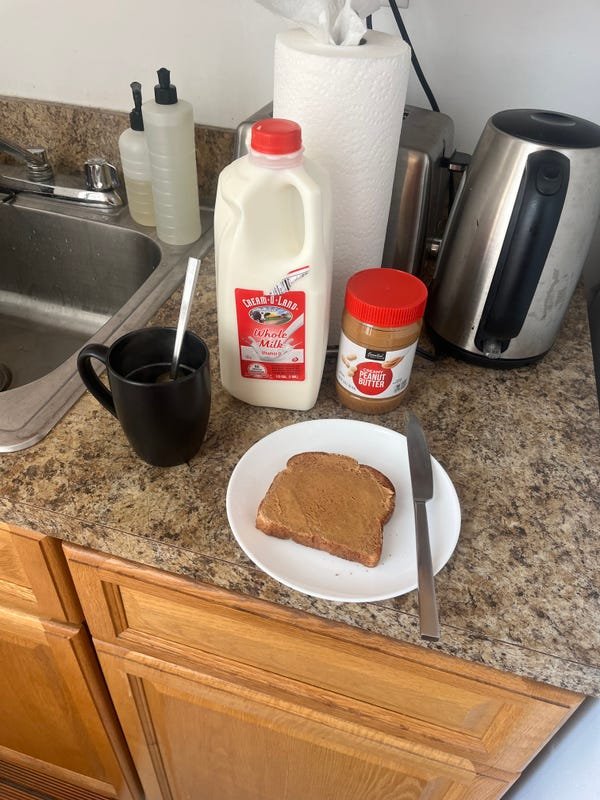
Since, besides the federal government, I am the one making the rules here, I decide on some adjustments. I’ll use the olive oil, butter, salt, pepper, and spices already in my apartment because part of thrift is utilizing the resources you already have. The same goes for my already-owned instant coffee that will serve as a vehicle for whole milk. Moderate alcohol consumption is not an official budget consideration, but it seems fine since Dr. Oz says it’s allowed and Dry January is passé. Price, quality, and availability are a delicate balance — I buy the cheapest peanut butter and ignore the ingredients list, which is surely not RFK Jr.-approved.
After making some tough calls, this is my haul:
1 bag potatoes
1 bag onions
1 can chickpeas
1 loaf whole grain bread, or the closest the store had to it
1 head cabbage
1 jar peanut butter
1 bag apples
1 block sharp cheddar cheese
½ gallon whole milk
2 dozen eggs
1 bag baby carrots
1 bag lentils
1 bag brown rice
1 bag frozen mixed vegetables
1 bag frozen peas
1.5 lbs ground beef
3 lb 8-piece cut chicken that I don’t think I understood what it was
Honestly, not a bad haul for $70.31.
Emily Stewart/Business Insider
Day 1: Tuesday
It would have made more sense to start this on a Monday morning, but there was a big snowstorm over the weekend, so Tuesday night kickoff it is. I start with some manageable basics, meaning I boil six eggs and rice and put them in the fridge, and I pick an easy recipe. Spoiler alert: I’m a terrible cook, so this is going to be a journey.
I’ve never been much of a food prepper (or life prepper), so I’m pretty impressed with myself for what I’d imagine others might consider a pathetic performance. My dinner is decent. ChatGPT has armed me with a plan for my leftovers. I have not yet over-potatoed, nor am I aware that sentiment is on the horizon.
Dinner: Roasted chicken breast with potatoes and carrots
The vibe: Cautiously optimistic, until I remember this plan does not allow for dessert.
One of the reasons I am bad at cooking is that my kitchen is tiny.
Emily Stewart/Business Insider
Day 2: Wednesday
My AI-assisted meal plans tell me I have a variety of breakfast options. My heart tells me I have only one — bread with peanut butter — which I fear may be the culinary highlight of my week. A midday trip to the dentist and the accompanying novocaine make me nervous about the lunch situation, but luckily, my meal is basically mush — chicken, rice, and peas. I make a different combination of ingredients into what appears to be a largely identical plate of mush for dinner, and set aside the leftovers from my lunchtime mush for the office tomorrow.
At some point during all of this, I realize that I have the ingredients for an actual good mush: mashed potatoes. This is very exciting. Post-dinner, I notice a coworker’s Instagram story of his New York Times-inspired creamy lasagna soup creation, which fits neither my diet nor my budget. My excitement fades.
Breakfast: 1 piece of toast with peanut butter, coffee with milk
Lunch: Chicken breast, rice, and peas
Snack: 1 apple, 2 slices cheddar cheese
Dinner: Ground beef skillet with onion, carrot, cabbage, and rice
The vibe: This is a lot like how I ate when I was broke in my 20s. I remember why I’m not a big fan of peas. Thank God for cheese.
Breakfast. Emily Stewart/Business Insider
Food prep. Emily Stewart/Business Insider
The cheese <3. Emily Stewart/Business Insider
Day 3: Thursday
I’ve reached the “bargaining” stage of this endeavor quicker than I thought. I catch myself looking at the new and improved food pyramid multiple times throughout the day to see if there’s something affordable but delicious that I’m missing. Broccoli? An avocado? The official guidelines list kimchi, which seems like the coastal political elite seeping through. Also, it’s $10 in the grocery store, so no.
ChatGPT assures me the free seltzer water in my office is allowed, which is a treat. When someone in the office announces there are free Girl Scout cookies on her desk, I don’t bother asking the robot if that’s OK, because I already know the answer. I meet a friend for drinks after work and, somewhat ashamedly, explain that I can’t stay for dinner because I pitched what I have now definitely decided was a very stupid idea. I will probably cheat sooner rather than later, but not yet.
Breakfast: 2 hard-boiled eggs, coffee with milk
Lunch: Chicken, rice, and peas
Snack: 1 apple that I spent $1 on because I did not plan and forgot to bring one from home
Dinner: Ground beef skillet with onion, carrot, cabbage, and rice
Vibe: I have to find a way to mix this up tomorrow.
Mush 1. Emily Stewart/Business Insider
Mush 2. You can see the problem. Emily Stewart/Business Insider
Day 4: Friday
The point of food isn’t just nourishment — it’s pleasure. This is a sensation that this diet is severely lacking.
In the midst of my desperation, I text Morgan Dickison, a registered dietitian at Weill Cornell Medicine, to ask for advice. The first thing she asks after I show her my food diary is whether I’m hungry, which I’m not — I’m having some pretty big portions, and the food isn’t exactly triggering additional cravings. She suggests seeking out some herbs, spices, and flavored oils, budget permitting. This prompts me to take a harder look at the spices in my cabinet to see what I might be able to incorporate. Her most specific recommendation: Rao’s tomato sauce — it’s not ultra-processed, and there’s no added sugar. (This is not the case, unfortunately, with Rao’s pesto.) She also low-key recommends I cool it on so much red meat. I wonder what RFK would say.
I head to the grocery store to buy Rao’s, but over the course of my five-minute walk, I forget why I’m there. I leave with chicken, an avocado, broccoli, two tomatoes, and corn tortillas, totaling $12.62. I have $22.07 left. Plus the $1 apple, so $21.07. Despite blanking on the sauce, the Morgan consultation/pep talk inspires what has been my best meal yet. Things may be looking up.
Breakfast: 1 piece of toast with peanut butter, coffee with milk
Lunch: Beef skillet with onion, carrot, and lentils
Snack: Hard-boiled egg, 2 slices cheddar cheese
Dinner: Grilled chicken breast with mashed potatoes
Vibe: Real live dietitian >>>>> AI.
This tastes better than it looks.
Emily Stewart/Business Insider
Day 5: Saturday
I am pretty committed to this bit, but I also don’t want to be a freak. After a glass of wine at the Westminster dog show agility preliminaries (which is awesome), I realize I have to eat something, lest I be too buzzed to enjoy the amateur canine obstacle courses. I get an $8 chicken empanada, which almost certainly breaks the rules. I decide the day has no more rules and go out for dinner.
Breakfast: 1 corn tortilla with 2 slices of cheddar cheese, in a quesadilla-type situation
Lunch: 1 chicken empanada
Dinner: Don’t worry about it
Vibe: Between the very agile dogs and my cheat meal, I have had a great day.
The dog show empanada and, more importantly, a dog on the agility course, about to do “the weave.”
Emily Stewart/Business Insider
Day 6: Sunday
I wake feeling more confident about this experiment, thanks to my Friday dinner semi-success and probably the glow of Saturday’s rule-breaking. I make an actually good brunch-type situation, and by “I make” I mean I generally start some things and then my boyfriend, a much better cook, takes over.
For dinner, it’s too cold to go to the store, so I manage to scrounge up the ingredients from my boyfriend’s brothers’ apartment to make pasta and homemade pasta sauce. I use it to concoct the chicken Parmesan I’ve been thinking about since my failed Friday Rao’s trip. I’m not sure if this is completely allowed, with the pasta (which is organic!) and also chicken breading, but I’m following along in spirit.
Part of what set this exercise in motion was comments from Agriculture Secretary Brooke Rollins, where she recommended a meal composed of a piece of chicken, a piece of broccoli, a corn tortilla, and “one other thing.” This is what I choose for my lunch finale, adding a quarter of an avocado as my “other thing.” It’s pretty good, though I have to embiggen it from the description to make it actually filling.
Breakfast: 1 corn tortilla with 2 slices of cheddar cheese, ¼ avocado
Lunch: The Brooke Rollins Special — 1 corn tortilla, chicken, broccoli, and ¼ avocado
Dinner: Ground beef and chickpea skillet with broccoli
Vibe: Victory.
Thank you, Secretary Rollins, for the inspiration. Honestly, it was pretty good.
Emily Stewart/Business Insider
So what did I learn from the diet?
Doing the RFK diet on a $105-a-week food plan was not as hard as I thought it would be. I came in under budget by $13, even with the mid-week grocery trips and the dog show empanada (and not counting the Sunday freebies or Saturday cheat meal). But being on such a strict diet and budget did lead to some notable limitations. My regimen lacked any appreciable amount of variety, and it made eating into an act focused almost exclusively on survival.
I ask Dickison, the dietitian, for a final rating of my adventure once I wrap it up. She says that, like a lot of people, I have room for improvement with fruits and veggies, commends my integration of chickpeas and lentils, and says I did a good job with protein at every meal, even if I was too heavy on ground beef. The budget piece of this undertaking is the hardest part, she says. It makes it challenging to incorporate some of the new food pyramid recommendations, such as berries, fresh vegetables, and fish, and it’s not aligned with how people live. “When I’m speaking with patients, we talk about all the different ways that you get food,” she says. Sure, sometimes it’s cooking at home, but it’s also fast casual at the office, a restaurant on a night out, or delivery when people are pressed for time. “The more convenient the option, the more expensive it gets,” she says.
What’s also unrealistic: The ability to religiously follow such a rigid diet for an extended period of time. Hunger levels and cravings matter. “It can be really difficult to manage those biological drives and also this premeditated budget, even if you did have the best intentions,” Dickison says. I wish I could text her every day for food advice, but I fear she would block my number.
This funny little food journey of mine has coincided with a giant internet debate about some people using DoorDash too much and others scolding them for not cooking more at home. After a week of being bound to team cook-at-home, I’m overly sympathetic to team DoorDash, if only because I’ve spent the past week envisioning the treat I’m about to get myself — via my delivery app of choice, Seamless — now that this is all over. Variety is, as the eye-rolling adage goes, the spice of life. Being able to switch up not only the dish but also the delivery method from time to time is part of that.
The experience has made clear the sacrifices we constantly make around affordability, sustenance, and gratification when it comes to food. The cheapest option is never the healthiest option. The healthiest option is never the most thrilling option. The most thrilling option may be the cheapest, but it’s usually bad for you.
It’s an economic issue as much as it is cultural and political. When people on the lower end of the income spectrum — or public benefits — are told to focus on whole-food basics, they’re told to give up on ease and joy as well. When people rely too much on delivery, they’re almost certainly overspending, but they do so because it saves time and energy compared to an elaborate kitchen production. It’s true that it’s generally better to cook real meals with fresh ingredients at home. It’s also true that life is complicated, and for a variety of reasons, that’s not always possible. I probably could have stretched my budget just as far, if not farther, with frozen, preprepared options.
Ultimately, for most of us, dinner is less of an ideological project than it is a daily logistical problem — one that has to be solved, night after night, in perpetuity.
Emily Stewart is a senior correspondent at Business Insider, writing about business and the economy.
Business Insider’s Discourse stories provide perspectives on the day’s most pressing issues, informed by analysis, reporting, and expertise.
The US just escalated its clash with Europe over tech regulation.
The State Department said it has barred five Europeans, including the EU’s former Internal Market Commissioner Thierry Breton and four members of digital campaign groups, from entering the country over what it called “censorship” of tech platforms.
The visa bans were met with backlash from European leaders on X, who accused Washington of intimidation and political overreach.
The dispute centers on the EU’s Digital Services Act and Digital Markets Act, which imposes obligations on major tech platforms — many of which are based in the US — to police content and curb anti-competitive behavior. Companies in breach of it can be fined up to 6% of their global annual revenue.
In a post on X late Tuesday, Secretary of State Marco Rubio said the State Department would block leading figures of what he called “the global censorship-industrial complex” from entering the US.
Every time Thibault publishes a story, you’ll get an alert straight to your inbox!
Stay connected to Thibault and get more of their work as it publishes.
“For far too long, ideologues in Europe have led organized efforts to coerce American platforms to punish American viewpoints they oppose,” Rubio wrote. “The Trump Administration will no longer tolerate these egregious acts of extraterritorial censorship.”
For far too long, ideologues in Europe have led organized efforts to coerce American platforms to punish American viewpoints they oppose. The Trump Administration will no longer tolerate these egregious acts of extraterritorial censorship.
In follow-up posts on Tuesday, Sarah B. Rogers, the undersecretary of state for public diplomacy, named Breton among the five European individuals sanctioned, accusing him of using the EU’s Digital Services Act to pressure Elon Musk and X during his tenure as commissioner for the internal market.
She also named Imran Ahmed of the Center for Countering Digital Hate, Clare Melford of the Global Disinformation Index, and HateAid leaders Anna-Lena von Hodenberg and Josephine Ballon, accusing them of pressuring US platforms over online speech. None of the four campaigners immediately responded to a Business Insider request for comment.
Rubio added that the US was “ready and willing to expand this list” unless officials reversed course, framing the move as a defense of free expression and US sovereignty.
European backlash
The back-and-forth has largely played out on X, a platform that was hit with a $140 million fine earlier this month for breaching the Digital Services Act.
Breton responded in Tuesday X post by invoking McCarthy-era politics, asking, “Is McCarthy’s witch hunt back?”
He added, “To our American friends: ‘Censorship isn’t where you think it is.'”
French President Emmanuel Macron also condemned the visa restrictions, describing them in a Wednesday X post as coercive measures aimed at undermining Europe’s digital sovereignty.
“The rules governing the European Union’s digital space are not meant to be determined outside Europe,” he said.
The European Commission “strongly” condemned the US decision, adding that the EU has the sovereign right to regulate its digital market and would seek clarification from US authorities.
Is McCarthy’s witch hunt back? 🧹
As a reminder: 90% of the European Parliament — our democratically elected body — and all 27 Member States unanimously voted the DSA 🇪🇺
To our American friends: “Censorship isn’t where you think it is.”
“Freedom of speech is the foundation of our strong and vibrant European democracy,” European Commission President Ursula von der Leyen wrote on X on Wednesday. “We are proud of it. We will protect it.”
Gérard Araud, France’s former ambassador to the US, said the dispute reflects a deeper rupture, writing on X that “the West” no longer exists and that Europe is now alone in defending its interests and values.
Daniel Fried, a former US ambassador to Poland and longtime US sanctions official, told Business Insider he could not recall a precedent for Washington imposing visa bans on a former European official in retaliation for policy decisions made in the course of their duties.
Similarly, Jacob Funk Kirkegaard, a senior fellow at the Brussels-based think tank Bruegel, told Business Insider that he could not recall any historical precedent for the move, describing the visa bans as largely symbolic and unlikely to trigger meaningful retaliation.
Musk in the middle
The dispute has been years in the making — and Musk X has often been at the center of it.
Breton repeatedly clashed with Musk after he bought Twitter in 2022 and pledged to loosen moderation in the name of free speech.
As the then-internal market commissioner, Breton warned that X could face fines or even be barred from the European Union if it failed to comply with EU law, later overseeing a formal investigation into the platform regarding disinformation and content moderation.
Those confrontations turned X into a symbol of the broader transatlantic fight over who sets the rules for online speech — a conflict that has now spilled from regulation into geopolitics.