A Russian governor has ordered large firms in his region to shortlist employees as “candidates” for military service, in a rare push for businesses to get involved with recruitment.
The order — signed by Pavel Malkov, the governor of Ryazan, a region 130 miles southeast of Moscow — instructed companies with 150 or more workers to select their employees by September 20.
These employees would be candidates for “military service under contract” with the Russian military, the noticesaid. In Russia, contract military service contributes to the bulk of recruitment for the Ukraine war and is meant to be voluntary.
The new legislation, dated March 20, was reported this week by Russian independent media and open-source intelligence groups.
The order is addressed to all business entities “regardless of their form of ownership,” indicating that private and state-owned organizations are subject to the requirements.
According to Malkov’s order, businesses and institutions with 150 to 300 workers must submit two candidate employees, while those with 300 to 500 workers must designate three. Firms and entities with 500 or more workers must submit five names.
Malkov’s order did not specify penalties for failing to submit the quotas on time. His directive cited two decrees signed in 2022 by Russian President Vladimir Putin putting the country under heightened readiness amid the full-scale invasion of Ukraine.
Ryazan local law says businesses that obstruct those decrees could be fined up to 1 million rubles, or about $12,300.
The candidacy mandate comes as Russia has been aggressively pushing new ways to find fresh troops while taking heavy losses in Ukraine, offering large sign-up bonuses to its citizens and increasingly leaning on informal or covert overseas recruitment networks.
Moscow said that over 420,000 people signed up for military contracts last year. But the recruitment rate has been repeatedly reported to be dwindling in larger cities, where residents are now more wary of joining the brutal conflict.
The heavy military focus is likely to come at a high cost to Russia’s already struggling economy. The country is facing labor shortages, for example, that its officials have warned could reach 11 million workers by 2030.
Russia hopes to eventually grow its active-duty force to 1.5 million soldiers, with a total force of 2.38 million when including support and civilian service personnel. In 2025, it spent about 6.3% of its GDP on defense.
The US Treasury Department is lifting Russian oil sanctions until April 11, as the Trump administration seeks to relieve global crude supplies choked by war in the Middle East.
A notice issued by the department’s Office of Foreign Assets Control on Thursday laid out a roughly four-week window authorizing the “sale, delivery, or offloading of crude oil or petroleum products” from Russia.
The move eases a yearslong effort by the US and its allies to squeeze Russia’s finances in response to its full-scale invasion of Ukraine in 2022.
Moscow, however, has still benefited from its energy trade — taxing the industry typically accounted for nearly half of its federal budget revenues before 2022 — by quietly transporting it via what the West has called a “shadow fleet” of third-party tankers.
An analysis from Urgewald, a German NGO, showed Russia’s fossil fuel export revenues averaged 510 million euros, or $587 million per day in the week following the strikes — 14% higher than the daily average in February daily average.
Treasury Secretary Scott Bessent said on Thursday that Russia stood to benefit from the temporary lifting of sanctions, but described the gains as limited in scale.
“This narrowly tailored, short-term measure applies only to oil already in transit and will not provide significant financial benefit to the Russian government, which derives the majority of its energy revenue from taxes assessed at the point of extraction,” he wrote in a post on X.
Brent crude oil prices were 0.6% higher at $101.07 per barrel at 11:16 p.m. on Thursday while US West Texas Intermediate was 0.4% higher at $96.15 per barrel.
The US and Israel launched a massive airstrike campaign against Iran on February 28, attacking over 5,500 targets with land, sea, and air assets. Iran has, in turn, vowed to block the Strait of Hormuz, the critical waterway serving the Persian Gulf, which accounts for about a fifth of the world’s crude oil.
Traffic in the strait has plummeted in the past week amid over a dozen reports of commercial vessels being attacked in its vicinity.
Despite sweeping Western sanctions imposed after the invasion of Ukraine, Russia has reoriented much of its energy exports away from Europe and toward alternative partners in Asia, notably China and India, where discounted Russian crude has become a major source of demand.
Last week, the US granted a temporary 30-day waiver to allow Indian refiners to purchase Russian oil.
Ukraine and its allies have long raised concerns about Russia’s ability to muster resources from its global energy trade to feed its war manufacturing industry. The Kremlin is now spending record amounts of its federal budget on defense, reaching 6.3% of its GDP in 2025.
Daily revenues of $610 million would be the equivalent of 12,000 to 30,000 of Russia’s Shahed-136 one-way attack drones, based on estimates that the loitering munitions cost $20,000 to $50,000 each.
President Donald Trump has repeatedly warned Iran that continuing to impede traffic along the strait would incur further US military action.
But Tehran has maintained a defiant posture, retaliating with drone and missile attacks on its neighbors and US forces in the region. Reports say it’s also begun to sparsely lay mines along the strait, which would further delay an opening of the strait by forcing the US and its allies to meticulously sweep for and clear explosives.
On Thursday, the new Iranian supreme leader, Mojtaba Khamenei, issued a statement through a newscaster that his government would continue blocking the strait.
Ukrainian President Volodymyr Zelenskyy said on Wednesday that his country had struck a Russian military industrial plant with locally made cruise missiles that flew nearly 900 miles to reach their target.
Ukrainian officials earlier reported that the missile strike on Saturday had hit a plant in Votkinsk, an industrial town in Russia’s Udmurt Republic, some 860 miles from the Ukrainian border.
“We carried out precise strikes with Flamingo missiles at a range of 1,400 kilometers,” Zelenskyy said at a press conference in Kyiv. “I believe this is truly a success for our industry.”
Such an attack would be one of the longest-range strikes carried out so far by the Flamingo, which is touted as one of the star products in Ukraine’s local defense manufacturing scene. Kyiv has been aggressively trying to expand its weapons industry as a complement to Western supplies and as a future export sector.
The Flamingos’ target, the Votkinsk plant, manufactures some of Russia’s key munitions, such as ballistic missiles for the Iskander system and the submarine-launched Bulava missile.
Every time Matthew publishes a story, you’ll get an alert straight to your inbox!
Stay connected to Matthew and get more of their work as it publishes.
Russia has not officially confirmed that the factory was hit, but Alexander Brechalov, the governor of the Udmurt Republic, said on Saturday that an unspecified facility in the region had been attacked and three people were sent to hospital.
Brechalov did not say if the Flamingo was used, but warned against drone threats over the region.
Ukrainian open-source groups later published satellite images that appeared to show damage to one of the workshops at the Votkinsk factory, with a gaping hole in its roof and signs of fire damage.
That evening, Kyiv had unleashed a large wave of drones and missiles into Russia in one of its biggest ever long-range attacks.
Russia’s defense ministry said that it shot down 77 Ukrainian drones on Saturday, but did not mention any Ukrainian missile threats.
Zelenskyy declined to say how many missiles or drones Ukraine launched in total on Saturday.
“There were interceptions by Russian air defense, there were also missiles that were not intercepted, and there were direct hits,” Zelenskyy said. “But the most important thing is that all the missiles that were launched all reached the target.”
Kyiv has often compared the Flamingo to the US-manufactured Tomahawk, saying that the Ukrainian turbofan-powered missile is much cheaper to make per unit and has a longer range of 1,900 miles.
The ground-launched Flamingo, however, takes up to 40 minutes to prepare for launch.
Ukraine is also still trying to build up its arsenal of the missile, with reports from last October saying that its manufacturer, FirePoint, hoped to produce up to seven a day by the end of 2025.
Kyiv said earlier this month that manufacturing had been affected by a recent Russian strike, with Zelenskyy warning that Ukraine had to “work on increasing quantity” of the Flamingo.
“We had certain technical problems because one large production line was destroyed as a result of a missile strike. They have already relocated and resumed production,” Zelenskyy had said at the time.
This story originally ran in Welt and appears on Business Insider through the Axel Springer Global Reporters Network.
“All we’ve got left now,” the Russian soldier said, “are radios, cables and pigeons.”
A decision earlier this month by SpaceX to shut down access to Starlink satellite-internet terminals caused immediate chaos among Russian forces who had become increasingly reliant upon the Elon Musk-owned company’s technology to sustain their occupation of Ukraine, according to radio transmissions intercepted by a Ukrainian reconnaissance unit and shared with the Axel Springer Global Reporters Network, to which POLITICO and Business Insider belong.
The communications breakdown significantly constrained Russian military capabilities, creating new opportunities for Ukrainian forces. In the days following the shutdown, Ukraine recaptured roughly 77 square miles in the country’s southeast, according to calculations by the news agency Agence France-Presse based on data from the Washington-based Institute for the Study of War.
Analysts in Ukraine’s Bureviy Brigade eavesdrop on Russian communications from an underground listening post in northeastern Ukraine.
Viktor Lysenko/BI
SpaceX began requiring verification of Starlink terminals on Feb. 4, blocking unverified Russian units from accessing its services. Almost immediately, Ukrainian eavesdroppers heard Russian soldiers complaining about the failure of “Kosmos” and “Sinka” — apparently code names for Starlink satellite internet and the messaging service Telegram.
Every time Ibrahim publishes a story, you’ll get an alert straight to your inbox!
Stay connected to Ibrahim and get more of their work as it publishes.
“Damn it! Looks like they’ve switched off all the Starlinks,” one Russian soldier exclaimed. “The connection is gone, completely gone. The images aren’t being transmitted,” another shouted.
Dozens of the recordings were played for Axel Springer Global Reporter Network reporters in an underground listening post maintained by the Bureviy Brigade in northeastern Ukraine. Neither SpaceX nor the Russian Foreign Ministry responded to requests for comment.
“On the Russian side, we observed on the very day Starlink was shut down that artillery and mortar fire dropped drastically. Drone drops and FPV attacks also suddenly decreased,” said a Ukrainian aerial reconnaissance operator from the Bureviy Brigade who would agree to be identified only by the call sign Mustang, referring to first-person view drones. “Coordination between their units has also become more difficult since then.”
The satellite internet network has become a crucial tool on the battlefield, sustaining high-tech drone operations and replacing walkie-talkies in low-tech combat. Since Russia’s February 2022 invasion, which destroyed much of Ukraine’s traditional communications infrastructure, Western governments have provided thousands of the Starlink units to Kyiv.
At some point, it felt like the Russians had more devices than we did,” said a Ukrainian soldier identified by the call sign Mustang
Viktor Lysenko/BI
Viktor Lysenko/BI
With the portable terminals, there is no need to lay kilometers of cable that can be damaged by shelling or drone strikes. Drone footage can be transmitted in real time to command posts, artillery and mortar fire can be corrected with precision, and operational information can be shared instantly via encrypted messaging apps such as Signal or Telegram.
At the outset of the Russian invasion, Starlink access gave Ukraine’s defenders a decisive operational advantage. Those in besieged Mariupol sent signs of life in spring 2022 via the backpack-size white dishes, and army units used them to coordinate during brutal house-to-house fighting in Bakhmut in 2023.
Satellite internet became “one of, if not the most important components” of Ukraine’s way of war, according to military analyst Franz-Stefan Gady, an adviser to European governments and security agencies who regularly visits Ukrainian units. “Starlink constituted the backbone of connectivity that enabled accelerated kill chains by helping create a semi-transparent battlefield.”
The operational advantages of Starlink did not go unnoticed by Russian forces. By the third year of the war, Starlink terminals were increasingly turning up in Russian-occupied territory. One of the first documented cases surfaced in January 2024 in the Serebryansky forest. Month by month, Ukrainian reconnaissance drones spotted more of the devices.
The Ukrainian government subsequently contacted Musk’s company, urging it to block Russian access to the network. Mykhailo Fedorov, then digital minister and now defense minister, alleged Russian forces were acquiring the devices via third countries. “Ukraine will continue using Starlink, and Russian use will be restricted to the maximum extent possible,” Fedorov pledged in spring 2024.
Yet Russian use of the terminals continued to grow throughout 2025, and their use was not limited to artillery or drone units. Even Russian infantry soldiers were carrying mini Starlink terminals in their backpacks.
“We found Starlink terminals at virtually every Russian position along the contact line,” said Mustang. “At some point, it felt like the Russians had more devices than we did.”
In the listening post this month, he scrolled through more than a dozen images from late 2025 showing Russian Starlink terminals set up between trees or beside the entrances to their positions.
“We targeted their positions deliberately,” Mustang continued. “But even if we destroyed a terminal in the morning or evening, a new one was already installed by the next morning.”
In the Russian-occupied eastern Ukrainian city of Kreminna, there was even a shop where soldiers could buy Starlink terminals starting in 2024. According to Ukrainian officials, these devices were not registered in Russia.
SpaceX’s move in early February to enforce a stricter verification system effectively cut off unregistered Starlink terminals operating in Russian-occupied areas. Only devices approved and placed on a Ukrainian Ministry of Defense “whitelist” remained active, while terminals used by Russian forces were remotely deactivated.
“That’s it, basically no one has internet at all,” a Russian soldier said in one of the messages played for Axel Springer reporters. “Everything’s off, everything’s off.”
The temporary shutdown allowed Ukraine to slow the momentum of Vladimir Putin’s forces, although the localized counteroffensives do not represent a fundamental shift along the front. Soldiers from other Ukrainian units, including the Black Arrow battalion, confirmed the military consequences of the Starlink outage for Russian forces in their sectors in interviews with the Axel Springer Global Reporters Network.
By mid-February, Russian shelling had increased again, though largely against frontline positions that had long been identified and precisely mapped — suggesting that Russia has yet to fully restore all of its lost capabilities.
Now, analysts from the Bureviy Brigade say Russian forces are scrambling for alternatives. They have been forced to rely far more heavily on radio communication, according to Mustang, which creates additional opportunities for interception.
Russian units will likely attempt to switch to their own satellite terminals. But their speed and connection quality are significantly lower, Mustang says. And because of their size, the devices are difficult to conceal.”The shutdown of Starlink, even if only of limited effect for now, highlights the limited ability of the Russian armed forces to rapidly implement ongoing cycles of innovation,” said Col. Markus Reisner of the Austrian Armed Forces. “This could represent a potential point of leverage for Western supporters to provide swift and sustainable support to Ukraine at this stage.”
NATO is deploying a Turkish drone carrier to the Baltic Sea to boost its surveillance and defense in response to “repeated” Russian airspace violations, the alliance announced on Friday.
The TCG Anadolu will support Eastern Sentry, a defensive operation the alliance launched in September after Russian drones crossed into Polish airspace, forcing a military response.
The Turkish drone carrier is deploying toward the coast of Latvia, where it will contribute to air surveillance and defense along NATO’s eastern edge. Allies have been surging fighter jets and warships to the Baltic region in response to Russian drone incursions.
Allied Joint Force Command Brunssum, one of three operational-level NATO headquarters, said in a statement on Friday that the deployment of the Anadolu follows “repeated airspace violations” that have been attributed to Russia.
JFC Brunssum called the deployment “a clear signal to the east” and said that it “sends an unmistakable message” that NATO is prepared to defend its territory.
A Bayraktar TB3 drone lands on the flight deck of the TCG Anadolu earlier this month.
Dursun Aydemir/Anadolu via Getty Images
It’s unclear when the carrier will arrive on station and how long it will remain there. The Turkish defense ministry could not immediately be reached for comment, and neither JFC Brunssum nor NATO’s Allied Air Command responded to a request for additional information.
The first-of-its-kind TCG Anadolu is the Turkish Navy’s only drone-carrying amphibious assault ship. It was commissioned in 2023 and is now Ankara’s most advanced vessel and flagship.
The 750-foot-long vessel was originally intended to carry helicopters and F-35B fighter jets, but after Turkey was kicked out of the F-35 program over its purchase of Russian surface-to-air missile systems, Ankara decided to repurpose the Anadolu for fixed-wing drones.
The Anadolu can carry Bayraktar TB-3 and Bayraktar Kızılelma combat drones, systems made by the Turkish company Baykar, as well as attack helicopters.
JFC Brunssum said the carrier is the largest ship in NATO’s Steadfast Dart fleet, which is comprised of 17 vessels, including amphibious landing ships, frigates, destroyers, and submarines.
Iran and China have also built their own drone carriers, and Portugal expects to receive one later this year.
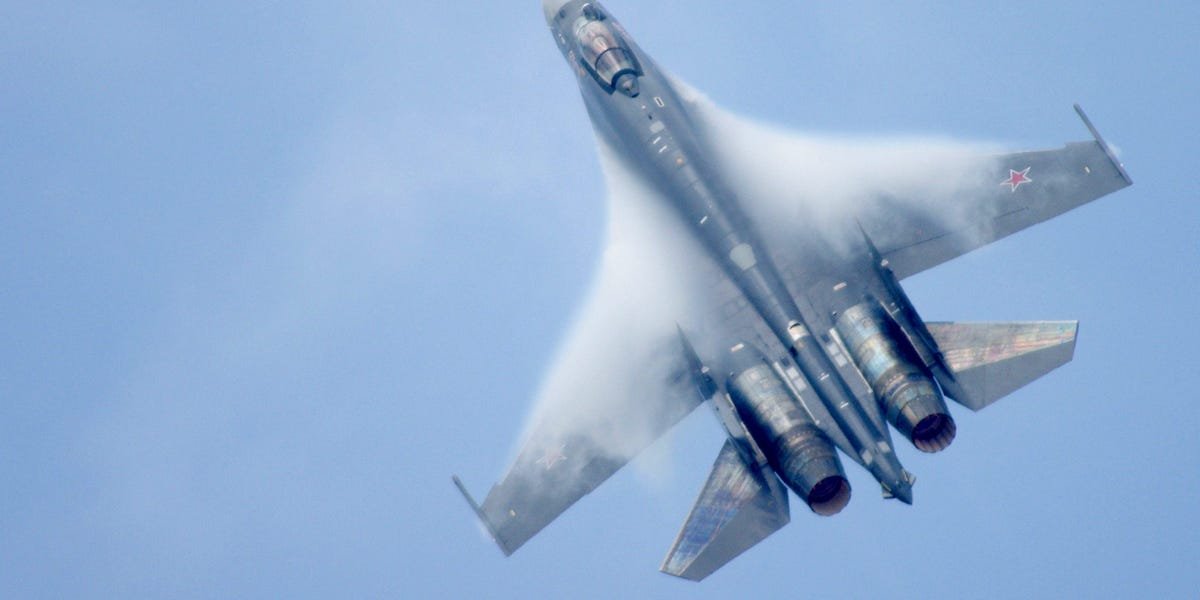
Russia’s Su-35 fighter jets are increasingly flying with longer-range air-to-air missiles that make them a potentially greater threat to NATO air operations, a leading airpower expert assessed in a recent report.
Justin Bronk, a researcher at the UK-based Royal United Services Institute, said in his assessment of Russian air power that regularly arming Su-35 and Su-30SM2 jets with R-37M missiles “has significantly contributed to increasing the threat that they can theoretically pose to NATO air operations.”
The R-37M missile, which NATO calls the RS-AA-13, is “much more capable at long range” than the R-77-1 missiles the Su-35 had previously relied on, Bronk told Business Insider in a discussion of his recent report.
R-77-1 missiles have a range of about 62 miles, while R-37M missiles are understood to have a range of around 200 miles. Real-world kills at range depend on a mix of factors, but reach still matters.
Bronk told Business Insider that the longer-range R-37M missiles had been “very much a specialist weapon” for a limited selection of Russian jets. But “now you see absolutely routine employment” of the weapon on Russia’s Su-35S.
The Su-35 fighter is “the primary air superiority aircraft for the Russians,” he added. The jet is key for Russia’s air force, with the UK Ministry of Defence in 2023 describing it as Russia’s “most advanced combat jet in widespread service.”
Bronk told Business Insider that for the NATO alliance, the regular arming of Su-35s and Su-30SM2s with the R-37M is “a problem” because it puts “more credible long-range air-to-air missiles at play from the Russian side.”
Those missiles used to be contained within a smaller part of the force, mainlyRussia’s MiG-31s. Now, Bronk said, having them on more jets “is obviously a significant growth in the potential threat that they can pose to NATO aircraft in a direct conflict.”
The R-37M was previously concentrated on Russia’s MiG-31 jets.
Mikhail Svetlov/Getty Images
Additionally, he said, Russia’s Su-35 crews are “generally more highly selected, better trained, more capable than the crews on the MiG-31s.” Russia’s better pilots tend to fly its top jets, and those will be the pilots operating these missiles.
Having them routinely carry long-range air-to-air missiles, rather than the “really pretty limited” R77-1 that they used to carry, Bronk said, “is a significant shift.”
A missile with a longer reach
The R-37M’s combat effectiveness has been spotlighted by Russia’s full-scale invasion of Ukraine, which began in February 2022.
Late that year, a RUSI report said the R-37M, combined with Russia’s MiG-31BM interceptor aircraft, was proving to be “highly effective and difficult for Ukrainian pilots to evade due to its speed, very long range, and specialized seeker for low-altitude targets.”
At that time, it said Russia was just starting to put them on Su-35S jets.
A newer report from RUSI in November highlighted how much more the R-37M missile was being used, saying that this missile “in particular, has been used to destroy several Ukrainian aircraft at long range,” including one kill recorded at more than 109 miles.
“This is significantly beyond the engagement range of most NATO air-to-air munitions,” the report said. But it also said that the missiles’ success was “heavily determined by Ukraine’s lack of effective radar warning receivers,” something NATO has fielded far more robustly across its air forces.
The Su-35 threat
Making the Su-35 more powerful is a big move for Russia. In 2022, analysts at the RAND Corporation described the Su-35 as Russia’s “signature heavy fighter.”
Ukraine has shot down multiple Su-35s in its fight against Russia’s invasion, but Bronk said that despite reported losses, the fleet has “marginally increased since the start of the full-scale war.”
He estimated that in late 2020, Russia had about 90 Su-35s. Between eight and 10 have been lost in combat or accidents, he said, but 55 to 60 new aircraft have since been delivered — leaving Russia with roughly 135 to 140 Su-35s overall, a net increase despite the attrition.
Bronk’s analysis was based on interviews with Western air forces and ministries, data from Ukraine’s armed forces, and open-source information.
He said that the Russian air force has gained so much valuable combat experience against Ukraine that its air force is now “a significantly more capable potential threat for Western air forces than it was in 2022.”
He said that in air-to-air combat, where Russian aircraft take on Western ones, the West still has a strong advantage, but longer-range air-to-air missiles complicate the picture.
And any fight would not only be in the air. The West would face not only Russia’s air force but also its vast ground-based air defense network, which the war has also made more formidable.
Bronk told Business Insider that Su-35 crews are typically “much better at working with the ground-based air defenses,” meaning the jets can operate more effectively under the umbrella of Russian surface-to-air missile systems and are therefore “more credible as an air-to-air threat.”
He said that the improvement of those ground-based defenses throughout the war — combined with the fielding of more powerful missiles on Su-35s that are increasingly integrated with them — is one reason why Russian airpower “represents a greater threat to Western air power capabilities in Europe” than it did before the full-scale invasion.
Cosmos floated his quadcopter over the ruined warehouse, guiding it through a corner of the roof where shattered metal sheets had collapsed to form a hole.
The drone pilot’s unit, the Wild Division, suspected that the building was a logistics hub for Russian soldiers, roughly 15 km, or about 9 miles, from the line of contact in southern Ukraine. These hidden locations often held ordnance or fuel stockpiles, and Cosmos’ fiber-optic drone was armed with explosives to destroy them.
Yet inside, the drone rotated its camera to reveal what looked more like a farmer’s garage: Four civilian cars, a pair of motorcycles, and two bridled horses.
“We had not expected to see this. It was unusual,” Cosmos told Business Insider, speaking on condition that he be identified only by his call sign.
“We were expecting to find some armored vehicles,” he added.
Video of the discovery went viral last week in Ukraine, as the war has increasingly seen Russian soldiers using unconventional transport tools, such as pack animals and bicycles, to conduct assaults or logistics missions. Cosmos said his drone mission was conducted in early February.
The smaller profile of a horse or civilian car might be harder for a drone to spot, though Russia’s repeated use of them has also raised questions about the viability of its tactics and whether it’s been producing enough military equipment to sustain its invasion.
Cosmos’ squad mates and officers at the Wild Division, a first-person-view drone company in the 82nd Air Assault Brigade, had seen clips of Russian soldiers riding on horses to attack Ukrainian positions before.
One famous example they remember was in Zaporizhzhia, when a Ukrainian drone crew attacked Russian infantry crossing the front lines on horseback last month.
Cosmos, who’s been piloting drones for a year, said it was the first time he’d personally seen the animals on the front lines.
He flew his explosive-laden drone straight into the back of one of the cars, and said his crew later struck several other vehicles inside. When Russian troops moved their transport assets, the Wild Division found the next warehouse and attacked that one, too, Cosmos said.
“The enemy usually lives in hiding close to these places,” Cosmos said of the warehouse. “It’s common for us to check all targets. Sometimes we can see the enemy infantry, or you can see their vehicles.”
Russia calculates war differently
The Wild Division declined to say where exactly the warehouse was located, but its brigade is generally deployed in the Donbas.
The commander of Cosmos’ battalion told Business Insider that the discovery of the horses surprised him, too.
“I thought it had been a location for transport vehicles, sort of a transfer hub,” said the major, whose call sign is Fizruk.
Fizruk said the appearance of horses and cars in his area of the front line could be a sign that Russian forces are running low on standard resources, but also reflects Moscow’s attritional nature of fighting.
The cars discovered by Cosmos appear to be Nivas, inexpensive civilian off-road vehicles from the Russian Lada car brand.
“They treat these like they will be losses anyway, that they will be destroyed anyway,” he said. “Look, a Niva costs, let’s say, $2,000. A Hummer, which the Armed Forces of Ukraine uses in many places, costs $20,000, maybe more.”
“Since they lose their equipment in assaults, from that point of view, why pay $20,000 for one vehicle if you can buy 10 Nivas for $20,000?” Fizruk added.
The Kremlin is known to pressure the front line with repeated ground assaults, sending small groups of infantry to approach Ukrainian positions on foot or in cheap vehicles. The strategy has been costly, with NATO now saying that up to 25,000 Russian troops are dying each month.
Sustaining that style of war has pushed Moscow to informal means of recruitment and weapons procurement, including hiring troops from overseas and receiving ammunition from North Korea.