Safety-advocates-say-GOP-effort-wont-mandate-needed-cockpit-alarm.jpeg

Safety advocates say GOP effort won’t mandate needed cockpit alarm

Lawmakers appear to be at an impasse after the failure of a bipartisan bill that would have mandated something most airline cockpits still lack: a real-time view of other aircraft.

The ROTOR Act failed in the House by a single vote. It had passed with bipartisan support in the Senate and backing from families of crash victims of the January 2025 collision involving an American Airlines jet. It also had the support of pilot and flight attendant unions, airlines, and the National Transportation Safety Board.

Advocates say they will oppose a new GOP bill that does not mandate cockpit monitors.

Families were unhappy with the bill’s failure to garner the two-thirds majority needed to pass a procedural measure on Tuesday: “It was defeated by eleventh-hour objections built on misleading technical claims the NTSB’s own investigators have publicly refuted,” they said in a joint statement.


Rep. Don Beyer, D-Va., speaks during a news conference to discuss aviation safety reform legislation

Rep. Don Beyer, a Virginia Democrat who supported the ROTOR Act, speaks during a news conference to discuss aviation safety legislation. He’s surrounded by families of the victims.

AP Photo/Mariam Zuhaib


The bill split House Republicans, with some of the 132 opponents saying the additional monitoring systems would be expensive and were unproven; some are advocating for an alternate bill, the ALERT Act, that leaves air traffic controllers primarily responsible for collision alerts and allows some military flights to opt out of transmitting their positions.

At the heart of the debate was a proposed requirement to equip commercial aircraft with GPS-based “ADS-B In,” which would display nearby air traffic on the flight deck screen — potentially closing the gap revealed by last year’s AA crash with an Army helicopter near Ronald Reagan National Airport that killed 67 people. Overstretched air traffic controllers had struggled to track the mix of commercial and military flights in DC’s crowded airspace that day.

Commercial aircraft have been required to carry the sister technology, “ADS-B Out,” since 2020, which feeds their position to air traffic control. Think of it like ADS-B Out is talking and ADS-B In is listening. ADS-B Out has drastically improved safety by being more precise than radar and enhancing pilot situational awareness.


Example of ADS-B

Example of a generic Garmin ADS-B traffic monitor in an aircraft.

Garmin


Supporters of the ROTOR Act — which would also require certain military planes to broadcast their position in civilian airspace — argued that adding these monitors would allow pilots, as the last line of defense, to react to hazards when seconds count.

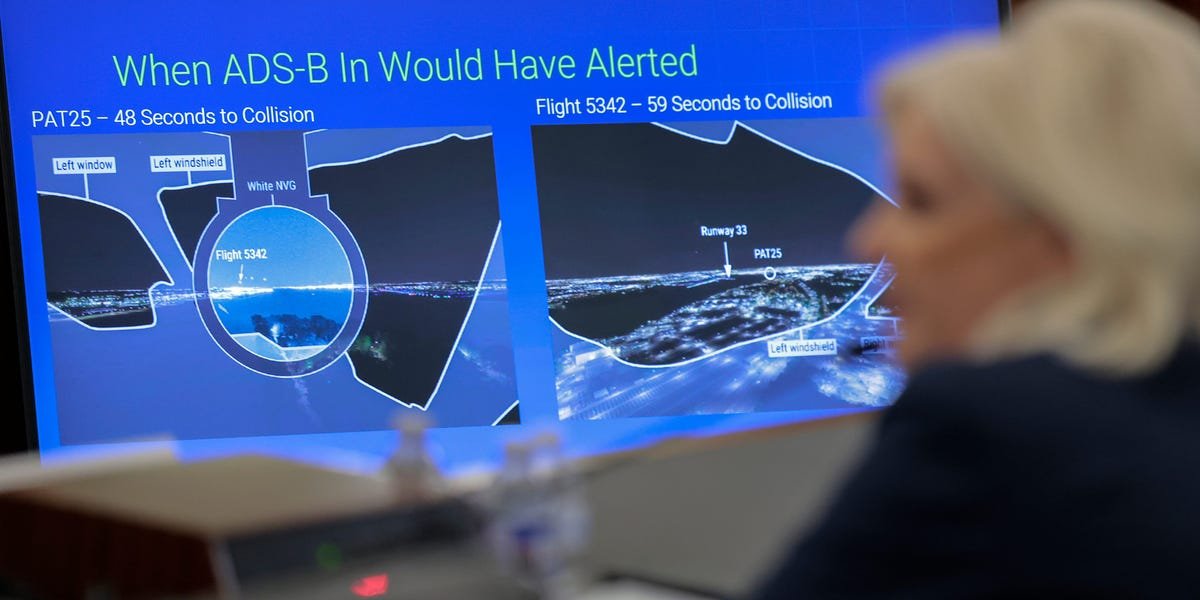
In comments shared with Business Insider, Syracuse University professor and aviation safety expert Kivanc Avrenli said the use of ADS-B In on the American jet would have given its pilots 59 more seconds to react before impact. In reality, the traffic-avoidance collision alert came only 19 seconds before, he said, and maneuver instructions weren’t possible due to altitude limits.

“In dense airspace, that extra 40 seconds can be the difference between having time to sort out a conflict and having no real options left,” he said. “Delaying these upgrades means continuing to rely on systems that simply were not built for this kind of scenario.”

ADS-B In would not only help in flight but also on the ground, where a series of runway incursions has exposed the limits of what controllers can handle in real time. In the months after the January accident, two separate military aircraft had close calls with US passenger jets.

The Pentagon initially supported the original bill. On Monday, it changed its position and said the technology risks “significant unresolved budgetary burdens and operational security risks affecting national defense activities.” Some Republicans came out against the bill and threw their weight behind a different effort.

House Republicans Mike Rogers and Sam Graves, who voted no to ROTOR, have instead pushed a revised version of the bill.


Families of the victims at sante hearing.

Families of the victims supported the ROTOR Act.

Heather Diehl/Getty Images


During a Senate hearing on Monday, Graves said ALERT would be a “comprehensive package” that would enhance military coordination and pilot training and address all 50 NTSB recommendations. He said the ROTOR Act only addresses two of the recommendations.

ALERT would not require ADS-B use — essentially maintaining the current system that relies on air traffic controllers to detect potential conflicts in and around airports and communicate with pilots. It would also absolve military aircraft of having to use the anti-collision technology in certain airspaces, citing security risks.

Graves added that ADS-B In would be a burden to implement on the 5,500 planes in the sky, would “unintentionally lead to an operational crisis in 2031,” and be an “unworkable” mandate.

NTSB Chair Jennifer Homendy — who oversees the research and writing of the agency’s recommendations — said on Thursday that the House’s ALERT bill is “watered down” and won’t do enough to prevent future accidents, adding that the bill doesn’t address all of the NTSB’s recommendations because it takes out the ADS-B In requirement.

The NTSB has recommended ADS-B In on cockpit displays since 2008. The Federal Aviation Administration has never mandated it, partly because it lacks a clear funding mechanism. Regulators have argued that the system, which provides visual and audio alerts, would impose a cost burden on airlines and on private plane owners who may not operate in congested airspace.

Homendy told a Senate Committee in February that American Airlines paid less than $50,000 per plane to retrofit roughly 300 Airbus A321s, as an industry example. That adds up fast across hundreds of aircraft. She said general aviation planes could carry portable receivers that cost as little as $400.

Some airlines, including American and JetBlue, have voluntarily added ADS-B In to their planes.


Source link

Anthropic-is-dropping-its-signature-safety-pledge-amid-a-heated.jpeg

Anthropic is dropping its signature safety pledge amid a heated AI race

Anthropic is no longer daring to be quite so different.

The AI startup founded by former OpenAI employees, laser-focused on the proper development of the technology, is weakening its foundational safety principle.

In a statement on Tuesday, Anthropic said that amid heightened competition and a lack of government regulation, it will no longer abide by its commitment “to pause the scaling and/or delay the deployment of new models” when such advancements would have outpaced its own safety measures.

The new policy means Anthropic is far less constrained by safety concerns at a moment when its flagship chatbot, Claude, is upending financial markets and sparking concerns about the death of software.

As part of the changes, Anthropic now has separate safety recommendations, called its Responsible Scaling Policy, for itself and the AI industry as a whole. The policy was loosely modeled after the US government’s biosafety level (BSL) standards

Anthropic’s chief science officer, Jared Kaplan, told Time Magazine that the responsible scaling policy was not in keeping with the current state of the AI race.

“We felt that it wouldn’t actually help anyone for us to stop training AI models,” Kaplan told Time. “We didn’t really feel, with the rapid advance of AI, that it made sense for us to make unilateral commitments … if competitors are blazing ahead.”

The new policy still includes a commitment to delay the development or release of “a highly capable” AI model, but only in more limited circumstances.

In a lengthy blog post, Anthropic cited “an anti-regulatory political climate” as part of the reason for its decision. The company and its CEO, Dario Amodei, have pushed for AI regulations with some success on the state level, but without any major steps at the federal level.

“We remain convinced that effective government engagement on AI safety is both necessary and achievable, and we aim to continue advancing a conversation grounded in evidence, national security interests, economic competitiveness, and public trust,” the company wrote. “But this is proving to be a long-term project—not something that is happening organically as AI becomes more capable or crosses certain thresholds.”

The company said the scaling policy was always intended to be “a living document,” which was outlined in the first version in 2023. That said, Amodei has previously said the safety policy was meant to mitigate the risks AI could unleash — even quoting Uncle Ben’s famous admonition to Peter Parker, aka Spider-Man.

“The power of the models and their ability to solve all these problems in biology, neuroscience, economic development, governance, and peace, large parts of the economy, those come with risks as well, right?” Amodei told podcaster Lex Fridman in November 2024. “With great power comes great responsibility.”

Anthropic said another reason for changing the standards is that higher theoretical levels of risk, ASL-4 and beyond, in their framework, cannot be contained by any one company alone. (In the biosecurity world, BSL-4 refers to the highest level of protection that an extremely small number of labs implement to handle pathogens like the Ebola virus.)

Safety is the core of Anthropic’s soul

Amodei has repeatedly said his company’s commitment to safety is evident in one of its first major decisions: holding back on releasing Claude in the summer of 2022.

Looking back on the move, Amodei has said that Anthropic was worried that it could not develop safeguards quickly enough for the public release of a breakthrough technology. OpenAI released ChatGPT in November 2022, kick-starting the AI race. Months later, Anthropic finally released Claude.

“Now, that was very commercially expensive,” Amodei said during a recent interview with billionaire and investor Nikhil Kamath. “We probably seeded the lead on consumer AI because of that.”

One of Claude’s previous training documents is internally referred to as the “Soul doc,” an example of rhetoric that would be out of place at most other AI companies.

Kamath pressed Amodei on how he responds to critics who say Anthropic is just pushing regulation to stop the growth of future competitors. Amodei said the 2022 decision was an example of how is company backs up its talk on safety. He also pointed to advocating for US export controls on advanced chips to China, a position that Nvidia CEO Jensen Huang has criticized.

“Anyone who thinks we benefit from being the only ones to do that, it’s really hard to come up with a picture where that’s the case,” Amodei said. “You look at any one of these and, ‘okay, fine,’ but you put enough of them together, and I don’t know, I ask you to judge us by our actions.”


Source link

Taylor Rains

Trump’s threat to ‘decertify’ Canadian planes is a safety risk

President Donald Trump’s threat to “decertify” Canadian-made aircraft — the backbone of many US carriers’ regional jet fleet — is a threat to aviation safety, industry watchers said Friday.

The president also doesn’t have the authority to unilaterally declare planes unworthy to fly in the US, Henry Harteveldt, an aviation industry authority and president of Atmosphere Research Group, told Business Insider. That authority belongs to the FAA.

The trade spat — another in a continuing back-and-forth between Trump and Canada — comes after Canada hasn’t fully certified newer US-made Gulfstream jets to fly in its skies. (It has certified older models.) Gulfstream planes are used almost exclusively by private aviation companies, governments, and the ultrawealthy.

Trump said on Thursday night, in a Truth Social post, that he would “decertify” Canada-made Bombardier jets until Canada approved the Gulfstream models. He also threatened a 50% tariff on “any and all” Canadian aircraft sold in the US until the situation was corrected.

Bombardier said in a statement that it’s in contact with the Canadian government. The FAA referred Business Insider to the White House. A White House official said decertification would not immediately affect aircraft already in operation; it would apply only to new deliveries.

That would be a relief for US airlines like American, Delta, and United, whose regional affiliates operate Bombardier CRJ aircraft to cities across the country.


SkyWest crj700.

Regional carrier SkyWest, operating on behalf of the Big 3 and Alaska Airlines, is the largest operator of Canadian-made planes. It has 238, per Cirium.

Fabrizio Gandolfo/SOPA Images/LightRocket via Getty Images


Still, any move to decertify these more than 2,000 passenger airliners and private jets — part of almost 5,550 Canadian-made aircraft and helicopters certified in the US, according to Cirium — could trigger thousands of flight cancellations a day. A 50% tariff would likely raise airline ticket prices.

Aviation analysts said Trump’s threat posed a safety risk in itself.

“Anything that intrudes on the turf of safety regulators coming from politics, trade issues, or personal grievances is a very, very bad idea,” Richard Aboulafia, managing director of the aviation consultancy AeroDynamic Advisory, told Business Insider.

Aboulafia said aircraft certification is intentionally non-political for a reason: Regulators are meant to evaluate risk, not respond to trade threats. Once certification becomes a political weapon, trust in the system erodes for manufacturers, operators, and the flying public, he contended.

Why is the Gulfstream certification delayed in Canada?

In Canada’s case, the delay in certification is likely not obstructionism but the result of independent regulatory decisions.

For the Gulfstream G700 and G800, Canada hasn’t completed its own certification, while the FAA has granted Gulfstream a temporary exemption from certain fuel‑icing rules designed to ensure aircraft engines and systems operate safely in extreme cold.

The FAA waiver means Gulfstream has until the end of this year to meet those requirements — meaning the aircraft is operating under essentially conditional certification in the US, despite being allowed to be delivered.

These waivers are not unusual and are typically granted to allow new aircraft to enter service while completing certain technical tests and paperwork, rather than because the planes are unsafe.

Still, history shows what can sometimes go wrong when thorough certification and safety protocols are deprioritized. The most consequential example was the Boeing 737 Max, which suffered two fatal crashes in 2018 and 2019 due to systemic design issues, killing 346 people.

More recently, in early 2024, a door plug separated on another 737 Max due to quality-control issues at Boeing’s Washington factory, further exacerbating scrutiny of production and certification. No one died in that incident.

Part of the reason the 737 Max issues slipped past regulators is that, for decades, global authorities often relied on reciprocal approvals, effectively rubber-stamping each other’s certifications to speed aircraft to market.

The Max disasters exposed the risks of that approach. Today, regulators — including those in Canada — are expected to conduct their own full assessments rather than automatically rely on approvals from foreign authorities.

The FAA itself is taking extra precautions before certifying the Boeing 737 Max 7 and 10, as both aircraft have technical problems that could lead to engine overheating. Boeing initially asked for a waiver but rescinded it amid the scrutiny.


Source link