
Jake Epstein

Satellite image shows Iran’s largest naval vessel, a tanker-turned-warship, smoking in port

Newly captured satellite imagery from the ongoing conflict with Iran shows it’s biggest warship — a former oil tanker converted into a floating base — on fire at a military port.

The imagery, captured on Monday by the US commercial imaging firm Planet Labs PBC and obtained by Business Insider, shows a massive plume of smoke rising from what analysts identified as the IRINS Makran in the harbor at Bandar Abbas, an Iranian port city adjacent to the Strait of Hormuz and the Makran’s home port.

President Donald Trump vowed on Saturday to “annihilate” Iran’s navy as he announced the start of “major combat operations” against the country.


The Iranian warship Makran burns in port.

A close-up view of the Makran.

Planet Labs PBC’


US Central Command, which oversees Middle East operations, said on Monday that it has destroyed all 11 of Iran’s ships in the Gulf of Oman. It was not immediately clear if that tally includes the Makran.

Commercial satellite imagery captured by US spatial intelligence firm Vantor on Sunday showed destroyed and sinking vessels, as well as damaged buildings at the Iranian naval base in Konarak.

Iran converted the Makran, an oil tanker, into a forward base ship in 2020 and commissioned the vessel into the navy the following year. Technically not a combat ship, it is still Iran’s largest warship and can carry roughly a dozen helicopters.

The deck can accommodate missile and rocket artillery launchers, as well as vertical takeoff and landing drones. The vessel has completed several long-distance voyages, including one that circled the globe.

The Makran is one of several Iranian warships that were once civilian vessels. In recent years, Tehran has converted several container ships into militarized drone carriers.


The Iranian warship Makran sails in the ocean.

The Makran is a tanker converted into a forward base ship.

Iranian Army via AP


CENTCOM said it struck one of these vessels, the Shahid Bagheri, in the opening hours of the conflict over the weekend. The carrier’s status is unknown.

The US strikes initially focused on Iran’s naval forces, command and control facilities, intelligence infrastructure, and ballistic missile sites, Gen. Dan Caine, the chairman of the Joint Chiefs of Staff, told reporters on Monday.

US and Israeli aircraft have also targeted Iranian air defenses, paving the way for both militaries to secure air superiority over large parts of the country.

Additional satellite imagery shows widespread damage across Iran, including at drone and air bases, official compounds, and missile bases. Other military infrastructure, such as radar systems, was also struck.

Iran has retaliated by launching waves of missiles and drones at bases hosting US forces across the Middle East, Israel, and most other countries in the region, including the Gulf states.

The US and its allies have said that they have intercepted hundreds of Iranian missiles and drones. Some have slipped past air defenses, though, killing more than a dozen people across the region, including six American service members.


Source link

Satellite-photos-capture-devastation-at-Iranian-Supreme-Leader-Khameneis-residence.jpeg

Satellite photos capture devastation at Iranian Supreme Leader Khamenei’s residence after US and Israeli strikes

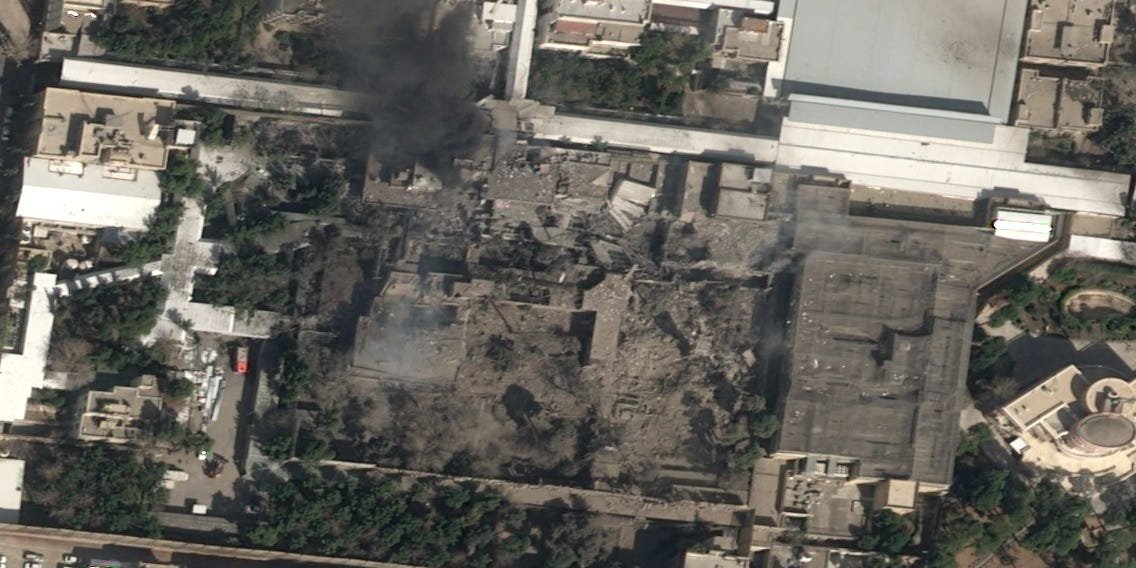
Satellite images captured after Saturday’s US and Israeli strikes on Tehran show that the residence of Iran’s supreme leader, Ayatollah Ali Khamenei, sustained severe damage.

The photos, provided to Business Insider by Airbus, show several collapsed buildings inside a compound in Tehran, which is known to be one of Khamenei’s main residences.

It’s unclear if the Iranian leader was present at the time of the strikes, though the US, Israel, and Iran all said that he was killed on Saturday.

It’s also not yet clear if it was Israel or the US that carried out this particular strike. Representatives for the Pentagon and Israel Defense Forces declined to comment on the hit when asked by Business Insider.


The burning roofs of several buildings can be seen in this satellite image over Tehran.

A cropped photo of the Leadership House in Tehran after the Saturday strikes.

Pléiades Neo (c) Airbus DS 2026


One of the heavily damaged buildings in the compound, at the bottom left of the image, is the House of Leadership, which is known as Khamenei’s office and principal place of residence.

In the images, smoke appears to be rising from its roof. Much of the compound has been obliterated, with felled trees and several more smoking buildings.

The large structure to the right of the compound is the Imam Khomeini Hussainia, a place of worship used by Iranian leaders for religious ceremonies and political speeches.

It’s unclear whether this larger building was also attacked, but what looks like debris can be seen on its roof.

A satellite image taken a year earlier shows the complex included at least six buildings, all of which are now damaged by the strikes.


An image taken in February 2025 shows an overhead view of the Leadership House.

This image from February 28, 2025, shows the complex a year before the strike.

Screenshot/Google Earth


A wider-angle view from another satellite image taken on Saturday appears to show that the strike was largely confined to Khamenei’s compound, which is located in the heart of the Iranian capital.


Ruined buildings can be seen in this wider shot of Khamenei's compound in Tehran.

Smoke rises from Khamenei’s residence in a wider shot of the compound.

Pléiades Neo (c) Airbus DS 2026


The compound’s neighboring buildings appear to be intact.


A wider shot of the Tehran neighborhood shows the Leadership House complex last year.

This Google Earth image was taken on February 28 in 2025.

Screenshot/Google Earth


In a video address after the attacks began, President Donald Trump told Iranians to “take over your government.”

“It will be yours to take. This will be, probably, your only chance for generations,” Trump said.

The US and Israel began their attacks on Saturday morning local time, hitting Tehran and several other Iranian cities in what has been one of the largest strike campaigns in recent years.

The full outcomes of these strikes are still being assessed, and much remains unclear about Tel Aviv and Washington’s exact objectives behind the attacks.

Meanwhile, Iran has responded by firing dozens of ballistic missiles and drones at its neighbors, saying it is targeting US military bases.

Khamenei had been in power in Iran for almost 40 years as a powerful religious leader in Shia Islam, becoming the country’s ultimate authority in government and the military.

It remains to be seen how his death will impact the fate of Iran’s military, society, and government structure.

February 28, 2026: This story was updated to reflect the death of Khamenei, as confirmed by the US, Israel, and Iran.


Source link

Satellite-images-show-an-Iranian-warship-burning-pierside-after-US.jpeg

Satellite images show an Iranian warship burning pierside after US and Israeli strikes

New satellite imagery shows an Iranian warship burning pierside following widespread US and Israeli airstrikes.

The imagery, collected Saturday by US spatial intelligence firm Vantor and obtained by Business Insider, shows some of the initial aftermath of the joint US and Israeli attack on Iran, a major combat operation against Tehran after the collapse of talks on nuclear weapons.

The Vantor images show a frigate burning at the Konarak naval base in southern Iran. A large billow of smoke can be seen rising from the wounded vessel.


Overview of a burning vessel at Iran's Konarak naval base on February 28.

A frigate on fire at Iran’s Konarak naval base.

Satellite image ©2026 Vantor.


In a close-up image, two other frigates are seen sitting nearby, appearing unscathed.

Trump said earlier in his video message announcing the US campaign, Operation Epic Fury, that the US military was “going to annihilate” the Iranian navy, as well as the country’s other military capabilities.

Trump said the goal was to ensure that Iran can “never” have a nuclear weapon. The president also urged Iranian citizens to “take control” in the aftermath of US operations.

“This will be, probably, your only chance for generations,” he said.


A burning frigate at Konarak naval base in Iran.

A close-up of a burning frigate at Konarak.

Satellite image ©2026 Vantor.


War analysts at the Institute for the Study of War think tank said on Saturday that there had been unconfirmed reports of strikes on Iranian naval assets.

“An Israeli OSINT [open source intelligence] account reported strikes on the IRGC Navy frigate Jamaran,” ISW said. “There are also unverified reports of strikes on the IRGC Navy Imam Ali Navy Base in Chabahar, Sistan and Balochistan Province.”

Other images collected by Vantor show drone launch activity at two nearby airbases in Konarak. After the initial attacks by the US and Israel, Iran launched retaliatory missile and drone strikes at US military bases around the region in Bahrain, Qatar, the United Arab Emirates, Kuwait, Jordan, and Saudi Arabia.


Drones dispersed at an airbase in Iran on February 28.

Drones dispersed at an airbase in Konarak.

Satellite image ©2026 Vantor.


Iran has also launched multiple barrages at Israel, including missiles and drones, and said it was carrying out an “extensive drone offensive operation” against its longtime foe.

US strikes on Iran included a mix of weapons such as Tomahawk cruise missiles, High Mobility Artillery Rocket Systems, drones, and undisclosed standoff weapons designed for long-range strikes outside the reach of enemy air defenses.

In response to retaliatory attacks from Iran, various air defense weapons have been active, including the MIM-104 Patriot surface-to-air missile and Terminal High Altitude Area Defense, or THAAD, batteries.


Drones dispersed and a runway blocked at the Konarak drone strip.

Drones dispersed on a blocked runway.

Satellite image ©2026 Vantor.


Saturday’s strike is the second time in less than a year that the US has launched a strike campaign against Iran. In June 2025, US forces targeted Iranian nuclear facilities. In the weeks prior to the most recent attack, the US built up a massive force presence in and around the Middle East.


Source link