Trump-says-he-will-sign-an-executive-order-to-have.jpeg

Trump says he will sign an executive order to have the Department of Homeland Security pay TSA workers

President Donald Trump said that he will sign an order “instructing the Secretary of Homeland Security, Markwayne Mullin, to immediately pay our TSA Agents.”

Trump made the announcement on Truth Social on Thursday.

“Because the Democrats have recklessly created a true National Crisis, I am using my authorities under the Law to protect our Great Country, as I always will do!” Trump wrote.

It’s unclear whether Trump has the power to allocate funds immediately without congressional approval, as the Senate has failed to reach a deal on how to fund DHS. A partial government shutdown began on February 14 due to a stalemate over immigration enforcement, mainly affecting DHS agencies.

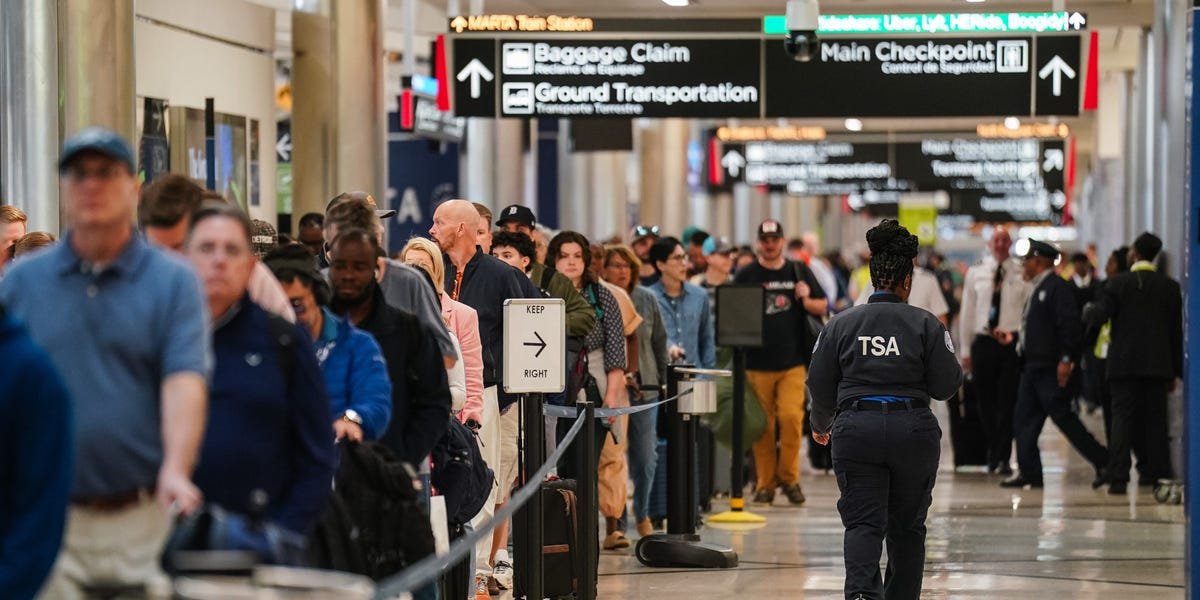
Trump’s comments come as travel chaos intensifies across major national travel hubs. TSA workers are set to miss another paycheck by Friday morning and have begun to call out sick en masse, creating a severe staffing shortage, which is leading to many hours in wait time at TSA checkpoints.

Delta Air Lines suspended travel perks for Congress members and their staff that usually speed up their security checks, citing the government shutdown.

The White House did not immediately respond to a request for comment.

This is a developing story. Check back for updates.


Source link

Lauren Edmonds Profile Photo

Travelers are waiting hours at airport security as unpaid TSA agents stop showing up for work

You might not think it possible, but waiting in line at airport security is somehow getting worse.

Thousands of travelers in the US waited up to three hours at security checkpoints on Sunday as the ongoing partial government shutdown caused staff shortages at the Transportation Security Administration.

Some stalled travelers shared photos of the winding lines and crowds on social media. A video shared on X by Aubry Killion, an anchor at WDSU, the primary NBC affiliate in New Orleans, showed a line of passengers stretching all the way out into the parking garage.

A photo shared to Reddit showed a massive crowd at Hartsfield-Jackson Atlanta International Airport in Georgia, where wait times have reached an hour. The airport is also encouraging travelers to arrive early for their flights.

“The delays are the result of residual impacts from two ground stops issued on Friday, which created a temporary backlog in passenger volumes, combined with current TSA staffing constraints,” a Hartsfield-Jackson Atlanta International Airport spokesperson told Business Insider.

Houston Airports, which operates the William P. Hobby and George Bush Intercontinental airports in Texas, warned travelers that the wait times could be hours long.

“As a result of the partial federal government shutdown, passengers at William P. Hobby Airport (HOU) should arrive at least 4 to 5 hours before their flight to allow extra time for TSA screening,” the operator said in a press release. “At times, TSA wait times at HOU may extend beyond 180 minutes.”

Houston Airports said TSA PreCheck may be unavailable at William P. Hobby Airport due to limited staffing. At George Bush Intercontinental Airport, travelers were told to allow extra time for security screening.

The Department of Homeland Security last month said it was suspending TSA Precheck and Global Entry due to the government shutdown, but later backtracked, leaving it up to individual airports.

Lauren Bis, deputy assistant secretary for public affairs at DHS, said TSA agents “received only partial paychecks earlier this month and now face their first full missed paycheck, leading to financial hardship, absences, and crippling staffing shortages.”

TSA agents are federal workers under DHS, which means they are directly affected by the partial shutdown that began in January. During the earlier 43-day government shutdown last year, TSA agents went weeks without pay. A shortage of air traffic controllers at airports in 2025 played a significant role in forcing the government to reach an agreement.

The US Congress failed to reach an agreement to fund DHS in February, in part because Democrats demanded changes to how the department enforces immigration law.

The long waits affected several major airports across the United States. The Louis Armstrong New Orleans International Airport in Louisiana also told travelers to arrive early.

“Due to impacts from the federal government’s partial shutdown, the TSA is experiencing a shortage of workers at the security checkpoint, which is causing longer-than-average lines,” the airport wrote on X. “Passengers with travel scheduled today are advised to arrive at least 3 hours before their scheduled departure to allow plenty of time to undergo security screening.”

Security checkpoints at Charlotte Douglas International Airport in North Carolina are about a 50-minute wait.


Source link

Lucia Moses

Who is Susan Rice, the former national security advisor in Trump’s crosshairs?

President Donald Trump has demanded that Netflix remove former US ambassador and national security advisor Susan Rice from its board, stepping up his criticism of the streaming giant as it seeks to merge with Warner Bros. Discovery amid antitrust scrutiny.

Rice, who served in senior roles in the Obama and Biden administrations, recently warned companies against aligning with Trump. Speaking on the “Stay Tuned with Preet Bharara” podcast published Thursday, she said corporations that “take a knee” to the president and skirt the law should expect consequences, predicting an “accountability agenda” if Democrats take back power.

“There is likely to be a swing in the other direction,” and these companies are “going to be caught with more than their pants down,” Rice said.” They’re going to be held accountable by those who come in opposition to Trump and win at the ballot box.”

Rice, a Democrat, has a long career in US foreign and domestic policy, working under Democratic presidents.

She served in the Clinton administration from 1993 to 2001, including roles at the National Security Council and as assistant Secretary of State for African Affairs.

Under Obama, Rice served as US ambassador to the UN, becoming the second-youngest person at 44 and the first Black woman to represent the US at the UN. She later served as head of the Domestic Policy Council under Biden.

She was born in Washington, D.C., and graduated from Stanford with a degree in history. She worked in management consulting for McKinsey and Company before entering government.

Rice has previously faced criticism from the right. In her 2019 memoir, “Tough Love: My Story of the Things Worth Fighting For,” she wrote that she was a frequent “villain” for conservative media.

After the 2012 killing of four Americans in Benghazi, Libya, Republicans accused her of misleading the public in interviews discussing the attacks. She was later cleared by subsequent investigations.

She also faced scrutiny by Trump and his allies for “unmasking” senior Trump officials to understand why the crown prince of the United Arab Emirates was in New York in 2016.

Unmasking is when senior government officials ask to learn the identity of a US citizen whose name has been withheld in intelligence reports about communications, such as intercepted calls. In some situations, national security officials argue that knowing the person’s identity is necessary to interpret and assess the intelligence information.

As UN Ambassador, Rice supported US intervention against Muammar Gaddafi.

Rice has written op-eds supportive of the Biden administration and accusing Trump of undermining democracy. In a 2025 column in The New York Times, Rice accused members of Trump’s national security team of “reckless negligence” after they discussed sensitive national security matters on Signal.

Disclosure: Mathias Döpfner, the CEO of Business Insider’s parent company, is a Netflix board member.


Source link

Why-more-CEOs-and-boards-are-worrying-about-security-The.jpeg

Why more CEOs and boards are worrying about security: ‘The risk is everywhere.’

For decades, executive security followed a familiar playbook: Most CEOs traveled freely at home, accepted protection only in high-risk foreign countries, and treated personal safety as a private concern rather than a boardroom imperative.

That world no longer exists.

Mentions of exec security protocols are popping up in more proxy filings, and companies like Starbucks are changing corporate jet policies due to what it calls “significant heightened security concerns.”

These moves follow the December 2024 killing of UnitedHealthcare CEO Brian Thompson in New York City and a shooting at a Park Avenue office building about eight months later.

Both instances shattered long-held assumptions that corporate leaders were at least somewhat insulated from the types of violence more often associated with politicians or celebrities, several security executives told Business Insider.

There isn’t a distinction between low-, medium-, or high-risk anymore, said Dale Buckner, head of the security firm Global Guardian, which works with Fortune 1000 companies.

“The risk is everywhere,” he said.

The news of the disappearance of “Today” co-host Savannah Guthrie’s mother, Nancy, has only added to a sense of unease for high-profile leaders, several of these execs said.

Boards step in

Buckner, a retired US Army colonel who served for more than two decades, said his firm has briefed more boards in the past 11 months than in the previous 14 years combined. Increasingly, Buckner said, boards view CEOs and other C-suite members as assets that must be protected, even if some leaders are leery of perceived constraints on their freedom.

“The board is overruling the CEO who is going, ‘I don’t need this,'” he said.

In regulatory filings, companies have begun to spell out their decisions. Starbucks said last month that, following a security review, it recommended that CEO Brian Niccol use company aircraft for both personal and work travel. While it’s made that recommendation before, the company lifted a spending cap it had in place for personal travel and will instead review those costs each quarter.

Unlike in its previous proxy a year earlier, Starbucks also cited “the existence of credible threat actors.”

Those concerns extend beyond the coffee chain.

Disney requires Bob Iger, who is set to step down as CEO next month, to use company aircraft for both business and personal travel. A security consultant identified “bona-fide, business-related security concerns” for Iger, Disney said in a January filing. That language didn’t appear in the company’s prior filing.

Meatpacking giant Tyson Foods said it hired a consultant during its fiscal year that ended in September to review risks associated with its senior management team “based on the evolving security environment for corporate executives.” One resulting change: requiring certain execs to use company aircraft for both business and personal travel.

Proxy filings by large US public companies that mention “executive security” or “corporate security” rose from 69 in 2023 to 87 in 2025, according to an AlphaSense analysis.

Representatives from Starbucks, Disney, and Tyson Foods didn’t respond to Business Insider’s requests for comment on the nature of the threats executives face.

18 armed agents

While high-profile CEOs have long had protection in high-risk zones, Buckner said what’s grown more common is keeping executives under a 24/7 safety umbrella.

Buckner said that the protocol for one of his protectees, a Fortune 500 CEO, includes 18 armed agents, camera surveillance of the executive’s home, and monitoring of its WiFi network. A former garage on the property now serves as an “op center,” he said.

“I have two to four roving armed agents around their home, 24 hours a day,” Buckner said.

It can be a challenge to determine whether something that starts as disapproval over a company or leader could morph into something more nefarious, security veterans said.

A threat might start out as a joke in poor taste, and a group targeting a company might pick it up. Then, all of a sudden, it becomes a real risk, said Lisa Kaplan, founder and CEO of the risk-intelligence firm Alethea.

‘The reality of risk’

Caleb Gilbert, founder of White Glove Protection Group, a security firm serving large companies and family offices, said the range of people who feel threatened has widened over the past six months.

“The reality of risk is resonating with more people. And that’s different than I’ve seen in the last 30 years,” he said.

One reason is that the cadence of high-profile incidents — from the attempted assassination of President Donald Trump in 2024 to the killing of conservative activist Charlie Kirk in September — hasn’t seemed to slow, Gilbert said. While attacks on business leaders remain rare, many nonetheless feel rattled, he said.

“It used to be where something bad would happen, there’d be time in between, and the executives would forget about it,” Gilbert said. Now, “with the security-minded glasses that they put on, it’s brought everything into focus.”

The cost of protection is part of that view. A small protective detail can cost about $1 million a year, while a full-scale operation can reach $30 million, he said.

In some cases, Gilbert said, even without a board’s prodding, executives are “willing to give up personal liberties that they cherished before for the sake of feeling safe.”

The apparent kidnapping of Nancy Guthrie could lead to demand from executives to detect threats against parents, Kaplan said. Typically, she receives requests from executives to monitor risks to their children.

Buckner said he recently spoke to a group of CEOs in Washington, DC, on security threats. Many reported feeling unnerved, he said.

“It’s palatable,” he said. “They’re scared that they’re in a new world order. They’re not quite sure how to navigate it.”



Source link

Dan DeFrancesco

What the software stock sell-off says about your job security

Everyone’s freaking out about AI again, which means it’s time to rethink how secure your career is.

BI’s Ana Altchek has a piece about how to future-proof your job since the only certainty in the job market appears to be more uncertainty.

A market meltdown in software stocks has people on edge this time. The characters might have changed, but the plot is still the same.

A new tool (an AI plugin from Anthropic) launched to automate work (tracking compliance and reviewing legal docs) leads to a sell-off among leaders in the space (legal-software stocks).

We can debate whether the reaction was warranted (more on that below), but this narrative isn’t going away. AI companies will keep automating different types of work, leaving the companies in that space scrambling and their employees nervous.

Ana spoke to experts about different ways to get ahead, from auditing your job to the skills you can lean into to build more career immunity. Overall, the idea is not to get caught flat-footed.

For more on the inner workings and culture of the business world, check out Ana’s weekly series “This Week at Work,” and subscribe to our workplace roundup newsletter, Work Shift. (You’re still required to read this every day, though. No excuses.)

One group has felt particularly safe amid the AI chaos.

Trade workers have been sitting pretty as panic rises among the white-collar workforce. A recent survey conducted by The Harris Poll found 75% of Americans agree that “hands-on skills and practical experience matter more than formal degrees when it comes to career success.”

And even more (78%) agreed “the stigma around trade or blue-collar work is declining” because hands-on skills are becoming so valuable.

The leaders of the AI revolution, from Elon Musk to Jensen Huang, have also praised tradework as a much more resilient career path.

That is likely the case in the short term. But down the road, all bets are off. Tesla is aggressively pushing into humanoid robots. OpenAI is also quietly scaling its robotics project.

There’s a long way to go, with most robots being more flop than pop. But the potential and interest in developing the space is there, as was evident at this year’s Davos. And some see the eventual economic impact of physical AI being far greater than that of software.

Because eventually, AI will come for all of us if we’re not willing to adapt.


Source link

AI-is-creating-a-security-problem-most-companies-arent-staffed.jpeg

AI is creating a security problem most companies aren’t staffed to handle, says an AI researcher

Companies may have cybersecurity teams in place, but many still aren’t prepared for how AI systems actually fail, says an AI security researcher.

Sander Schulhoff, who wrote one of the earliest prompt engineering guides and focuses on AI system vulnerabilities, said on an episode of “Lenny’s Podcast” published Sunday that many organizations lack the talent needed to understand and fix AI security risks.

Traditional cybersecurity teams are trained to patch bugs and address known vulnerabilities, but AI doesn’t behave that way.

“You can patch a bug, but you can’t patch a brain,” Schulhoff said, describing what he sees as a mismatch between how security teams think and how large language models fail.

“There’s this disconnect about how AI works compared to classical cybersecurity,” he added.

That gap shows up in real-world deployments. Cybersecurity professionals may review an AI system for technical flaws without asking: “What if someone tricks the AI into doing something it shouldn’t?” said Schulhoff, who runs a prompt engineering platform and an AI red-teaming hackathon.

Unlike traditional software, AI systems can be manipulated through language and indirect instructions, he added.

Schulhoff said people with experience in both AI security and cybersecurity would know what to do if an AI model is tricked into generating malicious code. For example, they would run the code in a container and ensure the AI’s output doesn’t affect the rest of the system.

The intersection of AI security and traditional cybersecurity is where “the security jobs of the future are,” he added.

The rise of AI security startups

Schulhoff also said that many AI security startups are pitching guardrails that don’t offer real protection. Because AI systems can be manipulated in countless ways, claims that these tools can “catch everything” are misleading.

“That’s a complete lie,” he said, adding that there would be a market correction in which “the revenue just completely dries up for these guardrails and automated red-teaming companies.”

AI security startups have been riding the wave of investor interest. Big Tech and venture capital firms have poured money into the space as companies rush to secure AI systems.

In March, Google bought cybersecurity startup Wiz for $32 billion, a deal aimed at strengthening its cloud security business.

Google CEO Sundar Pichai said AI was introducing “new risks” at a time when multi-cloud and hybrid setups are becoming more common.

“Against this backdrop, organizations are looking for cybersecurity solutions that improve cloud security and span multiple clouds,” he added.

Business Insider reported last year that growing security concerns around AI models have helped fuel a wave of startups pitching tools to monitor, test, and secure AI systems.


Source link

Prepare-to-pay-45-at-airport-security-if-you-dont.jpeg

Prepare to pay $45 at airport security if you don’t have a REAL ID

  • The TSA announced a $45 fee for travelers without acceptable ID at airport security checkpoints.
  • The alternative identity verification system, TSA Confirm.ID is set to be implemented on February 1.
  • It’s unclear how TSA Confirm.ID will work, but it’s intended as an option for flyers without a REAL ID.

The Transportation Security Administration has taken a page from the budget airline playbook.

The agency said Monday it is implementing a new alternative identity verification system, TSA Confirm.ID, that would charge travelers $45 at security checkpoints if they show up without a REAL ID or another acceptable government-issued ID, such as a passport or permanent resident card.

The new fee option is set to begin on February 1. The TSA said the fee would cover a 10-day travel period. Details about how the fee and identity verification would work were not yet available. The TSA did not immediately respond to a request for comment.

“TSA urges all travelers who do not have a REAL ID to pay the fee online before traveling,” according to a press release about TSA Confirm.ID and the new fee. “For passengers who arrive at the airport without paying the fee, information about how to pay for the TSA Confirm.ID option will be available at marked locations at or near the checkpoint in most airports. Travelers who undergo TSA Confirm.ID processing at an airport should expect delays.”

The TSA had previously proposed an $18 fee that would cover the costs for a biometric kiosk system designed to verify a traveler’s identity more quickly than the current manual process.

Under that proposal, the TSA said the new technology would be less time and resource-intensive than the current process when a flyer lacks these IDs, which involves providing personal information or answering detailed questions to match flyers to government databases.

“This notice serves as a next step in the process in REAL ID compliance, which was signed into law more than 20 years ago,” a TSA spokesperson previously told Business Insider about the $18 fee proposal.

Congress passed the REAL ID Act of 2005 in response to the 9/11 attacks, but it just rolled out in 2025.

In May, the TSA began requiring travelers to present a REAL ID or another government-approved identification to pass through airport security checkpoints.

The TSA says 94% of flyers already use REAL ID or another acceptable form of identification.

The agency is encouraging travelers who do not have a REAL ID to schedule an appointment with their local DMV to update their ID as soon as possible. A REAL ID card shows a star inside a circle in the upper right corner.


Source link