Nike’s “Win Now” turnaround plan isn’t seeing immediate results.
The sports giant announced its third-quarter earnings results for fiscal year 2026 on Tuesday, and revenue remained flat at $11.3 billion. Nike shares moved lower after market close, falling more than 8% despite the company delivering better-than-expected results.
On the call, CEO Elliott Hill said the company’s comeback is taking “longer than I would like,” but he and other executives expressed confidence in the approach.
So far, running is leading the charge with growth. It was the first category to move into the “sport offense,” which puts sports back at the center of its mission, as the company leans more into performance wear.
“The pace of progress is different across the portfolio, and the areas we prioritized first continue to drive momentum,” Hill said in the earnings press release.
Meanwhile, other parts of the portfolio, including Greater China, Converse, and sportswear, are still in earlier stages of their comebacks, the company said. Nike’s digitalsales declined 9% in a drop that the company said is due in part to being too promotional with higher markdowns.
Sportswear continues to be a headwind to revenue growth for Nike as it declined by low double digits in the quarter. It’s continuing its efforts to clean up inventory, which it said has taken several quarters to execute. The Nike sportswear and Jordan streetwear teams are moving from playing defense to playing offense, the company said.
“There is both an art and a science to seeding, igniting, and scaling new sportswear styles,” Hill said.
In March 2025, Nike publicly rolled out its turnaround plan, which Hill calls its “Win Now” strategy. The effort has reoriented the company around sports from running to basketball, rather than gender or age.
CFO Matthew Friend said Nike expects revenues to be down low single-digits compared to the prior year, with gains in North America offset by declines in Greater China. Assuming no significant changes, after the first quarter of fiscal 2027, higher tariffs are expected to ease for Nike,Friend said on the call.
“Given the softness in sportswear, traffic patterns, and promotions across Europe, as well as recent disruption in the Middle East, we anticipate ending the fourth quarter with elevated inventory,” Friend said.
The company expects to finish its “Win Now” actions by the end of 2026.
It’s been a confusing six days since missile attacks across the Middle East stranded travelers and planes in airports across the world.
Things are still far from normal as of Wednesday, but some travelers are getting home.
There is a slow-growing recovery in the United Arab Emirates, which has partially opened its skies and designated “safe” corridors for rescue planes to use.
There are a lot of people to move: cities like Dubai and Abu Dhabi host large expat populations and tourists, and their hubs usually handle tens of thousands of transit passengers a day.
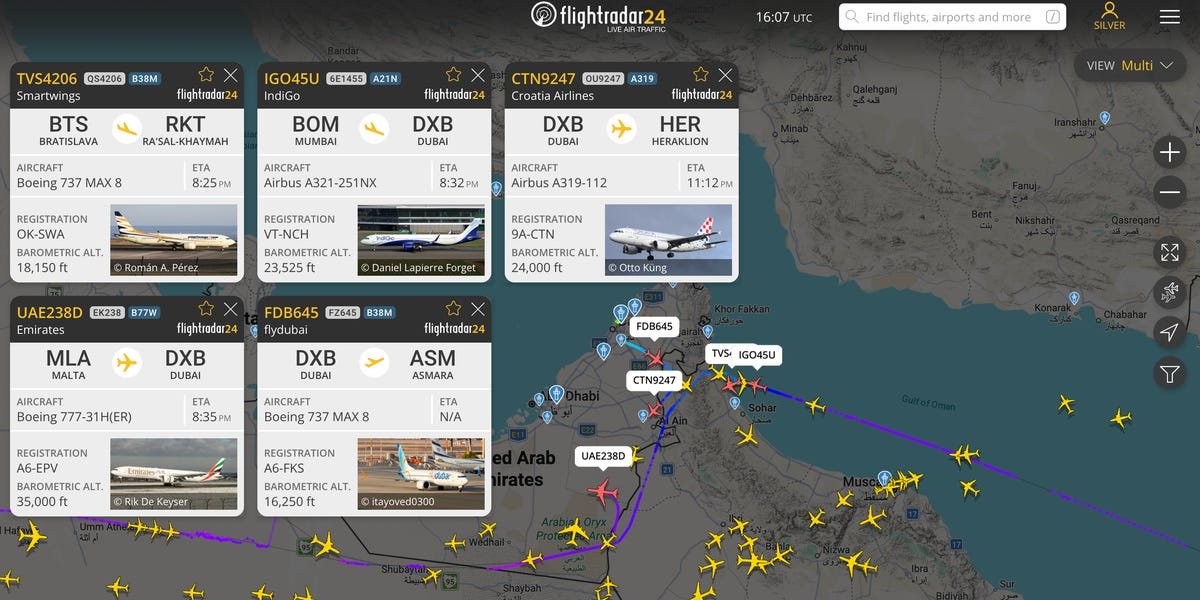
Working with local officials, Emirates, Flydubai, IndiGo, and Etihad Airways were among the first airlines to depart the UAE with passengers, crews, and cargo. Over 100,000 people followed these aircraft live on the aviation tracking website Flightradar24.
Even as Iranian threats continue to disrupt flying — forcing diversions, holds, and U-turns — airlines are still transporting passengers to destinations across Europe, Asia, and Africa.
Fortunately, Emirates and Etihad have big planes: many of their Airbus A380s, capable of carrying up to 615 passengers, have flown to cities such as London, Istanbul, Jeddah, Singapore, Paris, and Düsseldorf.
Although these flights don’t always take travelers all the way home, they offer a crucial escape from limbo — getting people into countries with open airspace and far more onward flight options.
Flightradar24 data shows several other carriers have joined the crowd: Air India, Air Arabia, Uzbekistan Airways, Kenya Airways, Morocco’s Royal Air Maroc, Saudi airline Flynas, Royal Jordanian, and India’s SpiceJet are all flying from Dubai to their respective hubs.
Passengers on a Kenya Airways rescue flight from Dubai arrive back home.
Thomas Mukoya/Reuters
European carriers, including Lufthansa, Swiss International Air Lines, Prague-based Smartwings, Aegean Air, and British Airways, are running special rescue flights from neighboring Muscat, Oman. Smartwings and Croatia Airlines are running select flights from Dubai.
Air France scheduled a repatriation flight from Dubai to Paris on Thursday evening, but suspended the plan shortly after the announcement due to “the ongoing security situation.”
Russian carriers Aeroflot and S7 Airlines have similarly departed with passengers, though their flights to Moscow are taking up to three hours longer because they have to fly the long way around closed airspace rather than fly directly over it.
Still, most airlines’ regular schedules to and from much of the Middle East remain suspended until at least the weekend, and they have asked passengers not to go to the airport unless they have been specifically notified.
No US airlines have sent rescue planes as of Thursday. Mark Dombroff, an aviation attorney with the law firm Fox Rothschild, told Business Insider that even if US carriers like United or American wanted to help, they legally can’t.
“The decision-making resides with the Federal Aviation Administration,” he said. “If the FAA says you can’t fly there as a US certificated carrier, that’s it. And in a sense, it’s no different than any other restricted airspace in this country, like Washington, DC.”
Some Americans have gotten home with the help of the State Department; it previously told those in over a dozen Middle Eastern countries to evacuate. The agency said it flew a charter flight to the US on Wednesday, and that more will be “surged across the region.”
It added that, as of Wednesday, “nearly 18,000 Americans have safely returned to the US,” including 7,300 helped by the State Department. It said thousands of others made it to Europe and Asia and are in transit back, and told those still stuck to get in touch for help by calling +1 (202) 501-4444 or filling out this form.
Some airlines remain effectively frozen. Qatar Airways has not flown a plane since Saturday due to Qatar’s airspace closure, leaving practically no options for those in Doha except to wait or drive hours to Saudi Arabia and fly out from there.
Flight options are still extremely limited
While some flights are better than none at all, special airline operations remain limited to certain routes and airports.
Flightradar24 data shows that Dubai International has seen just 100 takeoffs and landings since Saturday. Operations ramped up from Monday to Tuesday — but that was still less than 10% of the roughly 1,200 flights in and out on a usual day.
Rescue flights are largely restricted to the UAE, Oman, and Saudi Arabia: the skies over Iran, Kuwait, Iraq, Syria, Israel, Qatar, and Bahrain remain closed.
An Emirates A380 ferried hundreds of stranded people back to Germany.
Andreas Rentz/Getty Images
Aviation analytics Cirium estimates there are normally about 900,000 daily seats to, from, and within the Middle East; it said about 4.4 million seats in and out of the Middle East have been canceled since Saturday.
While airlines are actively adding flights to the schedule — despite the on-and-off missile threats in the region — there are nowhere near enough rescue seats yet to accommodate the tens of thousands of stranded travelers. British Airways said on social media on Wednesday that the rescue flights it planned through Saturday are already full.
Some wealthy travelers have abandoned commercial flying altogether, instead paying hundreds of thousands of dollars to charter private jets. Flightradar24 data shows a number of business aircraft flying to and from Oman, Saudi Arabia, and the UAE since Sunday.
Those with less deep pockets have chosen to travel by bus to Oman and Saudi Arabia, hoping to secure seats from airports still operating flights as normal.
But the drives are hourslong, and Oman Air warned Muscat-bound travelers crossing in from the UAE to arrive 12 hours early as traffic backs up for miles.
President Donald Trump seems to be trying a new approach in his quest to take over Greenland: The president said Saturday the US would send a hospital ship to the territory.
“We are going to send a great hospital boat to Greenland to take care of the many people who are sick, and not being taken care of there,” the president wrote on Truth Social. “It’s on the way!!!”
Greenland, however, isn’t interested.
Greenland’s prime minister, Jens-Frederik Nielsen, said in a subsequent Facebook post that “it’s going to be a no thank you from here.” Greenland provides free universal healthcare for all permanent residents and citizens.
“We have a public health system where treatment is free for citizens. It’s a deliberate choice. And a basic part of our society. It’s not like that in the United States, where it costs money to go to the doctor,” he wrote. “We are always open to dialogue and collaboration. Also with the U.S. But talk to us now instead of just coming up with more or less random outbursts on social media.”
Every time Tristan publishes a story, you’ll get an alert straight to your inbox!
Stay connected to Tristan and get more of their work as it publishes.
Trump has had his sights set on the Arctic island, a semi-autonomous Danish territory, since his first term in office. Trump has suggested the US could buy Greenland or even take it by force.
The president says Greenland’s location makes it strategically important as the melting of Arctic ice opens up new shipping routes and intensifies competition with Russia and China.
The island is also rich in critical minerals and already hosts a key US military base, which American officials say is vital to missile defense and Arctic security.
Major European leaders, including those from France, Germany, the UK, Italy, Spain, Poland, and Denmark, released a joint statement last month defending Greenland.
“Greenland belongs to its people,” the statement said. “It is for Denmark and Greenland, and them only, to decide on matters concerning Denmark and Greenland.”
I grew up in a house where coordinated family photos were the norm. My mom would line up the four of us kids in matching outfits — one year, freshly pressed sailor suits; the next, velvet dresses, with my brother in a matching tie. Every stray hair would be tucked in or sprayed down.
We were bribed (or more like lightly threatened) to smile with our eyes open, something that’s more difficult than it should be when you’re a kid who just wants to be DONE.
Then came the card — glossy, cheerful, and perfectly posed — the proof that our family had it all together, at least for one photo.
I kept the tradition going with my own kids
So when I had my own kids, I continued this tradition without question. Every year, I’d book a family photo session well in advance of Thanksgiving, hoping that temperamental Chicago weather wouldn’t put a damper on our outdoor photos.
I’d scour Pinterest for outfit inspiration, aiming for a coordinated but not totally matching vibe. The goal was to capture one frame of perfection — a photo worthy of the hundreds of envelopes I’d soon address by hand.
The author continued the tradition of holiday cards with her family.
Courtesy of the author
But the reality behind those photos was far from picture-perfect. There were bribes of hot chocolate and complaints about itchy sweaters. I’d smile through gritted teeth while the photographer tried to get everyone looking in the same direction. By the end, the kids were shivering, my husband was done, and I was wondering why we put ourselves through this every year.
And that was just phase one.
Once we had a “good enough” photo, I’d spend hours designing the cards online, tweaking fonts, choosing layouts, and agonizing over whether to include a photo of the whole family or the cuter one of just the kids.
Then came the addressing, stamping, and mailing — usually squeezed in between wrapping gifts, decorating the house, and trying to keep the ambiance somewhat festive. What was meant to be a joyful holiday tradition had turned into yet another item on my never-ending to-do list.
Quitting holiday cards lifted a huge weight
Two years ago, I finally asked myself, “Why am I doing this?”
When I couldn’t come up with a satisfying answer beyond “because we’ve always done it,” I decided to stop. No family photo shoot. No card design. No envelopes or stamps.
The author feels her family photos feel more authentic now.
Courtesy of the author
That first year without holiday cards felt strange at first, like I’d forgotten to do something important. December rolled around, and my mailbox filled with cheerful greetings from family and friends, each one featuring those perfectly posed families and braggy year-end recaps. For a fleeting moment, I felt a pang of guilt, like I’d dropped out of a club I’d been part of my entire adult life.
But then the feeling passed. What replaced it was a deep sense of relief.
Without the looming card deadline, December suddenly opened up. I had more time to actually enjoy the holidays — to bake sugar cookies in the shape of stars and drive through neighborhoods adorned in holiday lights. The pressure to present our family in a certain way — smiling, coordinated, festive — simply disappeared.
Now our photos (and holidays) feel more authentic
Instead of orchestrating a posed photo, we started taking more spontaneous pictures: messy, candid, real. A selfie at a local holiday market. A blurry shot of everyone laughing in front of our silver faux Christmas tree. A snowy mountain scene after a day of skiing. These pictures weren’t perfect, but they were us. And when I looked at them later, they didn’t remind me of how stressed I felt trying to get everyone to cooperate — they reminded me of how much fun we actually had.
The author and her family.
Courtesy of the author
Something else unexpected also happened: no one seemed to miss the cards. The people who truly wanted to connect reached out in other ways. It made me realize that keeping in touch didn’t have to involve postage and cardstock.
Letting go of the holiday card tradition didn’t make the end of the year any less special — it made them more so. It gave me permission to simplify and remember that the memories that matter most aren’t ones you send in the mail. They’re the ones you make together, no matching outfits required.