
Irans-Shahed-war-turns-into-booming-business-for-worlds-small.jpeg

Iran’s Shahed war turns into booming business for world’s small interceptor manufacturers

As the US-Israeli war with Iran rages across the Middle East and roils global markets, a small subset of drone makers — ones who build drones to destroy other drones — are seeing an upside to the conflict.

Interceptor drone manufacturers outside the region told Business Insider of a surge in requests for demonstrations and inquiries from potential buyers over the past week, as the US and its allies scramble to counter Iran’s loitering munitions.

“Since the beginning of the war, we have been receiving daily requests from the Middle East, whereas previously it might have been once or twice a month,” said Jens Holzapfel, business development director for Nordic Air Defense. The Swedish startup is building a propeller-driven interceptor, the Kreuger-100XR, which is being tested in Ukraine.

New interest has overwhelmingly come from Gulf state governments or entities working with their defense ministries, although European countries have also reached out, the companies said.

Misha Lu, a spokesperson for the Taiwanese firm Tron Future, said international inquiries for its counterdrone products, which include a single-use quadcopter interceptor and net-launcher drone, have “effectively doubled” since the war began.

Almost all prospective clients were asking for ways to protect critical infrastructure, such as airports and power grids, he said.

Lu added that potential buyers are also largely shifting their focus from anti-drone jammers to “hard-kill” solutions, which rely on explosives or physical force to destroy drone threats.

Surging interest in Ukrainian drones

Heightened demand for hard-kill counterdrone tech comes as Iran has launched thousands of one-way attack Shaheds against the US and its allies in the Gulf region. Some of the loitering munitions have successfully gotten through air defenses and struck their targets, including US military facilities.

Key concerns in air defense against Shahed threats have been cost and quantity. Traditional air-to-air or surface-to-air missiles are limited in supply and would be too expensive to engage en masse against Shaheds, which cost $20,000 to $50,000 each.


An Iranian Shahed drone sits in the middle of a room on Capitol Hill as congressional leaders make a presentation.

The Iranian Shahed has been a subject of Western concern for years, as Russia used the drones to bombard Ukraine.

Win McNamee/Getty Images


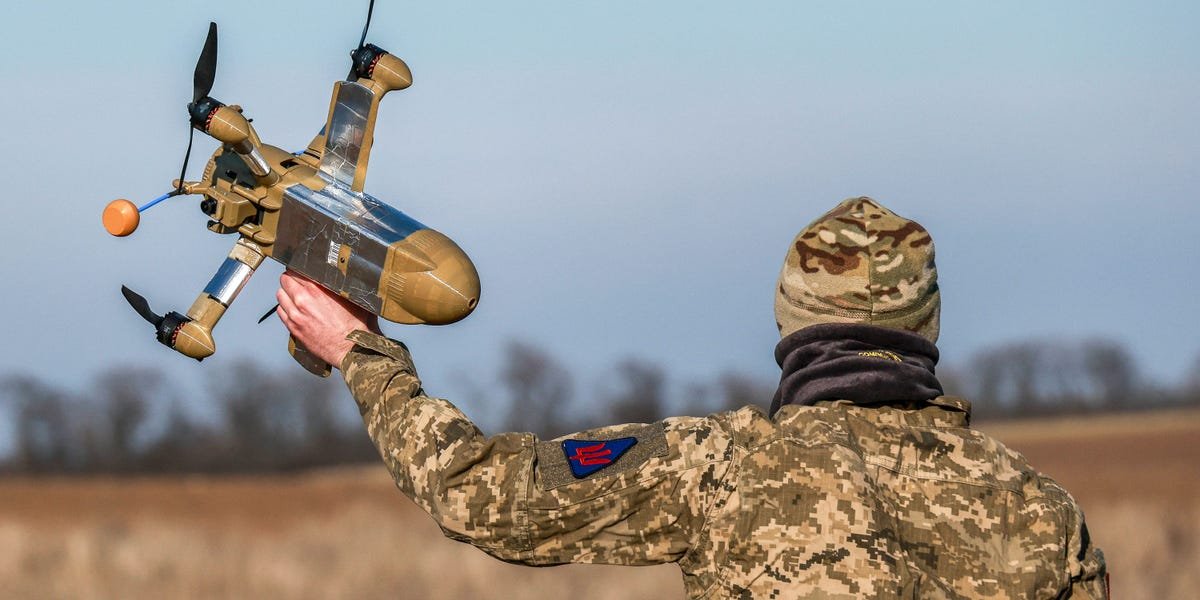
A cheaper solution, pioneered largely by Ukraine, is to use first-person-view or small drones to catch and ram into Shaheds.

The Wild Hornets, the Ukrainian manufacturer of a popular interceptor drone called the Sting, told Business Insider that the company previously fielded one or two business inquiries daily, but since last week has received “several dozen per day.”

Sting production is still heavily dedicated to helping Ukraine fight off Russia’s locally built versions of the Shahed; Kyiv says Moscow has launched over 57,000 of them so far.

“These are requests, not what we’ve agreed to,” a Wild Hornets spokesperson said of the new inquiries. “Our priority is Ukraine’s defense.”

Another major Ukrainian drone maker, Skyfall, told Reuters last week that it was receiving foreign requests for interceptors and could produce up to 10,000 a month without affecting Ukraine’s needs.

Still, Ukrainian firms may have difficulty closing any such deals for now. A wartime law broadly blocks drone exports from the country, as uncrewed aerial systems remain the pillar of its tactical combat operations.


A Urkainian soldier holds a Sting interceptor drone, which has been decorated to resemble a shark.

The Wild Hornets manufacture the Sting, a popular interceptor drone now used in Ukraine.

Alex Nikitenko/Global Images Ukraine via Getty Images


Whether the ban will remain, however, is unclear. Kyiv has been exploring the possibility of controlled exports, seeking to promote its fledgling defense tech market and touting its wartime production expertise and ability to test weapons in combat.

Ukrainian President Volodymyr Zelenskyy has also repeatedly signaled openness to assisting allied countries, including Gulf States, that request support and expertise against Shaheds.

So far, though, Zelenskyy has only confirmed that Kyiv is sending experts to the Middle East, without mentioning export sales.

Too much demand to cope with

For interceptor makers in other countries, the sudden demand is so great that most aren’t sure they can keep up with the influx of business. The technology is also fairly young, meaning some firms have yet to build out their production lines fully.

Agirs Kipurs, CEO of the Latvia-based firm Origin Robotics, told Business Insider that his firm is already working to fulfill existing contracts and may thus only meet a “limited part of the demand.”

“Obviously, we will not be able to meet all requests, as we are still scaling up production and building toward full output capacity,” said Kipurs, whose firm builds drones deployed in Ukraine and an autonomous interceptor used by NATO forces.

Jiří Janoušek, a representative for the Czech firm TRL Drones, said his company recently received multiple requests a day for its fixed-wing interceptors — a short-range drone and a larger jet-powered system that are used in Ukraine.

TRL Drones is increasing production capacity to accommodate new requests, Janoušek said, but has had to “carefully prioritize incoming opportunities,” giving preference to customers who already know their operational requirements and are ready to move quickly.

“Supporting Ukraine remains a core priority that continues to utilize a portion of our capacity,” Janoušek added.

Lu, of Tron Future, said that his firm is “fully engaged” with all the inquiries it’s receiving, but is still working on scaling production.


A quadcopter interceptor built by Tron Future sits on display.

One of Tron Future’s interceptors on display at an aerospace and defense show in Taipei.

Tron Future


Demand from Taiwan and East Asia has recently doubled, too, he added, with inquiries from Taiwanese law enforcement and military agencies reaching double digits.

There is concern about China’s own delta-wing drones, Lu said, such as the Loong M9 and Feilong 300D. Both appear highly similar to the Shahed-136.

Chinese industries have long supplied drone components to both sides of the Ukraine war, and Lu said it’s clear that the People’s Liberation Army is learning from the battlefield there.

“So we know that in a conflict scenario across the Taiwan Strait, we will also see similar saturation attacks where cheap drones of various classes mingle with missiles,” Lu said.



Source link

The-US-is-sending-a-new-drone-killer-to-the-Middle.jpeg

The US is sending a new drone-killer to the Middle East. It’s logged over 1,000 Shahed intercepts over Ukraine.

The US Army is deploying an American-made counter-drone system that has intercepted more than 1,000 Shahed-type drones in Ukraine to the Middle East, two defense officials confirmed on Saturday to Business Insider.

One of the US officials, who spoke on the condition of anonymity to discuss military developments, said that the Merops system will arrive in the Middle East within a week. Once it arrives, it’ll be ready for combat in a matter of days.

They declined to say how many systems the US is sending to the Middle East, only that the deployment will include a large quantity of interceptors.

The Associated Press first reported the Merops deployment.

The counter-drone system, which uses a roughly $15,000 interceptor, would give US and allied forces a much cheaper air defense option against Iranian drones, compared to expensive surface-to-air missiles.

The weapon’s deployment to the region comes as Iran has launched thousands of cheap attack drones at the US military and its allies across the Middle East after the US and Israel began Operation Epic Fury on February 28.

The Shahed drones, which cost roughly $20,000 to $50,000 according to available estimates, complicate the air defense picture.

In significant quantities, they can overwhelm even advanced air defense systems, or at the very least force Patriot and Terminal High Altitude Area Defense (THAAD) crews to expend millions of dollars in interceptors to defeat a threat only a fraction of that cost.

How the Merops works

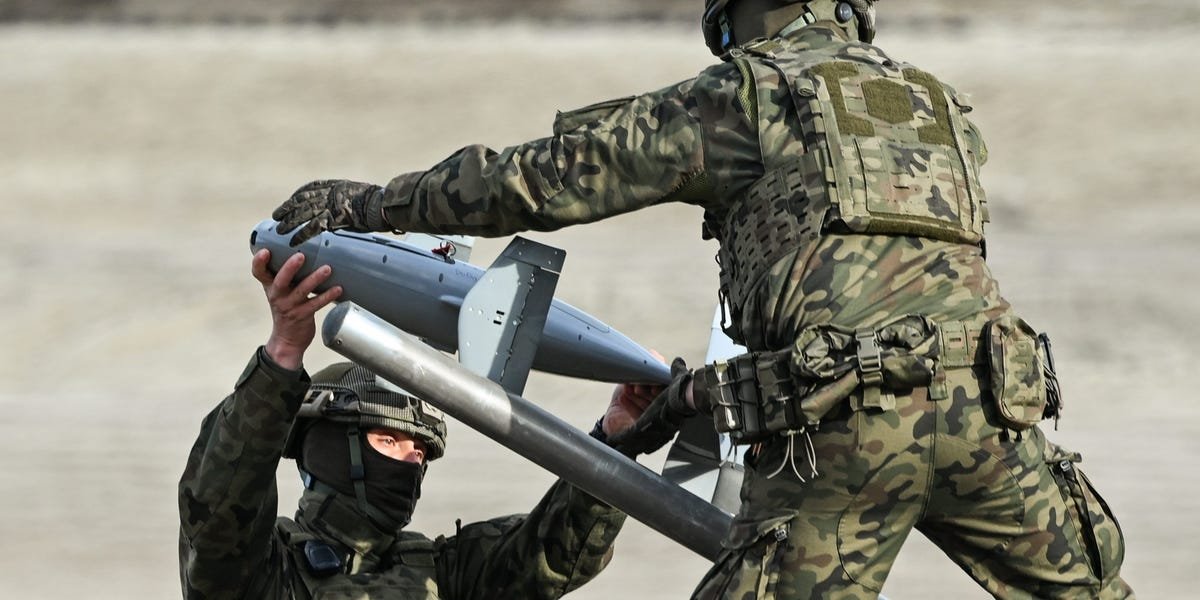
The Merops counter-drone system launches a propeller-driven drone called the Surveyor, which is a few feet long, can be carried by a single soldier, and uses artificial intelligence to navigate in jammed environments.

The overall system includes the Surveyor interceptor, a ground control station, and launch stations — all operated by a four-man crew with a commander, a pilot, and two technicians.

Its developer, the American initiative Project Eagle, says the Merops is tailor-made for taking down propeller-driven and jet-powered drones like the Shahed. So far, it’s logged over 1,000 kills against such uncrewed aircraft.

The Surveyor can fly at speeds of over 175 mph, meaning it’s more than fast enough to catch Iran’s commonly used propeller-driven Shahed-136, which flies at around 115 mph. Jet-powered versions of the Shahed reportedly fly as fast as 230 mph and are more challenging threats.

If the Surveyor, which can be mounted with a small explosive warhead, fails to hit its target, it can deploy a parachute to allow retrieval and relaunch of the drone.


A Surveyor drone descends while suspended from a parachute.

A Surveyor drone can be retrieved if it fails to hit any targets.

Artur Widak/NurPhoto via Getty Images


When Business Insider observed a demonstration of the Merops in Poland last year, one of the launchers was mounted on the back of a pickup truck.

A push for interceptor drones

According to one of the defense officials Business Insider spoke with, US forces in the Middle East are to be trained by Army soldiers from Europe to operate the Merops. The system is also being sent to countries in the region where US troops are not deployed.

The second defense official said that Merops’ use in Ukraine has provided the Army with air defense information that has already proven valuable in Eastern Europe and will now be useful for the Middle East.

US Army soldiers in Europe have taught NATO allies how to operate the Merops system, which was deployed to the alliance’s eastern flank following Russian drone incursions into Polish airspace.

Meanwhile, Ukrainian President Volodymyr Zelenskyy said on Thursday that his country had received a direct request from the US for help with countering Shahed drones.

Zelenskyy shared that he “gave instructions to provide the necessary means and ensure the presence of Ukrainian specialists who can guarantee the required security.”

Over the past year, Kyiv has focused heavily on building and deploying an arsenal of cheap interceptor drones to counter Russia’s versions of the Shahed, which the Kremlin launches in hundreds-strong waves at times.

Ukrainian interceptor drones cost around $2,500 each, and Zelenskyy has said that his country makes 1,000 of them a day.

All of these broader developments come amid the backdrop of President Donald Trump saying in an early morning TruthSocial post on Saturday that Iran had agreed to stop attacking US allies in the region.

“Iran, which is being beat to HELL, has apologized and surrendered to its Middle East neighbors, and promised that it will not shoot at them anymore,” he wrote. The president also threatened additional action against Iran, warning that the US is going to hit it harder.


Source link

Matthew Loh Headshot

Ukraine’s drone guru says the future of Russia’s Shahed warfare will be focused on speed

Ukraine has enough interceptor drone manufacturers, and now needs to prepare for the next phase of defending against Russia’s Shaheds, a prominent drone analyst said on Tuesday.

The new tech battle is going to be all about speed, said Serhii “Flash” Beskrestnov, an influential Ukrainian drone expert, in a Telegram post.

“There is no need to become the ‘one hundred and first’ manufacturer of drones against the current Shaheds,” he wrote. “We need to work for the future.”

Beskrestnov, who was recently appointed an advisor to Ukraine’s defense ministry, said the race would emerge as Ukraine gradually improves the effectiveness of its interceptor drones.

Interceptor drones are small uncrewed aerial systems primarily designed by Ukrainians to fly into the Kremlin’s Gerans, Russia’s mass-produced versions of the Iranian Shahed drone.

The interceptors have become a core pillar of Ukraine’s air defense network, offering a more cost-effective way to counter hundreds-strong waves of Gerans. Popular types of interceptor drones can cost around $2,500 to $6,000 each.

Beskrestnov predicted that Russia would soon adapt in three ways: installing evasion systems on its Gerans, building reliable flight corridors for the loitering munitions, and manually piloting them at extremely low altitudes to evade air defenses.

“We will cope with this and all the enemy’s bets will be on speed,” Beskrestnov wrote.

Russia’s most commonly used Geran is the Geran-2, based on the Shahed-136 and capable of about 115 mph. However, Moscow is. increasingly deploying jet-powered versions of the drone, dubbed Geran-3s, that can fly at speeds of up to 200 mph.

Now, Beskrestnov says it’s likely Russia will try to push those Geran-3s to 250 mph. The newer Geran-5, which is similar to Iran’s Karrar drone, is also feared to be capable of reaching 370 mph.

“At one point, all our interceptor drones may turn out to be useless,” the analyst warned.

Ukraine’s interceptor drones are typically first-person-view propeller-driven systems. Local engineers incrementally improved their designs to fly reliably at around 220 mph, but will likely be limited in how far they can push these aircraft, which are often built with inexpensive off-the-shelf parts.

“If you are a manufacturer, I ask you to begin developing interception systems for strike UAVs at such speeds right now, while we still have time,” Beskrestnov wrote.

His call echoes Ukraine’s initial research into interceptor drones in early 2024, when the tech was primarily used to destroy Russian reconnaissance drones.

As drone engineers realized at the time that Ukraine needed an answer to Russia ramping up Geran production, they spent months preparing their designs in anticipation of the growing threat.

By 2025, their present form began to emerge on Ukrainian drone markets, until Kyiv eventually set a production goal of at least 1,000 a day. As 2026 rolls on, it remains to be seen whether that could drastically change.


Source link

Videos-show-how-Ukrainian-helicopter-crews-use-machine-guns-to.jpeg

Videos show how Ukrainian helicopter crews use machine guns to hunt Russia’s exploding Shahed drones

Ukraine just gave us an extended look at one of its emerging tactics against Russia’s Shaheds: using helicopters to shoot the drones from above.

The Ukrainian navy published a two-minute montage of such operations on Thursday, saying that a helicopter crew had destroyed eight Shahed exploding drones and Gerbera decoy drones in a single day.

Cockpit and gun camera footage showed the Ukrainians engaging at least five delta-wing drones in flight, with another clip showing unidentified wreckage smoking on the ground.

Some clips indicate that at least one aerial engagement happened in the early morning or at night. Thermal footage from a gun camera showed the operator firing at a delta-wing drone, tracking its flight above open terrain before a screen flash indicates the drone was destroyed.

Other standard optical footage, filmed from a gun camera or the cockpit, appears to show several drones being destroyed high above the clouds or over water near a coastal settlement.

Additionally, an M134 minigun can be seen mounted from a helicopter’s side door, though the videos didn’t show the weapon itself in action.

The clips indicate some of the ideal conditions for downing a Shahed.

For one, the helicopter has to match the drone’s speed and trajectory and gain enough altitude to allow the minigun to fire downward at the Shahed. The chopper crew also needs to come within visual range of the drone to engage.

The footage comes several months after Ukraine said it would officially begin incorporating helicopter crews into its air defense network against Russia’s one-way attack drones, which Moscow uses in mass waves to pressure Ukrainian cities.

Because Russia mass-produces the Shahed and Gerbera, Kyiv has sought more inexpensive means, such as machine guns, instead of traditional antiaircraft missiles to counter them.

Ukraine’s commander in chief, Gen. Oleksandr Syrskyi, said in October that helicopters could sometimes destroy up to 40% of Russian Shaheds and Gerberas in one area.

Thermal and infrared cameras, such as the one seen in the latest footage, were among the systems that Syrskyi said would be equipped on such helicopters to improve their effectiveness.

Ukraine also uses ground crews with interceptor drones or truck-mounted machine guns to destroy Shaheds, but a helicopter crew can reposition much faster to engage multiple threats or hunt down a Russian drone that changes its flight trajectory.

The latter scenario became increasingly common as Russia was found to be outfitting Shaheds with more advanced communications and guidance systems, and, in rare cases, artificial intelligence.

Helicopters also allow for engagements at higher altitudes. Russia often directs its Shaheds to approach their targets at above 6,500 feet before swooping down to attack, making it more difficult for ground-based crews to hit the drones.

Aside from helicopters, Ukrainian troops have also been seen using M134 miniguns on turboprop planes to shoot down Shaheds.

Meanwhile, Russia has since been reported to be attempting to counter the Ukrainian helicopters by equipping its Shaheds with R-60 air-to-air missiles.

In November, Ukraine’s deputy minister of defense for innovation told Business Insider’s Jake Epstein that Moscow was also directly targeting patrolling helicopters and aircraft with Shaheds.


Source link