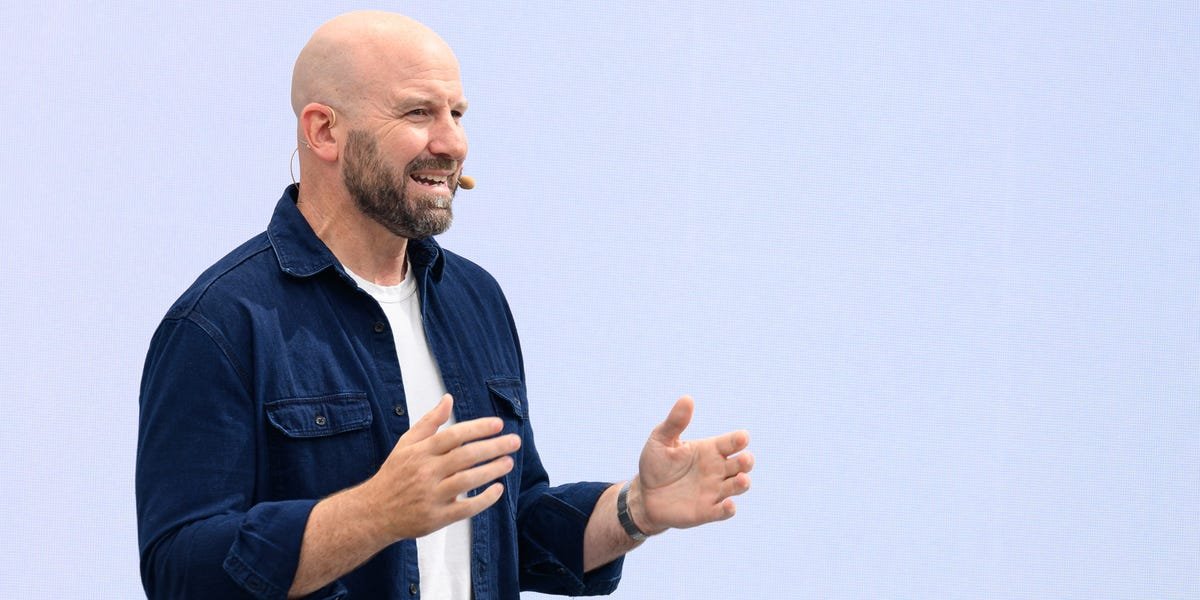
Nike’s “Win Now” turnaround plan isn’t seeing immediate results.
The sports giant announced its third-quarter earnings results for fiscal year 2026 on Tuesday, and revenue remained flat at $11.3 billion. Nike shares moved lower after market close, falling more than 8% despite the company delivering better-than-expected results.
On the call, CEO Elliott Hill said the company’s comeback is taking “longer than I would like,” but he and other executives expressed confidence in the approach.
So far, running is leading the charge with growth. It was the first category to move into the “sport offense,” which puts sports back at the center of its mission, as the company leans more into performance wear.
“The pace of progress is different across the portfolio, and the areas we prioritized first continue to drive momentum,” Hill said in the earnings press release.
Meanwhile, other parts of the portfolio, including Greater China, Converse, and sportswear, are still in earlier stages of their comebacks, the company said. Nike’s digitalsales declined 9% in a drop that the company said is due in part to being too promotional with higher markdowns.
Sportswear continues to be a headwind to revenue growth for Nike as it declined by low double digits in the quarter. It’s continuing its efforts to clean up inventory, which it said has taken several quarters to execute. The Nike sportswear and Jordan streetwear teams are moving from playing defense to playing offense, the company said.
“There is both an art and a science to seeding, igniting, and scaling new sportswear styles,” Hill said.
In March 2025, Nike publicly rolled out its turnaround plan, which Hill calls its “Win Now” strategy. The effort has reoriented the company around sports from running to basketball, rather than gender or age.
CFO Matthew Friend said Nike expects revenues to be down low single-digits compared to the prior year, with gains in North America offset by declines in Greater China. Assuming no significant changes, after the first quarter of fiscal 2027, higher tariffs are expected to ease for Nike,Friend said on the call.
“Given the softness in sportswear, traffic patterns, and promotions across Europe, as well as recent disruption in the Middle East, we anticipate ending the fourth quarter with elevated inventory,” Friend said.
The company expects to finish its “Win Now” actions by the end of 2026.
Andrew Bosworth — also known as “Boz” — is Meta’s chief technology officer, overseeing divisions from the metaverse and gaming to AI glasses. On Monday, a respondent to his Instagram AMA asked what “type of person” thrived at Meta.
“It’s a good question,” Bosworth said. “You should probably ask my org.”
Bosworth went on to share seven traits that he liked in an employee.
First, they have to be “relentless in pursuit of doing great work.” Meta employees take “pride and ownership” in their work, he said. They also “take it personally.”
Two of Bosworth’s tips were based on communication. Good Meta employees are both direct and appreciate directness in return.
Employees should take direct communication “in the spirit it’s intended and turn it into progress,” Bosworth said.
Direct communication can cause conflict. Luckily, Bosworth has a solution there, too. In a September blog post, he shared four steps for resolving workplace disputes, something that he has done “so many times” that he sometimes uses the same tools on himself.
Another trait Bosworth valued was the ability to roll with the punches. Bosworth called this being “adaptable.”
“When plans change, their first reaction isn’t a knee-jerk fear of change, but rather a tremendous curiosity and enthusiasm about what that might mean for them,” he said.
Indeed, things often change at Meta — including in Bosworth’s divisions. In his last AMA, he explained the company’s stance on VR after recent cuts. Bosworth said the company was still “bullish,” but its investment had to “match the size of growth.”
OpenAI says its agreement with the Department of War is “better” and has more safety guardrails than the one Anthropic was blacklisted for refusing to comply with.
In a blog post published Saturday, OpenAI shared some contract language from its agreement with the Department of War, including clauses that indicate its tech cannot be used for mass domestic surveillance or to power autonomous weapons or high-stakes decision systems like “social credit” scores.
“We think our agreement has more guardrails than any previous agreement for classified AI deployments, including Anthropic’s,” OpenAI’s post read. “In our agreement, we protect our red lines through a more expansive, multi-layered approach. We retain full discretion over our safety stack, we deploy via cloud, cleared OpenAI personnel are in the loop, and we have strong contractual protections. This is all in addition to the strong existing protections in U.S. law.”
OpenAI CEO Sam Altman took to social media shortly after the company’s blog post was published, answering questions from users concerned about the nature of OpenAI’s agreement with the government.
In Ask-Me-Anything-style responses, he doubled down on OpenAI’s agreement being better than Anthropic’s, not just for the broader AI landscape but also for the American people.
Every time Katherine publishes a story, you’ll get an alert straight to your inbox!
Stay connected to Katherine and get more of their work as it publishes.
“Anthropic seemed more focused on specific prohibitions in the contract, rather than citing applicable laws, which we felt comfortable with,” Altman wrote in response to a question about why OpenAI agreed to partner with the government when its rival would not. “I think Anthropic may have wanted more operational control than we did.”
OpenAI’s agreement with the federal government comes on the heels of Anthropic being blacklisted and declared a supply chain risk after refusing to comply with the military’s terms of use for the company’s frontier model, Claude.
Anthropic, in a Friday statement, said that “no amount of intimidation or punishment from the Department of War will change our position on mass domestic surveillance or fully autonomous weapons” and vowed to “challenge any supply chain risk designation in court.”
OpenAI, in its Saturday post, argued that Anthropic should not be designated as a supply chain risk and said it had made its position “clear to the government.” Its agreement with the Department of War stemmed, in part, from a desire to “de-escalate things between DoW and the US AI labs.”
“A good future is going to require real and deep collaboration between the government and the AI labs,” OpenAI’s post reads. “As part of our deal here, we asked that the same terms be made available to all AI labs, and specifically that the government would try to resolve things with Anthropic; the current state is a very bad way to kick off this next phase of collaboration between the government and AI labs.”
Representatives for OpenAI and Anthropic did not immediately respond to requests for comment from Business Insider. It was not immediately clear whether Anthropic, or any other leading AI company, had been offered similar contractual terms to those that OpenAI said it had agreed to.
OpenAI said that, as part of its deal with the Department of War, it will maintain “full control” over the safety stack it deploys, and robust “safety guardrails” to prevent misuse. Should the government violate the terms of the agreement, OpenAI said it “could” terminate the contract.
“We don’t expect that to happen,” OpenAI said in its post.
Altman, in his Ask Me Anything posts, wrote that OpenAI would not agree to allow the government to use its technology for mass domestic surveillance “because it violates the constitution.”
He added that he is prepared for a potential dispute over the legality of specific governmental requests in the future, but added that if the Constitution were amended to make such surveillance legal, “Maybe I would quit my job.”
“I very deeply believe in the democratic process, and that our elected leaders have the power, and that we all have to uphold the constitution,” Altman wrote. “I am terrified of a world where AI companies act like they have more power than the government. I would also be terrified of a world where our government decided mass domestic surveillance was ok. I don’t know how I’d come to work every day if that were the state of the country/Constitution.”
The dispute between the government and the AI giants has sparked widespread criticism, with critics concerned about the ethical implications of the Department of War’s use of AI and OpenAI’s agreement to provide the government access to its technology.
OpenAI on Saturday said it believes AI will “introduce new risks in the world” and, by allowing the government use of its models, will give people defending national security “the best tools” to do so.
Business Insider previously reported that Anthropic’s model, Claude, shot to the top of the app store on Saturday, and many people on social media, including celebrities like Katy Perry, have publicly posted about canceling their ChatGPT subscriptions in the wake of OpenAI’s agreement with the government.
Google executive Yasmeen Ahmad is looking for something specific when hiring engineers — and it’s not just technical know-how.
Ahmad told Business Insider that the typical software engineering interview used to focus on detailed coding tests and test suites. Now, as she hires for a forward-deployed engineering team, which will work with customers, she said she’s prioritizing people with fresh ideas.
The strongest candidates are “able to think outside the box,” Ahmad, director of Google Cloud’s data cloud, said. “They’re able to think outside the frame of how we would have normally described a problem.”
The executive added that candidates who take a traditional approach to engineering aren’t performing as well in her team’s interviews. The ideal candidate nowadays, she said, can demonstrate creative problem-solving by using AI to reimagine traditional processes. She said she evaluates that type of thinking in two ways:
1. Constant experimentation
Ahmad said she looks for candidates who are constantly “tinkering” with new tools. That gives her an immediate signal that they’re creative thinkers.
“When you’re interviewing them, they’re naturally immediately talking about, ‘oh, last week I had tried AI in this context, and this is how it made me better at doing my job in this way,'” Ahmad said.
These candidates aren’t trying new tools because their boss told them to or because it’s the new cool thing to try,she said.
“They’re the early adopters,” Ahmad said.
Tech executives have told Business Insider that side projects are becoming increasingly common for candidates to demonstrate their aptitude in interviews. However, Ahmad said candidates don’t need to have a GitHub repository of projects they’ve worked on in their spare time.
“It doesn’t have to be pet side projects, because people are busy,” Ahmad said, adding that workers can experiment on the job by trying out new ways to speed up their work.
2. Scenario testing
AI is being used more often throughout the interview process — in some cases, illicitly by job seekers, and in others, as a way for employers to test candidates’ AI capabilities. As these tools reshape hiring, Ahmad said scenario-based testing has become central component to the interview process, giving hiring managers a better way to assess creativity.
Ahmad said she’ll ask candidates how they would approach a scenario involving AI tools in an industry where they have no domain knowledge.
For example, if the example related to healthcare, a traditional candidate might say that they would take all the patients’ unstructured PDFs, feed them into a single LLM prompt, and ask it to generate a summary for the doctor. That would be a “massive liability,” Ahmad said, because in that scenario the candidate assumes AI can inherently understand the timeline of events or clinical context of an image by looking at it.
Ahmad said she’s looking for a candidate who can “find solutions in a way that breaks the chains of how that workflow process has traditionally gone.” So someone might suggest building the semantic context for the imaging data before the model sees it. Next, they would build a specific framework to ensure the agent is operating in the right time frame of data. Then, they would recommend designing a multi-step process that includes a continuous evaluation loop.
“We aren’t just hiring people to write prompts,” Ahmad said. “We are hiring people who can foresee how a model might silently fail in a high-stakes environment, and who know how to build the automated evaluation loops to catch it before it does.”
She said asking these sorts of questions to vet creativity is especially useful as AI transforms the software engineering industry by automating core parts of the job.
“We’re seeing the human role is evolving to more of an orchestrated role,” Ahmad said. “So rather than having to write all of the detailed code, it’s ‘how do I actually express my intent to a multi-agent system now and have that multi-agent system execute on that intent?'”
On a recent trip to France, Dr. Meghan Garcia-Webb was struck by an age-old paradox.
Everywhere she looked, she saw people enjoying cheese, wine, and bread — yet the average person seemed much healthier than the typical American.
In France, despite their reputation for rich cuisine, the obesity rate is a fraction of what we see in the United States, for all our calorie-counting and protein maxxing.
“There isn’t this pervasive diet culture of going to a restaurant and seeing how many calories are in this and how many carbs,” Garcia-Webb told Business Insider. “I do find it is refreshing in the sense that there’s not this fear around food, and the food is very satisfying.”
It’s just one example of how stressing less about your diet can lead to better weight loss and long-term health, she said.
Every time Gabby publishes a story, you’ll get an alert straight to your inbox!
Stay connected to Gabby and get more of their work as it publishes.
In her concierge medicine practice, Garcia-Webb specializes in helping high achievers, such as CEOs and attorneys, manage their weight. A lot of her job is pushing back on extreme diet fads, including the trend of tracking everything.
“I really enjoy food and the more I do this work, the more compelled I feel to show people that it actually is possible to be healthy and really like to eat,” she said.
Garcia-Webb said her favorite food hack makes it easy to eat well without turning your food journal into a full-time job. Here’s how to try it at home for more nutritious meals.
A stress-free guide to healthy eating
Everyone loves a food hack, and Garcia-Webb said hers is simple: when you prepare a meal, start by making half the plate fruits and non-starchy vegetables.
Filling half your plate with produce is a simple way to eat well without measuring each bite, calorie, or gram of protein.
Magda Tymczyj/Getty Images
“It’s actually very easy,” she said. “You don’t even have to cook them if you don’t want to.”
Think carrots, cucumbers, peppers, greens, tomatoes, berries, grapes, citrus — anything you’d find in the produce aisle (except potatoes). To make it even easier, opt for pre-cut options that are ready to eat or frozen produce, which is as healthy as fresh.
From there, Garcia-Webb builds a full meal by adding a source of protein, like lean meats or fish, to fill another quarter of the plate. The last quarter of the plate is for starchy foods like whole grains, pasta, rice, or potatoes.
The strategy makes it simple to get five servings a day of fruits and veggies. Each serving is about a handful when you’re eyeballing it.
As you fill up on produce, the high-volume, high-fiber food keeps you full and satisfied after eating, so you’re less likely to reach for junk food later. That means you’ll find yourself eating healthier without having to count a single calorie or even measure a portion.
When to track your food for weight loss
There’s nothing inherently wrong with tracking your eating habits, and calculating every gram of protein is fine if that works for you.
Still, for most people, too much tracking can be a burden, taking away the enjoyment of food and making you less likely to stick to your healthy habits long-term.
Instead of trying to track everything you eat forever, Garcia-Webb recommends keeping a food log for a few days: it can give you a baseline sense of your current habits and what you can change to move toward your goals.
“You build this intuitive knowledge, and then you have a rough sense of what it looks like for you,” she said.
A temporary habit of food tracking can be helpful if you feel like you’re doing everything right and wonder why you aren’t losing weight.
Food labels can mislead you by making a processed snack seem healthy because of added protein, but sneaking in extra sugars.
Luke Chan/Getty Images
Garcia-Webb said if you’ve never tracked your habits, it’s common to eat more and exercise less than you realize.
These days, plenty of convenience foods disguise ultra-processed junk with a “health halo” of added protein or other nutrients to make you believe you’re making a nutritious choice.
“People think that they’re eating healthier than they are,” Garcia-Webb said. “Something that we can all fall prey to is very good marketing.”
Over the past five to 10 years, OB-GYN Dr. Thaïs Aliabadi noticed an uptick in younger cancer patients in her practice.
Suddenly, more in their 30s and 40s were getting diagnosed with breast, uterine, and colon cancer, the latter of which is now the leading cause of cancer death in people under 50.
As to the causes, Aliabadi has her own theories.
“I think our lifestyles, our metabolic changes, the rates of obesity, the increase in insulin resistance, our poor diet, lack of exercise, chronic inflammation — these have all played a huge role,” she told Business Insider. She also mentioned environmental pollutants that can disrupt the endocrine system and the fact that women are getting pregnant later or not at all, which can change hormone exposure and increase the risk of breast cancer.
In better news, she also said higher rates of diagnoses also mean “we’ve gotten better and better at cancer detection and risk assessment,” as awareness around early symptoms have also improved.
While so many factors can feel out of our control, “I wish every woman knew that cancer is not always completely random,” Aliabadi said. In some cases, “we can actually see risk long, long before the disease appears.”
Aliabadi shared her three tips for preventing cancers in women (such as breast and ovarian cancer), from analyzing your risk to focusing on your metabolic health.
Improve your metabolic health with diet, sleep, and exercise
Regular exercise can lower the risk of multiple cancers.
skynesher/Getty Images
In terms of overall prevention, Aliabadi said starting a few healthy habits as early as possible is key.
“If you want to lower your risk of cancer, number one on the list is to maintain a healthy metabolic profile,” she said. It means lowering cholesterol, inflammation, and visceral fat — the fat surrounding your internal organs.
She said exercise, such as strength training and cardio, improves insulin sensitivity, reduces inflammation, and balances hormones, lowering the risk of multiple cancers.
Eating a diet “rich in whole foods” and cutting back on ultra-processed foods can also make a huge difference by boosting gut health and cutting down cholesterol.
Other good habits for metabolic health include stress reduction and getting adequate sleep. “Sleep deprivation is poison to our longevity, and persistent stress can affect our hormones and our immune pathways,” she said.
These habits don’t just decrease cancer risk — they also reduce the risk of cardiovascular disease, diabetes, and other chronic illnesses.
Cut down on carcinogens where you can
Even moderate drinking increases cancer risk.
Elena Noviello/Getty Images
Aliabadi said environmental toxins, like chemicals in food packaging, can be “a little tougher” to be aware of because of how ubiquitous they are.
However, there are still ways to reduce exposure to carcinogens (cancer-causing agents) and endocrine disruptors. A commonly spoken about one is tobacco, so abstaining from smoking cigarettes or vaping “can significantly lower many cancer risks,” she said.
The one she really emphasized cutting back on is alcohol, as even moderate drinking can increase cancer risks.
“In my office, I have zero tolerance for alcohol,” she said. “Not even a couple of glasses a week.”
Collect data on your body
Depending on risk factors, you might need to start screening earlier.
German Adrasti/Getty Images
While cancer screenings have recommended starting ages — some of which have been recently lowered to reflect an uptick in younger patients — Aliabadi says you shouldn’t rely on them.
“We need to stop thinking that prevention starts at 40, that mammograms start at 40,” she said. “Prevention starts in our teens and in our 20s, believe it or not.”
She urges women to take a two-minute online test and learn their lifetime risk assessment score for breast cancer, which uses information like family history, genetic mutations, and breast density to more accurately estimate when you should get screened. Olivia Munn, a patient of Aliabadi’s, famously took the test and was diagnosed with early-stage breast cancer despite having no symptoms.
Aliabadi said that testing for seemingly unrelated conditions, like PCOS, endometriosis, fertility, genetic conditions, and insulin resistance, can all play a role in evaluating your cancer risk and give you a better idea of how vigilant you should be.
Aliabadi, who herself had a high lifetime risk assessment score for breast cancer and was initially dismissed by doctors, said a patient knowing their body helps them better advocate for themselves and seek out second opinions if needed.
“If someone at the front desk tries to scare her away, she will be her own health advocate,” Aliabadi said. “She will know exactly why she’s there and why she needs that mammogram.”
Bracha Cohen has a front row seat to Wall Street’s AI revolution — and to how young people can compete in it.
“I would tell the new generation of graduates, in this world where AI is so transformational, to build judgment and not just skills,” Cohen, a partner within asset and wealth management engineering, said. “AI may automate execution, but it can’t fully replace decision-making, systems thinking, and ethical reasoning.”
Cohen joined Goldman as a programmer in 1994, long before anyone had to prove AI fluency on their applications. She said that serving in various roles across business lines helped her ascend to partner, the firm’stop leaders.
Today, her engineering team in asset management focuses on automating operations to help the business scale, including through AI. As of now, the booming business — which holds a record $3.6 trillion in assets — uses AI for routine work, like analyzing and summarizing data, Cohen said.
As white-collar hiring slows and anxiety about AI in junior roles grows, Cohen said young engineers should focus less on simply completing tasks and more on how systems function. Mastering engineering fundamentals is key, she said, since AI should serve “as leverage, but not as a crutch.”
Every time Alice publishes a story, you’ll get an alert straight to your inbox!
Stay connected to Alice and get more of their work as it publishes.
Bracha Cohen is a partner and engineer at Goldman Sachs.
Goldman Sachs
She added that computer science majors should practice evaluating risk and crafting good questions, both for other people and AI models. Two other Goldman partners also previously said that interpersonal skills and communication are becoming increasingly crucial in the AI workplace.
And engineers who want to work on AI in particular have their own set of criteria. Dan Popescu, a newly promoted managing director and Goldman’s head of AI engineering for asset management, previously told Business Insider that the most competitive hires need a suite of skills: knowledge in AI engineering, finance, and traditional software engineering.
Goldman spent $6 billion on technology last year and has rolled out internal AI tools, including an assistant and a limited banker copilot. In an October memo, the firm laid out the latest phase of its OneGS initiative, which it says will drive efficiency, slow hiring, and create a “limited reduction” in roles.
CEO David Solomon is one of several big bank leaders who have said that, in the long run, AI won’t reduce head count, and that the firm needs to focus on attracting more high-quality talent.