
Shield-AI-says-its-Hivemind-AI-pilot-just-flew-a.jpeg

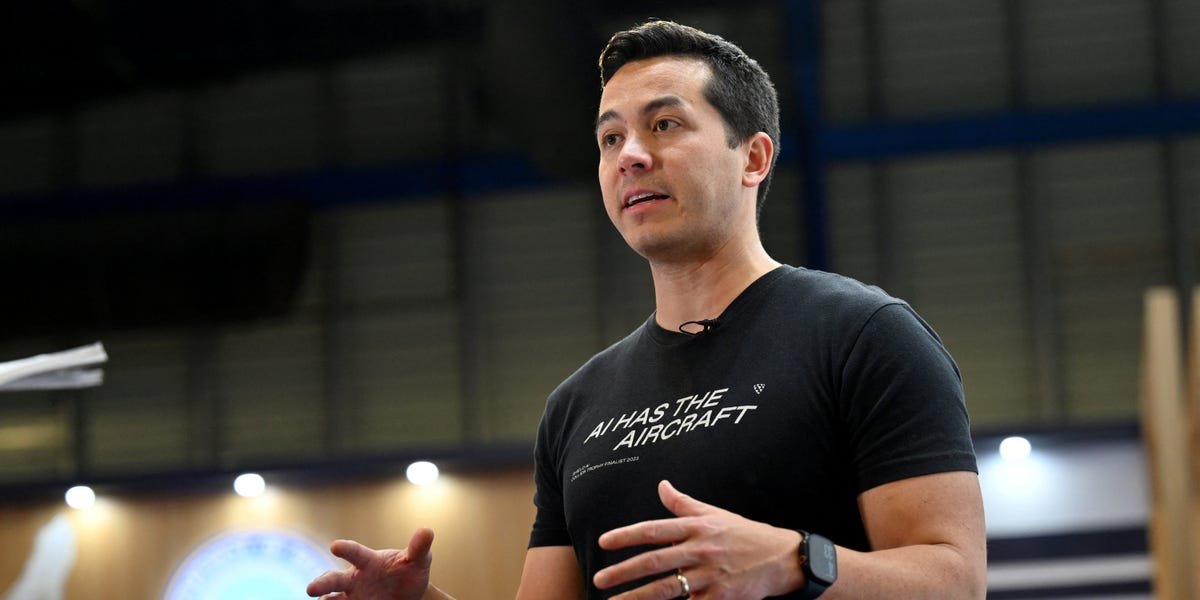
Shield AI says its Hivemind AI pilot just flew a drone vying to become a future Air Force uncrewed wingman

Shield AI’s artificial intelligence pilot has flown one of the US Air Force’s next-generation drone wingman contenders for the first time, the company announced this week.

Shield AI’s Hivemind, the same AI program that previously went head-to-head with a crewed fighter aircraft in aerial combat, was picked by the Air Force for autonomy testing as part of its Collaborative Combat Aircraft, or CCA, effort earlier this month. Now, it has flown Anduril’s CCA competitor, an achievement for the software that could pilot future uncrewed aircraft built to fly and fight alongside crewed US combat aircraft.

The US defense company said Hivemind, piloting Anduril’s Fury drone, also known as YFQ-44A, completed its first flight test over the Mojave Desert. The AI pilot met all required test points, including mid-mission updates and basic operational maneuvers, the company said.

The successful test opens the door for expanded mission autonomy testing with Hivemind, Shield AI said.

“This flight test showcases the potential of airpower built on mission autonomy,” Christian Gutierrez, vice president of Hivemind Solutions, said.

“Across platforms, domains, and environments, Hivemind provides resilient mission autonomy, proving that software is central to the future of airpower,” Gutierrez said, adding that “our collaboration with Anduril reflects a new era of defense acquisition, where autonomy is treated as a foundational warfighting capability on par with the aircraft itself.”

Shield AI has spent more than a decade developing Hivemind’s AI software, which is designed to perform many of the tasks of a human pilot. Unlike autopilot or other autonomous features, Hivemind is built to make real-time decisions, adjusting flight routes depending on conditions or obstacles to continue a mission, the company says.

The same AI software was used in the Air Force’s AI-enabled X-62A VISTA, a modified F-16 that flew simulated dogfights against a crewed fighter aircraft in 2024. The service has not publicly revealed which aircraft emerged victorious in those engagements.

Hivemind is also the AI pilot behind Shield AI’s new X-BAT fighter aircraft, which the company unveiled in October. Shield AI says that the X-BAT can operate without human intervention and take off without runways, as well as in contested environments where GPS and reliable communications might not be available.

Anduril’s Fury aircraft is one of the competitors for the CCA program, a priority of the Air Force that envisions uncrewed aircraft operating alongside crewed aircraft with some mixture of autonomy and human direction. Earlier this month, a test flight saw a CCA stand-in aircraft communicate and fly with an Air Force F-22 Raptor, marking another step forward in the CCA program.

On Wednesday, Col. Timothy Helfrich, the Air Force’s portfolio acquisition executive in fighters and advanced aircraft, commended the speed of work being done on autonomous pilots flying CCAs. “Quite an accomplishment going so quickly,” he said at a panel, “but we’ve got a lot ahead of us though.”


Source link

Shield-AI-cofounder-says-the-need-to-arm-the-V-BAT.jpeg

Shield AI cofounder says the need to arm the V-BAT drone is a big misconception

Brandon Tseng, Shield AI’s cofounder, said there’s a common misconception about his company’s signature software-powered drone: People say it needs to be armed.

The more experienced militaries who work with Shield AI, however, know they don’t need that capability in modern war, Tseng told Business Insider.

“Who doesn’t ask for that? The US military doesn’t ask for that because we understand joint fires. The Ukrainians don’t ask for it anymore, either,” said the former Navy SEAL, who is Shield AI’s president.

The V-BAT, a vertical takeoff and landing drone that uses artificial intelligence to fly in jammed environments, has primarily been used for intelligence and reconnaissance missions in high-profile conflict zones such as Ukraine. Shield AI said the V-BAT flew over 200 missions there in 2025.

The drone is still meant to be a multi-mission platform, Tseng said, and Shield AI has been exploring ways to mount weapons on it. The firm announced a partnership last month with South Korean arms manufacturer LIG Nex1 to equip the V-BAT with six-pound guided missiles.

“But at the end of the day, look: I describe V-BAT as a mini predator, reaper drone,” Tseng said. “That’s the mission it’s doing, which is: It’s finding targets. And it’s hard to find targets, you have to be out there for a long period of time.”


A South Korean Navy V-BAT flies through the sky in September 2025.

The V-Bat is being primarily used for ISR missions, but there are also options for the AI-powered drone to be equipped with weapons.

Kim Hong-Ji/REUTERS


To be fair, the MQ-9 Reaper is also commonly equipped with missiles.

However, Tseng said sophisticated militaries already have a vast array of other weapons that can turn the V-BAT’s intel into a precision strike.

“If you have been in these combat zones, the US allies who fought closely with us in Afghanistan, they do not ask for organic fires on board the V-Bat,” Tseng said. “Because everybody is so used to just saying: ‘Okay, I have a targeting package. What fires asset do I have lined up? Is it a one-way attack drone? Is it HIMARS? Is it artillery? Is it an SM-6? SM-3?”

“Doesn’t matter. You can find weapons,” he added. “The weapons are available. You need, actually, more intelligence.”

V-BAT’s early use in Ukraine

This was a framework that Ukraine still needed to improve when the V-BAT began spotting targets there in early 2024, Tseng said. The drone is meant to fly for over 13 hours and be easily deployable, requiring a two-person launch crew and no runway.

Tseng said that while Ukraine excelled in tactical drone warfare, its troops weren’t used to having a long-range asset that could spot targets for regular strategic attacks as the US military did.

“The strategic effects would happen, but they would be rare,” he said. “They’d be very, very deliberately planned operations, very expensive operations, things like what they did to the Russian runways with sending quadcopters deep into Russia via trucks.”

Ukrainian drone teams would use the V-BAT to find important targets, such as Russian S-300 and S-400 air defense systems, only to realize they hadn’t linked up with the right teams to strike them, Tseng said.

“We’d say: ‘Why didn’t you guys have these weapons lined up?’ They’d say: ‘Oh, well, we didn’t think to coordinate,'” Tseng said.

Since then, Kyiv’s forces have been using intelligence from V-BATs to carry out strikes with systems such as one-way attack drones or US-made HIMARS, Tseng said.

“There was a lot of learning over the past year for the Ukrainians,” he added.


Source link