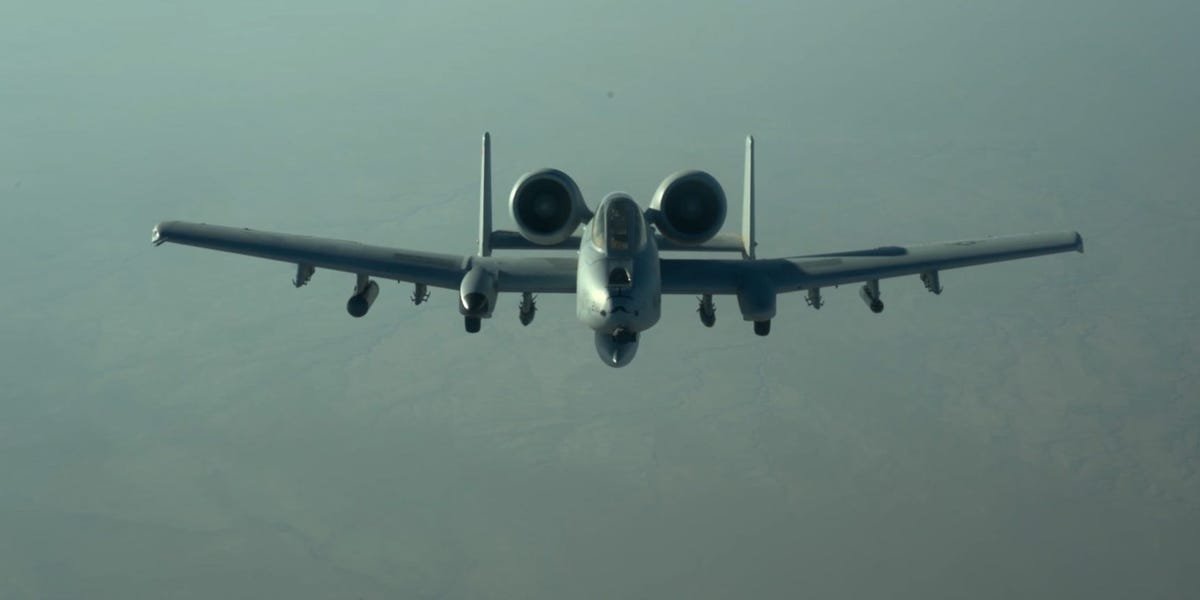
A US Air Force A-10 Thunderbolt II was shot down in Iran while attempting to rescue crew members from the downed F-15 Strike Eagle fighter jet. According to US officials, the pilot safely ejected over friendly territory and was unharmed.
Known as the Warthog, the A-10 has been in service since 1977… but the Air Force has been pushing to retire it from service, deeming the aircraft obsolete.
When a US Air Force F-15E Strike Eagle was shot down over Iran last Friday, both the pilot and the weapon systems officer bailed out over hostile territory.
Their fight for survival began the moment their plane came under enemy fire, from the intense ejection to the evasion of hostiles on the ground as they awaited rescue.
The jet’s pilot was rescued by US forces within hours, but the WSO was stranded in enemy territory for two days, signaling American rescue teams while avoiding the Iranians who were out looking for him.
The shootdown, the first fighter jet loss to enemy fire in this war, and the complex rescue that followed show why pilot survival training is as critical as air combat skills.
Ejection Training
Military aviators regularly undergo refresher training on surviving aircraft emergencies, from what to do when oxygen levels drop dangerously low to escaping a downed aircraft at sea, said Vincent Aiello, a retired Navy fighter pilot and former TOPGUN instructor.
“Flying a high-performance fighter jet is a full-contact sport,” he told Business Insider. “It’s very difficult on your body.”
Safe ejection preparation begins with body positioning. Because an ejection seat goes through what Aiello described as a “controlled explosion,” even small deviations can cause severe injury. The seat rockets a pilot out of the cockpit in a fraction of a second, generating forces strong enough to compress the spine and leave lasting damage.
An improper position of an aviator’s body can be fatal.
Airmen learn to properly adjust ejection seats in a course to ensure they’re ready to use in an emergency.
2nd Lt. Lauren Niemi/US Air Force
Aiello recalled being in an ejection simulator in one of his early training sessions — sensors detected if an elbow or foot was even a hair out of position, mistakes that in a real scenario could prove extremely harmful, he said.
“It’s not just the explosion,” he said — a pilot is “riding this blast wave” and can be thrown into the aircraft’s slipstream, which may be moving at hundreds of miles per hour.
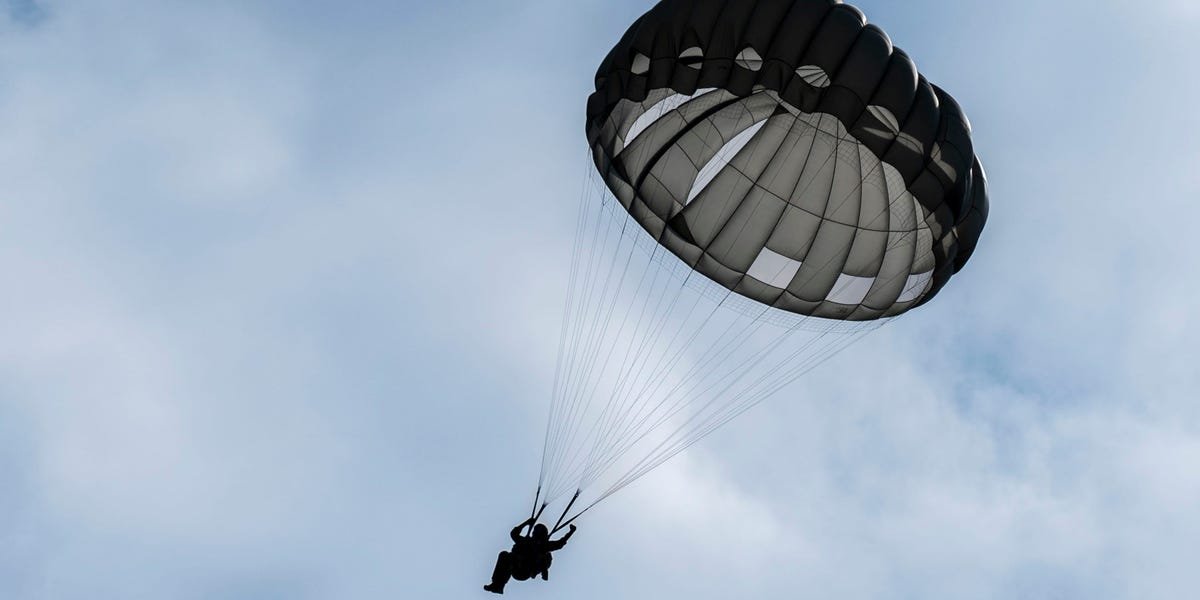
An ejection is a multi-step process. After the ejection handle is pulled, the cockpit canopy blasts off and then a rocket motor under the aviator’s seat fires to carry them safely away from the aircraft before releasing a parachute.
The process is intense and disorienting, Aiello explained, and is made even more difficult with military parachutes that are designed more for survivability thanfor easy maneuverability and soft landings, like sport parachutes.
“You’re almost guaranteed to be injured, but you should be alive,” he said. “And that’s the point, you don’t go down with the ship. You get out, albeit violently, but you’re alive.”
An aircrew student was dragged through the water during a 2005 training.
PO2 Scott Taylor/US Navy
SERE Training
Getting out of the jet is only the first hurdle if a pilot goes down in unfriendly territory — what happens in the minutes and hours immediately after landing can determine whether a pilot makes it home.
All US military aviators and aircrew undergo SERE training — short for “Survive, Evade, Resist, Escape.” The program, also required for personnel assigned to special operations units and others, prepares service members for isolation and potential captivity.
Much of the training was shaped by lessons from the Korean and Vietnam wars, when thousands of American service members, including pilots and aircrew, were taken prisoner and subjected to torture and inhumane conditions. Back then, there was little formal preparation for what troops might face.
Today, multiple SERE schools train military personnel how to survive being captured by an enemy and follow a similar concept — after classroom instruction, students spend several days living off the land before attempting to evade simulated enemy forces. They then undergo a “capture” and experience a prisoner-of-war camp environment, where they are tested through interrogations and propaganda scenarios.
Part of that means realistic stress for troops who must stick to the “code of conduct” for POWs, a set of rules meant to guide captured personnel through interrogations and torture, and to resist divulging sensitive information. Service members must also demonstrate their ability to maintain discipline and morale under sustained psychological pressure.
Pilots train for how to survive capture by a repressive regime in the Survival, Evasion, Resistance and Escape course.
Senior Airman Robert Nichols/US Air Force
In a conflict against a nation with advanced air defenses, the odds of ejecting into hostile territory rise sharply, making the training critical. The US has degraded Iranian air defenses, giving it air superiority, but that doesn’t completely eliminate the risk, as Friday’s incident shows.
“Whether you’re in the jungle, the Arctic, or the desert, you’re learning a mindset,” explained James Reeman, a retired Air National Guard F-16 pilot. “How am I going to be mentally prepared if things go wrong?” It’s an extreme example of being tested to personal limits, with sleep deprivation and simulated interrogations.
The experience of evading and resisting in small teams creates strong bonds, he said, and leaves little room for any big egos.
“You’re at your wits end, and they do a really good job of making you think it’s real,” he said.
“The last thing you expect is to get shot down,” said John Waters, who previously flew with the Air Force’s F-16 Viper Demonstration Team. But the unexpected can’t be where everything falls apart. Instead, that’s where pilots and aircrews lean hardest on their training.
The US military invests heavily in keeping pilots alive, not just because of the human cost. Experienced aviators are among its most expensive and difficult assets to replace.
SERE trains pilots and aircrew on how to be ready in case they need to eject.
Senior Airman Tiffany Del Oso/US Air Force
SERE training places aviators in high-stress environments specifically to test whether they can regain composure quickly and manage unpredictable interactions.
In today’s conflicts, the first people a downed pilot meets may be civilians with smartphones, not soldiers, adding a new layer of unpredictability.
Following a friendly fire incident involving three F-15s in early March, right after the start of the war with Iran, video footage began circulating online showing what was said to be locals in Kuwait encountering the downed American pilots.
Waters pointed to the footage of a pilot raising their hands as the locals approached as an example of de-escalation under pressure.Pilots fly with sidearms in case they find themselves in an emergency on the ground— but knowing when to engage and when not to is critical.
“This is obviously one of the worst ways this could have ended,” Waters said of the friendly fire incident that downed three F-15s on March 1. However, “it could have been much worse if this had happened over territory where people weren’t friendly, or where there wasn’t a friendly government.”
That much worse scenario is what the F-15 crew faced after being shot down inside Iran. Both airmen had to hold their own while they waited for recovery in two separate, harrowing rescue missions.
The US Army’s sweeping new deal with Anduril includes an $87 million effort to link counter-drone systems so troops can better spot, track, and destroy enemy drones — a threat growing on and off the battlefield.
The Army-led Joint Interagency Task Force 401 selected Anduril’s Lattice software for its new command and control system. JIATF-401, established last summer, has been working to write the rules for countering drones in partnership with the FBI and Department of Homeland Security. Sharing approved systems, particularly a common software that everyone can use, has been a priority for the task force.
The task force announced the decision last Friday, saying that a common backbone for its drone defenses was necessary as uncrewed aerial systems become an increasing threat.
Anduril’s Lattice is expected to allow personnel from across the military and federal agents to share and see each other’s data, have a clearer picture of what threats exist, and better coordinate responses to drone attacks, the service said in its press statement.
On Monday, Anduril said the task force’s command and control system with Lattice will involve numerous sensors for detecting drones and interceptors for stopping them.
Legacy weapon systems and new assets will be able to connect to the platform, “enabling distributed detection, tracking, classification, and ultimately engagement of UAS threats,” Park Hughes, Anduril’s managing director for air defense, said.
JIATF-401 was stood up last August to rapidly deploy counter-drone systems and common operating procedures across the military and government agencies.
US Marine Corps photo by Lance Cpl. Donovan E. Melendez
Lattice is also part of the Army’s new Next Generation Command and Control system, which the service has been testing since last year. NGC2 is being built with a Silicon Valley-style “move fast, fail fast, fix fast” approach, which the Army and other services have said is necessary to field new systems quickly.
The task force’s $87 million agreement falls under a much larger contract the Army also announced Friday. That agreement, worth up to $20 billion over the next decade, allows any federal agency to purchase Anduril’s off-the-shelf systems, the company’s chief business officer, Matthew Steckman, told reporters.
“The modern battlefield is increasingly defined by software,” Gabe Chiulli, chief technology officer for the Department of Defense’s Office of the Chief Information Officer, said in a release. “To maintain our advantage, we must be able to acquire and deploy software capabilities with speed and efficiency.”
Steckman said that while the contract isn’t the first of its kind, it was more complex because Anduril makes a wide variety of products, from software to drones and wearable artificial intelligence goggles, that the government can buy. The Army alone has 120 existing contracts with Anduril already, and the new deal is intended to help streamline how the company and the government do business.
“By establishing both the common C2 [command and control] software platform and the common process for the government to procure, deploy, and sustain ever-improving counter-UAS software at scale, the JIATF is very much accelerating the nation’s response to the UAS threat,” Hughes said.
The Army and other military services are shifting their approach, aiming to reduce what leaders see as bureaucratic hurdles in how weapons are tested, funded, and procured. That shift includes buying commercially available systems, such as software, drones, and counter-drone technology, from vendors like Anduril.
Officials have said the changing approach is designed to cut costs, speed up the acquisition process, and rapidly procure the weapons that troops need sooner rather than later.
An Israeli F-35 just scored the stealth fighter jet’s first-ever air-to-air combat victory against a crewed aircraft.
An F-35I “Adir” shot down an Iranian Air Force Yak-130 over Tehran, marking its “first shootdown in history of a manned fighter aircraft,” the Israeli military said in a statement on Wednesday.
Lockheed Martin’s F-35 Lightning II entered service in 2015 and is operated by around a dozen countries, including Israel, which fields its own variant of the fighter jet called the “Adir.”
The F-35 has intercepted missiles and drones in combat in the Middle East, but it had never shot down a crewed jet — until now. The incident also marks the first time in more than 40 years that Israeli fighters have downed a crewed enemy aircraft.
The Yakovlev Yak-130, which NATO calls the “Mitten,” is a subsonic twin-seater light combat aircraft that also serves as a training jet. Russia has built hundreds of these planes, which entered service in 2010. Several have been delivered to Iran.
Israel operates its own variant of the F-35 called the “Adir.”
US Air Force photo by William R. Lewis
Since the start of operations on Saturday, Israeli fighter jets have bombed targets across Iran, hitting air defense systems, missile launchers, and military facilities across the country. Hundreds of people have been killed, including dozens of military and government officials, as well as Iranian Supreme Leader Ayatollah Khamenei.
Israeli F-35s are operating in the Middle East alongside US and British F-35s. The UK Ministry of Defense said Monday that Royal Air Force F-35s shot down drones over Jordan, marking the first time one of its stealth fighters has destroyed a hostile target in combat.
American F-35 fighters are one of many US combat aircraft participating in the operations against Iran, including other stealth fighters, electronic attack jets, surveillance planes, airlifters, refueling tankers, and bombers.
US Central Command, which oversees Middle East operations, said on Monday that American forces have bombed more than 1,700 targets in Iran since the strikes began on Saturday.
The US military has targeted Iranian command and control facilities, air defense systems, ballistic missile sites, naval infrastructure, and communications capabilities.
This story is available exclusively to Business Insider
subscribers. Become an Insider
and start reading now. Have an account? .
Amtrak’s ”Trak Suit,’ designed by a New York School of Design student, was on sale for four days.
The limited release, which ended February 2, was popular enough that Amtrak is considering a second run.
The rail line is considering mass production with more versions at varying price points.
As someone who has spent more than 150 hours on Amtrak trains, let me tell you, comfort and functionality are key when selecting an outfit. Bonus points if you can make it look cool.
Enter Amtrak’s ‘Trak Suit, a blue and white microfiber fleece poly fabric set that has a detachable sleep mask in the hood, a color block pant design, and an embroidered Amtrak logo. The suit sold for $279 on the rail line’s website from January 29 to February 2.
The limited release was so popular that Amtrak is thinking about bringing it back.
“Given the great response we are seeing from fans, we are evaluating an extension or second run,” an Amtrak representative told Business Insider. “If we choose to mass produce these in larger quantities, we may even consider a few different versions of the design at different price points.”
Amtrak’s ‘Trak Suit was designed by a student the New York School of Design, Anastasiia Lukinskaia.
Amtrak
The ‘Trak Suit was designed by New York School of Design student Anastasiia Lukinskaia last fall.
When Amtrak launched the NextGen Acela train in August 2025, the rail line selected seven students from the New York School of Design to create two track suits to showcase during New York Fashion Week in fall 2025.
“When we revealed the ‘Trak Suits collection during fashion week in New York, the response from our fans was incredible,” Amtrak Vice President, Digital & Brand Management, Jessica Davidson, said in a press release.
I plan to spend hundreds more hours on Amtrak trains, so if the ‘Trak Suit comes back, I just might get one.