Photos-show-life-in-Western-Sahara-a-territory-no-country.jpeg

Photos show life in Western Sahara, a territory no country officially owns

Spain withdrew its rule in Western Sahara amid increasing resistance from the Polisario independence movement, and Morocco soon ushered in 350,000 Moroccans in a demonstration known as the Green March. Neighboring Mauritania also laid claim to part of the territory, but withdrew by the end of the decade due to military force from the Polisario Front.

After conflict ensued between Moroccan forces and Polisario fighters, a ceasefire was agreed upon in the 1990s under the auspices of the UN. Under the agreement, a referendum on independence was envisioned for the Sahrawi people, but the vote never took place.

The territory is divided diagonally by a Moroccan-constructed Berm, lined with land mines.

Fighting has resumed in recent years, though a Moroccan proposal for Western Saharan autonomy under Moroccan authority was addressed by the UN Security Council in 2025. It said Morocco’s proposal should be taken as a basis for discussions toward “a final and mutually acceptable political solution that provides for the self-determination of the people of Western Sahara.”

Polisario leaders oppose the plan and instead advocate a referendum on independence.


Source link

Photos-show-a-major-fire-at-a-key-UAE-oil.jpeg

Photos show a major fire at a key UAE oil port, a day after the US struck a major Iranian depot

  • A fire broke out near a key oil port in the United Arab Emirates on Saturday.
  • Officials said debris from an intercepted drone caused the fire and that operations were suspended.
  • The US attacked Kharg Island, a major oil depot in Iran, on Friday.

Fire erupted at a critical oil hub in the United Arab Emirates on Saturday amid the ongoing military conflict in the Middle East.

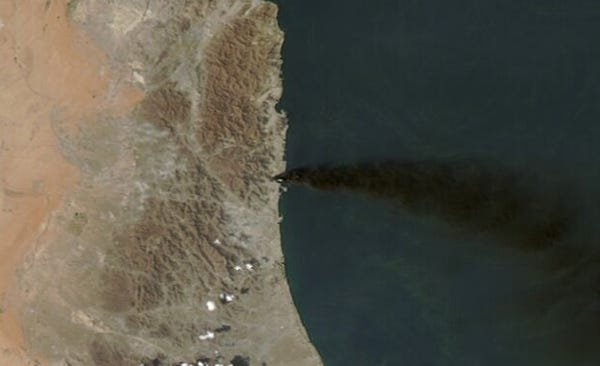
Plumes of dark black smoke billowed around the Port of Fujairah, the only multipurpose maritime facility on the UAE’s east coast. The Fujairah government’s media office said debris from an intercepted drone caused the fire. No injuries were reported.

The fire comes after Iran said it would retaliate against the US for attacking Kharg Island on Friday. Kharg Island, located about 300 miles from the Strait of Hormuz, is key to Iran’s oil industry and has refineries that process nearly all of the country’s oil exports.

President Donald Trump said the US had “totally obliterated” military targets on Kharg Island in a Truth Social post on Friday. In a Truth Social post on Sunday, Trump said he hoped other countries affected by the Strait of Hormuz closure would send warships alongside the US to help secure it.

War broke out in the Middle East last month when the US and Israel launched joint strikes against Iran. In response, Iran has targeted US military bases in neighboring countries like Qatar, Bahrain, Kuwait, and the UAE. The ongoing military conflict has shuttered airspaces and halted most traffic through the Strait of Hormuz. US strikes on Kharg Island and damage to the UAE’s Port of Fujairah could impact oil prices, which again surged past $100 on Friday, driving up gas prices around the world.

Smoke from the coast of Fujairah spread over the Gulf of Oman.

NASA MODIS satellite image of Fujairah on Saturday.

NASA Modis satellite image, November 14, 2026.

A satellite image taken on Saturday showed smoke from the fire spreading over the Gulf of Oman. The Port of Fujairah exported an average of 1.7 million barrels of crude oil and refined fuels each day in 2025, Reuters reported.

Some operations at the Port of Fujairah were suspended on Saturday.


Fujairah in the UAE on March 14, 2026.

Fire broke out in Fujairah on Saturday.

AP Photo/Altaf Qadri

Local outlets reported that some oil-loading operations were suspended on Saturday following the intercepted strike.

The Fujairah Oil Industry Zone can store millions of barrels.


Oil facility in Fujairah in the UAE on March 14, 2026.

The Fujairah Oil Industry Zone in Fujairah on Saturday.

AP Photo/Altaf Qadri

The Fujairah Oil Industry Zone, located near the port, is home to the largest commercial storage facility for refined oil products in the Middle East. The hub can store about 70 million barrels of oil.

The military conflict has sent oil prices skyrocketing.


Fujairah in the UAE on March 14, 2026

Oil prices have risen globally since the US and Israel launched attacks against Iran.

AFP/Getty Images

The ongoing war has disrupted the oil supply chain, sending oil prices over $100 a barrel this week. The International Energy Agency said it will release 400 million barrels from reserves in response, marking the largest coordinated release in the IEA’s history.

The International Energy Agency said the war has caused the largest oil market disruption in history.


Fujairah in the UAE on March 14, 2026.

Fujairah in the United Arab Emirates on Saturday.

AFP/Getty Images

The International Energy Agency said global oil supply will drop by 8 million barrels a day in March.

“Disruptions are not limited to upstream production and exports, with several refineries and gas processing facilities shut down due to attacks or for safety concerns,” the agency said in its monthly markets report. “The closure of the Strait is also forcing export-oriented refineries to cut runs or shut completely as product storage tanks top up.”

The UAE said it intercepted nine missiles and 33 drones launched from Iran on Saturday.


Fujairah in the UAE on March 14, 2026.

Iran launched over 30 drones at the UAE on Saturday, according to the UAE’s military defence.

AP Photo/Altaf Qadri

The UAE Defense Ministry said it intercepted nine ballistic missiles and 33 uncrewed aerial vehicles launched from Iran in an X post on Saturday.

“Since the onset of the blatant Iranian aggression, UAE air defences have engaged 294 ballistic missiles, 15 cruise missiles, and 1,600 UAVs launched from Iran,” it said.


Source link

A headshot of Insider's Pete Syme

Charts show how the Iran war has pushed ticket prices sharply higher on 3 major US airline routes

Your next flight could be twice as expensive because the Iran war is causing volatility in oil prices.

Brent crude is up more than 50% over the past month, to around $101 a barrel. Jet fuel costs are rising faster. The Argus US Jet Fuel Index is up 72% over the same period.

That spells difficulty for airlines because jet fuel is typically their biggest expense after labor. While many airlines around the world hedge against fuel costs, most American ones do not.

Using data from Deutsche Bank, Business Insider charted rising airfares in three major markets.

The data looks at the lowest available published fares 21 days in advance of the flights. The published fare doesn’t necessarily mean a ticket has been purchased for that amount, the Deutsche Bank research analysts said.

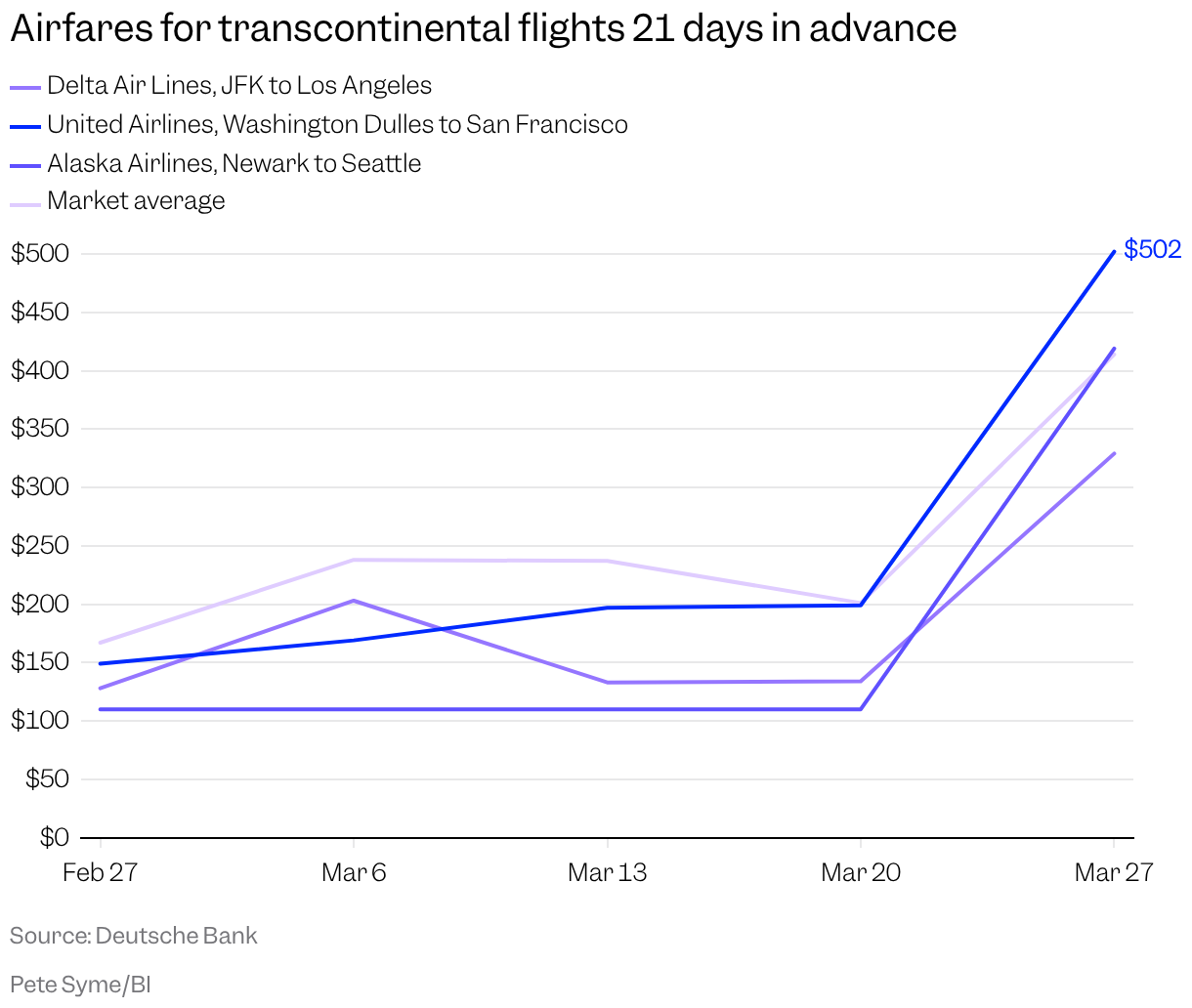
Cross-country flights, often known in the industry as transcontinental flights, have seen the biggest week-over-week spike — more than double, on average.

New York to Los Angeles is the country’s busiest domestic route, with a capacity of 3.4 million seats out of JFK Airport last year, according to OAG data.

The average price of a transcontinental flight has risen from $167 to $414, Deutsche Bank’s analysis showed. In the past week, the average has spiked 107%.

United Airlines is offering flights from Washington Dulles Airport to San Francisco for $502, up from $149 a month ago.

International business travellers are also seeing flight prices rise.

New York to London is the country’s most popular international route, and the 10th-busiest in the world. Nearly 4 million seats were scheduled on flights between JFK and Heathrow last year, per OAG.

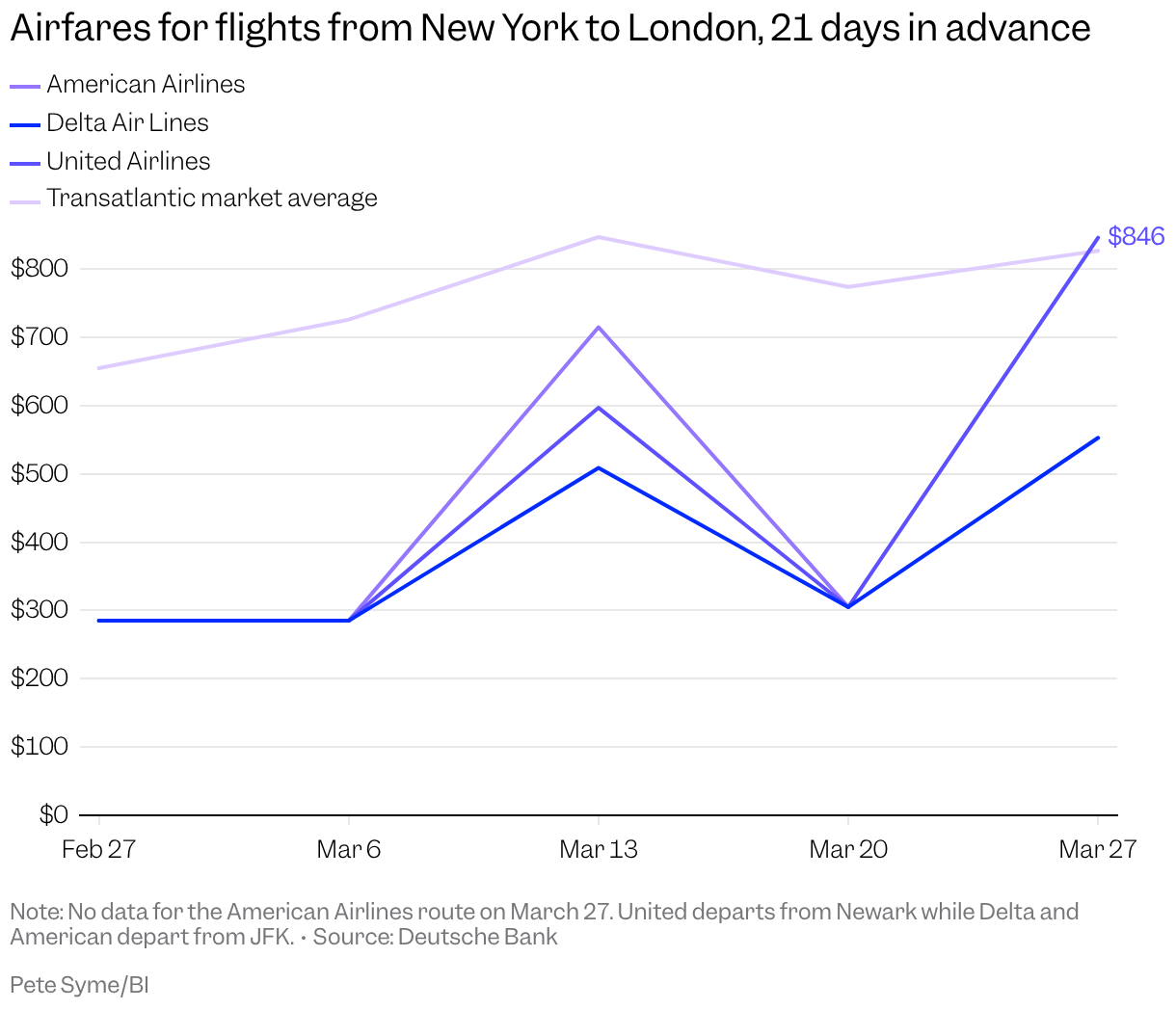
While the average Transatlantic flight is some 40% more expensive than a month ago, there are bigger rises for the New York-London route. However, it also appears more volatile here with a big dip last week.

Delta Air Lines’ service is up from $285 to $553 over the past month, while United’s is up to $846. That’s a 177% rise compared to a week earlier, according to Deutsche Bank’s analysis.

There’s bad news for vacationers, too.

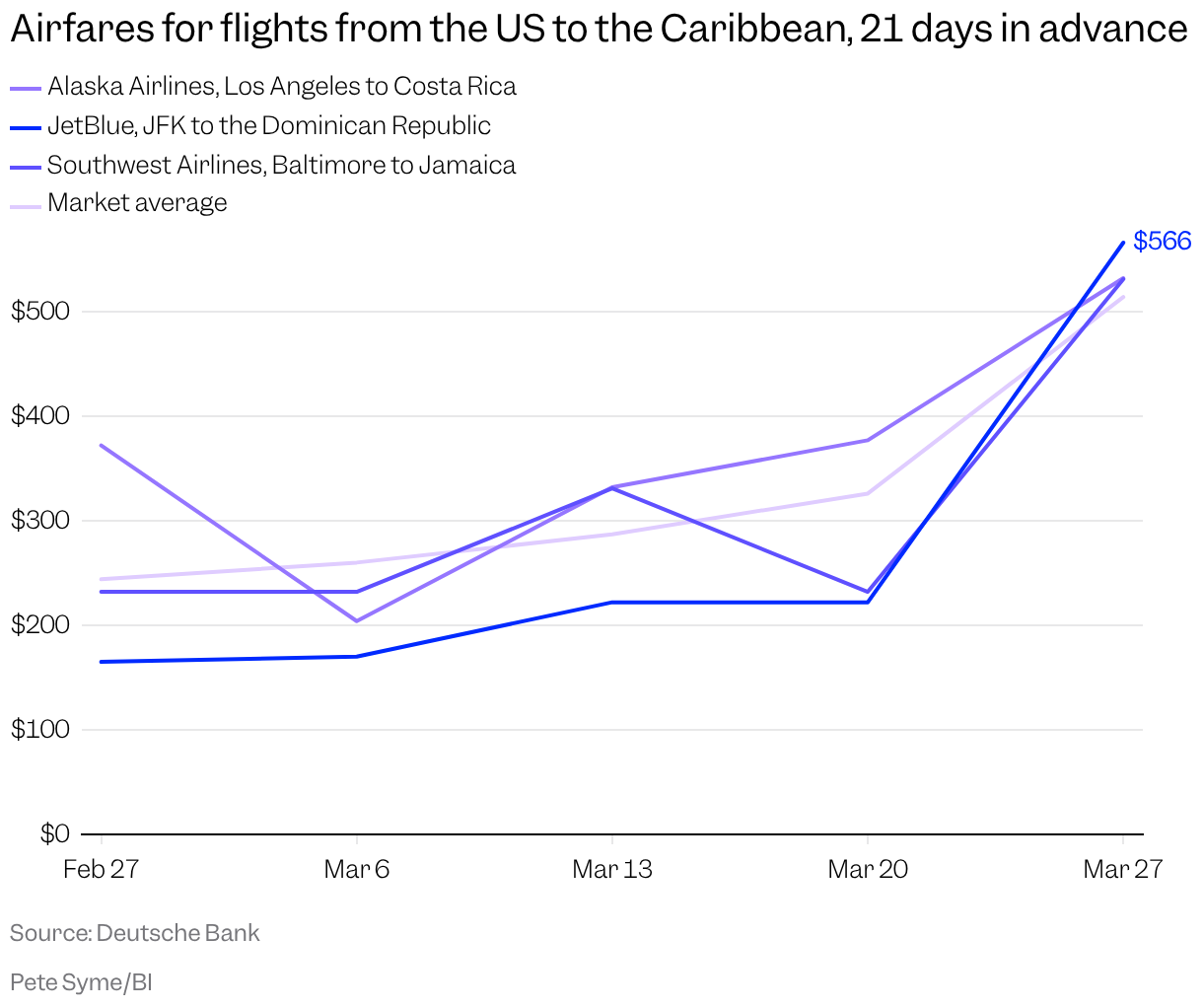
Flights to the Caribbean on March 27 are up 58% on average compared to a week before.

JetBlue’s flight from New York to Santo Domingo, Dominican Republic, has risen from $165 to $566 on March 27.

Compared to a year earlier, that’s a more than fourfold rise, Deutsche Bank found.

Southwest Airlines’ flight from Baltimore to Montego Bay, Jamaica, has more than doubled over the past week. And Alaska Airlines’ service from Los Angeles to San Jose, Costa Rica, is up 40% compared to a week earlier or 120% versus a year ago.




Source link