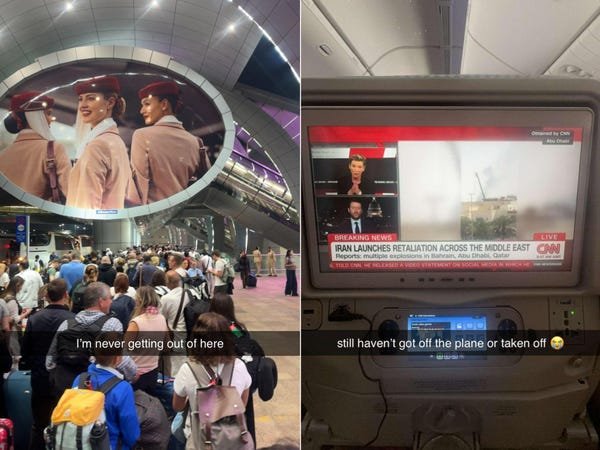
Photos-show-a-major-fire-at-a-key-UAE-oil.jpeg

Photos show a major fire at a key UAE oil port, a day after the US struck a major Iranian depot

  • A fire broke out near a key oil port in the United Arab Emirates on Saturday.
  • Officials said debris from an intercepted drone caused the fire and that operations were suspended.
  • The US attacked Kharg Island, a major oil depot in Iran, on Friday.

Fire erupted at a critical oil hub in the United Arab Emirates on Saturday amid the ongoing military conflict in the Middle East.

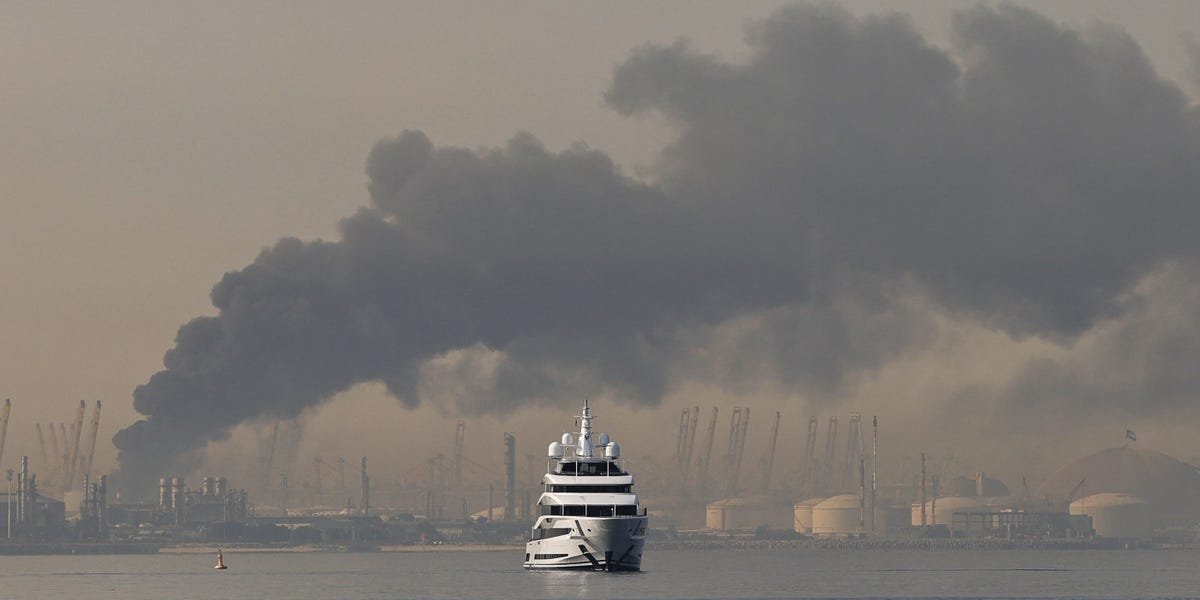
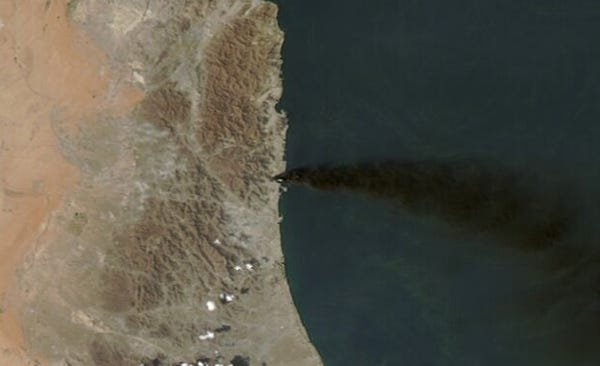
Plumes of dark black smoke billowed around the Port of Fujairah, the only multipurpose maritime facility on the UAE’s east coast. The Fujairah government’s media office said debris from an intercepted drone caused the fire. No injuries were reported.

The fire comes after Iran said it would retaliate against the US for attacking Kharg Island on Friday. Kharg Island, located about 300 miles from the Strait of Hormuz, is key to Iran’s oil industry and has refineries that process nearly all of the country’s oil exports.

President Donald Trump said the US had “totally obliterated” military targets on Kharg Island in a Truth Social post on Friday. In a Truth Social post on Sunday, Trump said he hoped other countries affected by the Strait of Hormuz closure would send warships alongside the US to help secure it.

War broke out in the Middle East last month when the US and Israel launched joint strikes against Iran. In response, Iran has targeted US military bases in neighboring countries like Qatar, Bahrain, Kuwait, and the UAE. The ongoing military conflict has shuttered airspaces and halted most traffic through the Strait of Hormuz. US strikes on Kharg Island and damage to the UAE’s Port of Fujairah could impact oil prices, which again surged past $100 on Friday, driving up gas prices around the world.

Smoke from the coast of Fujairah spread over the Gulf of Oman.

NASA MODIS satellite image of Fujairah on Saturday.

NASA Modis satellite image, November 14, 2026.

A satellite image taken on Saturday showed smoke from the fire spreading over the Gulf of Oman. The Port of Fujairah exported an average of 1.7 million barrels of crude oil and refined fuels each day in 2025, Reuters reported.

Some operations at the Port of Fujairah were suspended on Saturday.


Fujairah in the UAE on March 14, 2026.

Fire broke out in Fujairah on Saturday.

AP Photo/Altaf Qadri

Local outlets reported that some oil-loading operations were suspended on Saturday following the intercepted strike.

The Fujairah Oil Industry Zone can store millions of barrels.


Oil facility in Fujairah in the UAE on March 14, 2026.

The Fujairah Oil Industry Zone in Fujairah on Saturday.

AP Photo/Altaf Qadri

The Fujairah Oil Industry Zone, located near the port, is home to the largest commercial storage facility for refined oil products in the Middle East. The hub can store about 70 million barrels of oil.

The military conflict has sent oil prices skyrocketing.


Fujairah in the UAE on March 14, 2026

Oil prices have risen globally since the US and Israel launched attacks against Iran.

AFP/Getty Images

The ongoing war has disrupted the oil supply chain, sending oil prices over $100 a barrel this week. The International Energy Agency said it will release 400 million barrels from reserves in response, marking the largest coordinated release in the IEA’s history.

The International Energy Agency said the war has caused the largest oil market disruption in history.


Fujairah in the UAE on March 14, 2026.

Fujairah in the United Arab Emirates on Saturday.

AFP/Getty Images

The International Energy Agency said global oil supply will drop by 8 million barrels a day in March.

“Disruptions are not limited to upstream production and exports, with several refineries and gas processing facilities shut down due to attacks or for safety concerns,” the agency said in its monthly markets report. “The closure of the Strait is also forcing export-oriented refineries to cut runs or shut completely as product storage tanks top up.”

The UAE said it intercepted nine missiles and 33 drones launched from Iran on Saturday.


Fujairah in the UAE on March 14, 2026.

Iran launched over 30 drones at the UAE on Saturday, according to the UAE’s military defence.

AP Photo/Altaf Qadri

The UAE Defense Ministry said it intercepted nine ballistic missiles and 33 uncrewed aerial vehicles launched from Iran in an X post on Saturday.

“Since the onset of the blatant Iranian aggression, UAE air defences have engaged 294 ballistic missiles, 15 cruise missiles, and 1,600 UAVs launched from Iran,” it said.


Source link

A headshot of Insider's Pete Syme

Charts show how the Iran war has pushed ticket prices sharply higher on 3 major US airline routes

Your next flight could be twice as expensive because the Iran war is causing volatility in oil prices.

Brent crude is up more than 50% over the past month, to around $101 a barrel. Jet fuel costs are rising faster. The Argus US Jet Fuel Index is up 72% over the same period.

That spells difficulty for airlines because jet fuel is typically their biggest expense after labor. While many airlines around the world hedge against fuel costs, most American ones do not.

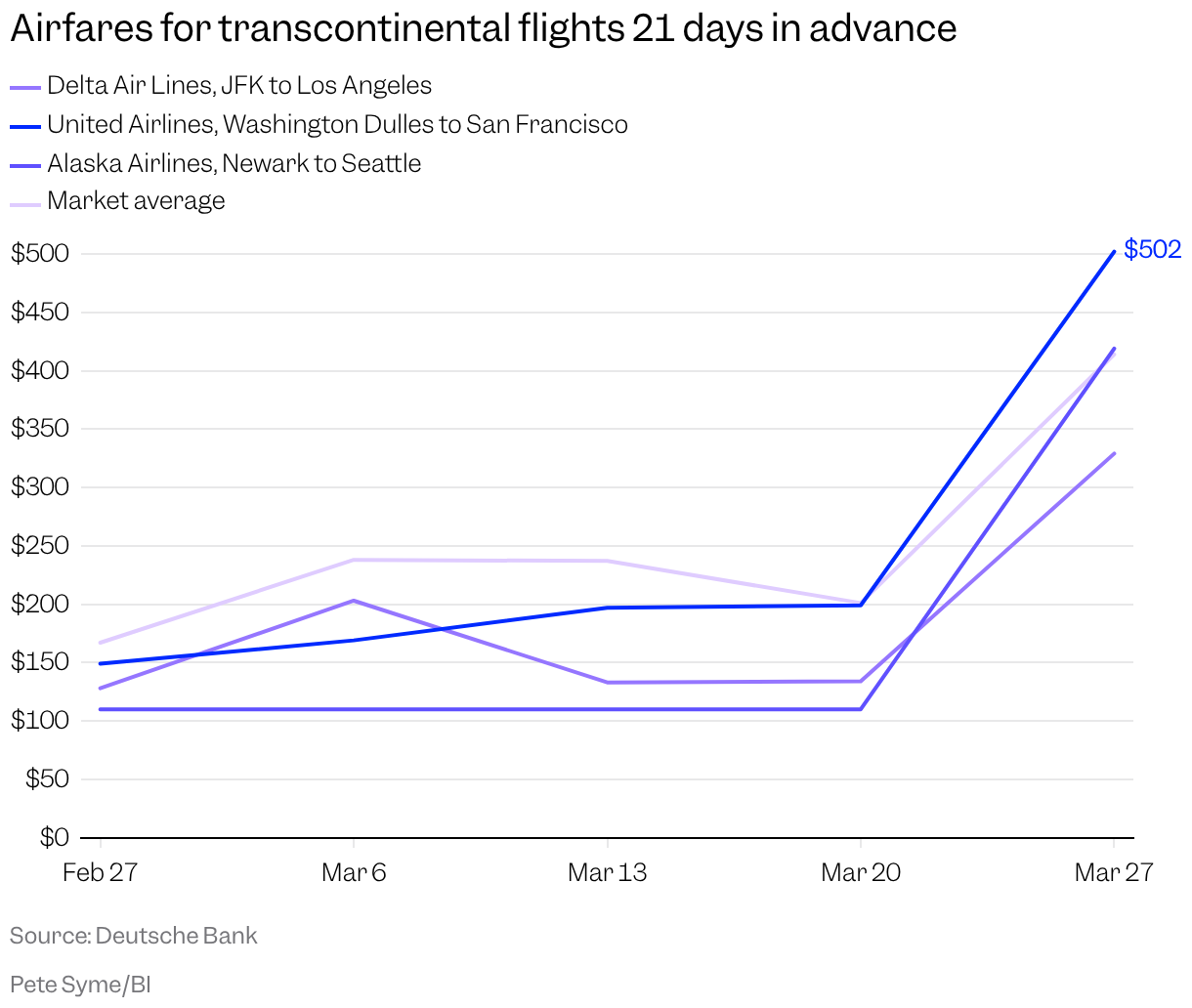
Using data from Deutsche Bank, Business Insider charted rising airfares in three major markets.

The data looks at the lowest available published fares 21 days in advance of the flights. The published fare doesn’t necessarily mean a ticket has been purchased for that amount, the Deutsche Bank research analysts said.

Cross-country flights, often known in the industry as transcontinental flights, have seen the biggest week-over-week spike — more than double, on average.

New York to Los Angeles is the country’s busiest domestic route, with a capacity of 3.4 million seats out of JFK Airport last year, according to OAG data.

The average price of a transcontinental flight has risen from $167 to $414, Deutsche Bank’s analysis showed. In the past week, the average has spiked 107%.

United Airlines is offering flights from Washington Dulles Airport to San Francisco for $502, up from $149 a month ago.

International business travellers are also seeing flight prices rise.

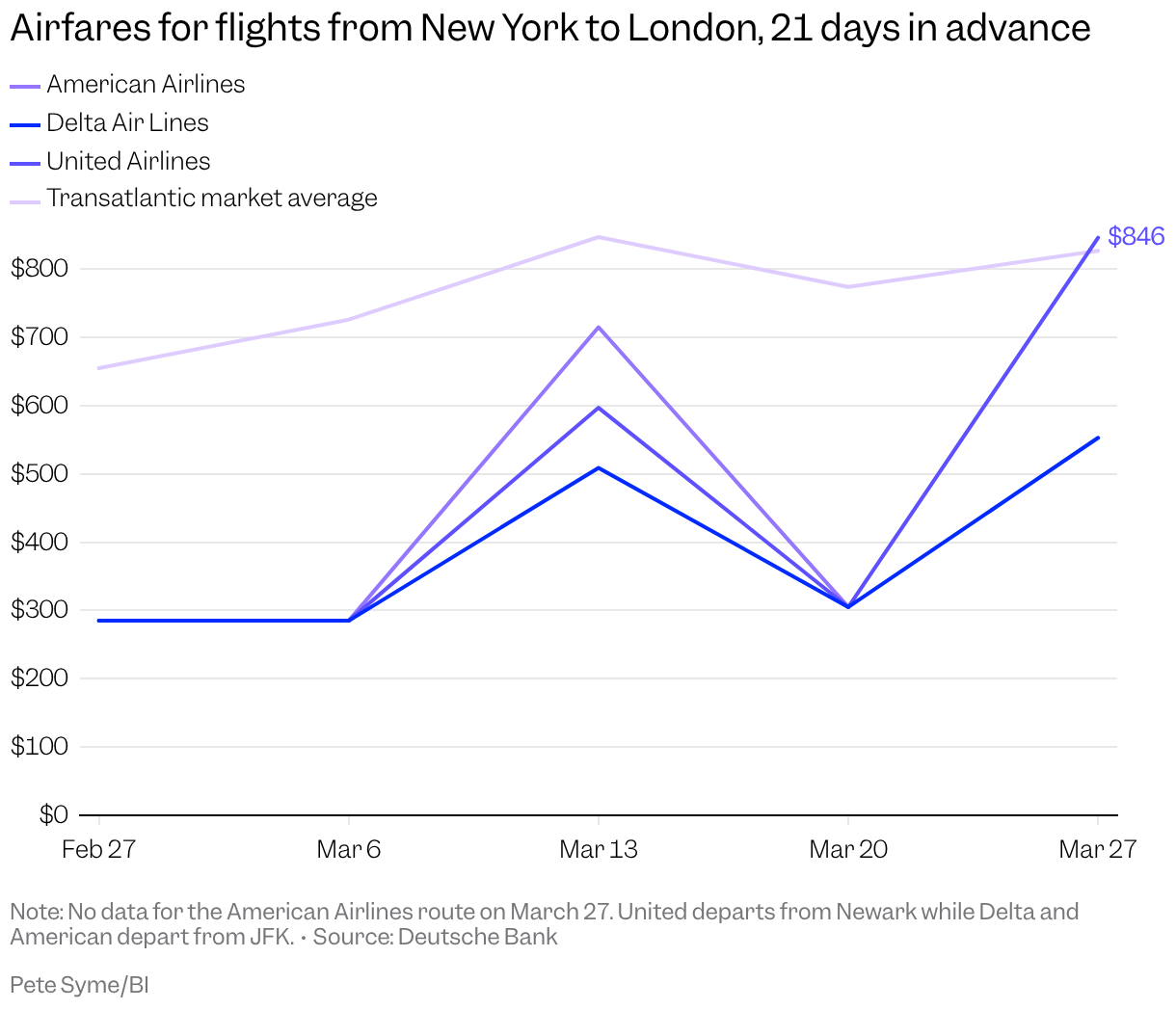
New York to London is the country’s most popular international route, and the 10th-busiest in the world. Nearly 4 million seats were scheduled on flights between JFK and Heathrow last year, per OAG.

While the average Transatlantic flight is some 40% more expensive than a month ago, there are bigger rises for the New York-London route. However, it also appears more volatile here with a big dip last week.

Delta Air Lines’ service is up from $285 to $553 over the past month, while United’s is up to $846. That’s a 177% rise compared to a week earlier, according to Deutsche Bank’s analysis.

There’s bad news for vacationers, too.

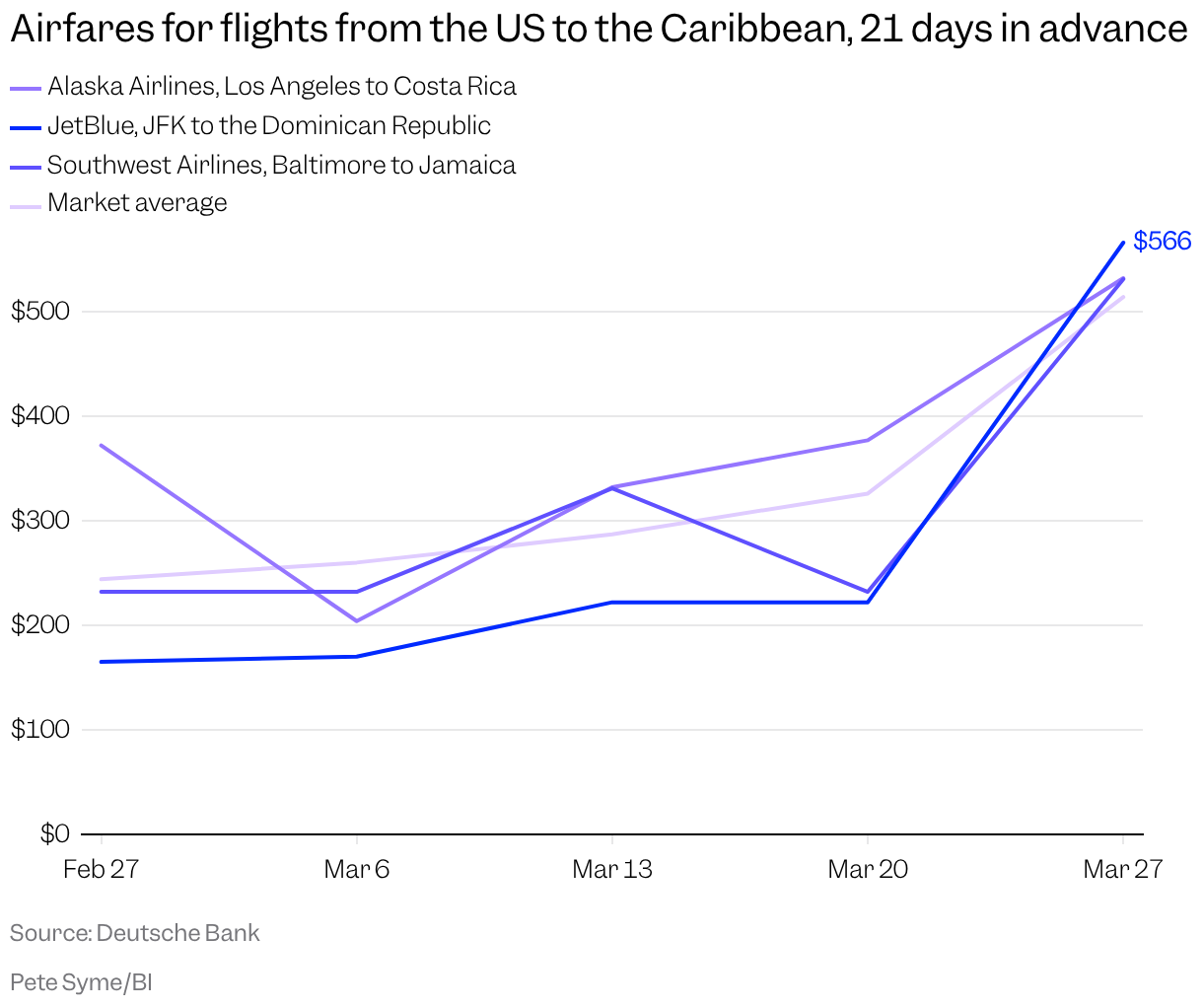
Flights to the Caribbean on March 27 are up 58% on average compared to a week before.

JetBlue’s flight from New York to Santo Domingo, Dominican Republic, has risen from $165 to $566 on March 27.

Compared to a year earlier, that’s a more than fourfold rise, Deutsche Bank found.

Southwest Airlines’ flight from Baltimore to Montego Bay, Jamaica, has more than doubled over the past week. And Alaska Airlines’ service from Los Angeles to San Jose, Costa Rica, is up 40% compared to a week earlier or 120% versus a year ago.


Source link

Before-and-after-photos-show-how-a-woman-unflipped-her-1920s-home.jpeg

Before-and-after photos show how a woman ‘unflipped’ her 1920s home to restore its charm

Taylor, 31, is a destination wedding photographer who lives in Detroit with her husband and two dogs.

In the fall of 2023, Taylor and her family were living in a condo that they loved. They knew they would buy a bigger property someday, but they weren’t in a rush. Then the algorithmic fates stepped in when Taylor spotted a historic home on Zillow that was a little over 3,500 square feet and built in the 1920s.

“It wasn’t too far from where we were in Detroit,” she told Business Insider of the house. “It’s in a historic neighborhood in the city.”

Since the four-bedroom house was nearby, Taylor and her husband decided to take a look, driving by it before setting up an actual tour. For Taylor, it was love at first sight.

“The moment we drove up, I just had a good gut feeling about it,” she said. She fell even more in love when they saw the interior layout.

Taylor and her husband put in an offer, and soon, the house was theirs.


Source link

Savannah Guthrie and her siblings have issued a video plea for their mother's safe return home.

NBC says Savannah Guthrie plans to return to ‘Today’ show as the search for her mother drags on

Savannah Guthrie and her siblings have issued a video plea for their mother’s safe return home.

  • Savannah Guthrie stopped by the Manhattan studio of the “Today” show on Thursday.
  • The morning show co-host has been on hiatus from the NBC program since her mother’s disappearance.
  • A “Today” spokesperson said Guthrie has plans to return to the show one day.

“Today” show host Savannah Guthrie visited the New York City studio of the NBC morning program on Thursday as the search for her missing mother entered its 33rd day.

Guthrie has been on hiatus from the show and with her family in Arizona since her mother’s mysterious February 1 disappearance. Last month, Guthrie dropped out of NBC’s coverage of the 2026 Winter Olympics in Milan amid the crisis.

Authorities believe that Guthrie’s 84-year-old mom, Nancy Guthrie, was abducted from her ranch-style home just outside Tucson, AZ, more than four weeks ago.

“Savannah Guthrie stopped by the studio this morning to be with and thank her ‘TODAY’ colleagues,” a “Today” show spokesperson told NBC News in a statement on Thursday. The “Today” show and NBC did not immediately respond to Business Insider’s request for comment.

The spokesperson added that Savannah Guthrie plans to return to co-hosting the morning show at some point, though no timeline was provided.

“While she plans to return to the show on air, she remains focused right now supporting her family and working to help bring Nancy home,” the spokesperson said.

Last week, Savannah Guthrie announced that her family is offering as much as $1 million for the return of her mother, while acknowledging that the elderly woman may be dead.

Memorial outside of Nancy Guthrie's home.
Arizona locals have set up a makeshift memorial outside of Nancy Guthrie’s home.

The veteran anchor said in an Instagram video message that her family still believes “in a miracle,” but said, “We also know that she may be lost.”

The reward offered by the Guthrie family is on top of the $100,000 that the FBI has already offered for information related to Nancy Guthrie’s disappearance.

As the search for Nancy Guthrie drags on, local law enforcement and the FBI are still trying to identify the masked and armed man who was captured on footage from the woman’s missing Nest doorbell camera the night she vanished.

The Pima County Sheriff’s Department has said investigators found drops of blood on Nancy Guthrie’s porch that were later confirmed to be hers.

Read the original article on Business Insider

Source link

I-visited-Punch-the-famous-baby-monkey-in-Japan-Heres.jpeg

I visited Punch, the famous baby monkey, in Japan. Here’s what TikTok doesn’t show.

Since moving to Tokyo last year, my friends back in New York have made a habit of sending me viral posts about Japan. That’s how I first learned about Punch, the baby monkey abandoned by his mother and now cared for by zookeepers at Ichikawa City Zoo, east of Tokyo.

Videos of Punch — a 7-month-old Japanese macaque — clinging to an Ikea orangutan have racked up millions of views on TikTok. The hashtag #HangInTherePunch has gone viral.

Javier Quiñones, commercial manager at Ingka Group, which operates Ikea stores worldwide, told Business Insider that Ikea has seen sales of the Djungelskog orangutan toy increase.

“The toy has long been one of our most sought-after across markets, and the story from Japan is now giving it a little extra love,” he said.


Woman wearing a facemask and earphones riding a train in Japan.

It took Hashimoto 2 hours to get there: three trains and a 30-minute walk.

Provided by Reeno Hashimoto


On a recent Friday afternoon, I visited the zoo

I expected other fans to be making the trek, but I didn’t spot a single rider headed for the zoo. The trains were packed at first — commuters with suitcases bound for Narita Airport, salarymen, uniformed schoolkids — but by the time we reached sleepy Ichikawa Station, most had cleared out.

Getting there took just under 2 hours: three trains and a 30-minute walk. The zoo-bound bus doesn’t run on weekdays.

Near the entrance, I began spotting both foreign and Japanese visitors climbing out of taxis, clutching monkey stuffed animals. It was obvious who they were there to see.


Entrance to the Ichikawa City Zoo in Japan.

Admission fee to the zoo was $2.80.

Provided by Reeno Hashimoto


Heading into the zoo

I paid the 440-yen, or $2.80, admission fee and made my way to Monkey Mountain, passing a mosaic mural of animals along the path.

There were rows of people lined up around a blue iron fence, phones raised, waiting to capture Punch in action. Spectators oohed as other monkeys climbed the rocky structure to play with a silver chain affixed to the top.

The air smelled of manure. The enclosure itself was stark — rocky, with little vegetation, more concrete jungle than mountainside.


Watching Japanese macaques at Ichikawa City Zoo.

Both foreign and Japanese visitors were at the zoo.

Provided by Reeno Hashimoto


Some of the monkeys appeared thin, even balding

Punch, by contrast, looked healthy, his fur darker and thicker than the others’. Visitors laughed when he leapt from a rock to the monkey bars.

He isn’t the only baby in the exhibit, but he appears to be the smallest. Mostly, he keeps to himself, occasionally playing with a slightly larger one.

A woman from Canada, wearing a Yankees hat and visiting with her family, told me she’d seen Punch playing with his Ikea toy earlier and interacting with the others.

“We didn’t see any monkey fights,” she said. “We don’t love zoos and were a little concerned about supporting one if it doesn’t have the best enclosures. They could use some improvements, but it was better than I thought.”


Monkey Mountain at Ichikawa City Zoo.

A troop of macaques at Monkey Mountain.

Provided by Reeno Hashimoto


After about 10 minutes, the troop grew restless.

“Lunchtime,” someone nearby said in Japanese.

The monkeys scrambled upward. Punch returned to the monkey bars. A slightly larger monkey barreled into him, knocking him off balance, but he quickly recovered.

A group of heavily made-up girls in Japanese high school uniforms arrived, giggling. “Yabai,” they whispered. “Kawaii.”


A man holding a monkey stuffed toy at Ichikawa City Zoo in Japan.

Visitors at the zoo were holding their own stuffed toys.

Provided by Reeno Hashimoto


Notably, Punch wasn’t clutching his orangutan.

The toy sat abandoned on the other side of the enclosure.

At 2:50 p.m., the monkeys began clamoring for food, climbing the door and hanging from the rails. Then a young man in a blue uniform entered.

Punch immediately climbed onto the zookeeper’s leg as he circled the enclosure, scattering orange and yellow pellets. Within minutes, the food was gone.

The zookeeper returned with what looked like grass. This time, Punch perched on his shoulder as they made another lap before disappearing into a back room together.


A zookeeper at the Ichikawa City Zoo in Japan.

Another zookeeper at the Ichikawa City Zoo.

Provided by Reeno Hashimoto


Around me, spectators wondered whether Punch would reappear before closing. Most were young adults — students and couples, some in coordinated outfits — clearly here for a photo.

I asked a zookeeper if he had time to answer a few questions, but he said the staff was overwhelmed by Punch’s popularity and too busy to respond, even to email inquiries.

Then an announcement crackled over the loudspeaker: Monkey Mountain was getting crowded. Visitors were asked to limit their stay to 10 minutes.

Punch’s fame was being rationed in 10-minute increments.


Source link

Images-show-destruction-at-Irans-drone-bases-naval-sites-radars.jpeg

Images show destruction at Iran’s drone bases, naval sites, radars

Newly captured satellite imagery shows destruction and damage to infrastructure at military installations across Iran after waves of US and Israeli airstrikes.

The images, collected on Sunday by the US spatial intelligence firm Vantor and obtained by Business Insider, show that a wide range of targets have been struck since Saturday, including a drone base, a naval facility, and a radar system.

The US involvement is more widespread than the brief round of American strikes in June 2025, which primarily targeted Iran’s nuclear sites.

In the southern coastal city of Konarak along the Gulf of Oman, the images reveal destroyed and damaged buildings, storage bunkers, and aircraft shelters at Iranian drone and air bases.


A close-up view of destroyed buildings in Konarak, Iran.

Destroyed buildings at a drone base in Konarak.

Satellite image ©2026 Vantor.


A close-up view of destroyed storage bunkers in Konarak, Iran.

Destroyed storage bunkers in Konarak.

Satellite image ©2026 Vantor.


At a nearby naval facility in Konarak, the imagery shows destroyed and sinking vessels and damaged buildings adjacent to the pier. The US military confirmed on Sunday that it had struck a Jamaran-class corvette and said it was “sinking to the bottom of the Gulf of Oman.”

President Donald Trump said on Sunday that the US has “destroyed and sunk” nine Iranian naval vessels and would continue to target the remainder of the fleet.

At the Zahedan airbase in eastern Iran, near the country’s borders with Afghanistan and Pakistan, imagery reveals an obliterated radar system.


A close-up view of strikes on aircraft shelters at an airbase in Konarak, Iran.

Strikes on aircraft shelters at an airbase in Konarak.

Satellite image ©2026 Vantor.


A close-up view of destroyed and sinking vessels and damaged buildings at a naval base in Konarak, Iran.

Destroyed and sinking vessels and damaged buildings at a naval base in Konarak.

Satellite image ©2026 Vantor.


The US military said on Saturday that it had targeted Iran’s Islamic Revolutionary Guard Corps (IRGC) command and control facilities, air defenses, missile and drone launch sites, and military airfields. B-2 stealth bombers struck fortified missile sites with 2,000-pound bombs.

In contrast, the US focused its attacks in June 2025 — the first direct American strikes against Iran in decades — on fortified sites associated with Iran’s effort to enrich uranium.

The Israeli military said it has targeted Iranian air defense systems, missile launchers, and fighter jets in strikes that began Saturday and have continued into Sunday. Israel said it has killed 40 senior Iranian commanders, as well as the country’s Supreme Leader Ayatollah Ali Khamenei.

Despite these blows, Iran has managed to launch a steady pace of drones and missiles, damaging buildings and ships across the region.

Israeli fighter jets have dropped thousands of munitions over more than 700 aircraft sorties. More than 200 people have been killed or wounded in the joint strikes, according to local reports.


A view of destroyed buildings at Khamanei's compound in Iran.

Destroyed buildings at Khamanei’s compound.

Satellite image ©2026 Vantor.


A view of a destroyed radar system at Zahedan airbase in Iran.

A destroyed radar system at Zahedan airbase.

Satellite image ©2026 Vantor.


Iran has retaliated to the strikes by launching hundreds of missiles and drones at Israel and more than half a dozen other countries across the Middle East, including at major US military bases in several Gulf states.

The retaliatory fire has killed and wounded dozens of people in Israel and the United Arab Emirates, officials said, and caused significant damage to civilian infrastructure across the Gulf.

US Central Command, which oversees Middle East operations, said on Sunday that three service members have been killed and five more seriously wounded as part of combat operations against Iran. It said several other American personnel sustained minor injuries.

The announcement marks the first time the US has acknowledged casualties during the operation. Trump warned of potential losses on Saturday when he announced the start of the strike campaign.

“The lives of courageous American heroes may be lost, and we may have casualties. That often happens in war,” Trump said in a video address to the nation. “But we’re doing this — not for now — we’re doing this for the future, and it is a noble mission.”


Source link

Photos-show-damage-to-Dubai-luxury-tourist-hotspot-after-Iranian.jpeg

Photos show damage to Dubai luxury tourist hotspot after Iranian strike

  • The US and Israel launched Operation Epic Fury against Iran on Saturday.
  • Iran’s retaliation involved strikes across six Gulf nations.
  • Photos taken during and after the strikes showed damage to a luxury hotel in Dubai and other spots.

The attacks launched by the US and Israel on Iran escalated on Saturday, with retaliatory strikes hitting nations across the Gulf.

Hours into what the Trump administration is calling Operation Epic Fury, Iran responded with attacks on more than six countries, from Dubai to Bahrain. Iran said it targeted bases that host US forces in the Middle East.

Satellite pictures also show extensive damage to Iranian Supreme Leader Khamenei’s residence. Khamenei was killed on Saturday, though it is still unclear if he was at the Tehran compound when it was struck.

Intercepted missiles were seen streaking across the sky in Dubai, a tourist hotspot, and their debris appeared to spark fires and other issues. Fairmont’s famous luxury property on the Palm was hit.

Chaos was also abound at airports, amid mass flight cancellations as planes scrambled to clear the airspace over Iran.


Source link

Image of Lakshmi Varanasi

Claude hits No. 1 on App Store as ChatGPT users defect in show of support for Anthropic’s Pentagon stance

While OpenAI locks down Washington, Anthropic is locking down users and rocketing to the top of the App Store.

Anthropic has been sidelined in Washington following a public dispute with the Department of Defense over how its AI models would be deployed. President Donald Trump ordered federal agencies to phase out its technology.

Meanwhile, OpenAI has secured new ground, with CEO Sam Altman announcing in a Friday night post on X that it had reached an agreement with the Department of War to deploy AI models in its classified network.

OpenAI’s agreement has left some loyal ChatGPT users uneasy about OpenAI’s ambitions, prompting online debates about the ethical implications — and some saying they were defecting to its rival Claude.

As of 6:38 p.m. ET on Saturday, Claude ranked number one among the most downloaded productivity apps on Apple’s App Store, trailing ChatGPT.


A screencap of the app store

BI


Converts have taken to social media to share screenshots documenting their switch.

Pop musician Katy Perry wrote that she was “done” on X, alongside a screenshot of Claude’s pricing page, with a red heart around the $20-per-month “Pro” plan.

Another X user, Adam Lyttle, wrote “Made the switch,” alongside a screenshot of his email inbox with a receipt from Anthropic and cancellation confirmation from OpenAI.

On Reddit’s ChatGPT subreddit, dozens of users say they’ve deleted their accounts and are urging others to do the same.

“Cancel ChatGPT” has become a common refrain online, while some users have taken a more personal tone, saying Altman’s move “crossed the line.”

The agreement hasn’t polarized all AI users, however.

In one Reddit thread, several commenters said the news does not affect their choice of AI model, arguing that Anthropic’s work with Palantir raises similar concerns. In November 2024, Anthropic, Palantir, and Amazon Web Services struck an agreement to provide US intelligence and defense agencies access to Claude models.

After Secretary of War Pete Hegseth said he would designate Anthropic as a “supply chain risk to national security,” Anthropic said it would “challenge any supply chain risk designation in court.”

In his Friday post, Altman said the Department of War had agreed with two of OpenAI’s safety principles.

“Two of our most important safety principles are prohibitions on domestic mass surveillance and human responsibility for the use of force, including for autonomous weapon systems,” Altman wrote on X. “The DoW agrees with these principles, reflects them in law and policy, and we put them into our agreement.”

By Saturday afternoon, OpenAI published a more detailed description of its contract with the DoW, including the specific language it used surrounding the use of its models for surveillance and autonomous weapons.

On the topic of autonomous weapons, OpenAI said:

The AI System will not be used to independently direct autonomous weapons in any case where law, regulation, or Department policy requires human control, nor will it be used to assume other high-stakes decisions that require approval by a human decisionmaker under the same authorities.

On the topic of mass surveillance, OpenAI said:

The AI System shall not be used for unconstrained monitoring of U.S. persons’ private information as consistent with these authorities.

While some chatbot users suggested it’s all fair in business, war, and federal procurement, others suggested the Pentagon’s stance may have handed Anthropic a public relations win.

X user Tae Kim joked that Hegseth might need a new title: “Secretary Hegseth Chief of Claude Marketing.”


Source link

Photos-show-chaos-at-airports-as-passengers-are-left-stranded.jpeg

Photos show chaos at airports as passengers are left stranded due to canceled flights

  • Airports across the Middle East have suspended all flight operations until further notice, leaving many stranded.
  • The US and Israel launched strikes against Iran on Saturday, with Iran launching retaliatory strikes across the region.
  • One Emirates passenger told Business Insider he was stuck on a plane for five hours without food before everyone was deplaned.

Travelers are in limbo as airport departure boards flip to red after air strikes in Iran resulted in closed airspace and triggered mass flight cancellations.

The heart of the chaos is in the Middle East, where airports in Dubai, Doha, and Abu Dhabi serve as megahubs for global connecting traffic. Data from the aviation analytics firm Cirium shows their home airlines — Emirates, Qatar Airways, and Etihad Airways — carry a combined 90,000 transit passengers a day.

That figure does not include the thousands of travelers whose final destination is the Middle East.

Emirates passenger Jaiveer Cheema, who was set to fly back home to the US on Saturday, told Business Insider that he was stuck on his plane for five hours with no food before everyone was deplaned and shuffled into the crowded terminal at Dubai International.

“The next several hours at the airport were chaos as no one knew what to do,” he said. “We spoke to several security guards and Emirates employees, and they all gave us different answers.”

Cheema said they stood in line after line until they eventually got a hotel voucher and took a bus to the lodging. He was still waiting for a room 90 minutes after arriving — it’s after midnight in Dubai; nearly 20 hours after he initially showed up for his 9 a.m. flight.

While many passengers are stranded within the region’s closed airspace, shuttered until further notice, the disruption has rippled far beyond it.

Flights to the affected region from places like London and the US have been canceled outright or diverted mid-journey — leaving travelers far from home in crowded airport terminals and uncertain when they will be able to depart.

Airlines have told passengers on social media to expect long wait times at airports and on customer-service phone lines as they try to manage the abrupt disruptions.

The sheer number of displaced people and planes on Saturday alone is expected to snowball worldwide if airports are unable to restart operations soon.

Passengers in Dubai were funneled into long snaking lines.

Jaiveer Cheema is one of the thousands of people stranded in limbo.

Courtesy of Jaiveer Cheema

Cheema spent hours in line but managed to secure a hotel voucher — though he had yet to secure a room when talking with Business Insider. He said he did not have answers from Emirates on what’s next.

An Emirates spokesperson did not immediately respond to a request for comment from Business Insider.

Passengers at Beirut Rafic Hariri International Airport in Lebanon are stranded.


Stranded passengers at Rafik Hariri International Airport

Passengers are stranded at Beirut Rafic Hariri International Airport on Saturday.

Anadolu/Anadolu via Getty Images

Airlines are pivoting their operations in response to the strikes. Lufthansa Group said it is suspending flights to Beirut, Tel Aviv, Amman, Erbil, and Tehran until March 7.

Airlines are suspending flights across the region, including Lebanon.


Cancelled flights at the Rafik Hariri International Airport on February 28.

Flight operations at the Beirut Rafic Hariri International Airport in Lebanon on Saturday.

Anadolu/Anadolu via Getty Images

In a statement shared on the Lufthansa Group’s website, the company said it would also suspend flights in additional areas.

“The following airspaces will also not be used until March 7: Israel, Lebanon, Jordan, Iraq, Qatar, and Iran,” the aviation corporation said. “In addition, Lufthansa Group airlines will suspend flights to and from Dubai and Abu Dhabi, Riad, and Dammam until March 1. Furthermore, the airspace of the United Arab Emirates will not be used until March 1.”

International flights at Tribhuvan International Airport in Nepal were disrupted.


Stranded passengers at Tribhuvan International Airport in Nepal.

Passengers waiting at Tribhuvan International Airport in Nepal on Saturday.

Navesh Chitrakar/REUTERS

The Tribhuvan International Airport shared a passenger advisory on Saturday, saying international flights “may be subject to delay, rescheduling, or cancellations” due to airspace restrictions.

Passengers flying with major airlines were told to check their flight status.


Passengers stranded at Tribhuvan International Airport in Nepal on February 28

Passengers at Tribhuvan International Airport in Nepal on Saturday.

Navesh Chitrakar/REUTERS

The Tribhuvan International Airport told passengers flying with major airlines — including Qatar Airways and Turkish Airlines — to coordinate with those companies to navigate travel issues.

Qatar’s airspace closure caused flight disruptions at Hamad International Airport.


Passengers at the Hamad International Airport in Qatar on February 28.

Passengers at the Hamad International Airport in Qatar on Saturday.

Stringer/REUTERS

Qatar’s Hamad International Airport said all aircraft movement has been temporarily suspended due to the country’s closed airspace.

“Our priority is always the safety of our passengers and employees. We are working closely with government stakeholders and airline partners to look after passengers that have been impacted,” the airport wrote in an advisory.

In London, flights to the countries Middle East were canceled.


A check-in counter for Emirates at London Gatwick Airport shows cancelled flights on February 28.

The Emirates check-in counter at London Gatwick Airport shows that flights are cancelled on Saturday.

Ben Stansall / AFP

Flights heading to the Middle East were also canceled at the London Gatwick Airport in England on Saturday.

London Gatwick Airport told some passengers to expect travel interruptions.


Passenger at London Gatwick Airport on February 28.

Passengers at London Gatwick Airport on Saturday.

Ben Stansall / AFP

A London Gatwick Airport spokesperson told Sky News it’s “expecting disruption to our Qatar and Emirates flights.”

Are you a stranded traveler with a story to share? Contact the reporters at ledmonds@insider.com and trains@insider.com along with your preferred contact information.


Source link

Satellite-images-show-an-Iranian-warship-burning-pierside-after-US.jpeg

Satellite images show an Iranian warship burning pierside after US and Israeli strikes

New satellite imagery shows an Iranian warship burning pierside following widespread US and Israeli airstrikes.

The imagery, collected Saturday by US spatial intelligence firm Vantor and obtained by Business Insider, shows some of the initial aftermath of the joint US and Israeli attack on Iran, a major combat operation against Tehran after the collapse of talks on nuclear weapons.

The Vantor images show a frigate burning at the Konarak naval base in southern Iran. A large billow of smoke can be seen rising from the wounded vessel.


Overview of a burning vessel at Iran's Konarak naval base on February 28.

A frigate on fire at Iran’s Konarak naval base.

Satellite image ©2026 Vantor.


In a close-up image, two other frigates are seen sitting nearby, appearing unscathed.

Trump said earlier in his video message announcing the US campaign, Operation Epic Fury, that the US military was “going to annihilate” the Iranian navy, as well as the country’s other military capabilities.

Trump said the goal was to ensure that Iran can “never” have a nuclear weapon. The president also urged Iranian citizens to “take control” in the aftermath of US operations.

“This will be, probably, your only chance for generations,” he said.


A burning frigate at Konarak naval base in Iran.

A close-up of a burning frigate at Konarak.

Satellite image ©2026 Vantor.


War analysts at the Institute for the Study of War think tank said on Saturday that there had been unconfirmed reports of strikes on Iranian naval assets.

“An Israeli OSINT [open source intelligence] account reported strikes on the IRGC Navy frigate Jamaran,” ISW said. “There are also unverified reports of strikes on the IRGC Navy Imam Ali Navy Base in Chabahar, Sistan and Balochistan Province.”

Other images collected by Vantor show drone launch activity at two nearby airbases in Konarak. After the initial attacks by the US and Israel, Iran launched retaliatory missile and drone strikes at US military bases around the region in Bahrain, Qatar, the United Arab Emirates, Kuwait, Jordan, and Saudi Arabia.


Drones dispersed at an airbase in Iran on February 28.

Drones dispersed at an airbase in Konarak.

Satellite image ©2026 Vantor.


Iran has also launched multiple barrages at Israel, including missiles and drones, and said it was carrying out an “extensive drone offensive operation” against its longtime foe.

US strikes on Iran included a mix of weapons such as Tomahawk cruise missiles, High Mobility Artillery Rocket Systems, drones, and undisclosed standoff weapons designed for long-range strikes outside the reach of enemy air defenses.

In response to retaliatory attacks from Iran, various air defense weapons have been active, including the MIM-104 Patriot surface-to-air missile and Terminal High Altitude Area Defense, or THAAD, batteries.


Drones dispersed and a runway blocked at the Konarak drone strip.

Drones dispersed on a blocked runway.

Satellite image ©2026 Vantor.


Saturday’s strike is the second time in less than a year that the US has launched a strike campaign against Iran. In June 2025, US forces targeted Iranian nuclear facilities. In the weeks prior to the most recent attack, the US built up a massive force presence in and around the Middle East.


Source link