Ukraine just gave us an extended look at one of its emerging tactics against Russia’s Shaheds: using helicopters to shoot the drones from above.
The Ukrainian navy published a two-minute montage of such operations on Thursday, saying that a helicopter crew had destroyed eight Shahed exploding drones and Gerbera decoy drones in a single day.
Cockpit and gun camera footage showed the Ukrainians engaging at least five delta-wing drones in flight, with another clip showing unidentified wreckage smoking on the ground.
Some clips indicate that at least one aerial engagement happened in the early morning or at night. Thermal footage from a gun camera showed the operator firing at a delta-wing drone, tracking its flight above open terrain before a screen flash indicates the drone was destroyed.
Other standard optical footage, filmed from a gun camera or the cockpit, appears to show several drones being destroyed high above the clouds or over water near a coastal settlement.
Additionally, an M134 minigun can be seen mounted from a helicopter’s side door, though the videos didn’t show the weapon itself in action.
The clips indicate some of the ideal conditions for downing a Shahed.
For one, the helicopter has to match the drone’s speed and trajectory and gain enough altitude to allow the minigun to fire downward at the Shahed. The chopper crew also needs to come within visual range of the drone to engage.
The footage comes several months after Ukraine said it would officially begin incorporating helicopter crews into its air defense network against Russia’s one-way attack drones, which Moscow uses in mass waves to pressure Ukrainian cities.
Because Russia mass-produces the Shahed and Gerbera, Kyiv has sought more inexpensive means, such as machine guns, instead of traditional antiaircraft missiles to counter them.
Ukraine’s commander in chief, Gen. Oleksandr Syrskyi, said in October that helicopters could sometimes destroy up to 40% of Russian Shaheds and Gerberas in one area.
Thermal and infrared cameras, such as the one seen in the latest footage, were among the systems that Syrskyi said would be equipped on such helicopters to improve their effectiveness.
Ukraine also uses ground crews with interceptor drones or truck-mounted machine guns to destroy Shaheds, but a helicopter crew can reposition much faster to engage multiple threats or hunt down a Russian drone that changes its flight trajectory.
The latter scenario became increasingly common as Russia was found to be outfitting Shaheds with more advanced communications and guidance systems, and, in rare cases, artificial intelligence.
Helicopters also allow for engagements at higher altitudes. Russia often directs its Shaheds to approach their targets at above 6,500 feet before swooping down to attack, making it more difficult for ground-based crews to hit the drones.
Aside from helicopters, Ukrainian troops have also been seen using M134 miniguns on turboprop planes to shoot down Shaheds.
Meanwhile, Russia has since been reported to be attempting to counter the Ukrainian helicopters by equipping its Shaheds with R-60 air-to-air missiles.
In November, Ukraine’s deputy minister of defense for innovation told Business Insider’s Jake Epstein that Moscow was also directly targeting patrolling helicopters and aircraft with Shaheds.
One might assume that TV personalities appear on Peacock’s murder-mystery competition show “The Traitors” for a paycheck and attention. But the savviest among the cast know the show’s real prize is something money can’t buy: redemption.
The series, a “Mafia”-esque game in which contestants must guess what “Traitors” are among them, while the Traitors must lie their way to the end of the game, might not seem like the friendliest environment for a celebrity or reality star looking to rehabilitate their image.
But over four seasons, the show has made viral stars and renewed celebrities out of several of its famous cast members, earning a reputation as the best cottage industry for celebrity image rehab this side of “Dancing with the Stars.”
Who knew a show about lying and manipulating could make you so beloved?
The making of a ‘Traitors’ star
“The Traitors” has always had a taste for the devilish ones. Hosted with campy flourish by Alan Cumming and filmed in a 19th-century castle in the Scottish Highlands, the show leans heavily into its calling card as a game of deception. As such, it’s attracted all manner of niche celebrities, many of whom come from competition shows like “Survivor,” “Big Brother,” and MTV’s “The Challenge,” which require strategy; or social reality shows like Bravo’s “Real Housewives,” which arguably relies on a fair amount of interpersonal strategizing and lying for sport.
Every time Callie publishes a story, you’ll get an alert straight to your inbox!
Stay connected to Callie and get more of their work as it publishes.
But the breakout star of “The Traitors” season four — which has been viewed for billions of minutes on Peacock since its January premiere, its biggest audience yet — isn’t a gamer or a Housewife. It’s someone who caught the casting director’s attention not by strategizing and scheming, but by coupling up and kissing on cue.
Rob Rausch on season four of “The Traitors.”
Euan Cherry/Peacock
Rob Rausch emerged from the neon-lit “Love Island” Villa in 2024 with a polarizing reputation. He’d dated and then promptly dumped Leah Kateb, a season six fan favorite, to chase a hot new bombshell who’d caught his eye. (No, really, the newcomers on “Love Island” are called “bombshells.”) While Kateb struggled with hurt and confusion about his change of heart, viewers grew suspicious of Rausch’s Southern charm and snake tattoos; save for one memorable meltdown, Rausch was mostly inscrutable as the Villa’s chaos swirled around him. In a postmortem interview with Alex Cooper, he summarized the feedback he received online: “Basically, I’m a toxic gaslighter, but I’m hot enough that it doesn’t matter.”
Rausch has said he turned down “The Traitors” multiple times because he didn’t want more drama. But from the moment he set foot on Scottish soil to film season four, he shrewdly leveraged his past drama to draw the spotlight.
“I honestly think I’ll make a good Traitor. I’m hard to read,” Rausch said in the season four premiere. “I’ve been told that by every girl I’ve ever dated.”
When Rausch was selected for the titular role, he picked off his costars one by one — including his fellow Traitors — with ease while remaining impressively unsuspected. In addition to earning praise for his strategic gameplay and knack for social manipulation, he was shown sticking up for his friends, playfully meowing at the camera, and quoting Mark Twain.
In one of the final episodes, fellow Traitor Eric Nam compared Rob to an eagle soaring above the fray, his feathers unruffled. Fellow cast member and “Real Housewives” star Dorinda Medley even said she was flattered to be targeted by Rausch for elimination. “He can do no wrong in my book,” she said. “I’m getting murdered, and I have butterflies.”
The viewers at home agreed. The qualities that made Rausch a villain in the “Love Island” Villa were the same ones that led to success and stardom in the “Traitors” castle, where everyone has signed up for a game of paranoia and deception.
“Rob came in carrying a ‘Love Island’ reputation for manipulation layered over with charm, and ‘The Traitors’ is essentially a format where those two qualities stop being a liability and start being a competitive advantage,” Evan Nierman, CEO of the global PR firm Red Banyan, told Business Insider.
As the season unfolded, Rausch’s scene-stealing moves inspired flattering headlines and countless TikTok fancams set to songs like Saweetie’s “My Type,” Kendrick Lamar’s “Like That,” and Taylor Swift’s “Cancelled!” On his own Instagram page, Rausch has flaunted brand partnerships with Sonic and Celsius, as well as his clothing brand, Creek Rat, to over 1.7 million followers.
Out of “Love Island” infamy, a star was born. With the space to show more of his personality in a different context outside of a dating series, Nierman said “The Traitors” has given Rausch a “multi-dimensional public profile.”
“Viewers observe you problem-solving under pressure, forming real friendships, navigating betrayal, and handling the game’s emotional weight in real time,” he said. “That’s character evidence more persuasive than anything a publicist could engineer from the outside.”
For reality stars, getting cast on ‘The Traitors’ is the hottest ticket in Hollywood
Rob Rausch makes his case at the “Traitors” roundtable on season four.
Euan Cherry/Peacock via Getty Images
Since the first US season debuted in 2023, “The Traitors” has become appointment TV for reality fans.
Juliana Martins, celebrity publicist and Founder of Eleven11 Media Relations, said she’s had requests coming in “left and right” from talent agents asking how they can get their clients cast on “The Traitors.”
“A show like this, from a publicity perspective, is phenomenal,” Martins said. “It’s also so competitive to get on now because everybody wants it.”
Because the game requires a certain amount of backstabbing and deception, even from the so-called Faithfuls — whose job it is to stay alive and sniff out the Traitors while voting to boot one player per episode — the show is high risk, high reward for those looking to reenter the news cycle.
“It really catapults reality stars into other opportunities,” Martins explained. “Dylan Efron, for example, reached a broader audience through ‘Traitors,’ and then he went on to do ‘Dancing With the Stars.'”
Efron, previously best known as Zac Efron’s younger brother, appeared on season three and — spoiler alert! — won the show with a small group of Faithfuls, including former “Bachelorette” Gabby Windey, who said appearing on “The Traitors” was “the best thing I’ve done for my career.”
Rob Mariano, aka “Survivor” legend Boston Rob, also starred on season three and parlayed his renewed visibility into a cohosting gig on the official “Traitors” podcast. He and Efron have transformed their in-castle “bromance” into a professional partnership.
“For legacy reality stars like Boston Rob, returning to a really popular series can reintroduce them to a new audience, new viewers, while also still re-engaging fans,” Martins said. “It can lead to future casting opportunities, brand partnerships, hosting gigs, and other opportunities that really contribute to their career longevity and their overall perception.”
Rob Mariano and Alan Cumming on “The Traitors” season three.
Euan Cherry/Peacock via Getty Images
Peter Weber, a former “Bachelor” star, received a hero’s edit on season two thanks to his bold gameplay, keen instincts, and self-branding as the ultimate Faithful.
Martins, who previously worked with Weber on the promotional campaign for his 2021 children’s book and has advised him on other projects, attributed his success on “The Traitors” to the show’s unique format.
“Most reality shows are built around a specific narrative framework. ‘The Bachelor’ centers on finding one true love, and because of that structure, that editing and the storytelling, they’re designed to support that one core goal and theme, which I think limits how somebody can fully show their personality,” Martins explained.
By contrast, a show like “The Traitors” is more playful and less precious about hemming in its contestants. Part of its charm is the varied cast of characters, all trying to suss out each other’s quirks and peculiarities.
“In Peter Weber’s case, viewers really saw qualities that have been a part of who he is, but weren’t really highlighted on his original seasons of ‘The Bachelorette’ or ‘The Bachelor,'” Martins said. “‘The Traitors’ gave audiences a fuller understanding of him, rather than redefining him.”
Still, that opportunity for a less restricted, more complex arc can be a double-edged sword (or, in the case of “The Traitors,” a double-edged dagger).
“The exposure can cut both ways,” Martins said. “The ‘Traitors’ format does leave very little room to hide.”
Not everyone on ‘The Traitors’ can pull off a redemption arc
Lisa Rinna and Colton Underwood, center, on “The Traitors” season four.
Euan Cherry/Peacock via Getty Images
Season four’s resident “Bachelor” star is Colton Underwood, a former pro football player who had a tumultuous ride on the dating show. (His most famous scene involved him hopping a massive fence to escape the camera crew.)
After coming out as gay in 2021, Underwood found himself back in the reality TV conversation with “The Traitors. Though he was hoping to be cast as a Traitor, he was ultimately made a Faithful, , and his aggressive gameplay ultimately made him a target both in the castle and on social media. He flung out accusations and dominated the roundtable debates. After he rallied his castmates to erroneously banish Tiffany Mitchell, she wrote on X, “It’s actually fuck Colton Underwood and I said that shit.”
Though Underwood did accurately guess that “Real Housewives” alum Lisa Rinna was a Traitor, he did so in a memorable scene where he threatened to blackmail her in the game, detailing a plan to “hold her hostage.” This language prompted many viewers to recirculate stalking accusations from Underwood’s ex-girlfriend, Cassie Randolph, who filed a restraining order against him in 2020. (She later dropped the order, and Underwood said at the time that he and Randolph “were able to reach a private agreement.”)
If Underwood hoped to use “The Traitors” to recover or distract from his past, it backfired. Many viewers criticized his energy as off-putting, unlikable, and overconfident. The Cut published an article titled, “Colton Underwood’s Reality-TV Rebrand Isn’t Going Very Well.” Meanwhile, Rausch is the latest star of the publication’s “Dream Date” series.
In a statement to Business Insider, Underwood’s representative said he had “the best time” on the show.
“Colton came into Traitors Season 4 as a fan of the franchise ready to play the game. Since leaving the castle, he has continued to expand his network and slate. His involvement in the show is one he’s truly grateful for.”
Historically, villains from other TV shows have fared well on “The Traitors.” Infamous “Vanderpump Rules” star Tom Sandoval was dubbed by The New York Times as “the most hated man in America” after a very public cheating scandal, but bumbled through “The Traitors” season three with little to no backlash.
“I was like, Tom Sandoval’s here? Damn, this guy’s still getting gigs? It’s good controversy,” Windey told Variety. “And then who knew? He actually kind of redeemed himself — he was the village idiot.”
Phaedra Parks and Alan Cumming on “The Traitors” season two.
Euan Cherry/Peacock via Getty Images
Nierman also cited Phaedra Parks — who was fired from “The Real Housewives of Atlanta” in 2017 after admitting to spreading harmful rumors about a fellow Housewife — as a cast member who had a massive reputational shift after appearing on “The Traitors.” In a game that rewards wit and discernment, her snappy one-liners and cutting takedowns at the round table went viral, and the moments helped all be forgiven by viewers. Her return to “Real Housewives” was announced shortly thereafter.
Vanzil Burke, who was Parks’ manager at the time, said the rumor-spreading scandal “almost destroyed” Parks’ career, but her popularity on “The Traitors” reopened doors for her.
“It was needed for her professional career,” Burke told Business Insider. “I had no doubt that she would go in, read the room, and handle it.”
Being a Traitor allowed Parks to play up her “bad girl” persona, Burke said, while also proving to viewers that she’d matured and mellowed since she last appeared onscreen.
Still, as with every PR maneuver, one size doesn’t fit all.
Rausch, Sandoval, and Parks read as authentic because they didn’t try to hide their notoriety, turning their perceived flaws — cunning, cluelessness, and shady reads, respectively — into assets. On the flip side, Nierman said Underwood lacked humility and self-awareness.
“The foundational rule of reputation repair is showing people you understand why they distrust you,” Nierman said. “Colton walked into the castle and did the opposite by immediately positioning himself as the leader of the Faithfuls in a way that confirmed every instinct that viewers already had about his controlling tendencies.”
“If the arc feels like a calculated PR move rather than genuine growth, then audiences will not only reject it but be even more against you,” Nierman added.
Ultimately, the real winners of “The Traitors” aren’t the players who go home with a portion of the prize pot (somewhere around $250,000, depending on their success in challenges). It’s the players who emerge with the public’s favor, a busy phone line, and maybe even a comeback story.
Hilary Duff, 38, says she walked away from her first marriage because she didn’t want to sacrifice her own happiness — even as a young mom.
On Wednesday’s episode of “Call Her Daddy,” the “Lizzie McGuire” star spoke about navigating a divorce in her late 20s and how motherhood shaped her approach.
Duff split from her first husband, Mike Comrie, in 2015. They share a son, Luca, who was born in 2012.
“I knew from my parents’ divorce that I was going to show my kid that you’ve got to fight for your happiness. And I knew that it was going to be better to do it when he was younger than it was going to be when he was five and aware, or eight and aware,” Duff told podcast host Alex Cooper.
Duff added that kids can sometimes blame themselves when their parents’ marriage doesn’t work out.
“I was like, if Luca cannot remember this and have two lives that exist that he can be happy in and feel secure in, I think we’re winning,” she said.
Duff said therapy was essential in helping her process the end of her marriage, and ultimately, the experience taught her to stand up for herself.
“You’ve got to fight for yourself, and it doesn’t matter that you have kids. Your kids are going to be OK. You know what I mean? You just have to show them that you also matter,” Duff said.
As a parent, it’s easy to lose yourself in your child and feel like their needs should outweigh your own, she said. But she added it was also “important” not to let that be the deciding factor in whether she stayed in an unhappy marriage.
Duff added that mom guilt can sometimes overshadow her own feelings.
“There’s this part of your brain where you’re like, ‘Yeah, I’m still in here, and I’m still me,’ and then there’s this huge shadow over it that’s like, ‘But everything for the family and everything for your kid,'” she said.
Duff added that finding balance between motherhood and her own identity is something she has to work at.
“It’s a constant conversation to choose yourself and choose something you know that you enjoy outside of family life and kids,” she said.
In 2019, Duff married Matthew Koma, and the couple has three daughters.
Duff isn’t the only celebrity who has spoken about navigating divorce with kids.
In a 2022 podcast appearance, Kim Kardashian said she tries to protect Ye, formerly known as Kanye West, in the “eyes of my kids, for my kids.”
“One day my kids will thank me for not sitting here and bashing their dad when I could. They’ll thank me and I’ll privately answer anything that they want to know. But it’s not my place anymore to jump in,” she said.
In February, Miranda Kerr said choosing forgiveness helped her co-parent peacefully with her ex, Orlando Bloom.
“When you have a child with someone else, they’re always going to be that person’s parent for the rest of their life. There are going to be situations where you’re going to need to talk if you like it or not. So why not make it harmonious?” Kerr said.
This story is available exclusively to Business Insider
subscribers. Become an Insider
and start reading now. Have an account? .
“Love Story” follows the doomed love story of JFK Jr. and Carolyn Bessette-Kennedy.
The show recreates several of Bessette-Kennedy’s iconic looks and timeless style.
The show’s costume designer was replaced after initial backlash to how star Sarah Pidgeon was styled.
The iconic style of Carolyn Bessette-Kennedy has been often imitated but never replicated — until now.
“Love Story,” which is produced by Ryan Murphy for FX, chronicles the fated relationship between John F. Kennedy Jr. and Carolyn Bessette-Kennedy, who died in a plane crash off the coast of Martha’s Vineyard in July 1999.
The series has drawn praise for its striking casting — with Sarah Pidgeon bearing an uncanny resemblance to Carolyn Bessette-Kennedy and Paul Anthony Kelly closely capturing the look of John F. Kennedy Jr. — as well as for its thoughtful costume design, which carefully recreates and honors Bessette-Kennedy’s real-life style.
Here’s a look at how the show recreated and paid homage to Carolyn Bessette-Kennedy’s style.
The series recreated an early Carolyn Bessette-Kennedy look down to the leather loafers.
Jenny Landy and Carolyn Bessette-Kennedy in New York City in 1995; Sarah Pidgeon filming “Love Story” in New York City. Patrick McMullan/Patrick McMullan/Getty Images; TheStewartofNY/GC Images
In this scene, before she meets John F. Kennedy Jr. for the first time, Carolyn (played by Sarah Pidgeon) wears a simple black turtleneck, flared black capri pants, and black leather loafers.
In both the show and real life, Bessette-Kennedy worked as a showroom assistant for Calvin Klein before rising the ranks to become head of publicity for the fashion house.
Despite marrying into American royalty, Bessette-Kennedy knew how to perfect a casual look.
JFK Jr. and Carolyn Bessette in New York City, and Paul Anthony Kelly and Sarah Pidgeon are seen on the set of “Love Story.” Mitchell Gerber/Corbis/VCG via Getty Images; Jose Perez/Bauer-Griffin/GC Images/Getty Images
She was often seen wearing loose Levi’s 517 jeans, her hair slicked back into a bun, with a simple monochromatic coat over the top.
When it came to recreating the New York City icon’s style, the series didn’t always nail it. Early leaked images from the set were criticized online for being too modern, fast-fashion-looking, and different from Kennedy-Bessette’s more upscale style.
In response to the backlash, the show brought in a new costume designer, Rudy Mance, who dedicated himself to making the costumes as accurate as possible.
“I get it. I’m protective of [John and Carolyn] as well. We all just wanted to be as precise and accurate as possible,” Mance told Variety.
Mance said he and his team studied for months throughout filming, comparing old paparazzi photos of the couple with the new looks he was creating for the show and pulling in as many archival and vintage pieces as possible to accurately recreate the look.
Part of Bessette-Kennedy’s enduring appeal was her dedication to a minimalist, understated style that felt polished yet effortlessly cool.
Carolyn Bessette-Kennedy in New York City; Sarah Pidgeon on the set of “Love Story.” Lawrence Schwartzwald/Sygma/Getty Images; Jose Perez/Bauer-Griffin/GC Images/Getty Images
“There’s so much mystery about Carolyn. My familiarity with her was through paparazzi images,” lead actor Sarah Pidgeon told Vogue.
Mance said that recreating Kennedy’s style before she was thrust into the public eye was the most challenging.
“Everybody knows what they wore from 1996 to 1999, but we were telling the story of how they met,” he said, according to Glamour.
Her formal looks remained simple but added a sexy edge, a balance “Love Story” tried to recreate.
Carolyn Bessette-Kennedy and JFK Jr. in 1998; Sarah Pidgeon in “Love Story.” Steve Eichner/Penske Media/Getty Images; FX Networks
Bessette-Kennedy often looked effortlessly sexy when she stepped out on red carpets, like in the strapless black Yohji Yamamoto gown photographed above. Pidgeon wears a similar dress for her meet-cute with Kelly in episode one of the series.
It was delicate work for Pidgeon to strike the same balance, especially when fans reacted strongly to early images of her in the role. However, the actor told Vogue she was ultimately grateful for the public feedback about her portrayal.
“The online conversations at the beginning of the process served as a reminder of how important it was to get our portrayal of Carolyn correct. She grew even more important to me,” Pidgeon told Vogue. “People really, really love Carolyn, and my priority every single day on set was doing justice to her legacy.”
And even when they were recreating simple outfits, the “Love Story” team ensured the fit was similar to what Carolyn would have worn.
Carolyn Bessette-Kennedy poses for a picture at a gala in 1999; Sarah Pidgeon in “Love Story.” Evan Agostini/Liaison/Getty Images; FX Networks
Although Bessette-Kennedy’s simple outfits could be recreated with off-brand designers — like the white blouse and floor-length black skirt by Yohji Yamamoto that she wore in 1999 — Mance was dedicated to finding archival pieces. Pidgeon was wearing true recreations of Bessette-Kennedy’s looks whenever possible.
He also ensured the pieces would fit Pidgeon similarly to how they fit Bessette-Kennedy, as Pidgeon told Vogue.
“We found her Prada and Valentino coats, and fitted some Levi’s so that they looked exactly how they fit Carolyn,” Pidgeon told Vogue.
By recreating the magic of Bessette-Kennedy’s wardrobe, the “Love Story” team offered a window into her world.
Carolyn Bessette-Kennedy in 1999; Sarah Pidgeon on the set of “Love Story.” Justin Ide/Getty Images; Jose Perez/Bauer-Griffin/GC Images/Getty Images
Kennedy’s clothes were always going to play a central part in her on-screen portrayal since style was so critical to her identity. However, Pidgeon said she hoped the clothes she wears offer a jumping-off point for the total woman she hopes to portray.
“She is known as this minimalist fashion icon, but I learned that she was also vivacious, funny, and had a wildness about her,” she told Vogue.
This story is available exclusively to Business Insider
subscribers. Become an Insider
and start reading now. Have an account? .
Thanks to the postwar Baby Boom and other factors, families in the ’50s began moving to the suburbs.
Levittown in Long Island, New York, is widely recognized as the first modern American suburb.
Each home looked the same — they were all built in the Cape Cod-style and cost around $7,000.
As World War II came to an end, families looked for ways to start over. Emboldened by the GI Bill’s provisions for home loans, they moved out of the cities in drovesfor newly developed suburban communities.
Levittown in Long Island, New York, was one of the first to introduce the idea of a pre-planned, mass-produced uniform suburban community, The New York Times reported. Families started moving there on October 1, 1947.
Though the community welcomed an influx of families, non-white prospects weren’t allowed. Notably, African Americans didn’t see the same benefits from the GI Bill, and it would take some years before racial and ethnic minorities broadly shifted to the suburbs.
Here’s what it was like to live in America’s first modern suburb in the 1950s.
Before the 1950s, people mostly lived in cities to be close to factory jobs.
Historical/Getty Images
At the time, most people lived close to the city center to work in factories, or they lived in rural communities to work on farms, according to economist Jay Zagorsky.
Everything changed in the 1950s when soldiers returned from World War II, sparking the great migration to the suburbs.
Irving Haberman/IH Images/Getty Images
The 1950 Census found that 60% of people lived in cities, while 40% lived in the suburbs.
Thanks to factors like the construction of highways, the development of new neighborhoods from farmland, and even safety in the event of an atomic attack, these percentages would soon shift drastically.
The GI Bill made it easier to afford a new home, prompting this transition from urban to suburban.
Newsday LLC/Getty Images
The GI Bill provided each returning soldier with benefits designed to stimulate economic growth. Each soldier was given a year of unemployment and free tuition to go to college. The military pledged to back all home loans, which allowed veterans to buy houses with little to no down payments.
The Baby Boom started at the same time, causing many families to outgrow their city apartments.
Joseph Scherschel/Getty Images
Shortly after WWII ended, the Baby Boom began. In 1946, 3.4 million babies were born, more than ever before, and 20% more than in 1945, per History.com. This trend continued into the ’50s.
By the end of the boom in 1964, this generation made up 40% of the country’s population.
Most historians think it was because Americans were eager to have families after having postponed marriage and childbirth because of the Great Depression and World War II.
Whatever the reason, people flocked to the suburbs to accommodate their growing families.
In response to this growing need for space, suburban communities popped up at a faster rate in the ’50s.
An aerial view of a suburban community. Hulton Archive/Getty Images
During the war, factories focused on creating wartime essentials, like airplanes and barracks. In the ’50s, they refocused their efforts on building home components and automobiles using the new practices — like the assembly line — they implemented in the war,
As a result, factories were able to produce materials for homes faster than ever before.
Levittown in Long Island, New York, is widely recognized as the first modern American suburb.
Tony Linck/Getty Images
Levitt and Sons, a construction company, purchased a 7-square-mile plot of potato and onion farms in Long Island in 1947. They set out to build one of the first uniform suburban communities in the US.
People flocked to home sale events to get themselves a slice of suburbia.
Al Fenn/Getty Images
The first homes in Levittown cost new residents around $7,000, The Guardian reported. For veterans, there was no down payment.
When adjusting for inflation, a Levittown home in 1950 would be roughly $97,000 in today’s money.
Every house in Levittown was identical. The Levitt family called it “the best house in the US.”
Joseph Scherschel/Getty Images
At first, all the homes were built in the same style, and some residents even admitted to walking into the wrong house at times because they couldn’t tell them apart, according to Khan Academy, citing Kenneth T. Jackson’s “Crabgrass Frontier: The Suburbanization of the United States.”
Outdoor spaces, like backyards, became focal points.
Robert W. Kelley/Getty Images
With the growing number of children, outdoor spaces became increasingly important to the suburban neighborhood.
Inside each home, there were four rooms, a built-in TV set, and Hi-Fi for the radio.
Joseph Scherschel/Getty Images
At first, they were modest homes, but most families saw their new suburban lives as luxurious.
Most Levittown residents experienced the responsibilities of owning a home for the first time.
A man and a woman clean opposite sides of a window. Many homeowners experienced the responsibilities of owning a home for the first time. Newsday LLC/Newsday via Getty Images
Many Levittown homeowners learned homeownership responsibilities, such as tending to a lawn.
The suburb helped cement the idea of the “nuclear family” in American culture.
Levittown also had seven shopping centers.
Underwood Archives/Getty Images
The shopping centers were called “village greens” and were designed to make the town more of a bustling community, per Encyclopedia.com.
The suburbs were also known for being a safe alternative to the gritty city streets.
Joseph Scherschel/Getty Images
Since the streets in the suburban neighborhood were considered safer than those in the city, parents used to allow children to bike around by themselves, per the National Center for Safe Routes to School.
Levittown was also known as a cheaper option compared to an apartment in the city.
Bernard Hoffman/Getty Images
The mortgage on a home in Levittown was reportedly about $29 per month, while most paid $90 per month in the city.
By comparison, the average rent in New York City in 2026 is just under $3,500, according to Zillow. The monthly cost of a 30-year mortgage on a Levittown home today would be roughly $2,000.
With all the amenities and perks, the community grew rapidly. In less than a decade, the population of Levittown reached 82,000.
Bettmann/Getty Images
The community has over 17,000 homes, making it one of the largest private housing projects in the history of the US.
As a result, Levittown became a model for other suburban communities in the US during the 1950s.
A suburban community in the 1950s. Joseph Scherschel/Getty Images
Suburban home construction boomed in the 1950s. In fact, at least 15 million units were under construction by the end of the decade, according to the Wealth Management Group.
Although suburban communities boomed in the ’50s, the shift was reserved for white Americans.
Joseph Scherschel/Getty Images
For years, there were rules that restricted minorities from buying homes in Levittown, and even as the Civil Rights Movement was starting to take form and the rest of the country began integrating after Brown v Board of Education in 1954, Levittown remained mostly white.
Two-thirds of Levittown residents today are white, according US Census estimates.
Some of the few non-white families resisted this standard.
Some non-white residents like William Cotter and his family fought against Levittown’s whites-only standard. Newsday LLC/Newsday RM via Getty Images
In 1952, William Cotter, a Black man, and his family, sublet a home at 26 Butternut Lane. When the lease was up, Levitt refused to renew it or sell them the home.
The refusal sparked support for the Cotters, and the family eventually purchased another home from a white homeowner.
With modern highways leading to the suburbs, men commuted into the city.
New highways leading to the suburbs didn’t come without traffic. Newsday LLC/Newsday via Getty Images
The suburban boom corresponded with the expansion of interstate highways in the US, starting the modern iteration of the commute from the suburbs to the city.
In 1950, 80% of men in Levittown commuted to Manhattan for work, The Guardian reported.
During a typical day, the streets of Levittown were filled with women, as the men were mostly working in the city.
Bettmann/Getty Images
When men left to fight in WWII, women began entering the workforce, gaining newfound independence and freedom. However, they were suddenly expected to give this up again and instead focus on childbearing and rearing.
In 1963, author Betty Friedan wrote in “The Feminine Mystique” that the suburbs “were burying women alive.” However, some believe that women’s dissatisfaction with staying home “contributed to the rebirth of the feminist movement in the 1960s,” History.com reported.
Women also got active in civic engagement.
Women and children protest in favor of new stop signs. Newsday LLC/Newsday RM via Getty Images
In 1959, women of Levittown, with children in hand, protested in favor of putting stop signs in an area with automobile-related deaths.
Levittown became a symbol of prosperity and anticommunism in American politics and culture.
William J. Levitt speaks with three senators. Bettmann/Bettmann Archive/Getty Images
As American politics increasingly centered on anticommunism and Cold War tensions rose, Levittown and suburbs like it took on a symbolic meaning in American culture, representing prosperity and the “American Dream.”
Levitt was once quoted saying, “No man who owns his own house and lot can be a Communist. He has too much to do.”
In 2026, Levittown is still a sizable community with a population of about 50,000. Though it’s full of modern businesses and technology, the community still holds a legacy as a post-war suburban haven.
Stephen Colbert said CBS pulled a Democratic lawmaker’s interview from “The Late Show” over concerns about federal regulations. So, he posted it on YouTube instead.
The dispute marks the latest flash point in a growing tension between late-night hosts, broadcast networks, and the Federal Communications Commission.
James Talarico, a Democratic Texas state representative running for a highly competitive US Senate seat, was scheduled to appear on “The Late Show” on Monday night.
Colbert told viewers during his monologue that network lawyers intervened.
“He was supposed to be here,” Colbert said Monday night. “But we were told in no uncertain terms by our network’s lawyers, who called us directly, that we could not have him on the broadcast.”
Every time Ben publishes a story, you’ll get an alert straight to your inbox!
Stay connected to Ben and get more of their work as it publishes.
Colbert said he was also told not to acknowledge the decision on air.
“Then I was told, in some uncertain terms, that not only could I not have him on, I could not mention me not having him on,” he said. “And because my network clearly doesn’t want us to talk about this, let’s talk about this.”
CBS said in a statement that it did not prohibit “The Late Show” from broadcasting the interview. It said it gave the show legal guidance.
While CBS didn’t air the interview on TV, the show uploaded it overnight to its YouTube page.By midday Tuesday, the video had racked up more than 2 million views — significantly more than other recent guest interviews, which had largely drawn between about 75,000 and 510,000 views on YouTube.
The last guest to surpass 1 million views was Bad Bunny, who appeared on “The Late Show”ahead of his Super Bowl halftime performance.
A spotlight on the FCC’s ‘equal time’ rule
Jimmy Kimmel was briefly suspended after FCC chair Brendan Carr called out the comedian’s political jokes.
: Todd Owyoung/NBC/NBCU Photo Bank via Getty Images
Colbert said the network’s concerns stemmed from the FCC’s so-called “equal time” rule, which requires broadcast stations to provide equivalent opportunities to legally qualified political candidates.
“It’s the FCC’s most time-honored rule, right after ‘No nipples at the Super Bowl,'” Colbert said on Monday night’s television-aired monologue.
The rule applies to over-the-air television and radio broadcasters, but not to cable channels or online platforms — meaning CBS’s broadcast would fall under its purview, while YouTube would not.
He said most late-night talk shows — including his own — typically qualify for what’s known as the “bona fide news exemption.”
That carve-out is designed to give news and public affairs programs flexibility to respond to events without having to book opposing candidates for balance.
Colbert has hosted several Democratic and independent lawmakers this year, including Pennsylvania Gov. Josh Shapiro, Virginia Gov. Abigail Spanberger, and Sen. Bernie Sanders of Vermont.
In recent months, the FCC has stepped up scrutiny of broadcast networks.
On January 21, the FCC’s Media Bureau published a letter that said it had “not been presented with any evidence” that any current late-night or daytime talk show qualifies for the “bona fide news exemption.”
Colbert said that the letter is part of what worried CBS’s lawyers.
CBS said in its statement that, “The show was provided legal guidance that the broadcast could trigger the FCC equal-time rule for two other candidates, including Rep. Jasmine Crockett, and presented options for how the equal time for other candidates could be fulfilled.” It said the show decided to publish the interview through its YouTube channel instead.
Last week, the FCC opened a probe into Disney-owned ABC after “The View” hosted Talarico.
In the YouTube interview, Talarico said the regulatory scrutiny was politically motivated.
“I think that Donald Trump is worried that we’re about to flip Texas,” Talarico told Colbert. “This is the party that ran against cancel culture, and now they’re trying to control what we watch, what we say, what we read.”
Talarico is locked in a competitive Democratic primary for the Senate seat against Rep. Jasmine Crockett. The winner is expected to face a Republican nominee that could include incumbent Sen. John Cornyn, former Texas Attorney General Ken Paxton, or Rep. Wesley Hunt.
The open Senate seatis set to be decided during this year’s mid-term elections.
A broader strain between CBS and its staff
Monday’s standoff adds to an already complicated period for Colbert and his network.
In July, CBS said “The Late Show” would be canceled in May 2026, a move that was “purely a financial decision against a challenging backdrop in late night.”
It came after Colbert criticized CBS’s decision to settle a $16 million class-action lawsuit filed by President Donald Trump over its editing of a “60 Minutes” interview with his then-presidential opponent, Kamala Harris.
Some lawmakers raised concerns about CBS’s decision, questioning whether it was political.
CBS is owned by Paramount, which was acquired in August by David Ellison’s Skydance Media.
The network has faced other turbulence in recent months. Recently installed CBS News editor in chief Bari Weiss was criticized for her December decision to delay a “60 Minutes” segment on the Trump administration’s use of jails in El Salvador. And, on Monday night, Anderson Cooper said he would be leaving “60 Minutes” after 20 years on the show.
The FCC and representatives for Colbert did not immediately respond to requests for comment from Business Insider.
This story is available exclusively to Business Insider
subscribers. Become an Insider
and start reading now. Have an account? .
The White House released a new official portrait of President Donald Trump in June.
The dramatically lit photo shows Trump against a dark backdrop with a serious expression.
Unlike most contemporary presidential portraits, the background doesn’t include an American flag.
President Donald Trump’s official White House portrait does not feature an American flag in the background — it’s the first presidential photo in over 60 years without one.
Taken by chief White House photographer Daniel Torok, the dramatically lit photo shows Trump against a dark backdrop with a serious expression. The style hearkens back to the past presidential portrait styles of Presidents Franklin D. Roosevelt, Herbert Hoover, and Calvin Coolidge, who also appeared unsmiling against dark backgrounds.
And while there is no flag behind Trump in his new portrait, he is wearing an American flag pin on the lapel of his blue suit, a tradition that began with President George W. Bush’s photo.
A portrait of Trump released earlier last year, which did feature an American flag, was taken during the presidential transition period and “was always meant to serve as a placeholder,” a White House official told Business Insider.
The new photo is one of several aesthetic changes Trump has made to the White House in his second non-consecutive term. In the Entrance Hall, he moved President Barack Obama’s painted White House portrait across the hall and replaced it with a painting depicting his raised fist following an assassination attempt. He has also added numerous gilded gold furnishings to the Oval Office and paved over the lawn in the Rose Garden to create a terrace he said would be better suited for large events.
Take a look at how presidential portraits have changed through the years.
President Calvin Coolidge, 1923
A portrait of President Calvin Coolidge. Library of Congress
President Herbert Hoover, 1929
A portrait of President Herbert Hoover. Underwood & Underwood
President Franklin D. Roosevelt, 1933
An official portrait of President Franklin D. Roosevelt. Elias Goldensky/Library of Congress
President Harry Truman, 1945
President Harry Truman’s official White House portrait. Keystone-France/Gamma-Keystone via Getty Images
President Dwight Eisenhower, 1953
President Dwight Eisenhower’s official White House portrait. Keystone-France/Gamma-Keystone via Getty Images
President John F. Kennedy, 1961
President John F. Kennedy’s official White House portrait. Bachrach/Getty Images
President Lyndon B. Johnson, 1963
President Lyndon B. Johnson’s official White House portrait. Official White House photo
President Richard Nixon, 1969
President Richard Nixon’s official White House portrait. Official White House photo
President Gerald Ford, 1974
President Gerald Ford’s official White House portrait. Official White House photo
President Jimmy Carter, 1977
President Jimmy Carter’s official White House portrait. Official White House photo by Karl Schumacher
President Ronald Reagan, 1981
President Ronald Reagan’s official White House portrait. Official White House photo
President George H.W. Bush, 1989
President George H.W. Bush’s official White House portrait. Official White House photo by David Valdez
President Bill Clinton, 1993
President Bill Clinton’s official White House portrait. Official White House photo
President George W. Bush, 2001
President George W. Bush’s official White House portrait. Official White House photo by Eric Draper
President Barack Obama, 2009
President Barack Obama’s official White House portrait. Official White House photo by Pete Souza
President Barack Obama, 2013
President Barack Obama’s second official White House portrait. Official White House photo by Pete Souza
President Donald Trump, 2017
President Donald Trump’s first White House portrait. Official White House photo by Shealah Craighead
President Joe Biden, 2021
The official portrait of President Joe Biden, taken in the Library room at the White House. Official White House photo by Adam Schultz
President Donald Trump, 2025
President Donald Trump’s second official White House portrait. Official White House photo by Daniel Torok
President Donald Trump, 2025
Donald Trump’s new White House portrait. Official White House photo by Daniel Torok
This story is available exclusively to Business Insider
subscribers. Become an Insider
and start reading now. Have an account? .
I was at Levi’s Stadium when Bad Bunny performed his historic Super Bowl halftime show.
We missed the surprise cameos from Pedro Pascal and Cardi B.
The crowd absolutely lost it when Lady Gaga appeared.
“Look for us on TV!” I told my parents before my fiancé and I headed to Levi’s Stadium in Santa Clara, California, for our very first Super Bowl.
“Oh, we’re not going to watch the game,” they replied. “But can you text us before Bad Bunny comes on?”
This year’s Super Bowl halftime show might have been even more anticipated than the Big Game. And after a lackluster performance from the New England Patriots against the Seattle Seahawks, it was clear that the real star of Sunday was Bad Bunny.
Here’s what it was like to watch his halftime show from the Super Bowl stands.
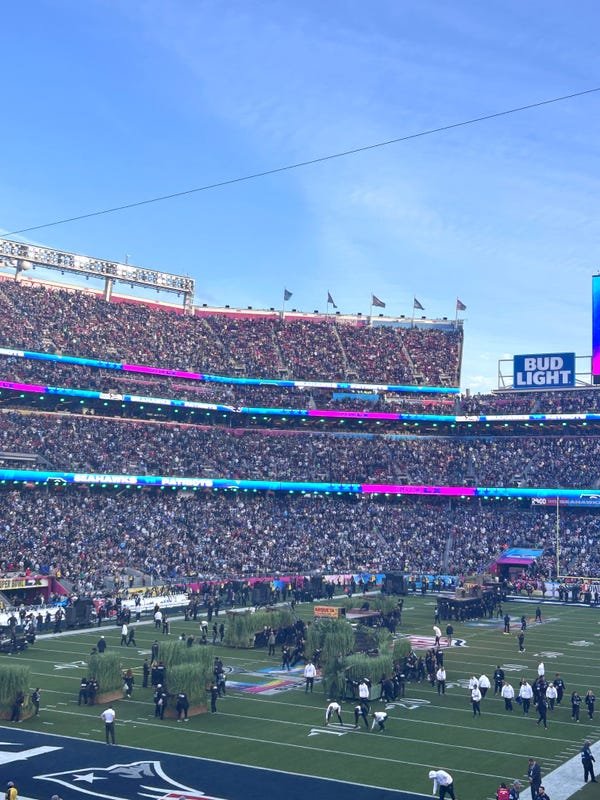
Right after the first half came to an end, dozens of crew members rushed to prepare the field.
Staff members rolled out carts with the tufts of grass. Anneta Konstantinides/Business Insider
We got a sneak peek at Bad Bunny’s set as we watched people wheel out carts with tall tufts of grass, a nod to the sugarcane fields of his native Puerto Rico.
Everyone in the stands laughed as we watched extras dressed as grass walk by.
Extras dressed as grass added to the scenery. Anneta Konstantinides/Business Insider
I assumed the extras were going to dance, but they were actually added to accommodate rules for protecting the natural grass at Levi’s Stadium.
Bruce Rodgers, who has produced the Super Bowl halftime show for the past two decades with his company Tribe Inc., told Wired that the NFL limited how many carts could be wheeled out onto the football field. So the team decided to dress up performers to help re-create the lush greenery of Vega Baja, Bad Bunny’s hometown.
Andrew Athias, one of the extras, told Business Insider that the grass costume weighed 40 pounds. He flew to California from the East Coast and spent two weeks in rehearsals to be part of the field cast.
“I got paid $18.70 per hour for the gig, but I would’ve done it for free,” he said.
Once the stage was set, we realized our seats were the farthest away from the performance.
Most of the performance took place on one end of the football field. Anneta Konstantinides/Business Insider
La Casita, a major stage piece from Bad Bunny’s “No Me Quiero Ir De Aquí” residency, arrived at the end zone for the Super Bowl halftime show — just not the one we were behind!
Still, the excitement was palpable as Bad Bunny kicked off his 15-minute performance with “Tití Me Preguntó.” One guy in front of me even started FaceTiming his friend, holding the phone so she could watch the entire show.
We caught parts of the halftime show with the help of one of the stadium’s jumbotrons…
We watched a lot of Bad Bunny’s performance via a jumbotron. Anneta Konstantinides/Business Insider
Bad Bunny walked through the tall grass, passing by various set pieces that paid homage to Puerto Rico — including stands selling Coco Frio and piraguas — at the start of his performance.
From the stands above, all we could see were the tops of the grass. However, a jumbotron directly across from our seats showed us what fans at home were seeing on their TV screens.
… but sometimes it only showed stock images.
One of the stock images on the jumbotron. Anneta Konstantinides/Business Insider
Everyone around me was confused when the jumbotron in front of us kept cutting away from Bad Bunny to show random images, including some leaves and a cityscape.
People quickly realized that the screen behind us was still showing the halftime show, so we wondered if the stock images were due to a technical issue.
When I rewatched the show at home, I noticed our jumbotron was often visible on camera. I’m not an expert in production design, but I figure the decision might have been made to make it look less distracting in the telecast.
We completely missed the surprise cameos.
Multiple celebrities were dancing in Bad Bunny’s casita during the halftime show. Christopher Polk/Billboard via Getty Images
I found out that stars including Cardi B, Alix Earle, Pedro Pascal, and Jessica Alba made a quick surprise cameo during the halftime show, thanks to excited texts from my friends who were watching from home.
But there was no missing Lady Gaga.
Bad Bunny and Lady Gaga perform at the 2026 Super Bowl. Kevin C. Cox/Getty Images
Lady Gaga was also a total surprise for the fans in the stands, and I just about lost it when she appeared to sing a salsa version of “Die With a Smile.”
Alas, I have no pictures of this moment because I was too busy crying tears of joy.
The surprise halftime wedding went by in a flash.
A couple got married during Bad Bunny’s halftime performance. JOSH EDELSON / AFP via Getty Images
Watching the couple say “I do” from the stands was a quick but special part of the show, especially when it was later revealed via ESPN that the couple had originally invited Bad Bunny to their wedding — only for him to invite them to get married during his Super Bowl performance instead.
Bad Bunny and his dancers ran across the football field for the parade of the Americas.
We could spot all the flags from our seats in the stands. Anneta Konstantinides/Business Insider
The show made its way over to our side of the football field as Bad Bunny’s backup dancers carried flags from countries in North and South America.
The show ended with fireworks and a powerful statement.
The grand finale of the Super Bowl halftime show. Anneta Konstantinides/Business Insider
“The only thing more powerful than hate is love,” the sign read, evoking Bad Bunny’s statement during his Grammys acceptance speech the week prior.
The stadium erupted as Bad Bunny began singing “DTMF,” his message emblazoned for all to see — no matter where we were sitting.
As fireworks lit up California’s slowly darkening blue sky, I knew I had just watched something historic.
This story is available exclusively to Business Insider
subscribers. Become an Insider
and start reading now. Have an account? .
On Sunday, Bad Bunny took the stage at Levi’s Stadium for the Super Bowl LX halftime show.
The show was full of nods to Puerto Rico and included subtle political and cultural statements.
Here are some details from Bad Bunny’s halftime performance that you might have missed.
Bad Bunny’s Super Bowl LX halftime show was more than a hit-filled performance — it was a carefully staged cultural statement.
Beyond the headline moments, the show was packed with intentional details, from visual symbolism to casting choices, that were easy to miss in real time.
We’ve rounded up the moments you might not have caught, and why they mattered.
Bad Bunny’s “Ocasio 64” jersey
Bad Bunny wore Zara for his Super Bowl halftime performance. Bob Kupbens/Icon Sportswire via Getty Images
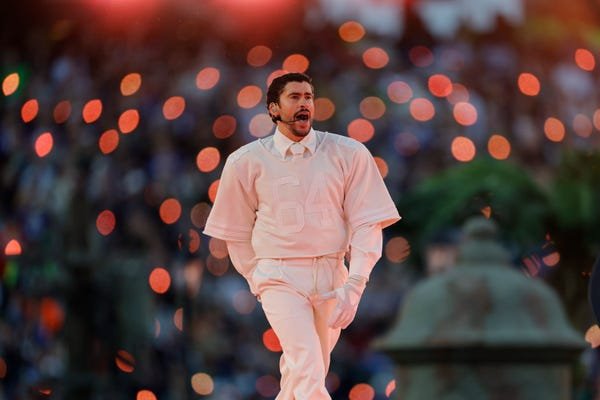
Bad Bunny — born Benito Antonio Martínez Ocasio — wore a white Zara football jersey emblazoned with his last name, “Ocasio,” and the number “64.”
The number set off widespread online speculation about its meaning, with theories ranging from personal and musical references to Hurricane Maria, but no definitive explanation has been confirmed.
The cameos
The halftime performance featured several celebrity cameos. Christopher Polk/Billboard via Getty Images
Bad Bunny’s halftime show featured several celebrity cameos from the likes of Lady Gaga, Ricky Martin, Pedro Pascal, Cardi B, Karol G, Jessica Alba, and Young Miko.
Lady Gaga appeared in a blue dress and sang a salsa rendition of her chart-topping hit “Die With a Smile,” while fellow Puerto Rican native Ricky Martin took to the stage to perform Bad Bunny’s “Lo Que Pasó a Hawaii.”
Maria Antonia Cay, known as Toñita, also made a cameo, briefly appearing onstage to hand Bad Bunny a drink. She runs Caribbean Social Club in Williamsburg, one of the last Puerto Rican social clubs in New York City.
An actual wedding
A couple got married during Bad Bunny’s halftime performance. JOSH EDELSON / AFP via Getty Images
A couple featured in Bad Bunny’s performance actually got married during the set, league sources confirmed to ESPN.
The outlet said that the couple had originally invited Bad Bunny to their wedding. Instead, the singer invited them to get married during his show.
The power lines
Bad Bunny’s halftime set featured electricity poles as stage props. Kevin Sabitus/Getty Images
During his performance of “El Apagón,” a song whose title translates to “the power outage,” Bad Bunny leaned into the track’s themes about the frequent blackouts in Puerto Rico.
The stage featured his dancers dressed as jíbaros, or traditional Puerto Rican farmers, who began climbing utility poles that sparked and exploded.
The dancers dressed as plants
The halftime show featured dancers dressed as plants. San Francisco Chronicle/Hearst Newspapers/San Francisco Chronicle via Getty Images
Bad Bunny brought Puerto Rico to Levi’s Stadium by covering the stage in greenery inspired by Vega Baja, where he grew up.
In another stadium, that kind of lush landscape would typically be created by wheeling carts of plant props onto the field, Bruce Rodgers, whose company Tribe Inc. handled the show’s production design, told Wired.
But NFL rules limited how many carts could be used to protect Levi’s Stadium’s natural grass, so the team dressed performers as plants to get the same effect, Rodgers said
Boricua pride on display
Bad Bunny’s halftime performance featured various references to Puerto Rico, including a piragua stand. Patrick T. Fallon / AFP
Bad Bunny’s halftime performance featured several cultural symbols of Puerto Rico, including sugar cane fields, a piragua stand, and a casita.
The billboard message at the end of the performance
The billboard at the end of Bad Bunny’s halftime performance was a reference to his Grammys speech. JOSH EDELSON / AFP
As fireworks lit up the sky to mark the end of Bad Bunny’s halftime performance, a stadium screen displayed the message, “The only thing more powerful than hate is love.”
The quote echoed a line from the singer’s Grammy acceptance speech last week.
While accepting the award for best música urbana album, Bad Bunny called out ICE.
“We’re not savage,” he said. “We’re not animals. We’re not aliens. We are humans, and we are Americans.”
Later that night, Bad Bunny also made history as the first artist to win Album of the Year with an all-Spanish record.
This as-told-to essay is based on a conversation with Andrew Athias, 33, a Philadelphia-based digital marketer and content creator. It has been edited for length and clarity.
I was one of the 500 bunches of dancing grass at Bad Bunny’s Super Bowl halftime show. I got paid $18.70 per hour for the gig, but I would’ve done it for free.
I’m a big Bad Bunny fan. I’ve been to three of his concerts since my girlfriend introduced me to him in 2021.
I found the grass gig through a company called Backlit, which handles finding extras for the halftime show. I found it last year when I saw Kendrick Lamar at the Super Bowl halftime show, but I forgot about it until Bad Bunny was announced as Super Bowl’s headliner in October, and I decided to apply.
I was one of the few crazy people to fly over from the East Coast to be part of the field cast. I flew out to San Francisco from Philadelphia in the middle of a snowstorm and have been out here for two weeks, rehearsing for the big day, and it has been worth it.
Job description: Be athletic
The requirements for the role were pretty basic. You had to be no taller than six feet, no shorter than five feet seven inches, and of an athletic build.
Every time Aditi publishes a story, you’ll get an alert straight to your inbox!
Stay connected to Aditi and get more of their work as it publishes.
The listing said we had to be able to wear a 40-plus-pound costume and to be comfortable dancing in proximity with other performers for long periods. Other than that, we had to measure every part of our body from head to toe, elbow to floor, shoulder to clavicle, etc. Those were the only requirements.
They didn’t tell us we’d be wearing a grass costume and kept it super vague.
12-hour rehearsals with a 40-pound grass costume
My part was actually really easy. They just told me where to stand, and they said, “Don’t move. Stand here and be one with the grass.”
The suits were heavy and uncomfortable. Every now and again, you’ll have a blade of plastic grass going places where grass should not go. Fortunately, we were given some protective goggles.
There were definitely times when we were wearing the suits for about six or seven hours because they had to make alterations. There were about eight practices in total, with the last three lasting 12 hours each.
But the production crew did their best to make this suit as wearable as possible; they listened to every complaint and tried to fix it.
And getting to see behind the scenes of the production was a treat.
It was really cool to see Bad Bunny perform just a foot away. But because he was in LA for the Grammys during some of our rehearsals, the crew had a Bad Bunny stand-in they called “Good Rabbit.”
An electrifying atmosphere
Bad Bunny’s Super Bowl halftime performance.
Kevin Mazur/Getty Images for Roc Nation
One of the other things they asked for in the application was whether you had marching band experience or experience in the entertainment industry. I was in a collegiate a capella group, so I’m not scared of performing in front of big crowds.
But it’s definitely different when you have a stadium full of people vibing, moving, grooving to Bad Buddy’s music.
I spent about $2,600 on flights, hotels, and a rental car for the two weeks. I’m a content creator without a full time job now, so I didn’t have to take any paid time off for this.
The hardest part of the gig was keeping quiet
The hardest part of the whole thing wasn’t the long hours or the heavy costume, but rather keeping quiet about it. They made us sign an NDA to not talk about it or post anything on social media for two weeks.
So when I saw people posting about what his setlist was going to be, it was so hard to have so much knowledge and power and not be able to do anything with it.
I told only a very small handful of people that I was going to San Francisco and would be involved in the half-time show.
I didn’t tell them what I was dressed as. I didn’t tell them where to look for me on the field. All I said was, “You’re going to see me. You just didn’t know that you saw me.”