A crewed US Air Force fighter and an uncrewed jet-powered aircraft flew together recently, communicating and showing how autonomous drones might fight in a future air war alongside human pilots.
US defense firm General Atomics, a competitor in the Air Force’s Collaborative Combat Program aimed at developing and fielding loyal wingman-type drones, said on Monday that its MQ-20 Avenger, long a CCA stand-in, flew with an F-22 Raptor.
During the test at Edwards Air Force Base earlier this month, the stealth fighter’s pilot commanded the test drone to carry out tactical maneuvers, perform combat air patrols, and execute airborne threat engagement tasks.
The most recent demonstration is an advancement of a similar test in November 2025, when an F-22 pilot used a tablet to control an MQ-20, a test aircraft being used to demonstrate CCA-style teaming. The tablet allowed the pilot to communicate with the drone and send commands during flight.
The flight test earlier this month saw the Raptor pilot use government-provided autonomy software on the F-22 and a tactical data link to pass commands in real time to the drone.
Every time Chris publishes a story, you’ll get an alert straight to your inbox!
Stay connected to Chris and get more of their work as it publishes.
“This demo featured the integration of mission elements and the ability of autonomy to utilize onboard sensors to make independent decisions and execute commands from the F-22,” David Alexander, the president of General Atomics Aeronautical Systems, Inc., said in a statement.
The Air Force views CCAs as an attritable force multiplier that will be used with manned aircraft and autonomy.
US Air National Guard photo by Staff Sgt. John Macera
General Atomics said the latest demonstration showed how CCA-type platforms could increase the combat power available to human pilots in a future war.
The Collaborative Combat Aircraft program is a priority for the Air Force as a way to bolster American airpower. These drones are meant to fly alongside advanced fighters, including the coming sixth-generation F-47 being developed by Boeing.
Air Force officials say CCAs aren’t disposable, but they’re cheaper than fighters like the F-35 Lightning II Joint Strike Fighter. They are built to be attritable so they can be risked in combat instead of a human-piloted aircraft.
Testing with the MQ-20 is helping inform the Air Force’s CCA program, which is focused on General Atomics’ YFQ-42, Anduril’s YFQ-44, and Northrop Grumman’s YFQ-48A. The air service envisions these systems as easily upgradable platforms compatible with high-end crewed aircraft.
CCA-type drones, which include designs beyond those with dedicated Air Force program designations, are designed to carry out missions on their own, from air-to-air combat to strike and intelligence roles, while also boosting the power of a formation by adding more sensors and weapons without another pilot in the cockpit.
The Air Force says that CCAs are not intended as replacements for its crewed jets but are rather partners that will change how pilots work with artificial intelligence and drones — and expand US airpower in a fight, especially against a near-peer adversary.
Lori Schott, a mother from rural Colorado, said she stared down Meta CEO Mark Zuckerberg as he walked into court in Los Angeles on Wednesday to testify in a landmark trial regarding social media addiction.
Schott lost her 18-year-old daughter, Annalee, to suicide in 2020. She believes the content Annalee saw on social media platforms “destroyed” her mental health.
“I made eye contact with him for quite a long time,” Schott said of Zuckerberg. “I was not backing down.”
Schott is not a plaintiff in the case where Zuckerberg testified on Wednesday, but is among more than 2,000 individuals who have similar personal injury lawsuits pending regarding social media addiction and harm.
The case underway in Los Angeles centers on a 20-year-old woman, identified by the initials KGM, who says her use of social media throughout her childhood negatively affected her mental health, contributing to depression and suicidal thoughts. It is considered a bellwether trial that could indicate how other similar lawsuits related to social media harm, like Schott’s, could play out.
Lori Schott, a mother from rural Colorado, lost her 18-year-old daughter, Annalee, to suicide in 2020.
Jill Connelly/Getty Images
Meta, which owns Instagram and Facebook, was named as a defendant alongside Google-owned YouTube, TikTok, and Snapchat. TikTok and Snapchat both settled the lawsuit out of court.
Last month, Meta warned investors that its mounting legal battles over youth safety could “significantly impact” its 2026 financial results. Attorneys for more than 100,000 individual arbitration claimants have “sent mass arbitration demands relating to ‘social media addiction'” since late 2024, the company said in a 2026 10-K, which warned that potential damages in certain cases could reach into the “high tens of billions of dollars.”
In a statement, Stephanie Otway, a Meta spokesperson, said: “We strongly disagree with these allegations and are confident the evidence will show our longstanding commitment to supporting young people.” Otway highlighted changes the company has made over the past decade, including Teen Accounts, which give parents tools to manage their teens’ accounts.
Google declined to comment. TikTok did not respond to a request for comment. A Snapchat spokesperson said in a statement: “The Parties are pleased to have been able to resolve this matter in an amicable manner.”
On Wednesday, parents showed up hours before the courthouse opened in hopes of getting a seat inside. Many of them had personal stories about how they believed social media use harmed their children.
Parents gathered outside the Los Angeles Superior Court on Wednesday.
Frederic J. Brown / AFP via Getty Images
“We face a lot of stigma from people telling us we’re bad parents,” said Amy Neville, another parent who attended to show her support. She said that once the evidence comes out in the trial, she believes “the tide will turn, and the general public will be on board with us.”
“It is by design that social media is tearing their family apart,” Neville said.
On the stand, Zuckerberg said that teens represent less than 1% of Meta’s ad revenue and that most teens don’t have disposable income, so it’s not especially valuable to advertisers to reach them.
Zuckerberg said it’s in Meta’s best interest to create a platform that inspires people and makes them want to stick around for the long term.
“If people aren’t happy with a service, eventually over time they’ll stop using it and use something better,” he said.
Sarah Gardner said that regardless of the outcome of the trial, she hopes it raises awareness about how the social media companies, and specifically Zuckerberg, have been operating. Gardner is the CEO of the Heat Initiative, an advocacy group that pressures Big Tech companies to make their platforms safer for kids. She was at the courthouse with the parents who believe they have been affected.
Gardner said she’s hopeful the trial will empower more people to say, “I don’t want to be on Instagram anymore.”
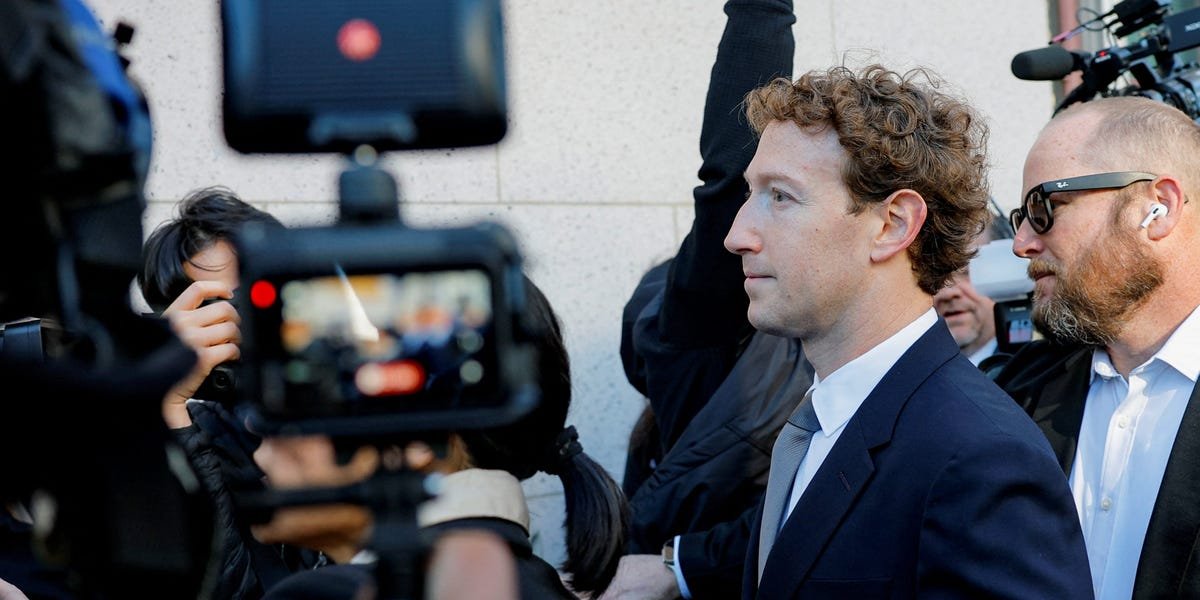
As Mark Zuckerberg was ushered into the Los Angeles Superior Court early on Wednesday morning, one accessory in his entourage stood out: Meta Ray-Ban glasses.
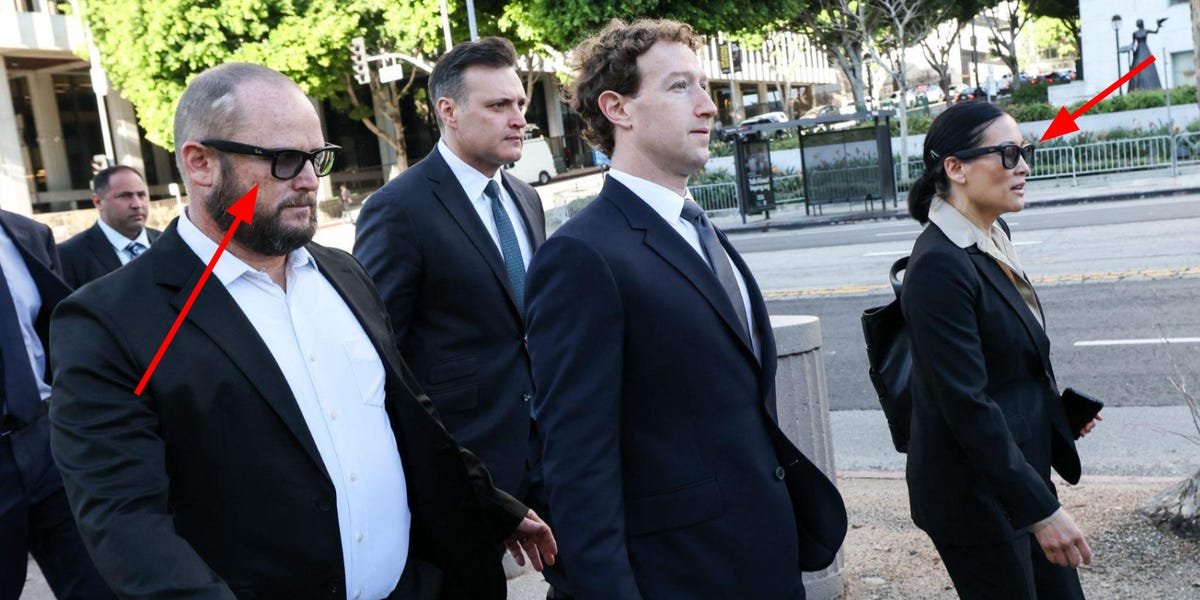
Zuckerberg, wearing a navy blue suit and tie, arrived without any glasses. Flanking either side of him as he walked up to the courthouse were longtime executive assistant Andrea Besmehn and an unidentified man donning Meta’s Ray-Ban glasses.
Meta declined to comment about the accessory choice.
AI-powered smart glasses weren’t just a hot accessory in the California sun. They were a hot topic inside the courtroom.
The judge presiding over the trial announced that anyone using glasses to record inside the courtroom would be “held in contempt of the court,” according to CNBC.
This isn’t the first trial where Meta’s glasses have caused issues.
Last year, while Meta battled the Federal Trade Commission’s antitrust allegations, New York Times reporter Mike Isaac posted on X (formerly Twitter) that he had been reprimanded by the court for wearing Meta Ray-Bans.
do not wear camera glasses in federal buildings folks 😞
Andrea Besmehn (left) and an unidentified man donning Meta’s Ray-Ban glasses while accompanying Zuckerberg.
Frederic J. Brown / AFP via Getty Images; Mike Blake/Reuters
The glasses cameo came as Zuckerberg took the stand in a Los Angeles trial accusing major social media companies of building addictive products that harm young users. The case centers on a now-20-year-old plaintiff, identified in court filings as “KGM,” who alleged that Instagram and YouTube worsened her depression and suicidal thoughts after she started using the apps as a child. TikTok and Snap have already settled, leaving Meta and Google’s YouTube as the remaining defendants in the trial, which could shape similar lawsuits nationwide.
The trial underway in Los Angeles is focused on design features that plaintiffs say keep teens scrolling. Zuckerberg’s testimony follows an earlier appearance from Instagram chief Adam Mosseri.
Meta’s Ray Ban smart glasses have become a surprise hit. On the company’s earnings call last month, Zuckerberg said that sales of the glasses more than tripled in 2025, and compared the moment to the shift from flip phones to smartphones.
Meta has increasingly positioned the glasses as a vehicle for its AI ambitions. In addition to taking pictures and playing music, users can ask questions to Meta AI, Meta’s AI assistant, about anything that they’re looking at through the glasses.
Last week, the New York Times reported that Meta is planning to add facial recognition technology to the glasses.
Ukraine’s large-scale drone war is pushing Western militaries to treat small drones less as high-end equipment and more as expendable ammunition that isn’t meant to come back.
US Army and British Army officials, as well as a NATO veteran who volunteered to fight in Ukraine, told Business Insider that effective drone warfare requires sending large numbers forward — and accepting many will be lost as a routine cost.
Maj. Rachel Martin, the director of the US Army’s new drone lethality course, told Business Insider that the conflict shows that “if you’re going to flood the zone with drones,” especially in a combat situation where electronic warfare is heavy, “you’re going to lose a lot of drones.”
She said it’s a “transition from the army of old,” where a lost drone was “a significant emotional event” that was reported to senior leadership. In Ukraine, it’s different. “Drones go down all the time.” There, losses are typically shrugged off, rather than investigated.
Drones are key to Ukraine’s fight, and the idea that many will be lost is understood across the military.
Sean Gallup/Getty Images
That shifting mindset is shaping how Western militaries train.
Lt. Col. Ben Irwin-Clark, the commanding officer of the British Army’s 1st Battalion of the Irish Guards, told Business Insider that his battalion has changed its training to allow drones to be damaged or even destroyed to reflect battlefield realities. “I absolutely think they need to be disposable because otherwise you’re not training realistically,” he said.
Not high-end equipment
Jakub Jajcay, a former special forces member from Slovakia who fought in Ukraine, told Business Insider that if NATO militaries want to start using drones for real missions, they “need to get used to the fact that they’re basically expendable material more akin to ammunition or fuel or gasoline, things like that, rather than specialized high-end pieces of equipment that need to be looked after.”
He said when he was serving in the military for his home country, “drones were very specialized pieces of equipment.”
The drones were fairly expensive, he shared, “and there was always a sort of bureaucratic process” in using them. Sometimes, only designated individuals were allowed to use the drones.
Ukraine uses small drones differently from the way that Western militaries did in previous conflicts.
Paula Bronstein/Getty Images
If something happened to a drone, “that would’ve been a big problem in training. If we had lost a drone, somebody would’ve been in big trouble for that.” The war in Ukraine shows how poorly that peacetime mindset fits large-scale combat.
Russia’s invasion of Ukraine has featured drones on an unprecedented scale. Ukraine says roughly 80% of its strikes are carried out using drones rather than other weapons. Many never reach their targets and are lost along the way, though.
Cheap drones worth several hundred dollars have destroyed weaponry worth millions. But many of them don’t have any effect. A report last year from the UK’s Royal United Services Institute said that “between 60 and 80% of Ukrainian FPVs fail to reach their target, depending on the part of the front and the skill of the operators.”
Some drones are jammed or disrupted by electronic warfare, while others are shot down or get their cables cut. Sometimes they’re knocked out by soldiers on their own side.
Many of the drones on the battlefield are single-use, designed to explode when they hit their target, but many of them are destroyed, damaged, or disabled before they even reach that point.
Jajcay said that even drones designed to be used again and again “have a lifespan of maybe a few dozen missions at most.”
He also said that drones failed “all the time,” and those losses were expected.
Allies want to learn as much as possible from Ukraine’s drone warfare.
Paula Bronstein /Getty Images
The West is changing its view
The US Army is recognizing and learning from these dynamics in Ukraine, as are other Western militaries, as they incorporate the idea that drones cannot be treated as overly precious assets into their drone warfare training and doctrine.
Maj. Wolf Amacker, who leads the Army’s Unmanned Aircraft Systems and Tactics Branch at the Aviation Center of Excellence, told Business Insider that out of the thousands of drones used daily, only around 30% of them hit their targets, while many others don’t have a significant impact on their targets.
The Army is learning that lots of drones need to be sent forward.
Irwin-Clark told Business Insider that the way the UK sees drones has also shifted. He said “every time there’s an iterative change in technology in the battlefield, everyone gets very excited about it and the ownership of that asset tends to be far too high.”
The US Army is training troops for drone warfare.
US Army/Leslie Herlick
He said that often when a new and powerful technology emerges, senior leaders will try to tightly control it, arguing that because there are only a handful available, only a select few should have the authority to decide when it’s used. The assets are carefully protected, at least initially. Later on, trust is imparted to soldiers to handle technology previously in the charge of higher-ups.
That pattern, Irwin-Clark said, is “exactly what’s happening with drones.”
His battalion wrapped the first drones it received years ago in bubble wrap, “and we didn’t fly them very often,” he said. “When we did,” he continued, “we made sure we flew in the middle of a field with nothing, no obstacles around.”
Now, his battalion is deliberately crashing its latest drone delivery into targets, while looking at how to make repairs. “It really doesn’t matter if we break them,” Irwin-Clark said.
The US is coming at it the same way. Martin, who previously commanded a Gray Eagle drone company, said her course takes into account that “drones crash. I’ll say that to the day I die having owned drones as a commander: drones crash.”
Secretary of Defense Pete Hegseth said last year that the defense department needs to view small drones as consumables rather than “durable property” — more like ammunition than valuable equipment. It’s a change that Jajcay described as “a step in the right direction.”
Western armies were using various drones in warfare before Russia’s invasion, often using them as surveillance platforms or tools for launching missile strikes. Small drones weren’t used the way they’re being used in Ukraine, but the US, UK, and others are learning drone lessons from the war.
Martin said the ongoing conflict in Ukraine shows that even when you lose drones, it’s ultimately “still cheaper than employing missiles on specific targets.” That’s an equation the US Army can’t totally ignore.
“They’re cheaper, and you’re not putting human lives in danger” to carry out the mission, she shared. And the Army knows that “they’re going to crash. It’s going to happen.”
This as-told-to essay is based on a conversation with Rose Barboza, founder ofBlack Owned Maine. It has been edited for length and clarity.
In the summer of 2020, I started a directory of Black-owned businesses in Maine. I was looking for a way to support the Black community for people who couldn’t attend protests. I also wanted to make a longer-term economic impact.
It immediately took off. These were my neighbors and local businesses that I just hadn’t heard about. That’s the thing: People joke about Maine being the whitest state, but there are actually plenty of Black-owned businesses here. They’re just not in Maine’s heritage industries, so they don’t necessarily get a lot of attention.
The directory took off like a rocket ship. Black Owned Maine now has four employees, including me, and an annual operating budget of about $250,000. In addition to the directory, we host events and business advising to support Black Business owners. As of late 2025, we had 423 businesses on the list, including a gym, beauty salons, restaurants, translation services, and more. About half of them were owned by immigrants.
I felt the directory became too dangerous when ICE arrived in Maine
I’ve always worried about what could happen if the list got into the wrong hands. My concern grew as there were rumors of ICE coming to Maine to do a large-scale raid. I was worried about agents being able to scrape our website and target the businesses that were listed.
My community was hesitant to bring the list down. Many businesses rely on us for free advertising. One beauty salon owner recently told me she got four new clients in one week after we featured her on our social media. I didn’t want to take that away if I didn’t need to.
When ICE arrived in Maine in January, I decided it was too unsafe to have a public-facing list of Black businesses. We took down the directory in late January.
We’re considering putting the list behind a paywall
Creating Black Owned Maine is the biggest thing I’ve ever done, aside from having children. Taking it down felt like a defeat of my life’s work.
When I feel discouraged — which is often these days — I have to remind myself we’re not at the end. There’s a path forward from here, and we just have to see what it is.
One option we’re looking at is putting the directory behind a paywall. It’s expensive to run this nonprofit, and in recent years, grants for this type of work have been hard to come by. We believe people should be compensated for doing social justice work, and charging to access the directory feels like a way to practice what we preach about economic empowerment.
It would take about $100,000 to rebuild the website in a way that can keep information secure. That includes the cost of staff needed to operate it for about two to three years. Still, it’s a lot of money to ask for. Right now, we’re encouraging people who have used our list to donate.
Despite everything, I’m still hopeful
Maine is such an accepting place. And yet, I’ve had business owners reach out to ask me to take down social media posts featuring them. People are scared. It feels like they’re being forced into hiding.
I’m hoping people will continue to support Black and immigrant communities in Maine. Recently, I booked an appointment with a new dentist, an immigrant from Southeast Asia. Her clinic is a little further away, but I want to support her. If we’re all more intentional about where we spend our money, we can make a difference.
Sometimes I think, “Why are we even doing this?” But underneath the difficulties, I’m still hopeful.
Editor’s note: Business Insider reached out to ICE for comment.