In 2024, I woke up to a difficult truth: I was unhappy. A solopreneur since the early 2000s, I’d built a six-figure business while raising three boys.
My workaholic drive meant giving my all to every client. It paid off: the photography studio I ran earned flawless five-star Google reviews and a long roster of loyal clients. I even earned industry recognition (including a book deal and invitations to speak on stages at national events).
But around me, things had been changing. The market had grown more crowded every year. The unique approach I’d brought to the marketplace had become common practice. And I — at 55 — was not the same person as the 30-something who’d started the business.
I slowly found myself quietly wondering whether and how to unravel a business that had taken 20 years to build. Friends and family wondered if walking away made any sense. But deep inside, I felt a yearning for change. I’d lost touch with the parts of myself that once felt creative and inspired. I was ready to grow and evolve. The life I’d built no longer fit.
Leaping into the unknown
In October of 2024, I closed the business for good. It wasn’t easy. It meant stepping away from an identity I’d carefully built, and from the financial security it provided. I needed space to figure out what I wanted next as I entered the second half of life.
When I locked the doors for the last time, I felt happy. Relief washed away any regret I thought I’d have. I felt lighter — free from the burden of a business I no longer enjoyed, and that no longer fueled my own growth. I’d been stagnant, and now I was free to move forward, to find new ways to express myself, to do work that felt meaningful again.
Having connected with lots of other women my age, I’ve learned I’m not alone in making a midlife leap.
Rediscovering purpose in midlife
After giving myself space and settling into a slower pace with no more 48-hour workweeks, I dove into learning. I signed up for a few courses, curious to see where inspiration would lead.
I reflected on all the iterations I’d experienced in the past: corporate professional, career coach and trainer, and small-business owner. I then crafted a list of my skills, knowledge areas, and natural abilities. Then I repeated the process from the inside out, reflecting on where I felt excitement and expansion.
Suddenly, I saw all the unwritten books I’d placed on the “someday” shelf. I saw myself speaking from stages to women struggling with menopause and midlife transitions. And I understood why it had been time to move forward.
I’m not done working. I’m redirecting my talent and life experiences. I’m choosing a new path that feels meaningful given the stage of life I’m in and the challenges I face as a menopausal woman.
This year, I enrolled in a coaching certification program tailored to address the needs of menopausal women. I’ve learned that although many midlife women might be rethinking their lives and seeking a renewed sense of meaning and purpose, the pressures of career and caregiving hold many back from leaning into the shifts they feel called to make. The obstacles are both emotional and practical.
A mentor once told me: You are what you spend your time doing. As I step forward with renewed purpose and energy, I’m confident that with each step, I’m building a life that fits the new version of me I’m growing into. I spend mornings writing my books and pitching essays. My afternoons involve learning, building a network, and following through on my commitment to a daily wellness activity. In the evenings, I spend quality time with my husband, who’s now retired, and we plan trips to exciting new places.
And for the first time in years, I feel like myself again.
For years, Brittany Nemandoust struggled to keep her small business afloat.
Chocbox, her DIY chocolate-making kit company, started as a pandemic project after shutdowns left her temporarily out of work as a dental hygienist. When she returned to the dental office, the business remained a side hustle.
Sales fluctuated, spiking over the holidays and slowing down during the spring and summer.
Around April 2024, she and her husband, Kevin, sat down to discuss whether it was time to shut it down. Sales weren’t enough to cover expenses, including rent for a small office in Los Angeles and payroll for a part-time employee, and Nemandoust had taken on credit-card debt to keep the company running.
On paper, closing made sense. But she wasn’t ready to give it up.
“I was really optimistic. I’m like, ‘I know that it’s going to happen at some point. It’s going to blow up,'” she told Business Insider. “I just had a feeling.”
Each Chocbox kit includes a chocolate mold, pre-measured ingredients, and step-by-step instructions.
Ethan Noah Roy for BI
A few weeks later, an opportunity emerged. Nemandoust had noticed videos of a thick, pistachio-filled “Dubai chocolate” bar flooding TikTok. Influencers were trying to recreate it at home, and comment sections were filled with the same questions: Where do you get these ingredients? How do you make this?
Unlike most viewers, she already ran a chocolate kit business. Plus, years earlier, she had custom-designed a chocolate mold that was 20-30% thicker than standard molds — originally, she said, because she felt customers deserved a more substantial bar. That thickness turned out to be exactly what the viral Dubai bar required.
The couple went to a Middle Eastern grocery store in their neighborhood, bought pistachio cream and kataifi pastry, and tested their own version. Then, they filmed a video of the two of them breaking the bar in half and tasting it.
“It wasn’t a pretty video. It was just very raw,” she said, but the response was immediate.
Within 20 minutes, the video had 500 views, more than her videos typically received. Minutes later, the count doubled. By the end of the day, more than 100,000 people had viewed the video, and orders were pouring in. She hit TikTok’s daily cap for new sellers, 100 orders, that day and again the next.
There was just one problem: She didn’t have hundreds of kits ready to ship.
Managing quick growth after a viral moment
Going viral was exhilarating, but chaotic.
Two ingredients in particular — kataifi and pistachio cream — were difficult to source. Online suppliers were sold out, so she and Kevin started calling Turkish markets across Los Angeles. They even phoned gelato shops, knowing pistachio cream is often used in pistachio ice cream.
They also needed extra hands to pack orders, so they called friends, family, and anyone willing to pack boxes at odd hours.
“When you go viral, you need it now,” Nemandoust said. “You don’t have time to go through a hiring process or wait a week for a bulk order of items. You need it ASAP.”
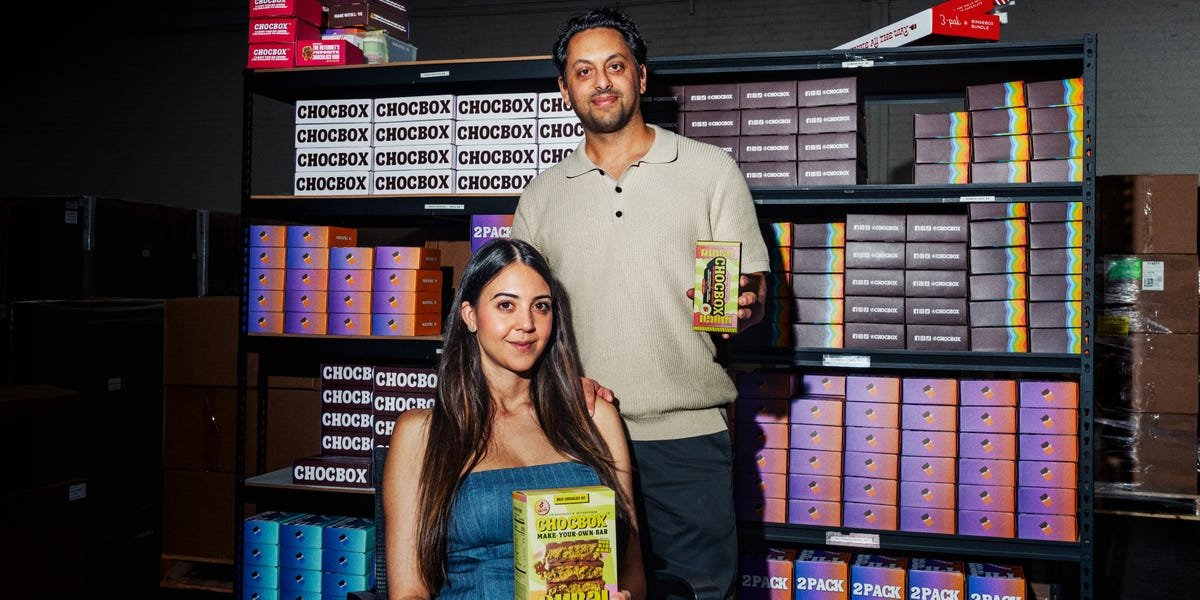
Nemandoust launched Chocbox from her parents’ home during the pandemic. Today, she operates the business out of a 6,000-square-foot warehouse in Los Angeles.
Ethan Noah Roy for BI
In addition to pulling from every resource they had, they worked 15-hour days, waking up around 6 a.m. and finishing late at night. They often livestreamed their long days, which helped build their community that would be integral to sustained success.
“We would be up and just livestream at like 11 pm at night, blasting music, and I honestly think that’s how we started building our community — showing people the rawness of what it means to go viral,” she said.
As chaotic as that time was, the couple still focused on building systems to keep up with demand. They created instructions for assembling a kit, for how it should look when complete, and for packaging and labeling it correctly. They printed photos of finished kits and taped them to the walls, and recorded short videos demonstrating the packing process so new helpers and employees could avoid mistakes.
“The worst thing you can do when you go viral is not fulfill orders,” Kevin, who quit his corporate job in 2025 to help grow Chocbox, said. “People are dying for your product, and if you don’t send it, that can almost instantly kill your momentum.”
They also resisted the temptation to assume the viral spike would last forever. Instead, they focused on turning a moment into infrastructure: improving sourcing, tightening operations, and gradually expanding capacity. They moved from a 5-by-6-foot cubicle to larger office spaces in the same building, eventually upgrading to a 6,000-square-foot warehouse. Today, they employ eight people.
Strategies to build a lasting business
Going viral brought new customers, but didn’t guarantee customer retention. To create a lasting business, they’ve focused on building a community and creating the best possible product.
Nemandoust regularly hosts livestreams on TikTok to showcase products and connect with customers.
Ethan Noah Roy for BI
From the start, Nemandoust leaned into community-building. She livestreamed on TikTok, assembling kits in real time, answering questions, and interacting directly with viewers.
“I want people to think of me when they think of Chocbox,” she said. “I want to be part of the brand.”
The livestreams weren’t just sales channels. They became a means of building trust. Customers watched orders being packed, saw the behind-the-scenes scramble, and felt included in the growth.
Affiliates became another key pillar. TikTok’s native affiliate system allowed creators to tag Chocbox products in their videos and earn commissions. At first, influencers were simply buying the kits themselves and posting about them. Over time, the couple built a more intentional network of roughly 30 highly engaged affiliates, whom they call “Chocboxers.”
“We invest in them, and they invest in us,” Kevin said, noting that some of their affiliates earn thousands of dollars a month in commission. “They’re an extension of our brand.”
Beyond community, they’ve maintained discipline in their product strategy and kept a tight focus on a hero product: the chocolate-making kit. They later added refill kits and a jarred version of their pistachio filling, branded as “Dubai Dip,” but resisted flooding their website with dozens of flavors.
The Nemandousts in their Los Angeles warehouse.
Ethan Noah Roy for BI
“When we release products, they have to be really good,” Nemandoust said. “It’s never going to be mediocre.”
They’re constantly engaging with their customers, asking them what they want and using that feedback to create products that excite their community.
Today, both Brittany and Kevin work on Chocbox full time. Sales still fluctuate seasonally — peaking during the holidays and around Valentine’s Day, slowing in summer — and growth still comes with stress, but the conversation they had in April 2024 feels distant now.
They said the company recently surpassed 300,000 units sold on TikTok Shop. Just a couple of years ago, they were preparing to shut Chocbox down. From the outside, the milestone looks like an overnight success. It’s anything but, said Kevin: “If people really knew how hard it was behind the scenes, the amount of turbulence it took to get here is insane.”
That turbulence, the couple says, is the part most aspiring founders don’t see. At the end of the day, starting and maintaining a small business is “really hard,” he said. But if you want to do it, “the only thing getting in the way of starting a business is truly yourself. Just start.”
The US federal government is shutting down again, but it won’t be like last time.
Funding for a slew of federal agencies runs out at midnight late on Friday, and lawmakers on Capitol Hill failed to send a series of bills to fund those agencies to President Donald Trump’s desk in time.
Even though the Senate passed a series of bills to fund the government on Friday, the House is not set to vote on them until late Monday at the earliest, meaning the shutdown will last at least a few days.
Some parts of the federal government have already been funded, meaning that the shutdown, even if it drags out, is only partial.
Additionally, it’s unlikely that this shutdown will last as long as the one that began in October, which stretched for 43 days and became the longest government shutdown in American history.
Here’s what could be affected — and what won’t be
In October, funding for the entire federal government was being held up, and the shutdown was far-reaching. This time, some parts of the federal government would remain operational.
That’s because Congress has already passed a series of spending bills that fund agencies and programs through September 30.
Among those programs are SNAP and WIC, which were notably affected by the previous shutdown. Additionally, national parks would likely remain open, veterans would continue to receive benefits through the Department of Veterans Affairs, and staff on Capitol Hill would continue to be paid.
But plenty of other government agencies and programs would be affected if the shutdown drags out, including the Department of Defense (including troops), the State Department, the Treasury Department, the Transportation Security Administration, and the Federal Emergency Management Agency.
Notably, Immigration and Customs Enforcement (ICE) and Customs and Border Protection would remain operational, even though it’s funded via the Department of Homeland Security.
That’s because DHS received $190 billion in funding via the “One Big Beautiful Bill Act” in July, including $75 billion for ICE and roughly $65 billion for CBP.
It’s unlikely to last as long as before
Unlike in the fall, lawmakers in both parties are working together to try to resolve the situation as quickly as possible.
The odds of a shutdown first rose following the fatal shooting of Alex Pretti by Border Patrol agents in Minneapolis on Saturday.
Democrats vowed to oppose a bill to fund the Department of Homeland Security, which oversees ICE and CBP, until reforms to immigration enforcement are made.
The House had already passed a package of six funding bills, including the DHS bill, and they had been stitched together into one package in the Senate.
The Senate has now passed a reformulated version of that package, with DHS funding continuing for only two weeks to allow for a renegotiation.
It’s unclear as of now whether that package will pass the House when lawmakers return to the lower chamber next week.
When a power outage hit San Francisco on Saturday, local drivers had to navigate more than just darkened roads and inactive stoplights.
Footage shared on social media shows some Waymo robotaxis stalled in traffic, clogging roadways and causing disruptions. One video on X showed at least five Waymos crowding an intersection, forcing human drivers to maneuver around them.
A Waymo spokesperson told Business Insider that the company has suspended its services in the area because of the power outage.
“Our teams are working diligently and in close coordination with city officials, and we are hopeful to bring our services back online soon. We appreciate your patience and will provide further updates as soon as they are available,” the spokesperson said.
The power outage affected about 130,000 Pacific Gas & Electric customers on Saturday. In an X post on Sunday, the company said a fire caused “significant and extensive” damage to its substation. The company said crews are working to restore power for 21,000 San Francisco residents.
On X, Tesla CEO Elon Musk used the incident to promote his company’s own robotaxis. “Tesla Robotaxis were unaffected by the SF power outage,” he wrote.
Tesla and Waymo are direct competitors in the autonomous ride-hailing market, but are relying on different technologies to get them there.
Tesla robotaxis use cameras and AI to find their way around. Waymo uses a suite of light sensors, radar, cameras, and detailed maps that are uploaded and regularly updated. That means sudden changes to the areas where a Waymo robotaxi operates could impact its ability to navigate.
Waymo, owned by Alphabet Inc., debuted its autonomous ride-hailing service to the public in 2018 in the Phoenix metro area.
The company has expanded its services to other cities, including Austin and Atlanta, through a partnership with Uber, but it hasn’t all been smooth sailing.
In May, Waymo recalled the software for more than 1,200 cars after some collided with “chains or gates.” More recently, a Waymo vehicle hit and killed a beloved bodega cat in San Francisco, sparking outrage from residents.