
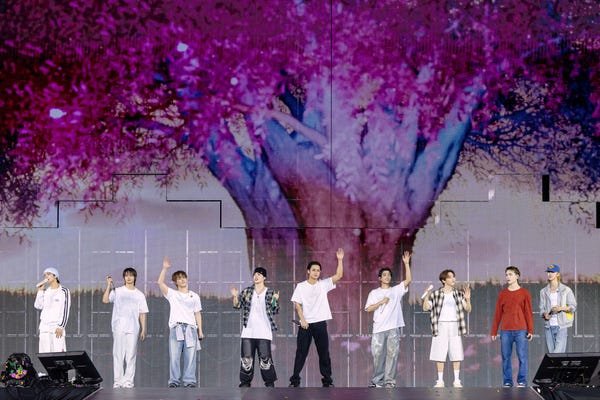
Hot-boys-bright-lights-sweltering-city-Inside-Seventeens-Singapore-stadium.jpeg

Hot boys, bright lights, sweltering city: Inside Seventeen’s Singapore stadium concert

  • Seventeen kicked off the Southeast Asian leg of their tour on Saturday in Singapore.
  • I was in the stadium — again — to see them live.
  • Sweltering heat aside, it’s an experience I’ll never forget.

Heat — that was the word of the day at the boy band Seventeen’s concert in Singapore.

Heat, with legions of fans clutching bags toting pickets bearing their favorite member’s face, comparing merchandise hauls like the spoils of war. Heat, under the blazing equatorial sun. And heat, on stage, when the nine active members of the 13-person group emerged to thunderous cheers.

Stepping into the stadium on Saturday reminded me of the bigger picture. This band is one of the crown jewels of the K-pop business machine. They’ve been working together for 11 years, playing to hundreds of thousands of people who cross continents just to see their favorite boys.

The concert on Saturday marked the start of Seventeen’s Southeast Asia tour leg

Seventeen’s Singapore concert lasted around three and a half hours, with more than a dozen encore songs.

Pledis Entertainment

I’ve been following Seventeen for just over a year now, which makes me a newbie Carat — the name the group has for its fans. The band, which is down four members because of South Korea’s mandatory military service, has been touring the US and East Asia, playing over 26 shows to date, to close to 800,000 people.

Seventeen kicked off the “NEW_” tour in South Korea on September 13 and 14, and did shows in five US cities. They’re back after a short break following their winter dome tour in four Japanese cities.

Performing at Singapore’s National Stadium is no walk in the park


A composite image of the bag check outside the National Stadium in Singapore and two hands holding Seventeen light sticks.

My friend and I came prepped and ready for the show with our concert light sticks.

Cheryl Teh

The 55,000-seat National Stadium in Singapore is a tough venue to play, in part because of the humidity and the heat. It was around 90 degrees Fahrenheit at kickoff.

But it’s the stadium of choice for any big act coming to the island. Taylor Swift performed six nights at the stadium in 2024, and Lady Gaga did four shows there in May 2025.

Seventeen played the venue for two nights in January 2025.

The band is touring with nine out of 13 members, but made up for the missing members with an abundance of energy


A group shot of the band Seventeen in Singapore

Seventeen is touring with nine members — four are serving mandatory military service in South Korea.

Pledis Entertainment

At nine people, the band rallied hard. They kicked off the show with tracks from their 2025 album, “Happy Burstday,” which sold over 2.52 million copies in its first week of release.

The group also dug deep into their archives and pulled out tracks like “Hot,” “Hit” and “Rock” for a segment that the members said was particularly hard to get through because of the strenuous choreography.

The fans were treated to some smooth dance moves and pop-rock


A composite image of Seventeen members Dino, Jun, and Vernon in concert.

Seventeen members Dino, Jun, and Vernon.

Pledis Entertainment

Every member of the team got their fair share of airtime with the nine solo songs, each showcasing their personal style.

The group’s youngest, Dino, and Chinese member Jun showed off their slick moves in “Trigger” and “Gemini.” Korean-American member Vernon went full pop-rock and brought out his electric guitar for “Shining Star.”

The band’s vocalists also served up some sweet, heartrending ballads


A composite image of Seventeen members Seungkwan, Joshua, and DK in concert.

Seventeen members Seungkwan, Joshua, and DK performed a set of three ballads during their segment of the concert.

Pledis Entertainment

Joshua — the group’s other Korean-American, and my favorite band member — kicked off a segment of ballads with his saccharine solo song, “Fortunate Change.” Hong is fresh off an appearance at the Golden Globes and this year’s Super Bowl.

His bandmates Seungkwan and DK — who are in the midst of promoting their unit album, “Serenade” — showed off their vocal chops with their solos, “Raindrops” and “Happy Virus.”

The moment the stadium started to feel like a club


A composite image of Seventeen members The8, Mingyu, and S.Coups.

It was party time with dancer The8 and the rappers Mingyu and S.Coups.

Pledis Entertainment

The crowd went wild when the group’s resident Calvin Klein model, Mingyu, strutted down the stage in head-to-toe denim for “Shake It Off.” That was right after the electro-dance party number, “Skyfall,” from his bandmate The8.

The deafening cheers kept coming for the band’s leader S.Coups’ head-banging hip-hop track, “Jungle.” The rapper — like his teammates Joshua, Mingyu, and Jun — is a fashion week regular in Europe.

Some fans flew across the world to see Seventeen live


A group shot of Seventeen on stage.

Seventeen performed in five US cities. The band will wrap its “NEW_” tour in April in Incheon, South Korea.

Pledis Entertainment

S.Coups was the reason Jackie Ko flew in from California. This was Ko’s 11th time at a Seventeen concert and first abroad.

Ko told me she spent around $2,500 for the trip. It was worth it, she said — she heard songs that weren’t on the US set list.

“S.Coups and Seventeen helped me get through some of the toughest times,” Ko told me. “He makes me feel rejuvenated. He’s my motivation to keep going, no matter what life throws at me.”

Seventeen, like many of their peers, have helped rev up the K-pop business machine


A group shot of Seventeen members performing

One of my personal highlights from the concert: “Network Love,” a unit track.

Pledis Entertainment

Seventeen is part of an industry that generates billions in annual revenue. Tickets to their Singapore show started at $199 Singapore dollars, or around $155, and topped off at $320.

The monetizable hype was evident in the run-up to the concert: Singapore’s Marina Bay Sands resort lit up the landmark in the band’s colors, organized a party featuring their songs at the property’s Marquee club, and had half a dozen restaurants curating custom menus inspired by their tracks.

The group’s parent company Hybe is riding Seventeen and similar groups’ success: Shares are up 55% in the last year.

There’s a reason fans shell out for the band — these concerts feel like once-in-a-lifetime experiences


A crowd shot of the Singapore stadium during the Seventeen concert.

There’s really nothing quite like a Seventeen concert.

Pledis Entertainment

For four hours, there is nothing that shines brighter or makes me happier than watching Seventeen perform. In these troubled times, that’s something worth holding onto.

Seth Aw, an artist from Singapore, agreed.

“The feeling of being in a stadium with other fans enjoying the same moment is so healing,” Aw said. “I don’t think anything can compare to how a good concert makes me feel, and that gives me strength to deal with many things in life.”


Source link

I-embedded-myself-in-a-vibe-coding-team-at-Geminis.jpeg

I embedded myself in a vibe coding team at Gemini’s AI hackathon in Singapore. Building an app in 7 hours takes real work.

  • I spent seven hours with a vibe coding team at Google’s Gemini 3 hackathon in Singapore.
  • Watching from the sidelines was intense.
  • From prompting and debugging to filming the demo — here’s how it all unfolded.

Just after sunrise, four vibe coding enthusiasts from Malaysia crossed into Singapore with a loose idea — and a bet that AI could build most of their app.

Hours later, they were racing to prototype it at Google’s Gemini 3 Hackathon in Singapore.

The four friends, all in their late 30s to 40s, came from different professional backgrounds. Chan Wei Khjan is an accountant. Chan Ler-Kuan lectures on AI at a private university. Loh Wah Kiang works in IT. Lee How Siem, who goes by Benny, is the chief technology officer of a Malaysian startup.

Their initial idea was a “feng shui” app to analyze properties in Singapore — a potentially lucrative use case in a market obsessed with housing and wealth accumulation. Feng shui is a traditional Chinese practice that evaluates how a person’s surroundings, along with birth factors, influence luck and well-being.

I embedded with the team at Google’s developer space in Singapore in January to observe how a vibe-coding project comes together — or nearly falls apart — in seven hours.

9:30 a.m.: The brief

Thorsten Schaeff from Google DeepMind welcomed the participants.

Lee Chong Ming/Business Insider

The assignment: Teams of up to four people had to build a working demo, publish a public repository with code, and submit a short video explaining their project by 5:30 p.m.

Each project had to fit into one of six tracks, including generative media, deep research, and enterprise orchestration.

Organized by Google DeepMind and 65labs, Singapore’s AI builder collective, the hackathon featured a 100,000-credit Gemini API prize pool, with first place getting 30,000 credits.

By the end of the day, 189 participants had built 76 projects.

10:30 a.m.: Getting started


Hackathon team getting started

The team discusses how to prototype their idea.

Lee Chong Ming/Business Insider

The team had pivoted to a new idea due to time constraints: a feng shui app that could analyse a user’s outfit and workspace through the phone camera in real time and assess how “lucky” they were.

Wei Khjan took the lead on prompting. He typed the first instructions into Claude, asking it to generate the workflow and code. Ler-Kuan focused on whether the AI’s output aligned with feng shui concepts. Wah Kiang and Benny hovered over the codebase, refining ideas and flagging issues.

“For people who don’t know how to read code, it’s helpful to have people who do,” Wei Khjan said.

While waiting for the code to be generated, Ler-Kuan opened Google’s AI Studio to design the app’s logo. They called their app “Feng Shui Banana.”

11:40 a.m.: The bugs arrive


computer screen with code

The implementation plan was generated by AI.

Lee Chong Ming/Business Insider

After about an hour, Claude generated the initial codebase for the app. It was designed to work with the Gemini Live API, enabling real-time image and text analysis. It ran but was riddled with bugs.

An error message flashed when they tested the camera feature, so Wei Khjan copied the error back into the AI and asked for it to be fixed. Minutes later, the feature worked.

It wasn’t right. The feng shui logic was off, especially where colour analysis intersected with the user’s birth timings. Ler-Kuan manually corrected the underlying dictionary and its mappings.

The team kept prompting to tighten the features: shorter explanations, clearer output, and more streamlined user interfaces.

By 12 p.m., the app was rough, but it existed.

12:20 p.m.: Lunch can wait


Testing the feng shui app

Ler-Kuan tests the camera feature on the app.

Lee Chong Ming/Business Insider

Lunch arrived. The team stayed glued to their screens.

The app didn’t respond instantly when a user changed their outfit, nor did it update its feng shui analysis in real time.

Wei Khjan explained how one prompt matters. Instead of issuing commands, he asked the AI to “discuss it with me.” The shift changed how the model reasoned, and it worked more like a collaborator.

After some prompting, the app updated with a real-time camera analysis. It was striking to watch a feature emerging from a short back-and-forth with AI.

1 p.m.: Putting the app to the test


Screenshot of me testing the app

A screenshot of the feng shui app on my phone as I test its camera feature.

Lee Chong Ming/Business Insider

I helped the team test the app.

The camera correctly identified what I was wearing: a dark green polo, a yellow participant tag, and a white name card hanging from my neck. According to the app, I was already wearing colours aligned with my luck for the day.

The app suggested small tweaks, such as additional accessories, that could enhance the feng shui of my outfit.

1:20 p.m.: Pizza break


Pizza break

The team munched down their pizzas in about 20 minutes.

Lee Chong Ming/Business Insider

They finally had lunch and joked around to ease the tension. Four hours remained before they had to submit their project.

1:40 p.m.: Back to work


Feng shui banana landing page

The landing page for their app.

Lee Chong Ming/Business Insider

Ler-Kuan shifted focus to workspace feng shui, feeding knowledge into the model and refining how the app would evaluate desks and work setups. Wah Kiang and Benny worked on the video demo.

By 2 p.m., they had a landing page that looked animated and 3D. When I asked Wei Khjan how he felt, he smiled.

The team also revisited the app’s tagline. After cycling through suggestions from multiple AI models, they settled on a line that didn’t come from an AI at all: “A wisdom, not a superstition.”

3 p.m.: Filming the demo


Filming the demo

Wah Kiang and Benny are filming Ler-Kuan as they reenact scenes for their demo video.

Lee Chong Ming/Business Insider

By late afternoon, the restlessness was showing. The team snacked and paced, then decided to film the video explaining their project.

They used Gemini to generate a storyboard for the demo video. The model laid out several scenes and drafted the script. The team followed along, filming clips and stitching everything together as they went.

Their workspace feature was also up and running.

4 p.m.: Final touches


Hackathon team scrambling

The team is hard at work as the deadline approaches.

Lee Chong Ming/Business Insider

The app had come together nicely. With some time to spare, they decided to add audio output for users who prefer listening to reading on a screen.

The first attempt to generate a voice using AI fell flat. It sounded robotic.

After debugging and several iterations, they landed on a voice they liked, similar to how a Chinese feng shui master might speak.

5:30 p.m.: Deadline


Finishing the hackathon

Taking a group photo as they submit the project.

Lee Chong Ming/Business Insider

As the deadline approached, the team was still stitching clips for their video and nitpicking the AI-generated presenter voice.

The organizers had urged teams to submit early. With about 15 minutes to spare, they made the call to lock the final cut and hit submit.

Then it was over. The hunger hit immediately, and everyone got in line for some well-deserved food.

Even as an observer, watching from the sidelines was tiring. Seven hours of vibe coding turned out to be anything but effortless.

The team didn’t win a prize, but agreed that the hackathon had been worth it.

“Sometimes, the best experiences come from saying ‘yes’ without overthinking,” said Ler Kuan. “Innovation starts with curiosity and a little bit of spontaneity.”

Do you have a story to share about vibe coding? Contact this reporter at cmlee@businessinsider.com.


Source link