
Headshot of Ben Shimkus

Skeptical of the ‘SaaSpocalypse’? Bill Gurley says you should channel your inner Warren Buffett and strike

Bill Gurley has some suggestions on how you might invest in the so-called SaaSpocalypse if you believe the companies still have value.

Software-as-a-Service stocks have stumbled to start 2026. Investors worry that new AI generative tools — particularly Claude Code’s latest app-building update — could become direct competitors with legacy SaaS giants like Salesforce, Atlassian, and DocuSign.

Appearing on CNBC’s Squawk Box, Gurley, the longtime Benchmark general partner, acknowledged the concerns and compared it to another disruptive moment in tech.

“Right after Facebook went public, there was a concern about this mobile transition, and their stock went from $42 to like $18. That was fear of a technology disruption,” he said.

Still, Gurley emphasized that today’s SaaS fears feel unusually widespread.

“I’ve never seen a disruption that had this much anxiety and go across so many companies,” he said.

Yet he noted that even AI-native companies aren’t abandoning traditional software vendors. Anthropic, which makes the Claude chatbot, uses tools from Workday and Salesforce, he said.

“They’re paying for these things,” he said.

If the stocks continue to fall, Gurley suggested that investors who believe in the SaaS companies channel Warren Buffett, who has long argued that moments of panic are the perfect time to buy.

“You shouldn’t be blogging about what’s wrong with the prices,” he said. “You should be quiet and picking them up off the floor.”

He’s worried about circular investment


A person walks on a pathway toward AMD's glass-filled offices. There is a gray sign outside that says the company's name

AMD and Meta just announced a deal on Tuesday morning. Gurley said he is worried about the deal’s structure.

Justin Sullivan/Getty Images


Gurley expressed concern about the increasing circularity of deals between AI companies and the firms building their massive physical infrastructure.

“This is a little bit odd that we got started this way from the very beginning,” he said, referring to early transactions between Microsoft and OpenAI that involved cloud credits flowing back into Microsoft’s Azure business.

There’s a fresh example of intertwined AI and infrastructure agreements on Tuesday morning: Meta and Advanced Micro Devices announced a deal in which Meta would buy six gigawatts of computing power from the chipmaker.

The arrangement could also result in Meta owning up to 10% of AMD’s stock.

Gurley said he once described similar AI and infrastructure deal structures to ChatGPT without naming the companies involved.

“It spit out words like Enron and WorldCom,” he said. “All I did was describe the structure of the deals. I didn’t say which companies they were.”

Gurley said he doesn’t think regulators will step in to fix the circularity issue.

“When it comes undone — and it will come undone one day for reasons we can talk about — I think people are going to point these things and say they shouldn’t have existed,” he said.

AI as ‘jet fuel’

For workers worried about AI’s impact on their jobs, Gurley was far more optimistic.

He called AI “jet fuel” for people passionate about their work (something he has also said on X), and argued that the tools can dramatically accelerate skills and productivity.

“You can learn faster than you could have ever learned at any point in history right now,” he said. “You can fire this thing up and get it on your side.”

Even in an era of sweeping technological disruption, Gurley said he wouldn’t choose a different path if he had to start all over again.

“If we lived in a society where all jobs paid the same, I would have still done venture capital,” he said. “I just had so much fun being a part of it.”

Gurley didn’t respond to a request for comment from Business Insider.


Source link

I-was-skeptical-but-Martha-Stewarts-crispy-tofu-recipe-is.jpeg

I was skeptical, but Martha Stewart’s crispy tofu recipe is my new favorite for a meatless, protein-packed lunch

  • I’ve been looking for a high-protein, meatless recipe that I could use for quick, easy lunches.
  • I decided to try Martha Stewart’s crispy fried tofu recipe, and it’s become my new go-to.
  • The tofu is flavorful enough on its own, but I love adding it to grain-and-veggie bowls.

Traumatizing: that’s the word I’d use to describe my first experience with tofu.

The first time I tried cooking tofu at home, it was completely flavorless, and worse yet, the texture reminded me of a soggy marshmallow.

It was almost enough to make me swear off tofu completely, but I’ve been on the hunt for high-protein, plant-based recipes, so I thought I’d bravely give it another go with Martha Stewart’s crispy fried tofu.

Stewart says that her recipe is not only a cinch to make, but also yields super-crunchy tofu. After trying it myself, I agree.

Not only was this tofu delicious, but it filled me up for several hours.

Extra-firm tofu in particular, which this recipe calls for, contains about 14 grams of protein per 3-ounce serving, although this can depend on the brand and product you buy.

Here’s how I make it.

You only need a few ingredients.

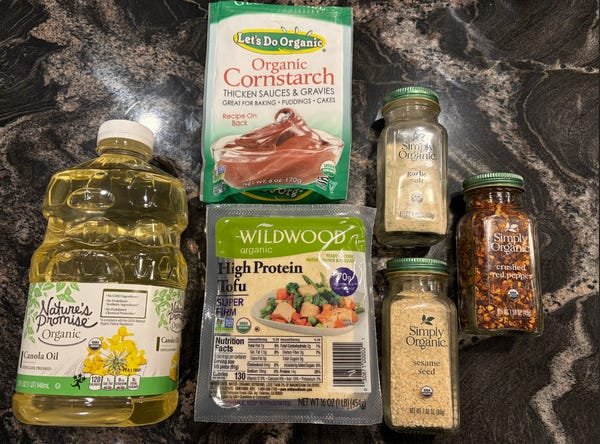
The ingredient list was short and sweet, and I already had several in my pantry.

Rebecca Strong

Conveniently, I already had most of the required ingredients for this recipe in my pantry and fridge.

Aside from extra-firm tofu, the recipe calls for a neutral cooking oil (like safflower), salt, and cornstarch.

Stewart also recommends grabbing mayonnaise and Sriracha for a dipping sauce, as well as chopped scallions and lime wedges for serving.

First, drain the tofu to ensure crispy results.


The writer draining tofu on a baking sheet.

In my experience, taking some time to drain the tofu is worth it.

Rebecca Strong

Although draining liquid out of tofu may take a little extra time, trust me when I say it’s worth it — because excess moisture will prevent your tofu from crisping up.

Stewart recommends lining a baking sheet with multiple layers of paper towels, arranging the sliced tofu on top, and then layering more paper towels on top of the tofu before weighing it down with another baking sheet topped with some heavy cans.

Then, wait 30 minutes for the liquid to drain onto the paper towels.

Stewart suggests slicing the tofu lengthwise into long strips, but I prefer to cut mine into cubes — I find that smaller pieces yield crispier edges.

Don’t forget to dredge the tofu.


The writer dredging the tofu in a bowl.

Next, I coated the tofu in cornstarch.

Rebecca Strong

After draining the tofu, coating it in cornstarch is key: When I first tried a fried-tofu recipe, I didn’t follow this step, and it didn’t crisp up nearly as well.

Stewart suggests mixing any of your preferred spices into the cornstarch prior to dredging, so I added garlic powder, sea salt, and sesame seeds. Other options mentioned in the recipe include Cajun seasoning, onion powder, and ground cumin.

To coat it, pour the cornstarch and spices into a large bowl or container, then add the tofu. Once everything’s in the bowl, either toss it with your hands or pop on a lid and shake it all up until all the sides are coated.

Next, it’s time to fry.


The writer frying the crispy tofu on a stovetop.

I used organic canola oil to fry my tofu.

Rebecca Strong

Heat up your oil in a large, heavy-bottomed pan over medium.

Stewart’s favorite oil for this recipe is safflower, since it has a high smoke point and neutral flavor — but canola oil, sunflower oil, vegetable oil, and peanut oil also work. I used organic canola oil because it’s what I had on hand.

If the tofu is too crowded in the pan, it won’t get evenly crunchy on the outside — so, Stewart says it’s best to split the tofu into two batches.

Fry each batch until the exterior of the tofu has just turned golden brown, turning every minute or two to ensure all sides make contact with the oil.

This should take five minutes, according to Stewart, but it took me closer to seven — perhaps because I like mine extra crunchy.

Finally, transfer your tofu to a paper-towel-lined plate and season it.


The finished crispy tofu on a paper towel.

The tofu came out looking crunchy and delicious.

Rebecca Strong

Once the tofu is done cooking, transfer it to a plate lined with paper towels to soak up any excess oil.

This is when Stewart recommends seasoning the tofu with salt, but because I already added salt to the cornstarch coating, I skipped that step.

Stewart’s favorite dipping sauce for this tofu is a mixture of mayo and Sriracha. I’m not a huge mayo fan, so I used a spicy tahini for a similar but nuttier vibe.

I did, however, follow her tips to garnish with scallions for a pleasantly peppery bite.

Now, I love adding this tofu to grain-and-veggie bowls for easy, high-protein lunches.


The tofu in a bowl with scallions, Brussels sprouts, cauliflower, and rice.

This tofu is great on its own, or as the starring ingredient in a veggie bowl.

Rebecca Strong

Miraculously, this recipe completely transformed my feelings about tofu.

I was amazed by the satisfying, crunchy texture and the sheer amount of flavor it held when seasoned well and served with the right sauce.

Best of all, this tofu is super versatile. Since falling in love with this recipe, I’ve started adding it to grain bowls with veggies for a super-satiating lunch or dinner.

My favorite combo is quinoa or white rice with roasted or sauteed Brussels sprouts, cauliflower, and broccoli. Sometimes I’ll toss in some avocado for creamy texture and healthy fats, or take a cue from Stewart and add a squeeze of lime.

I also believe this tofu would be a tasty addition to a Caesar salad, lettuce wrap, or taco with black beans and avocado.


Source link