
Fed-meeting-live-updates-FOMC-holds-rates-steady-as-oil.jpeg

Fed meeting live updates: FOMC holds rates steady as oil prices soar

The Bureau of Labor Statistics published new consumer price index data last Wednesday, showing the inflation rate held steady at 2.4% in February as expected. Core inflation, which excludes volatile food and energy prices, also held steady at 2.5%.

However, that report was based on data mainly gathered before the start of the Iran war, which could heat up inflation and jeopardize progress toward the 2% goal. Economists expect to see the effects of the oil shock from the Iran war as soon as the next report.

The Bureau of Labor Statistics published new consumer price index data last Wednesday, showing the inflation rate held steady at 2.4% in February as expected. Core inflation, which excludes volatile food and energy prices, also held steady at 2.5%.

However, that report was based on data mainly gathered before the start of the Iran war, which could heat up inflation and jeopardize progress toward the 2% goal. Economists expect to see the effects of the oil shock from the Iran war as soon as the next report.

Oil prices remain elevated as the Strait of Hormuz remains largely closed off. Gas prices are up from a month ago, and there are other factors affecting what consumers pay at the pump, such as higher demand in the spring.

Alexandra Wilson-Elizondo, global co-chief investment officer of multi-asset solutions at Goldman Sachs Asset Management, said February data “was collected before the conflict in Iran sent crude oil surging roughly 30%, with natural gas, aluminum, fertilizer, freight rates, and shipping insurance moving higher with it.”

“The Strait of Hormuz remains the wildcard, and if disruption is sustained, the inflation improvement embedded in today’s print could reverse quickly,” Wilson-Elizondo said in commentary following the CPI report.


Source link

Table

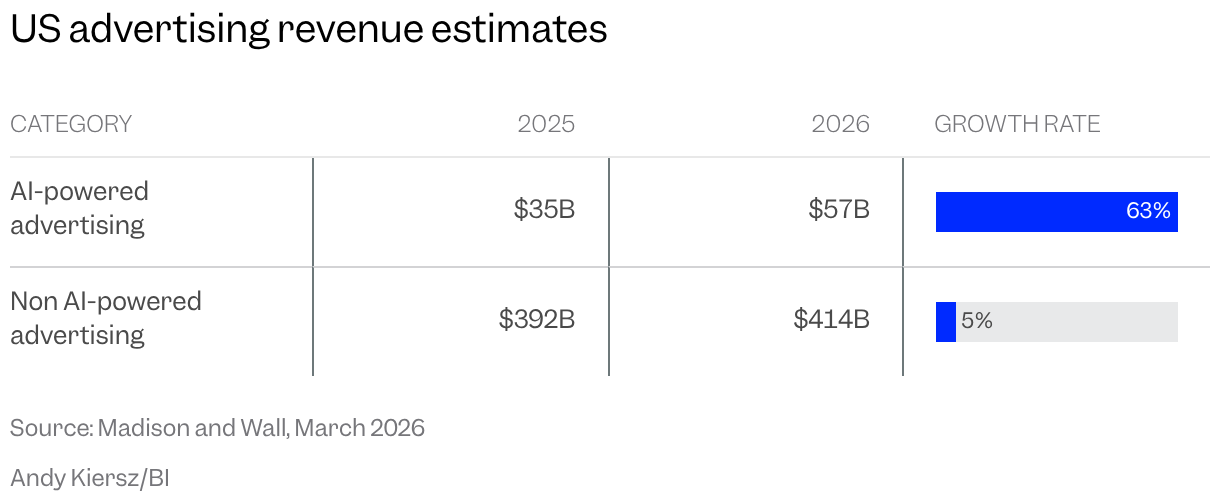
AI-powered ad spend is set to soar 63% this year as brands ditch manual controls

AI-powered ad tools are rapidly gaining market share.

Meta CEO Mark Zuckerberg memorably declared last year that its automated ad tools had become so powerful that brands could simply connect a bank account, set their campaign objectives, and let its artificial intelligence take over. New data suggests a growing number of advertisers are doing just that.

A report released this month by the Madison and Wall consulting and advisory firm estimated that AI-powered advertising revenue in the US will grow 63% to reach $57 billion in 2026, accounting for 12% of total advertising spending.

Madison and Wall said the 88% of advertising that doesn’t rely on AI-powered tools will grow by 5% in the same period.

“We think it’s a new dimension” of advertising growth, said Luke Stillman, managing director at Madison and Wall.

The firm defines AI-powered advertising as spend that flows through platforms where AI controls targeting, bidding, budget allocation, and campaign optimization with minimal human intervention.

The two biggest tools of this kind are Google’s Performance Max and Meta’s Advantage+, though many other platforms, from Amazon to TikTok, offer similar AI-powered advertising products. Search and social media are the dominant channels for AI-powered ads, Madison and Wall said.

Tech companies often cite these tools as a way for advertisers to speed up the time it takes to create and deliver ad campaigns, though some advertisers are wary about handing over the reins entirely to black box systems. Generative AI ad tools, in particular, can occasionally go rogue and produce bizarre ads if not closely monitored.

Stillman said that while use of AI-powered ad tools leans slightly more toward small advertisers, the spending figures are now so large that it’s clear big brands are adopting the tech as well.

“Every advertiser is going to say, ‘We really value control, and we want transparency to understand where every one of our dollars is spent,'” Stillman said.

That said, when Madison and Wall looked at where companies are deploying their budgets, the firm saw “little evidence that they are not willing to trade transparency and control in return for price and performance.”

If AI-powered tools help an advertiser hit their return on ad spend targets, “transparency is a nice-to-have, not a must-have,” Stillman said.

Madison and Wall estimated that AI-powered ad budgets will grow at a compound annual rate of around 29% through 2030.


Source link