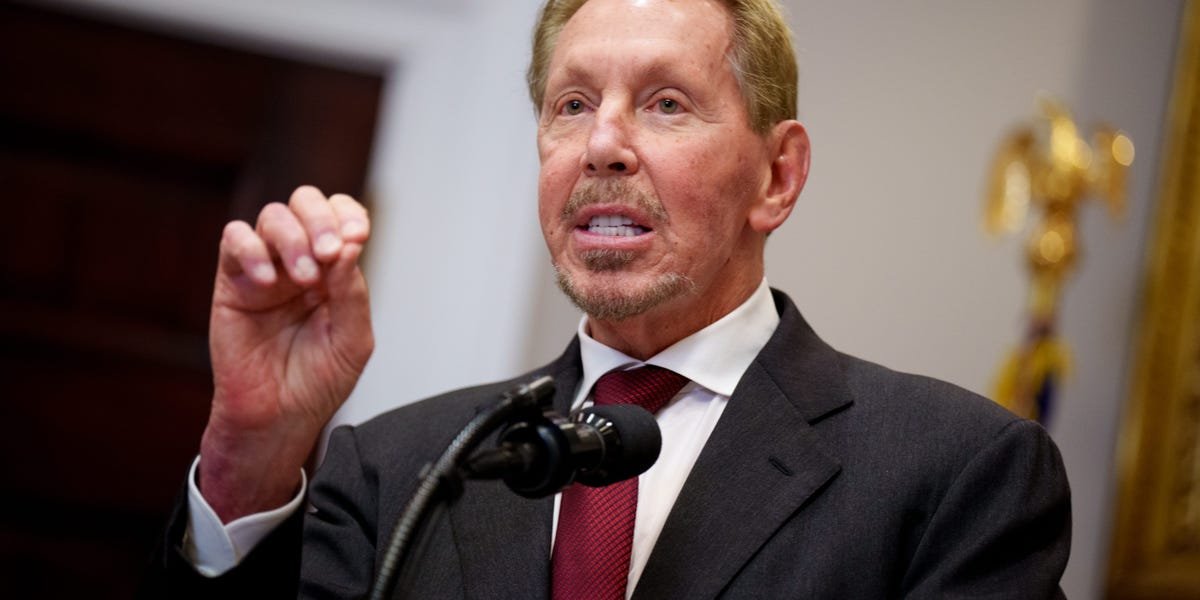
Oracles-Larry-Ellison-downplays-software-apocalypse-fears-We-think-the.jpeg

Oracle’s Larry Ellison downplays software apocalypse fears: ‘We think the SaaSpocalypse applies to others, but not to us’

Oracle executives downplayed fears that AI will spell the death of software-as-a-service companies.

Oracle Chairman Larry Ellison said during the company’s earnings call on Tuesday that he believes the so-called Saaspocalypse will be a problem for other companies, but not his.

“We have these coding tools now that allow us to build a comprehensive set of software, agent-based software, to implement to automate a complete ecosystem like healthcare or financial services,” Ellison said. “That’s what we’re doing at Oracle. That’s why we think we’re a disruptor. That’s why we think the Saaspocalypse applies to others but not to us.”

Fears that AI will replace traditional software tools have been particularly high over the past month, after Anthropic released new agentic AI tools, triggering a sell-off in software stocks, including Salesforce and Asana.

Oracle CEO Mike Sicilia also said on the earnings call that he doesn’t agree with the idea of the Saaspocalypse.

“I do think that AI tools and their coding capabilities would be a threat if we weren’t adopting them, but we are, and very rapidly,” he said. “We are building brand new SaaS products using AI and also embedding AI agents right into our existing applications suites.”

Sicilia added, “I’ve not yet met a customer who tells me they’re ready to give away their retail merchandising system, their core banking system, demand deposit account systems, electronic health record systems, and some cobbling together of niche AI features are going to replace all of that overnight. In fact, we hear quite the
opposite from the customers.”

Oracle isn’t the only company trying to downplay the fears of AI companies like Anthropic and OpenAI becoming a threat to software giants.

Salesforce CEO Marc Benioff recently tried to reassure investors that the company’s focus on AI agents would insulate it from the software apocalypse. “If there is a ‘SaaSpocalypse’, it may be eaten by the ‘SaaS-quatch’ because there are a lot of companies using a lot of SaaS because it just got better with agents,” he said.

Workday CEO Aneel Bhusri also tried to allay fears during the company’s earnings call last week that HR and business software systems require complex security and regulatory needs, and boasted that AI companies such as Anthropic and OpenAI are running its software.

Have a tip? Contact this reporter via email at astewart@businessinsider.com or Signal at +1-425-344-8242. Use a personal email address and a nonwork device; here’s our guide to sharing information securely.




Source link

Chong Ming Lee, Junior News Reporter at Business Insider's Singapore bureau.

The CEO of a $15 billion AI company says the biggest AI winners won’t be software — they’ll be mines, farms, and trucks

AI’s biggest impact will likely happen far from laptops, says the CEO of a $15 billion AI company.

Qasar Younis, the cofounder and CEO of Applied Intuition, said on an episode of “Lenny’s Podcast” published Sunday that “the real impact of AI in the next 5 to 10 years” would show up in physical industries, like “in farming, in mining, in construction, in self-driving trucks.”

Applied Intuition develops software to test and power autonomous vehicles and other machines. The company said in June that it raised $600 million in a funding round, valuing it at $15 billion.

Software tools like Moltbook and OpenClaw may excite developers, but Younis said they touch only a small slice of society.

“I love the stuff that’s happening on these platforms, but it’s still segregated to, like, frankly, developers,” he added.

Instead, he said the biggest shift will come from adding intelligence to machines already embedded in the physical economy.

“More pragmatically, it’s actually just putting intelligence into things that already exist all around us.”

Industries like trucking and farming urgently need that kind of autonomy, he said.

“People are not fighting for those trucking jobs,” Younis said. The average farmer is already in their late 50s, meaning many will retire in the coming decade, potentially worsening labor shortages.

AI is more likely to help fill labor shortages in these industries than replace them entirely, he added.

The company has tested autonomous trucks in Japan, where an aging workforce means a driver shortage, and it’s working on AI in mining safety and efficiency.

AI’s impact on blue-collar industries

Earlier this year, Wall Street grew worried that new AI tools and agents could replace some software products entirely.

A research paper by Citrini, an investment firm focused on thematic equity investing, triggered a global stock sell-off last month after researchers outlined a scenario in which the AI boom wipes out white-collar jobs and ultimately slows economic growth.

Against that backdrop, some industry leaders say physical industries could end up benefiting from the technology.

For instance, robots could help address labor shortages in manufacturing. Daniel Diez, the chief business officer of Agility Robotics, told Business Insider in a report published on Sunday that manufacturers globally “simply can’t find the people to do this work.”

Ford CEO Jim Farley said last year that AI-powered augmented-reality tools are helping technicians repair trucks more efficiently, though he warned that automation could still reshape jobs across the broader economy.

Business Insider reported last year that some Gen Z workers are increasingly considering trade and blue-collar careers as automation and AI create uncertainty around traditional white-collar professions.


Source link

Chong Ming Lee, Junior News Reporter at Business Insider's Singapore bureau.

I’m a senior software engineer laid off from Block. There are 3 things I’m keeping in mind as I reenter the job market.

This as-told-to essay is based on a conversation with Isaac Casanova, who has worked at Block for nearly three years as a senior software engineer. It has been edited for length and clarity.

I wasn’t even looking at my computer at the time. One of my good friends started spam calling me. I picked up the phone, and he told me to check my email.

I read the email from Jack Dorsey, and I was like, whoa, I guess I don’t have a role anymore.

We were well aware that rolling layoffs were underway. Most people assumed it would be capped at 1,000. I didn’t feel like anything big like that was coming. For it all to happen at once like that is obviously a shock.

I never got a low rating. In my conversations with folks, I was doing fine. That’s why it’s characterized as a layoff, not a performance thing. This is just a change in business direction.

Check your ego — the industry is tough

I’m managing my expectations as I look for work.

It seems like companies are tighter with headcount and more picky about who they want.

There are definitely fewer positions. Companies are doing more with less. These agents are automating some tasks and are slowly improving at understanding concepts.

The compensation is definitely lower. We’re hearing across the industry that stock grants are lower than they used to be. Refresher grants are lower. Bonuses — if they exist.

Once you get in, it’s stack-ranked performance management. Your output is compared to your peers from day one. It’s definitely tougher.

You’ve got to check your ego. That might be the part people struggle with more than their technical ability.

Separate your identity from your job

At the end of the day, companies are beholden to shareholders.

Jack’s memo came across as what someone in that position making a tough decision would say. A call was made, and it had to be communicated. I don’t have any negative feelings about anybody that I worked with or at the company.

The biggest expense of running an organization is employees. The higher you are — senior engineer, engineering manager, head of product — the more expensive you are.

You need to remember that and evaluate your relationship with work. Many people in these positions tie their identity to their jobs. Those are the people most affected when these things happen.

You try not to take it personally. You see it as a new opportunity. There’s a human aspect — you just lost your job, and it kind of sucks for a bit — but you can’t let it hold you down. You can’t let it define you. These things happen, and you need to adjust.

The good thing about when these things happen is the network of people that you’ve met. Build the network so that when things like this happen, you can maneuver.

Be flexible — AI is changing the role

You could tell on the inside that things were changing.

A couple of years ago, I was doing most of the coding by hand. That slowly turned into using interfaces like Cursor, Claude Code, Goose, and ChatGPT. You’d slowly read things internally like, “Let’s speed up.” You were expected to speed up because the agents could make you more productive.

You’d have conversations with some of your colleagues and be like, “I haven’t opened my IDE in a month.” As a software engineer, that’s definitely a shift.

AI turns you from a person who just turns out code into more of an experimenter — a builder.

Software engineering, for a long time, was so by the letter, by the design, by the spec. Exact and precise, but slow.

Now we have these tools, the industry expects you to move fast. You can shift your mindset from that rigid engineering, step-by-step, to more of an exploratory “attack the problem, solve it, refine it later.”

Don’t get too trapped in the domain that you’re working in. Block tended to hire specialists who could also generalize when needed. So, be flexible. Using these tools allows you to get context in areas that you might not have had the opportunity to work in.

Do you have a story to share about tech layoffs? Contact this reporter at cmlee@businessinsider.com or on Signal at cmlee.81.


Source link

Microsoft-is-considering-a-new-AI-loaded-software-bundle-for-Microsoft.jpeg

Microsoft is considering a new AI-loaded software bundle for Microsoft 365, sources say

  • Microsoft is considering releasing a new AI revamp of its software bundle, sources say.
  • The bundle could include Microsoft Copilot and its new AI agent hub, Agent 365.
  • The company could charge up to $99 per user.

After years of internal buzz and false starts, Microsoft is considering rolling out its long-rumored E7 enterprise productivity software bundle, a pricier, AI-loaded version of Microsoft 365, according to two people familiar with the plans.

Microsoft 365 is a popular suite of productivity software that includes widely used tools such as Microsoft Word, Excel, and PowerPoint. Microsoft sells this software primarily in bundles called E3 and E5, where the E stands for “enterprise.” E3 is a more basic offering, while E5 has more bells and whistles.

A larger, more expensive “E7” software bundle has long been rumored and has earned a kind of mythical status inside Microsoft, with employees and salespeople debating and guessing whether it will ever appear.

Microsoft’s AI-packed E7 bundle comes as competitors like Google, Salesforce, and nearly every major software-as-a-service company rush to embed AI tools and autonomous agents into their products. Software stocks have taken a significant hit this year as investors worry that generative AI tools will upend traditional software products.

Microsoft declined to comment.

The new E7 bundle under consideration includes everything in the E5 bundle, plus AI features such as Microsoft Copilot and the company’s new AI agent hub, Agent 365, the people said.

Microsoft is looking into per-seat and consumption-based pricing for E7, but could charge up to $99 per user per month, the people said. E5’s current advertised price is $57 per user per month while Copilot is advertised as an add-on for $21 per user per month.

The company previously floated a new AI software bundle in 2024, but paused the plan.

Have a tip? Contact this reporter via email at astewart@businessinsider.com or Signal at +1-425-344-8242. Use a personal email address and a nonwork device; here’s our guide to sharing information securely.



Source link

After-weeks-of-getting-bashed-two-software-giants-can-make.jpeg

After weeks of getting bashed, two software giants can make the case for why AI won’t kill them

After being marked for dead, software companies have a chance to tell their side of the story.

Excluding Canada’s Olympic hockey teams, no one has had a tougher go recently than software companies. Everyone faces some fear over AI, but software’s diagnosis has been more dire than most. (Author Nassim Taleb was the latest to write software’s eulogy, although he’s not known for his optimism.)

Two software giants — Salesforce and Snowflake — get to make the case for why they’re still very much alive. Both companies report earnings after the bell and will be interested in changing a narrative that’s helped push their stocks down 27% (Salesforce) and 26% (Snowflake) this year.

(Workday, another software company that’s been getting hammered, made the case yesterday why AI is friend, not foe.)

A major problem for software companies is that their opponent is largely hypothetical. Even if both companies report blockbuster earnings, there’s still the counterargument that AI will eventually eat their lunch.

Anthropic has played this game masterfully. The startup has strategically rolled out product announcements for its AI chatbot, Claude. The news has devastated entire industries despite there being no evidence of widespread adoption yet.

Here’s what to look out for from Salesforce and Snowflake when they report:

Salesforce: Marc Benioff’s company is the prototypical enterprise software company. Customer relationship management systems are all about workflow and rely heavily on seat-based subscriptions. That makes Salesforce a prime target for AI automation and a bellwether for other software companies.

Benioff has sought to address competitors head-on with Salesforce’s own AI agents and even contemplated a name change to acknowledge the shift. But Agentforce has had its share of challenges. An internal survey showed that most employees feel AI is increasing their productivity, but Salesforce will want the same positivity coming from outside its walls.

These days, AI might not even be Salesforce’s biggest headache. An off-color joke from Benioff at a recent employee event has outraged many workers and even prompted fellow Salesforce executives to speak out.

Snowflake: The data-warehousing giant might seem like a major beneficiary of AI. Models need tons of data to function. Snowflake helps companies organize and analyze massive amounts of data. Everybody wins!

The potential future isn’t as rosy. Snowflake’s business might not face the direct risk that other software companies struggle with, but it could slide down the totem pole of customers’ tool set. Instead of being considered a crucial software, it could become just another piece of back-end infrastructure.

Snowflake’s own CEO warned of this future, saying models’ desire to have easy access to all types of data means “everything else, the world, is just a dumb data pipe that feeds into that big brain.”

And unfortunately for Snowflake, the value you provide to customers as a “dumb data pipe” is a lot lower, meaning you can’t charge as much.


Source link

Shuby headshot

Snowflake’s CEO says software giants risk becoming a ‘dumb data pipe’ to AI models

The biggest software companies might be reduced to mere data sources, says Snowflake’s CEO.

“The big model makers want to create a world in which all of the data for all of the enterprises is easily available to them,” Sridhar Ramaswamy said on an episode of Alex Kantrowitz’s “Big Technology Podcast” published last week. “Everything else, the world, is just a dumb data pipe that feeds into that big brain.”

Prior to becoming Snowflake’s CEO in 2024, Ramaswamy was a partner at Greylock Ventures and cofounded AI search startup Neeva, which was acquired by Snowflake.

Ramaswamy added that Snowflake needs to operate with a “fear” that people would stop using AI agents developed by software companies and instead want an all-inclusive agent that has data from Snowflake, for example, and everywhere else

He said his solution was to let customers take the lead and decide how they want to access their data — directly through their own agents, or through a product like ChatGPT.

In the last few months, AI labs have evolved from being sources of AI infrastructure to becoming software providers themselves. OpenAI has entered the sales, support, and document analysis market, threatening incumbents such as Salesforce and Oracle.

On a podcast released last week, Andreessen Horowitz general partner Anish Acharya said software firms were being unnecessarily punished by Wall Street over fears that AI could take over their industry. The VC said that legacy software could not be replaced so easily, because it would not be worth it to use AI for every business function.

He said that software accounts for 8% to 12% of a company’s expenses, so vibe coding to build the company’s resource planning or payroll tools would only save about 10%. Instead, companies should focus on big-ticket items, like developing their core businesses or optimizing other costs.

Ramaswamy and Acharya’s comments follow a brutal start of the month for software stocks, which dragged down tech and broader markets. The sell-off started when already-wary investors panicked about Anthropic’s new AI tool, which can perform a range of clerical tasks for people working in the legal industry.


Source link

Shuby headshot

Anthropic’s CEO says we’re in the ‘centaur phase’ of software engineering

Dario Amodei has a novel analogy to describe how AI and humans are working together.

On an episode of the “Interesting Times with Ross Douthat” podcast published on Thursday, the Anthropic CEO compared human engineers and AI working together to the mythical horse-and-human combination known as the centaur.

He used chess as an example: 15 to 20 years ago, a human checking AI’s output could beat an AI or a human playing alone. Now, AI can beat people without that layer of human supervision.

Amodei, who cofounded AI lab Anthropic in 2021, added that the same transition would happen in software engineering.

“We’re already in our centaur phase for software,” Amodei said. “During that centaur phase, if anything, the demand for software engineers may go up. But the period may be very brief.”

He said he’s concerned about the “big disruption” entry-level white-collar work would see. The CEO added that it may be unfair to compare this to the shift from farming to factory to knowledge work revolution because that happened over centuries or decades.

“This is happening over low single-digit numbers of years,” he said.

Amodei is among the most prominent voices warning that AI could erase some white-collar work, especially in law, finance, and consulting. In a January essay, he predicted that AI could disrupt 50% of entry-level jobs in the next one to five years.

The leaders of other top AI labs, including Mustafa Suleyman and Demis Hassabis, have made similar comments about advanced AI automating service jobs within the next 18 months.

Execs at some software companies counter that AI would make engineers more productive and that companies would need more of them.

“The companies that are the smartest are going to hire more developers,” GitHub CEO Thomas Dohmke said on a July podcast. “I think the idea that AI without any coding skills lets you just build a billion-dollar business is mistaken.”

Atlassian’s CEO said that as AI advances, people will keep coming up with new ideas for the technology they want, and engineers will be needed to build it.

“Five years from now, we’ll have more engineers working for our company than we do today,” Mike Cannon-Brookes said in an October interview. “They will be more efficient, but technology creation is not output-bound.”


Source link

Software-engineers-are-getting-crushed-by-AI-—-and-they.jpeg

Software engineers are getting crushed by AI — and they think you’re next.

Software engineers are getting crushed by AI, and they think you’re next.

AI’s ability to automate code is simultaneously making developers productive and overworked. One technologist said his job is harder than ever, lamenting that “AI fatigue” is real.

The good news is it won’t last forever. The bad news is that’s because most of them will be out of a job.

Software veteran Steve Yegge predicts that AI will eventually lead Big Tech companies to cut 50% of their engineers. (He wasn’t a total drag. Yegge offered advice to software engineers for avoiding the ‘vampiric effect’ of AI.)

“Ok, but I don’t work in tech. Why do I care?” you callously ask. (So cold!)

Well, according to the people in the thick of it, AI isn’t stopping with them.

Matt Shumer, the CEO of an AI startup, warned AI’s disruption will be “much bigger” than COVID. The post has racked up more than 69 million views on X, gaining traction outside traditional tech circles. Shumer spoke to BI’s Brent D. Griffiths about the post and the fact that he (surprise!) used AI to help him write it.

It’s worth noting Shumer’s company specializes in AI personal assistants. He certainly benefits from getting people on board with AI. But that doesn’t invalidate a lot of his points about workers needing to adapt to a rapidly changing environment.

There’s a counterargument to the doomsday prophecy.

Maybe engineering jobs are especially ripe for AI disruption?

The job, after all, is highly digital and requires hard skills, two factors that make it a strong candidate for AI automation.

Software engineers have also been somewhat insulated from the tech-based disruptions the rest of us have endured and adapted to during the pre-AI times. A new tool here. A new app there. At some point, many of us have gotten numb to tech disrupting what we do. You just figure out how to adapt.

Meanwhile, software engineers were living on easy street. You don’t have to worry about the tools when you’re the ones building them. For years, software developers enjoyed healthy salaries, good work-life balance, and fantastic job security.

Now the tables are turned, and suddenly it’s everyone’s problem?

I’m not suggesting AI won’t impact the rest of us. For starters, entry-level jobs across the board appear to be on the chopping block thanks to AI. Consultants also seem ripe for some shakeups. And the legal industry is certainly feeling the heat.

(I could mention journalism, but we were on the extinction list long before AI. When I started college in 2007, my professors all told me the industry was dying. Almost two decades later, we’re still here. If anything, it looks like AI has created some high-paying jobs for writers.)

AI might end up being massively disruptive for all of us, but at this point, we’re all used to it.

Where do you stand on the AI doomsday prophecy? Send me an email at ddefrancesco@businessinsider.com.


Source link

Jamie Heller, incoming Editor-in-Chief

What’s the future of the software business look like? Our top tech columnist weighs in.

The future of software

Software stocks had a brutal week, aside from a Friday rally, extending what has been a rough year for the industry. I touched base with our tech columnist, Ali Barr, the best I know on AI business models. He also wrote this piece in the midst of the selloff.

Ali, you’ve been covering AI adoption and costs by big business since you started our Tech Memo newsletter. What’s your gut on whether the recent selloff was overblown?

Software business models have underpinned the tech industry for decades. Companies invest heavily upfront to build software, but each additional copy costs almost nothing to distribute. So revenue scales faster than costs, driving fat profit margins. That dynamic helps explain why Microsoft, the world’s largest software company, is so valuable.

AI challenges this model. If this new technology makes employees more productive, companies may need fewer software subscriptions. And as AI tools improve, businesses could replace existing software with AI-driven workflows or even build their own software using AI coding tools. Finally, if software companies embrace AI, that could make their services more expensive to run than traditional software. That would mean rising usage doesn’t automatically translate into soaring profitability.

If software in the AI era becomes less profitable and grows more slowly, then it’s logical that the stock prices of software companies might fall. A lot.

Big Tech spending on AI data centers and other infrastructure is set to soar again this year. How will these companies generate a return on these huge investments?

The numbers are breathtaking. Just two companies, Google and Amazon, are planning capex of almost $400 billion in 2026. A couple more years of the same, and that’s more than $1 trillion.

To get a return on this, they will have to come up with new revenue of well over $1 trillion in future years. AI is amazing and really useful, but it’s hard for some investors to see how this happens. Even if new AI products are awesome, do consumers and companies have enough money to buy all this stuff? I don’t know. One outcome could be that Big Tech giants make do with slimmer profit margins in an AI future. That’s similar to the concerns that have hammered software stocks lately.

Who are the most-interesting people to watch in the sector?

I pay attention to Andrej Karpathy. He was director of AI at Tesla and a founding member of OpenAI. He’s pretty independent nowadays, which means what he says about AI can be trusted more. Bonus: He coined the term “vibe coding.”

Aditya Agarwal was Facebook’s first head of product engineering. He was also CTO and VP of engineering at Dropbox. He’s a coding powerhouse. Recently, he used Claude to do some coding and was stunned by the power of this tool. “I am filled with wonder and also a profound sadness,” he wrote on X. “We will never ever write code by hand again. It doesn’t make any sense to do so. Something I was very good at is now free and abundant.”

I’m usually skeptical, but the start of 2026 feels like a moment of highly disruptive — and destructive — change.


Source link

Dan DeFrancesco

What the software stock sell-off says about your job security

Everyone’s freaking out about AI again, which means it’s time to rethink how secure your career is.

BI’s Ana Altchek has a piece about how to future-proof your job since the only certainty in the job market appears to be more uncertainty.

A market meltdown in software stocks has people on edge this time. The characters might have changed, but the plot is still the same.

A new tool (an AI plugin from Anthropic) launched to automate work (tracking compliance and reviewing legal docs) leads to a sell-off among leaders in the space (legal-software stocks).

We can debate whether the reaction was warranted (more on that below), but this narrative isn’t going away. AI companies will keep automating different types of work, leaving the companies in that space scrambling and their employees nervous.

Ana spoke to experts about different ways to get ahead, from auditing your job to the skills you can lean into to build more career immunity. Overall, the idea is not to get caught flat-footed.

For more on the inner workings and culture of the business world, check out Ana’s weekly series “This Week at Work,” and subscribe to our workplace roundup newsletter, Work Shift. (You’re still required to read this every day, though. No excuses.)

One group has felt particularly safe amid the AI chaos.

Trade workers have been sitting pretty as panic rises among the white-collar workforce. A recent survey conducted by The Harris Poll found 75% of Americans agree that “hands-on skills and practical experience matter more than formal degrees when it comes to career success.”

And even more (78%) agreed “the stigma around trade or blue-collar work is declining” because hands-on skills are becoming so valuable.

The leaders of the AI revolution, from Elon Musk to Jensen Huang, have also praised tradework as a much more resilient career path.

That is likely the case in the short term. But down the road, all bets are off. Tesla is aggressively pushing into humanoid robots. OpenAI is also quietly scaling its robotics project.

There’s a long way to go, with most robots being more flop than pop. But the potential and interest in developing the space is there, as was evident at this year’s Davos. And some see the eventual economic impact of physical AI being far greater than that of software.

Because eventually, AI will come for all of us if we’re not willing to adapt.


Source link