
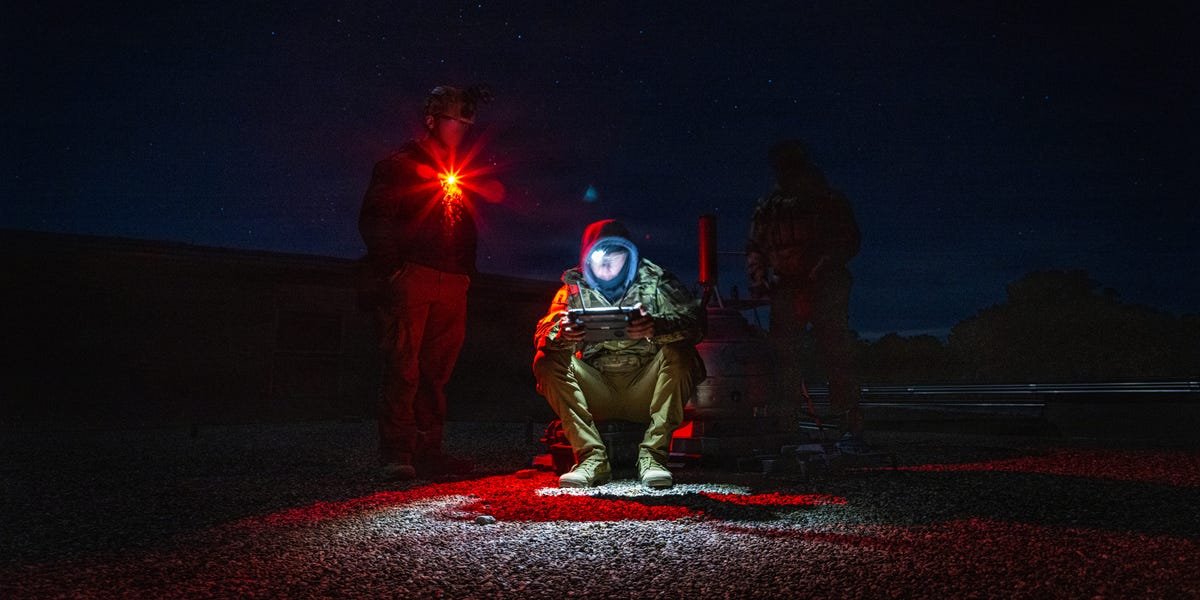
The-US-Army-is-test-driving-a-new-hotline-for-soldiers.jpeg

The US Army is test-driving a new hotline for soldiers overwhelmed with too much data — both in and out of combat

As the Army transforms into a more data-centric force, it’s testing out how to support soldiers navigating data problems, drowning in battlefield information, and adapting to new systems.

The US Army Data Operations Center, a 180-day pilot program, is the service’s solution to data management, providing a hotline for soldiers across the Army to receive help with problems ranging from data on the Next Generation Command and Control system to troubleshooting new software or issues in the cloud. It’s the latest element of what Army leadership describes as a generational shift in how the service operates and fights.

ADOC went live last week, with a small team of civilian and soldier data specialists and engineers taking requests from different organizations. As of Tuesday, officials told reporters, the center had received seven requests.

The warfighting engagement cell, operating 24/7, receives questions, essentially tickets in a dashboard, and then analyzes the issues, works with data engineers to provide solutions, and sends them back to the user.

While the center is currently in test-mode, it could be the nexus of how the Army manages its data problems across the service. “I think ADOC will serve as the Army’s single authoritative organization for anything when it comes to data operations,” Lt. Gen. Jeth Rey, deputy chief of staff of the Army’s G-6, said. ADOC, Army leaders said, could be vital to helping the Army’s transition to fully maturing in the data space.


A laptop computer sits at a desk with people standing around it.

The Army is undergoing a major, data- and software-driven transformation. 

US Army photo by Cpl. James Robinson


The center has so far received requests related to unit training. But ADOC is able to respond to tickets from soldiers in conflict or battlefield environments.

“We haven’t received anything yet to support those operations, but if there were to be a request, we would surge on that and prioritize that appropriately,” said Brig. Gen. Michael Kaloostian, director of Command and Control Future Capabilities Directorate at Army Transformation and Training Command.

One major aspect of the first 180 days of ADOC is tracking trends in the types of problems it receives, what types of information related to data could be implemented in training, and whether the center should be expanded.

Conversations are already underway about what role artificial intelligence can play in help requests and whether an AI agent could field a call and provide a solution before a specialist gets involved.

The center helps address what Army leaders have referred to as data silos in the service, separating different programs, weapons, and software. It was born out of the Army recognizing frustration over red tape that prevented full-picture understandings of information.


Soldiers stand around in a white tent. One soldier holds a laptop.

ADOC is currently a 180-day pilot for the Army to gather information and feedback before seeking next steps. 

US Army photo by Pfc. Thomas Nguyen


“We’re seeing these lieutenant colonels and these operational data teams that are banging their heads against the wall trying to figure out how to make these connections happen,” Kaloostian said.

“They need somebody to call,” he continued. “There isn’t a help desk for them to call. That’s why we say we’re the 9-1-1 for those operational data teams… We’re just there to augment and help. Let’s alleviate some of that burden.”

There is a surge in data from across the battlefield, and the Army believes accessing, analyzing, and understanding all of that data quickly will be essential in a potential future war.

But with more sensors, weapons, and systems, and therefore more data, comes the potential for data overload. ADOC, Army officials said, is an example of the service trying to help cut through the noise and move faster, with an ultimate goal being, as Lt. Gen. Chris Eubank, head of US Army Cyber Command, said, that the service is “creating soldiers that are data-smart more and more, and the heavy lifting is done inside of a central organization, if need be.”

The Army has undergone a seismic shift in how it thinks about battlefield data, specifically getting information to commanders and decision-makers and how weapons and technologies communicate and work together. It’s a transformation initiative perhaps best exemplified by NGC2, the Army’s future warfighting software, which is heavily data-driven.

“It used to be about firepower, but it isn’t really about that anymore,” Rey argued. “It’s really about who can get the data to make decisions faster, to dominate.”




Source link

Ukrainian-soldiers-armed-with-scissors-say-they-cut-any-fiber-optic.jpeg

Ukrainian soldiers armed with scissors say they cut any fiber-optic drone cable they see — even if it might be their own

Ukrainian soldiers are out cutting and snapping any fiber-optic drone cables they come across, regardless of which side they belong to. They use scissors, knives, even their bare hands.

Troops say it doesn’t matter if a drone is Ukrainian or Russian. If they’re not sure, they just assume it’s hostile.

These unjammable drones controlled by long, thin cables have flooded the battlefield as a countermeasure to the electronic warfare that often renders radio-frequency drones inoperable.

As these drones have become increasingly prolific, the result has been forests and trenches snarled with discarded and active cables.


A snowy field with brown shubbery with thin white cables running across it and a small drone in a grey sky

Fiber-optic drones can leave webs of cables across Ukraine.

Francisco Richart/SOPA Images/LightRocket via Getty Images


Dimko Zhluktenko, an analyst with Ukraine’s Unmanned Systems Forces, said that he always carries scissors so that he can “cut each and every optic fiber that we see.”

He said that his unit “actually stopped considering them friendly or foe. We think that all of them are kind of the enemy drones.”

In a YouTube video about the gear he carries, Zhluktenko said scissors became so essential that when his unit started operating in areas littered with fiber-optic cables, every team member was required to carry a pair. He said that he bought retractors for his team so no one would lose them.


A man in khaki gear stands in a dark space with stairs leading up to light behind him, pulling out scissors from a pouch at his chest

An analyst with Ukraine’s Unmanned Systems Forces said he carries scissors to cut the cables of fiber-optic drones he comes across.

Dimko Zhluktenko


A Ukrainian soldier who spoke with Business Insider on the condition of anonymity said troops can often break the thin strands with their hands; that isn’t often necessary, though. Soldiers in his unit already carry scissors for medical purposes. Many also have knives.

He said that there can be so many cables about on the battlefield that “you don’t know if it’s a new thread or if it’s an old one that’s been lying around for a long time.” So his unit severs any they find as often as possible.

Not just fiber-optic cables

Other similar behaviors have been observed on the battlefield.

There are sometimes so many drones in the sky that soldiers looking up from the ground can’t even begin to tell which is friendly and which is hostile. In such cases, soldiers can be ordered to shoot down any drone they see.

Soldiers in charge of electronic warfare systems sometimes panic and jam everything in the air when they can’t tell drones apart, Zhluktenko previously told Business Insider.


Thin pale wires come out of a black and white cylinder with a gloved hand holding them

Drones controlled by fiber-optic cables are popular as they can’t be jammed.

Viktor Fridshon/Global Images Ukraine via Getty Images


Zhluktenko told Business Insider that cutting the fiber-optic cables is not something that he had to do often, as his unit was typically working in areas further from the front-line fighting that had fewer of the fiber-optic drones. He described it as something that they “sometimes” encountered.

Soldiers in Ukraine’s 15th Mobile Border Detachment “Steel Border” previously said in a video for Ukraine’s state border service that using scissors is a reliable way to disable the Russian drones. Russian soldiers have reportedly done the same.

If the cable is intact on an active and operational drone, the only other way to stop it is to physically shoot it (troops say a shotgun works best); that requires a mix of skill and luck, though.

Fiber-optic drones are a relatively new feature in this war that have not previously been fielded at this scale. That these drones can be disabled with simple tools — scissors, knives, bare hands — underscores a broader pattern in Ukraine: sophisticated systems are often countered with low-tech fixes.

In many cases, some of the most effective counters to advanced technology have been older or improvised combat tools — from shotguns used against small drones to nets draped over vehicles and positions to blunt aerial attacks. Even the drones themselves are cheap innovations designed to overcome more expensive equipment and wartime demands.


Source link

Headshot of Chris Panella.

US Army leaders say soldiers are drowning in so much battlefield data that AI is needed to make sense of it all

Army leaders say the modern battlefield is so saturated with sensors and networked weapons generating more data than soldiers can realistically process on their own that artificial intelligence is needed to meaningfully sort it all.

For years, the Army’s focus was on fielding more sensors for battlefield information and awareness, but now the service is also having to think about information overload and managing the massive amounts of data coming in.

During a recent US Army and NATO exercise in Europe, troops used a homegrown AI system to consume and sort data. The value wasn’t strictly that the AI could do it faster but rather that it could remember context and patterns that humans couldn’t.

The case from the Dynamic Front exercise is another example of how the US military is increasingly implementing AI and automation into everything from enemy attack simulations to paperwork.

“The modern battlefield, what we’re already seeing across the globe, it is swimming in sensors, and we are drowning in data,” Col. Jeff Pickler, the Army 2nd Multi-Domain Task Force commander, said at a media roundtable on Dynamic Front.

There aren’t enough people to decipher all the available information, he said. “They will never be able to fully process all of that.”


Two soldiers stand near an artillery piece about to fire in a wintry landscape.

This year’s Dynamic Front included almost 2,000 US personnel and almost 4,000 personnel from allies and partners.

US Army photo by Kevin Sterling Payne


The software aimed at addressing that problem remains in beta testing. In the next iteration of Dynamic Front — which will merge with another exercise, Arcane Front, to pair technology experimentation with theater-level combat rehearsals — Army leaders say they intend to test the AI at a larger scale.

“If we’re looking at a target set in the European theater where we think we’re going to need to process upwards of 1,500 targets a day, that’s beyond the human scope,” Pickler said. “The answer to the equation there is in AI and automations.”

During a potential large-scale conflict in Europe, AI could assist in locating and assessing those targets.

The system can do this quickly, but the speed isn’t the main benefit. AI can remember patterns that humans might forget or not even notice. Pickler gave an example of AI realizing that unrelated shipping reports, a local power outage, and a fertilizer delivery together might suggest missile fueling activity.

“So the difference isn’t seconds versus minutes — it’s minutes instead of months. Not because the machine scans quickly, but because it keeps context across sources that humans can’t hold in memory,” Pickler said after the roundtable.

“It doesn’t replace analysts by reading faster,” he said, “it replaces the weeks analysts spend reconnecting information spread across thousands of reports.”


Two soldiers sit at a table working on laptops.

AI, autonomy, and machine learning are at the forefront of the Army’s modernization efforts.

US Army photo by Capt. Regina Koesters


In a conflict scenario, that could mean analysts reach a clearer picture of the battlefield faster. Correlations between data gathered from different sensors could surface more quickly. If an adversary were fueling, arming, or moving weapons in ways that were not immediately obvious, AI could help flag those links.

Humans, though, would still decide how to respond.

Soldiers have seen success with iterating on the current AI model, the Army said. It’s been retooled during testing, and humans remain in the loop, reviewing outputs at multiple stages.

The goal is to continue increasing the overlap the model would have with human-produced information. In a targeting example, a milestone would be if AI achieved 90 to 95% agreement with humans on 100 target sets.

The Army’s push for AI and automation is also driving the development of its Next Generation Command and Control software, a priority initiative.

The technology being developed by vendor teams including Anduril, Palantir, and Lockheed Martin uses AI and machine learning to provide commanders and soldiers with real-time data on ammunition levels, maintenance needs, intelligence feeds, targeting, and simulated enemy attacks.

But AI is also changing other aspects of how the Army works. Autonomous features in drones, weapons, and targeting might be at the forefront, but behind the scenes, personnel are using new tools, redesigned workflows, and data integration for recruiting, maintenance, and inventors. These are manual tasks that the service believes can be improved with AI.


Source link