
F-15E-Strike-Eagles-deployed-during-Operation-Epic-Fury-can-fly.jpeg

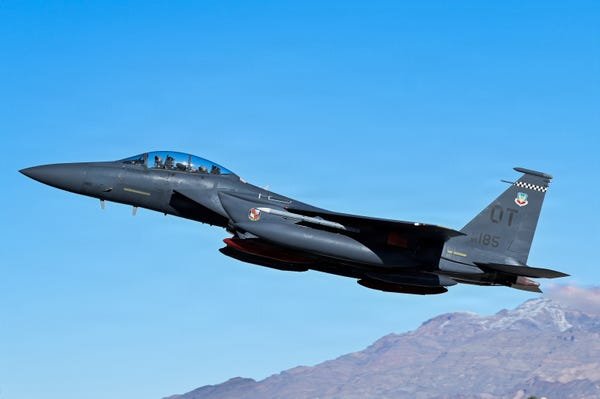
F-15E Strike Eagles, deployed during Operation Epic Fury, can fly 2.5 times the speed of sound. Take a closer look.

  • The US Air Force deployed F-15E Strike Eagles during Operation Epic Fury against Iran.
  • The fighter jets are designed for air-to-air and air-to-ground combat in all weather, day or night.
  • Kuwait mistakenly shot down three F-15E Strike Eagles in a “friendly fire” incident, CENTCOM said.

F-15E Strike Eagles, fighter jets designed for air-to-air and air-to-ground combat, are usually a dominating force in the skies.

When three F-15E Strike Eagles were mistakenly shot down by Kuwait during Operation Epic Fury, it brought renewed attention to one of the Air Force’s fastest, most versatile aircraft.

Here’s a closer look at the F-15E Strike Eagle, an advanced aircraft the US is using to destroy Iran’s missile arsenal and drone bases from the skies above Iran.

The F-15E Strike Eagle has been in service in the US Air Force for nearly 40 years.

An F-15E Strike Eagle at Nellis Air Force Base in Nevada. 

U.S. Air Force photo by Airman 1st Class Jasmine Thomas

The first F-15A model flew in 1972, and the first F-15Es were produced in 1988, according to the US Air Force.

It’s the fastest crewed aircraft in the US Air Force.


An F-15E Strike Eagle flies through the sky.

An F-15E Strike Eagle during an exercise at Gando Air Base in Gran Canaria, Spain. 

U.S. Air Force photo by Staff Sgt. Elizabeth Davis

The air-to-air and air-to-ground attack aircraft can fly at 1,875 miles per hour, or 2.5 times the speed of sound.

The F-15E Strike Eagle’s high thrust-to-weight ratio enables it to accelerate during vertical climb.


An F-15E Strike Eagle.

An F-15E Strike Eagle in flight. 

U.S. Air Force photo by Staff Sgt. Tylin Rust

The high thrust-to-weight ratio also allows the F-15E Strike Eagle to execute tight turns without sacrificing speed. It has two Pratt & Whitney F100 engines, each producing over 23,000 pounds of thrust.

Another distinguishing capability is the plane’s head-up display, which projects flight and tactical information directly on the windscreen.


The head-up display on a C-17 Globemaster III.

The head-up display on a C-17 aircraft. 

U.S. Air National Guard photo by Tech. Sgt. John Linzmeier

Pilots can track and attack targets, check the status of weapons, and see other tactical and flight information without taking their eyes off the windscreen.

The fighter jet also includes a low-altitude navigation and targeting infrared for night (LANTIRN) system.


The underside of an F-15E Strike Eagle.

The underside of an F-15E Strike Eagle. 

U.S. Air Force Photo by Airman 1st Class Olivia Gibson

The LANTIRN system allows the planes to fly in any weather and attack ground targets at low altitudes. The system consists of two pods, a navigation pod and a targeting pod, mounted under the plane.

F-15E Strike Eagles can carry both nuclear and conventional weapons.


Loading an AIM-120 missile onto an F-15E Strike Eagle

US Air Force crew members load an AIM-120 missile onto an F-15E Strike Eagle aircraft at Mountain Home Air Force Base in Idaho. 

Airman 1st Class Donovin Watson/366th Fighter Wing

Its armament includes an internally mounted 20-millimeter gun with 500 rounds of ammunition, AIM-9 Sidewinder missiles, and AIM-120 AMRAAMs, an acronym for the radar-guided Advanced Medium-Range Air-to-Air Missiles.

The F-15 also regularly carries ground attack weapons like the Joint Direct Attack Munition, or JDAM, a kit that adapts an unguided munition into a “smart” bomb with fins and GPS guidance.

F-15E Strike Eagles are flown by a pilot and a weapons systems officer.


The cockpit of an F-15E Strike Eagle.

The cockpit of an F-15E Strike Eagle. 

U.S. Air Force photo by Airman 1st Class Aidan Martínez Rosiere

The weapon system officer sits directly behind the pilot, and closely manages the plane’s sensors and weapons.

Two variants of the F-15 are single-seaters: the F-15A and F-15C.

The planes can fly 2,400 miles without refueling, and can be refueled in flight.


An F-15E Strike Eagle receives in-flight refueling from a KC-135 Stratotanker.

An F-15E Strike Eagle receives in-flight refueling from a KC-135 Stratotanker during an exercise over the Atlantic Ocean. 

U.S. Air Force photo by Senior Airman Cody J. A. Mott

F-15E Strike Eagles have a fuel capacity of 35,550 pounds.

The fighter jets can be refueled in flight by KC-135 Stratotanker aircraft, which Boeing developed from its “Dash 80” prototype in the 1950s.

KC-135s were also deployed to Israel as part of Operation Epic Fury. One crashed in western Iraq on Thursday, killing six US service members. United States Central Command said the circumstances of the crash were under investigation, but it “was not due to hostile fire or friendly fire.”

Each F-15E cost $31.1 million to produce in 1998, according to US Air Force figures. That would be around $62.3 million when adjusted for inflation.


F-15E Strike Eagles at Travis Air Force Base in California.

F-15E Strike Eagles parked at Travis Air Force Base in California. 

U.S. Air Force photo by Kenneth Abbate

Newer F-15 models cost around $100 million, The Wall Street Journal reported.

The newest version of the aircraft is the F-15EX Eagle II, which features more advanced controls and upgraded engines.

On March 1, Kuwait’s air defenses mistakenly shot down three American F-15Es during Operation Epic Fury in what US Central Command described as a “friendly fire incident.”


F-15E Strike Eagles in the Middle East.

F-15E Strike Eagles at an undisclosed base in the Middle East. 

U.S. Air Force photo by Senior Airman Jared Brewer
All six crew members ejected safely. The incident is under investigation.

“Kuwait has acknowledged this incident, and we are grateful for the efforts of the Kuwaiti defense forces and their support in this ongoing operation,” CENTCOM said.


Source link

Luigi-Mangiones-evidence-hearing-so-far-—-in-sound-and.jpeg

Luigi Mangione’s evidence hearing so far — in sound and photos

  • Luigi Mangione has been in court in NY fighting the admissibility of evidence tied to his arrest.
  • Mangioni stands accused of murdering UnitedHealthcare CEO Brian Thompson.
  • Here are some of the images, audio, and video presented at the hearing, which continues Monday.

Luigi Mangione does not want future jurors to see the gun and handwritten “manifesto” that his arresting officers in Altoona, Pennsylvania, say they pulled from his backpack.

No surprise there. The Glock-style metal-and-3D-printed 9mm is a match, prosecutors say, to shell casings and a bullet from the fatal ambush shooting, five days prior, of UnitedHealthcare CEO Brian Thompson. And Mangione’s writings? Prosecutors say they detail the 28-year-old Baltimore native’s plan to “wack” a healthcare insurance company’s CEO.

Mangione and his lawyers have been in state court in Manhattan since Monday, arguing that the backpack was unlawfully searched without a warrant.

Six law enforcement witnesses have testified, and the court hearing is set to continue next week. Here are some of the images and audio presented in court so far — and why they matter.

The original 911 call — laughter, apologies, a bagel order.

Prosecutors, led by Assistant District Attorney Joel Seidemann, bear the burden of proving that Altoona Police acted professionally, even calmly.

To that end, some of the first evidence Seidemann presented was this 911 audio, which sets the stage for what was to come. Police say they arrived at the McDonald’s expecting the visit to be uneventful in part because the manager who made the call was so apologetic — insisting she was only seeking to appease her customers. Dispatch listed the call as “Priority: Low.”

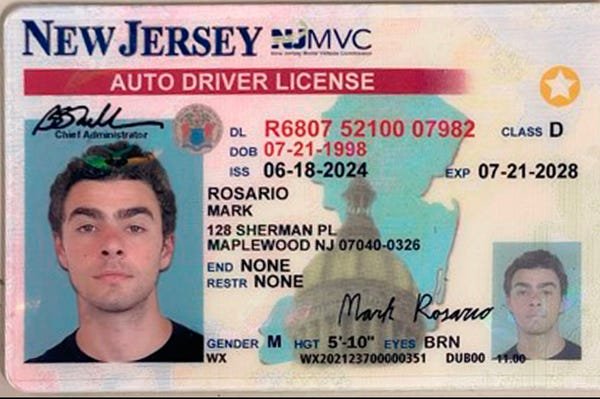
Prosecutors say Mangione tried to throw cops off the scent by claiming he was a “homeless” guy named “Mark.” He handed them this ID.

The license Luigi Mangione is charged with forging bears the false name “Mark Rosario” and a fake New Jersey address.

Manhattan District Attorney’s Office/Business Insider

“What’s your name?” the first of two patrolmen entering the McDonald’s asked. “Uh, Mark,” Mangione answered, according to sealed police bodycam footage shown in court Monday. He told them he was homeless.

Here is the New Jersey license that Mangione then gave the two cops. Moments later, he complied with the command to pull down his blue and white paper medical mask. “I knew it was him immediately,” Patrolman Joseph Detwiler testified, adding, “I stayed calm.”

Bodycam footage showed the officer whistling along as Jingle Bell Rock played on the McDonald’s sound system — to keep Mangione calm as well, he told the judge.

An arresting officer testified he was concerned Luigi Mangione could be dangerous, in part because he’d seen images like this one.


This is a still photo from sidewalk surveillance video of the fatal shooting of UnitedHealthcare CEO Brian Thompson, shown during an evidence suppression hearing in state court in Manhattan.

A still photo from sidewalk surveillance video that was shown at the hearing of the fatal shooting of UnitedHealthcare CEO Brian Thompson.

Manhattan District Attorney’s Office/Business Insider

Detwiler had closely followed the manhunt for Thompson’s killer, the veteran patrolman told New York Supreme Court Justice Gregory Carro from the witness stand.

He’d said he’d seen NYPD social media postings publicizing the as-yet-unnamed shooting suspect’s face. Elsewhere online, he had seen surveillance footage of the shooting, which was played in court.

“I knew in New York that they hadn’t found the firearm,” Detwiler testified to explain that safety was behind the decision to frisk Mangione and search his backpack before arresting him on the initial Pennsylvania charges of forgery and providing a false ID to law enforcement.

Additional evidence was taken from Mangione at Altoona’s police station, including a small folding knife and $7,800 in large bills.


Currency taken from Luigi Mangione included 77 $100 bills and one $50 bill.

Currency taken from Luigi Mangione by Altoona, Pennsylvania police included 77 $100 bills and one $50 bill.

Manhattan District Attorney’s Office/Business Insider

Before they left the McDonald’s, Mangione alerted the police to a small folding knife they’d failed to find in his pocket. It was of legal size, Detwiler’s partner, Patrolman Tyler Frye, testified Thursday, adding that even so, “It could possibly hurt somebody — seriously.”

At the Altoona police station, a more thorough search of Mangione’s clothing and backpack recovered $7,800 in large bills and currency from Thailand, Japan, and India, totaling $1,620. “There’s a gun,” Patrolwoman Christy Wasser is heard saying in footage showing her searching Mangione’s backpack.

Given the gun and the overlooked knife, the decision was made to strip-search Mangione.


Source link