
Ive-spent-years-living-far-from-my-older-brother-A.jpeg

I’ve spent years living far from my older brother. A 4-day trek in South America put me in the lead for once.

My older brother, Fergus, and I have spent most of our adult lives chasing the same thing — just never in the same place at the same time.

We’re both adventurous, but our lives have unfolded on different continents since 2009. That was the year he left home. I was still in high school.

He spent his 20s traveling around the world. And in 2016, when I was 25 and working as an editor in Toronto, he moved to Australia.

Two years later, when he moved back to Canada, I was the one who’d caught the travel bug. We were only in the same place for a few days before I left for Colombia.

I’ve been living in South America ever since.

Sibling adventure in South America

In January, Fergus visited me in Ecuador, where I’ve been living for eight years. To catch up properly, I planned a multi-day trek through sleepy mountain towns.

Walking for days through remote landscapes felt like the best way to make up for lost time.

We started in a small farming town about two hours outside Quito. With backpacks and a few changes of clothes, we set out along a dirt road tracing green mountains through farmland. Over 26 miles, we passed rows of peaks, clay brick homes, and a river carved into a deep gorge.

With no signal and no one around, we talked about everything: his winter plans, my writing, our younger brother’s upcoming wedding, and memories from camping trips we’d nearly forgotten.

At the river, we sat on rocks and drank beers we’d picked up before leaving town. Cows mooed faintly in the distance. “I’m so glad you finally made it,” I told him.


A man reading signs in Spanish during a hike in Ecuador.

The siblings caught up and celebrated a missed birthday. 

Provided by Sinead Mulhern


Belated celebration

It felt like a celebration six months late. Fergus had turned 40 in July, and living abroad, I’ve missed plenty of milestones. I booked a cabin along the route — a belated birthday gift, complete with a spa and traditional Ecuadorian food.

We stayed close over the years, despite the distance. Out of four siblings, we’re the most alike — athletic, adventurous, drawn to the same kinds of places. As a kid, I stole his CDs; he shaped my taste in music.

Now we both live unconventional lives: me as a freelance writer in Ecuador, him as a tree planter in western Canada.

Still, his 10 days in Ecuador were the most time we’d spent together as adults. A four-day trek through remote terrain could have been a gamble, but I knew he’d be in. No questions asked.


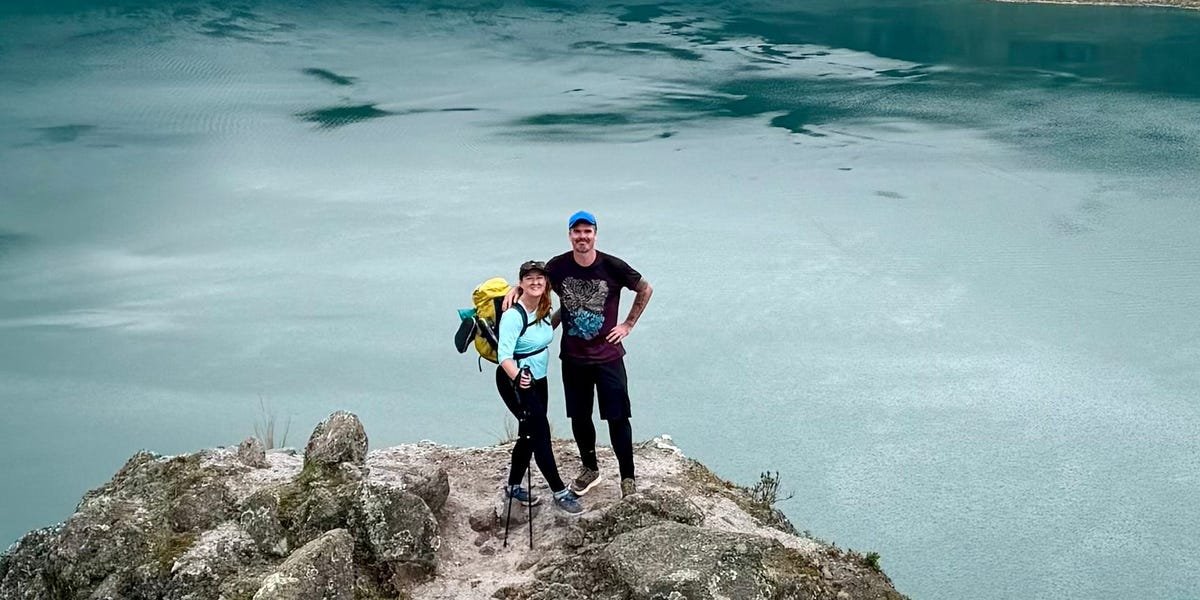
Brother and sister on a trek in South America.

The siblings caught up during the four-day trek. 

Provided by Sinead Mulhern


Witnessing his wanderlust inspired mine

Toward the end of our trip, we reached a tiny town — a church, a few dogs, a handful of homes. It was late afternoon, I was hungry and ready to stop when Fergus pushed ahead, scrambling up a steep gorge and insisting the top was “just a few minutes” away.

Sweating and irritated, I followed. Midway up this impossible-angled gorge, I checked my frustration, recognizing that I had been doing the same to hiking buddies over the past few years. And also, this trek was my idea, and I knew who I was doing it with.

Later, by a turquoise lagoon, I looked at him and saw not just the brother who packed my lunches and drove me to piano lessons, but someone I’ll rely on for decades.

When it was time to leave, our bus to Quito never came. Instead, we hitched a ride, climbing into the back of a moving truck after getting directions from other trekkers.

“Get in,” I told him, quickly translating the driver’s words from Spanish. For once, I was leading.




Source link

Amanda Goh

For this mom, moving to work in South Korea felt like a ‘full-circle moment’ — even if it came with one sacrifice

When Motolani Adedipe moved from Oklahoma to Seoul, South Korea, in August, she didn’t just pack her suitcase — she brought along her 6-year-old daughter, newborn baby, and mom.

Adedipe, who is from Nigeria and moved to the US to attend grad school in Texas, first grew curious about South Korea while interning at a biotech firm in Boston, where she shared an apartment with a Korean roommate.

“For that summer, I ate a lot of Korean food. She put me on K-dramas,” Adedipe, now 39, told Business Insider. That early curiosity soon grew into an interest in Korea’s history, economy, and language.


A woman posing with calligrpahy.

She became interested in Korean culture after sharing an apartment with a Korean roommate in Boston.

Provided by Motolani Adedipe.


Adedipe began learning Korean nine years ago online and continued after she moved to Oklahoma for work, where she became an associate professor at the University of Oklahoma Health Sciences Center.

In September 2024, Adedipe applied for a Fulbright scholarship to extend her research in prostate cancer survivorship. She already knew she wanted to go to South Korea — even as she prepared to give birth to her second child that November.

She made it through the first review in December, but when months passed with no update, she figured she hadn’t made it. So when the acceptance came through in April, the moment felt surreal.


A woman giving a presentation at a podium on stage.

Winning the Fulbright scholarship gave her a chance to further her research in South Korea.

Provided by Motolani Adedipe.


“It was like the best news and almost the worst news at the same time. Best because finally I get to do this. But of course, the anxiety, how do we start planning now?” Adedipe said.

Thankfully, her family was supportive, especially her husband.

“It required faith, sacrifice, structure, and for both of us to really imagine a life that looked very different from what we had planned,” she said.

Moving to Seoul

Her physician husband couldn’t accompany her to South Korea, but they agreed that she would bring both daughters along.

“How many of her peers would ever say, ‘Oh, I took a gap year in Korea’?” she said, referring to their 6-year-old.

Knowing the scholarship would last just one year made the decision easier. Her husband has visited them in South Korea several times and plans to make more trips over the coming months.

“I saw it as an opportunity for my children to experience another culture, language, and way of life, while still having a clear sense of return,” Adedipe said.

Now, she homeschools her daughter in the morning before sending her to a “hagwon,” a type of private academy that many Korean students attend after school.


A young girl wearing a hanbok, photographed from the back.

She says she sends her daughter to an after-school academy in Seoul.

Provided by Motolani Adedipe.


“Not all of her friends speak English, so they kind of communicate through play,” she said.

Adedipe’s mom, who had traveled to Oklahoma to help out with the kids, joined them in Seoul.

As she searched for housing, Adedipe had a long checklist: enough space for her family, easy access to the subway, flat streets her mother, in her early 60s, could navigate, and a neighborhood that felt safe for kids.

She found a two-bedroom, one-bathroom apartment in Mapo-gu, a district in western Seoul home to several universities.


A woman posing in Bukchon Hanok Village in South Korea.

Her two-bedroom apartment is about a 30-minute commute to her office.

Provided by Motolani Adedipe.


Although the apartment was smaller than she initially hoped for, it turned out to be a great fit: It’s surrounded by greenery and about a 30-minute commute to her workplace.

Her scholarship includes a housing stipend that covers her rent, which she declined to share.

Per the latest December data from the Korea Real Estate Board, the median monthly rent for an apartment in Mapo-gu is 1.39 million Korean won, or about $940.

Adedipe says her schedule varies from week to week, but her work typically starts in the afternoons. She goes into her office at Seoul National University Hospital several times a week, while continuing to supervise her lab in Oklahoma remotely at night.

Forging closer relationships with her loved ones

Data from the Ministry of Justice showed that the number of foreigners living in South Korea at the end of 2024 stood at 2.65 million, a 5.7% increase from the previous year.

A US veteran who had retired in South Korea previously told Business Insider that he appreciated the country’s safety and culture of respect. Meanwhile, a millennial who moved from Switzerland to Seoul said she valued the convenience of city life, including how most stores stay open late.


A woman posing with a famous Little Prince statue in Busan, South Korea.

She says she has been surprised by the kindness of strangers in the city.

Provided by Motolani Adedipe.


One of the biggest adjustments, Adedipe said, has been the extent to which technology is deeply woven into daily life in Seoul. Nearly everything is tied to having a registered phone number.

“Once I got my card and I got a bank account and I got a phone number that was registered, life became easy,” she said.

Even though the city is known for its fast-paced lifestyle, Adedipe says she’s been surprised by its human side.

“I lost my stylus in the bus, and I was able to get it back. It was tagged, and they verified they found it. That could never happen in the US,” she said.

Watching her daughter flourish and adapt to their life in Seoul has been especially meaningful.

“Now that I’m seeing where she’s shining. My goal is to keep encouraging her to find her passion in life and do that,” she said.


A woman wearing a traditional hanbok.

Being able to live and work in South Korea felt like a “full circle moment” for her.

Provided by Motolani Adedipe.


In addition to learning Korean, her daughter takes part in extracurricular activities, such as piano, inline skating, and Taekwondo.

“She’s doing everything that I never could have been able to give her because in Oklahoma, if you’re doing all those classes, you have to drive your kids to all those classes,” she said. “But here in Korea, because of how the education is structured, she does all of that in a school, and she loves it.”

Living abroad with her mother has brought them closer. After leaving Nigeria for the US in her 20s, Adedipe went nearly eight years without seeing her mom because of visa issues.

“And now that I get to live with her again, it’s like a dream come true,” she said.

Looking back on her own experience, Adedipe says living and working in South Korea has felt like a “full circle moment,” after years of interest in the country.

“It felt like all the pieces of my life — research, storytelling, culture, and well-being — were suddenly being invited into the same room,” she said.

Do you have a story to share about relocating to a new city? Contact this reporter at agoh@businessinsider.com.


Source link

Another-South-Korean-shipbuilder-just-won-a-US-Navy-maintenance.jpeg

Another South Korean shipbuilder just won a US Navy maintenance job as the country’s yards scoop up more American work

South Korean shipyards are steadily becoming an integral part of US Navy maintenance work. Following in the footsteps of some of the nation’s shipbuilding giants, another local shipbuilder just secured a new contract.

HJ Shipbuilding and Construction announced on Monday that it won a deal to service a US Navy vessel — the Lewis and Clark-class dry cargo ship USNS Amelia Earhart — as Washington increasingly turns to South Korea’s impressive commercial shipbuilding sector to support strained American yards and keep the fleet afloat.

The maintenance contract is with the Navy’s Naval Supply System Command and Military Sealift Command.

The work on the Amelia Earhart — which will include an inspection of the ship’s hull and systems, follow-up repairs and replacements, and a paint job — will begin in January 2026 at the Yeongdo Shipyard in Busan. The vessel will be delivered to the Navy by the end of March.

The Amelia Earhart is one of the Navy’s supply ships that refuels and resupplies aircraft carriers and warships at sea. Its overhaul adds to a growing list of US Navy work going to South Korean companies.


A grey vessel sails in the dark blue ocean next to an aircraft carrier with a fighter jet sitting on it. The sky is blue in the background.

South Korea is investing billions in US shipbuilding initiatives, including upgrades to shipyards and equipment.

Official US Navy photo


Major South Korean shipbuilder Hanwha Ocean finished repairs on the USNS Wally Schirra, another Lewis and Clark-class vessel, in March, marking a first for a South Korean shipyard. And then HD Hyundai Heavy Industries, one of the country’s largest shipbuilders, received a maintenance contract for another ship in the class, the USNS Alan Shepard.

HJ Shipbuilding and Construction said it’s the first midsize shipbuilder in South Korea to win a maintenance contract with the US Navy.

While smaller voyage repairs to US Navy ships occur regularly at allied yards, the continued contract wins for South Korean shipyards highlight the growing shipbuilding collaboration between Washington and Seoul.

That partnership, which has included business deals for South Korean companies abroad as well as investments in American yards, is part of a broader willingness by the Trump administration to rely on its Pacific ally amid efforts to fix US shipbuilding issues.

Billions of dollars are being put into modernizing US shipyards and addressing workforce and training issues as South Korea’s government calls its investments a plan to “Make American Shipbuilding Great Again.” The US is also turning to Japan, another large shipbuilder, for assistance.

South Korea and Japan are the second and third largest shipbuilders in the world, respectively, and Navy leadership is increasingly recognizing their value in this sector. China, however, dominates the shipbuilding industry, relying heavily on its dual-use yards, workforce, and equipment to make military and commercial vessels at a rapid pace.


Source link