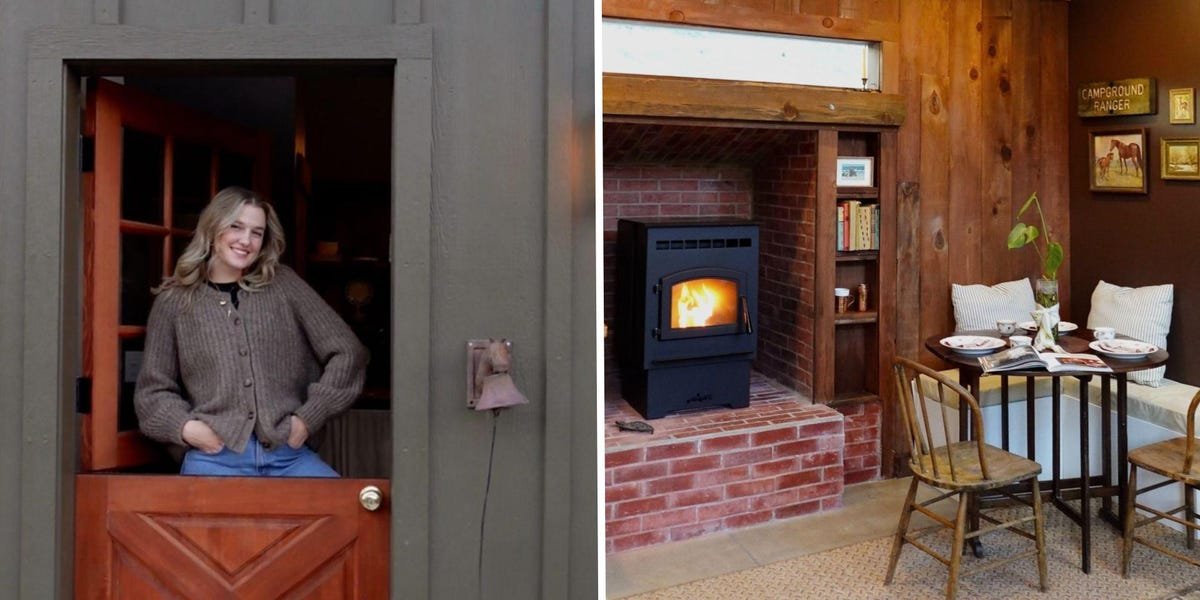
Corippo’s parents had purchased a small piece of land near the national park in California when real estate prices were low, unsure what to do with it.
When they started toying with the idea of building a cabin on the land, Corippo, her brother, and her sister decided to pool their resources and invest in the build with her parents.
“When we were little, my parents invested in Apple stock, which they bought for nothing,” Corippo said. “We used those Apple stocks in our savings to invest in this first home.”
The 650-square-foot house became a family project. It had one bedroom, a separate lofted sleeping area, and one bathroom. Corippo and her father told Business Insider the build cost around $300,000, which included creating a well, septic tank, and driveway on the property. Corippo moved into the finished space in 2024.
“It was definitely a family collaboration of making it somewhere I could live, but also something that would be an investment once I moved out,” Corippo said.
When a one-of-a-kind aircraft from World War II needs work done, not just any body shop will do.
At the National Air and Space Museum’s Steven F. Udvar-Hazy Center in Chantilly, Virginia, staff members repair and preserve historic aircraft in an in-house restoration hangar that offers a behind-the-scenes look at the work that goes into maintaining the museum’s collection.
The Mary Baker Engen Restoration Hangar at the National Air and Space Museum’s Steven F. Udvar-Hazy Center in Chantilly, Virginia.
Talia Lakritz/Business Insider
The Smithsonian museum’s second location, situated about 30 miles from the National Air and Space Museum’s flagship site in downtown Washington, DC, offers an expansive setting with 340,000 square feet of exhibit space.
The Mary Baker Engen Restoration Hangar, which is connected to the exhibits, can accommodate several aircraft at a time and houses everything workers might need, including a sheet-metal shop, a welding room, a paint room, and a fabric shop.
It also features floor-to-ceiling windows overlooking the hangar, allowing visitors to watch the work happening in real time.
Observation windows overlook the Mary Baker Engen Restoration Hangar.
Talia Lakritz/Business Insider
Holly Williamson, public affairs specialist at the National Air and Space Museum, told Business Insider that visitors shouldn’t expect to see planes being built with the speed of a factory assembly line. Progress can be slow, with some restoration projects spanning months or years.
“This kind of will look like paint drying if you just sit here for the whole day,” Williamson said. “It’s a lot of research. It’s very detail-oriented.”
Despite the slow pace, there’s still plenty to see. One of the museum’s longer-term projects is “Flak-Bait,” a Martin B-26 Marauder that flew 202 combat missions during World War II, including D-Day.
“Flak-Bait,” a Martin B-26 Marauder.
Talia Lakritz/Business Insider
When the museum first opened in 1976, visitors were allowed to touch the aircraft’s nose, which wore down the paint. Workers have focused on restoring its appearance while preserving its authentic combat damage.
“It flew more missions than any other aircraft in World War II for the US, so we want it to look like it’s been through hundreds of missions,” Williamson said.
Another striking display is a Sikorsky JRS-1 seaplane, the only aircraft in the museum’s collection that was present at Pearl Harbor when it was attacked on December 7, 1941. After Pearl Harbor, the Sikorsky JRS-1 patrolled for Japanese submarines. It arrived at the Mary Baker Engen Restoration Hangar in 2011.
A Sikorsky JRS-1.
Talia Lakritz/Business Insider
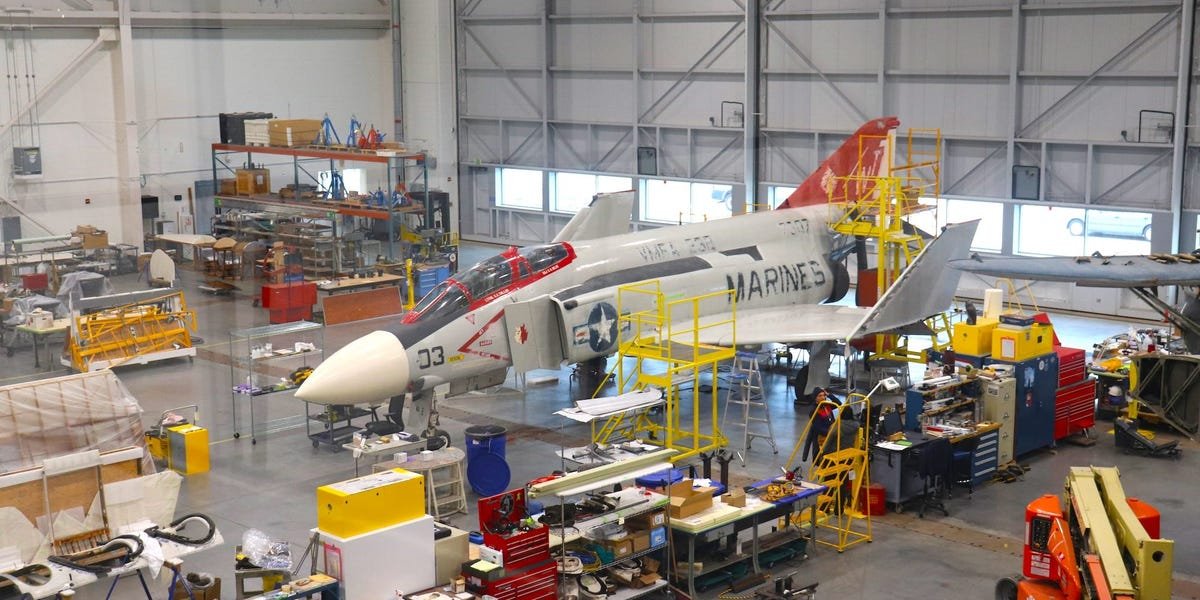
Staff members are also working to restore a McDonnell F-4S Phantom II, a fighter and bomber that shot down an MiG-21 during the Vietnam War. After the Vietnam War, it underwent modernization and was redeployed in 1983, remaining in service until its last squadron duty in 1987.
A McDonnell F-4S Phantom II.
Talia Lakritz/Business Insider
The rest of the hangar floor is a maze of tools, machinery, aircraft parts, and storage bins, indicators of just how intricate the museum’s restoration efforts are.
Certainly more interesting than watching paint dry.