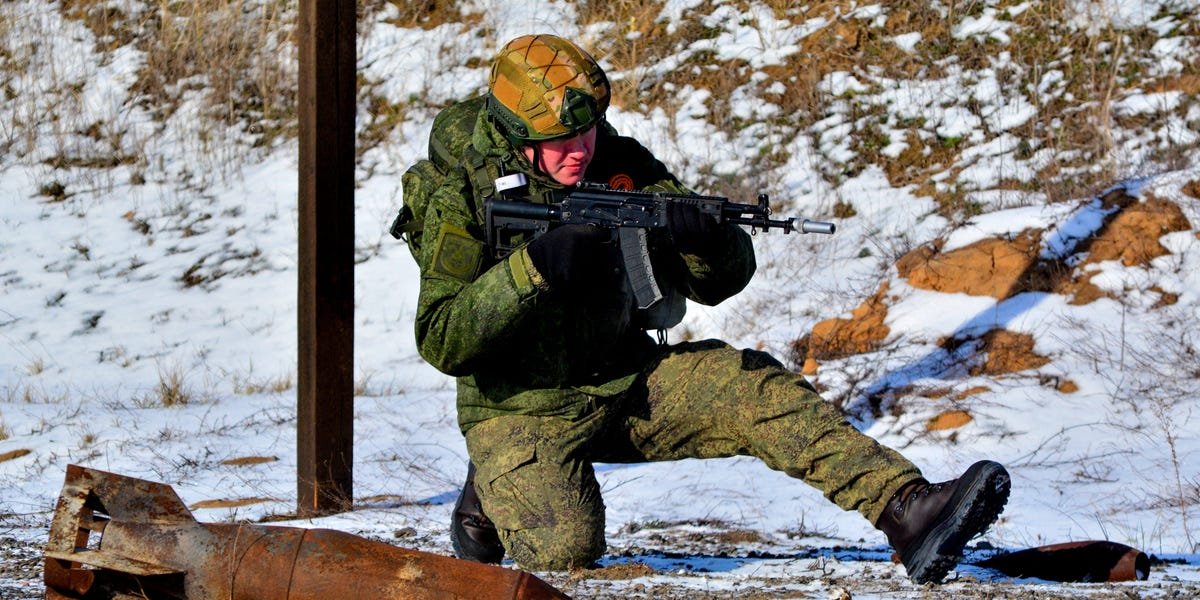
Russia’s primary small arms manufacturer, Kalashnikov Concern, said on Thursday that it’s developing 5.45mm rifle rounds specifically designed to disable drones.
Though similar types of bullets have emerged sporadically on the Russian battlefield since last year, Kalashnikov Concern said it plans to mass-produce the rounds, formalizing a national effort to make drone-killing ammo for individual troops.
The armsmaker said the 30-round magazine is built for the AK-12 gas-operated assault rifle, with each bullet releasing a “multi-element projectile that significantly increases the probability of hitting UAVs.”
Kalashnikov Concern said the round can be used in burst and single-fire modes and was tested against a drone hovering in the air and another drone flying along a preset path.
Ukraine has been making its own anti-drone rifle rounds, with a bullet called the “Horoshok,” or “Little Pea,” that splits into multiple fragments to widen the area of impact. Kyiv said in December that it plans to produce 400,000 of these rounds a month.
The Ukrainian 5.56mm round, however, sees the bullet traveling some distance before it fragments — extending the range of the shot.
Kalashnikov Concern said in its announcement that the fragments of its bullets “systematically separated upon exiting the barrel” during tests against fast-moving small drones.
Some Russian units were thought to have first publicized the overall idea, such as one group of soldiers who filmed themselves in February 2025 using steel pellets and heat shrink tubes to convert 7.62mm rounds into makeshift shotgun shell-like bullets.
The entire concept calls back to the now-widespread use of shotguns in the Ukraine war as a final line of defense against first-person-view drone attacks. The tactic became especially popular as both sides started using fiber-optic drones, which can’t be remotely jammed.
The West is experimenting with anti-drone rifle rounds, too.
The US Navy’s Naval Surface Warfare Center, for example, said in February that it’s developing a “drone-killer cartridge” containing bullets that split into three fragments. Other American and European startups are selling their own versions of split-fragment rifle rounds.
Meanwhile, the concept is catching the eye of the larger defense industry. The Belgian arm of Thales, the French-headquartered prime, has been building a 70mm airburst rocket filled with steel pellets to counter one-way attack drones like the Shahed.
The US has been battling Iran for more than 24 hours, and the scale of what the American military brought into the fight is now coming into focus.
After a slow but steady drip of details, we now have a clearer, more comprehensive picture of the kind of US combat platforms involved and the targets struck on the opening day of combat, executed alongside the Israeli military.
US Central Command said forces involved in Operation Epic Fury struck over 1,000 Iranian targets with destroyer-launched Tomahawks, stealth B-2 Spirit bombers armed with 2,000-pound bombs, and US-made drones modeled after Iranian Shaheds, among other assets and munitions. It called the drones “American-made retribution” as the US struck Iran with a weapon Tehran designed.
Here’s the breakdown from US Central Command, which oversees US operations in the Middle East, on what went into the fight. It’s extensive, though some things are left off, covered by a note that says the operation also includes “special capabilities we can’t list.”
A graphic breaking down the weapons used in Operation Epic Fury from US Central Command
US Central Command
Beyond the B-2 bombers, the list of aircraft includes fifth-generation fighters like the F-35 Lightning II Joint Strike Fighter and F-22 Raptor, as well as a mix of attack aircraft and fourth-gen fighters.
There are also electronic attack planes, airborne early warning and control aircraft, surveillance platforms, and logistics aircraft, such as airlift and refueling planes, listed. The Airborne early warning aircraft can detect and track targets that can be passed off in real-time to fighter jetss like the F-22 and F/A-18.
Drones include the MQ-9 Reaper, a combat and reconnaissance system, and the new Low-Cost Unmanned Combat Attack System, or LUCAS, drones. The former is intended to return home, while the latter is purposefully expendable.
Suppression operations aimed at breaking down Iranian defenses set the conditions for air superiority and permitted damaging strikes across Iranian territory. There have been no credible reports of aircraft losses.
Other assets involved include High Mobility Artillery Rocket Systems, or HIMARS, weapons that can fire both guided rockets and missiles. They gained notoriety for their combat effectiveness in Ukraine. In addition to destroyers, American aircraft carriers are in the area, launching fighter aircraft like the F/A-18 Super Hornet and F-35C, the carrier-based variant of the stealth fighter.
While much of the weaponry on the list is offensive or intended to support offensive operations, some assets are strictly defensive. These include Patriot surface-to-air missile systems and Terminal High Altitude Area Defense, or THAAD, batteries. These have been used in air defense battles as Iran launched its missiles.
Prior to the beginning of “major combat operations” against Iran, which President Donald Trump announced early Saturday morning in a video message, the US spent weeks building up its military presence not seen in the area in decades.
The impact of operations, in which the US has suffered some personnel losses, has been felt across Iran. The US has hit command and control centers, operational centers of Iran’s Islamic Revolutionary Guard Corps, missile sites, navy warships, and critical communication sites.
The Israeli military, as part of Operation Roaring Lion, has also struck hundreds of targets across the country, which has seen much of its military and political leadership killed.
I used to save my favorite clothes for a version of my life that never showed up.
The blazer stayed in my closet because it felt “too professional” for a normal day. The heels were waiting for a dinner I’d yet to be invited to. The earrings were longing for an occasion that felt important enough to justify wearing them. Meanwhile, I wore the same outfits on repeat — to work, to run errands, to all the places where my actual life was happening.
I wasn’t saving them for a rainy day. I was saving them for the perfect one. The problem was that “special occasion” never came.
It wasn’t just about clothes
This habit wasn’t limited to clothes. I treated everything the same way. A Sephora gift card sat untouched in my drawer, waiting for something “really worth it.” I rationed my favorite lip gloss as if it were a limited resource. I refused to light my favorite candle unless the night felt special enough to deserve it. I even held onto the last spritz of my discontinued One Direction perfume for years, as if saving it could somehow make more.
The author started to feel like she was saving her life for later.
Courtesy of the author
The special occasion is always vague — an imaginary fancy dinner, a future milestone, a celebration that exists only in theory. So I wait. Years pass. The things I loved enough to save start to feel untouchable. By the time I consider using it, we’ve waited so long that it feels wrong to start now.
Every time Mia publishes a story, you’ll get an alert straight to your inbox!
Stay connected to Mia and get more of their work as it publishes.
Looking back, it sounds dramatic, but at the time, it felt practical. Why waste something nice on an ordinary day?
Then one day, the thought hit me: why am I living my life like a waiting room?
It felt like I was saving my life for later
That mindset didn’t stop at my closet. Saving a jacket for the right moment slowly turned into saving fun for the weekends, saving joy for later, saving happiness for a version of life that felt more legitimate than the one I was already living.
I realized I was treating weekdays like something to get through instead of something to participate in. When I did the math on how many days I was mentally skipping, it felt less like discipline and more like quietly wasting my life away.
So I stopped waiting.
I started wearing my favorite pieces on regular days
The shift was small at first. I wore blazers to the bars. I strutted in my nice heels to run errands. I put on the earrings just to go to the grocery store. Not for compliments, not for Instagram, not to prove anything to anyone, but because I liked how it made me feel.
The clothes didn’t lose their value because I wore them. They gained it. Each piece started collecting moments and memories instead of dust. Now, when I reach for something I love, it reminds me of a workday that felt a little lighter or a Trader Joe’s run where I found my new favorite snack.
The author says clothes are meant to be worn more than once.
Courtesy of the author
That’s the part people tend to dismiss as “romanticizing your life,” a phrase that’s been flattened into internet fluff. But this wasn’t about pretending my errands were glamorous or turning my Mondays into Fridays. It was about presence. About intention. About letting regular days count instead of treating them like placeholders.
If I’m being honest, it changed more than my outfits. Work felt less like something I had to endure. Errands felt less like chores. I stopped waiting for permission to enjoy my life. I started dressing for myself instead of an imaginary audience or a hypothetical future. I even started liking Mondays.
I realized the dinner counts. The errand counts. The workday counts. And if the opportunity does truly come? I’ll wear those pieces again. Clothes are meant to be worn more than once.
The special occasion didn’t disappear. I just stopped waiting for it to arrive.
At the center of the US operation that captured Venezuelan President Nicolás Maduro and his wife was an elite and secretive special operations group, per multiple reports.
Citing officials, outlets like The New York Times and The Wall Street Journal reported that Delta Force, alongside law enforcement personnel, carried out the extraction of Maduro as part of Operation Absolute Resolve, a surprise nighttime raid of the Venezuelan leader’s compound in Caracas.
Business Insider wasn’t able to independently confirm the participation of the elite unit in the operation. The Pentagon directed BI’s queries to the White House.
In discussions of the complex operation, President Donald Trump said only that it was executed by “the most highly trained soldiers in the world,” adding that “there’s nobody that has their talent.”
Caracas, the capital of Venezuela
Juan BARRETO / AFP via Getty Images
The president may have been speaking about all of the personnel involved. US officials said that the operation to grab Maduro included land, air, sea, space, cyber, and intelligence forces. But Trump’s language could easily apply to Delta Force, a top-tier special operations unit.
Here is what we know about this elite force.
An essential but highly secretive group
Delta Force, officially known as the 1st Special Forces Operational Detachment-Delta (SFOD-D), is tasked with capturing and eliminating high-value targets. Like other tier-one special mission units, such as SEAL Team 6, Delta Force tackles some of the US Army’s most covert and complex tasks.
The special operations unit, founded by Col. Charlie Beckwith in the 1970s for direct combat action, unconventional warfare, and counterterrorism, is headquartered at Fort Bragg in North Carolina, also home to other Army special operations forces.
Operators train for rapid infiltration and exfiltration, intense close-quarters combat, precision marksmanship, demolition, hostage rescue, and more. Unlike some other units, Delta pulls the best warfighters it can from across the US armed forces, though it mainly draws from Army special operations forces. Known as “quiet professionals,” Delta Force operators generally do not speak openly about their activities.
Much of the elite force’s work is highly classified, but some Delta missions are public knowledge.
Delta Force was involved in the US operation, Just Cause, that ultimately led to the capture of Panamanian dictator Manuel Noriega during the 1989 invasion of Panama. And the group distinguished itself during the 1993 Battle of Mogadishu, made famous by the book and film “Black Hawk Down.” Two snipers were posthumously awarded the Medal of Honor for their actions.
This century, this unit was among the US special operations forces that surged into Afghanistan immediately after the 9/11 attacks, played a role in the 2003 capture of former Iraqi President Saddam Hussein, and was involved in the death of the infamous Islamic State leader Abu Bakr al-Baghdadi in 2019.
Aircraft, explosions, and smoke were seen across Caracas, the capital of Venezuela, during the US operation.
Reuters
And now reporting indicates Delta Force, along with the 160th Special Operations Aviation Regiment, was instrumental in capturing Maduro.
The assault on Venezuela and raid on Maduro’s compound
The US president and other US officials shared details of the raid that captured Maduro on Saturday.
Dan Caine, chairman of the Joint Chiefs of Staff, said the apprehension team broke into a fortified compound to capture Maduro after months of planning. US intelligence agencies watched and studied his patterns of life, while other teams trained for the operation on a replica of Maduro’s home. The US used a similar tactic to ready for the 2011 raid on Osama bin Laden’s compound.
Reports indicate Delta Force was inserted into the target area by the 160th SOAR, the Night Stalkers famous for their ability to get special operators in and out of tough spots.
With fighters, bombers, electronic warfare planes, and more delivering strikes and providing air cover, Caine said the helicopters carrying the extraction team were able to reach their target with “totally the element of surprise.”
During the complex apprehension operation, American operators moved fast through the building to find Maduro and his wife, seizing them before they could get the door closed on a steel safe room.
Venezuelan President Nicolás Maduro arrives in New York.
Reuters
Trump said that Venezuela’s military was overwhelmed by US forces. Several American personnel were injured, the president said, and one of the helicopters was hit but remained flyable. No troops or equipment were lost in the operation.
The Trump administration is holding Maduro responsible for supporting narco-terrorism (drug trafficking) and other criminal activity. The recent operation is also about oil, with the administration accusing Venezuela of using oil revenue to fund malign activities. Maduro has denied the allegations.
Trump said on Saturday that the US would run Venezuela until a “safe, proper” election could occur. He also said that US oil companies would be entering the country, which has the world’s largest proven crude oil reserves.
To secure these operations, he said that he’s not ruling out putting US troops on the ground. He said the US military is ready to conduct more attacks if needed.
US Attorney General Pamela Bondi said Maduro and his wife were charged in New York with drug and weapons offenses. He is due to appear in court.
This story is available exclusively to Business Insider
subscribers. Become an Insider
and start reading now. Have an account? .
A woman gave birth in a robotaxi in San Francisco earlier this week, Waymo confirmed.
Waymo told local media that the robotaxi safely delivered its passengers to the hospital.
It’s not the first birth recorded in a Waymo, and with the company expanding rapidly, it may not be the last.
One San Francisco robotaxi arrived at its destination with an unexpected extra passenger on Monday.
A woman in labor gave birth in the back seat of a Waymo robotaxi while traveling to the hospital, the company confirmed in a blog post on Wednesday.
“Some people just can’t wait for their first Waymo ride,” the company said.
A spokesperson for the Google-backed robotaxi firm told The San Francisco Standard, which first reported the news, that Waymo’s remote monitoring team detected “unusual activity” in the backseat of the driverless vehicle.
Employees called 911 once they realised what was happening. But the robotaxi delivered its passengers to the hospital without needing assistance, and was subsequently removed from Waymo’s fleet for cleaning.
Apparently, it’s not the first time someone has given birth in a Waymo, with the company confirming to The San Francisco Standard that a similar incident previously occurred in Phoenix.
Waymo is growing up fast
Waymo has had a big year, with the company’s robotaxis becoming a regular sight on San Francisco’s streets, alongside expansions into new markets in Austin and Atlanta.
On Wednesday, Waymo said it had served over 14 million trips so far this year, and expected to hit 1 million rides a week by the end of 2025.
It hasn’t all been smooth sailing. Last month, Waymo issued a software update to 3,067 robotaxis after reports that its vehicles were driving past stopped school buses, according to a regulatory report filed on Thursday.
Waymo is planning a major expansion next year as it faces competition from Tesla’s nascent robotaxi service, which launched in Austin in June.