Jimmy Kimmel took several digs at CBS and President Donald Trump while presenting two awards at the Oscars on Sunday.
While announcing the nominees for best documentary short film, Kimmel took a swipe at CBS over free speech.
“As you know, there are some countries whose leaders don’t support free speech. I’m not at liberty to say which. Let’s just leave it at North Korea and CBS,” Kimmel said.
His remark appeared to allude to several recent controversies at CBS, including the network’s decision to cancel “The Late Show With Stephen Colbert,” a move some lawmakers have questioned as potentially politically motivated.
Last year, CBS also faced backlash after editor-in-chief Bari Weiss pulled a “60 Minutes” segment about the Trump administration’s deportation of migrants to El Salvador’s CECOT prison hours before it was scheduled to air.
Every time Amanda publishes a story, you’ll get an alert straight to your inbox!
Stay connected to Amanda and get more of their work as it publishes.
As Kimmel continued introducing the award, he added another subtle jab, this time at Amazon MGM’s “Melania.” The film, which cost $40 million to acquire and another $35 million to market, grossed $7 million in its opening weekend.
“Fortunately for all of us, there’s an international community of filmmakers dedicated to telling the truth, oftentimes at great risk, to make films that teach us, that call out injustice, that inspire us to take action, and there are also documentaries where you walk around the White House trying on shoes,” he added.
After presenting the award to “All the Empty Rooms,” a short about the bedrooms left behind by victims of US school shootings, Kimmel returned to present the best documentary feature.
Without naming anyone, he joked, “Oh, man, is he going to be mad his wife wasn’t nominated for this?”
The award went to “Mr. Nobody Against Putin,” about a Russian primary school teacher who becomes a whistleblower against the Kremlin’s wartime propaganda.
Kimmel himself is no stranger to the debate over free speech on late-night television, having been briefly taken off-air last September over his comments on Charlie Kirk’s death.
Business Insider will be in the room when he speaks. We’ll share real-time updates on what he says and how World Economic Forum attendees react.
After an issue with Air Force One, Trump landed in Switzerland on a replacement plane just after 12:30 p.m. local time, and is scheduled to speak at 2:30 p.m.
Follow along here for real-time updates, reaction, and on-the-ground commentary from Business Insider’s staff in Davos.
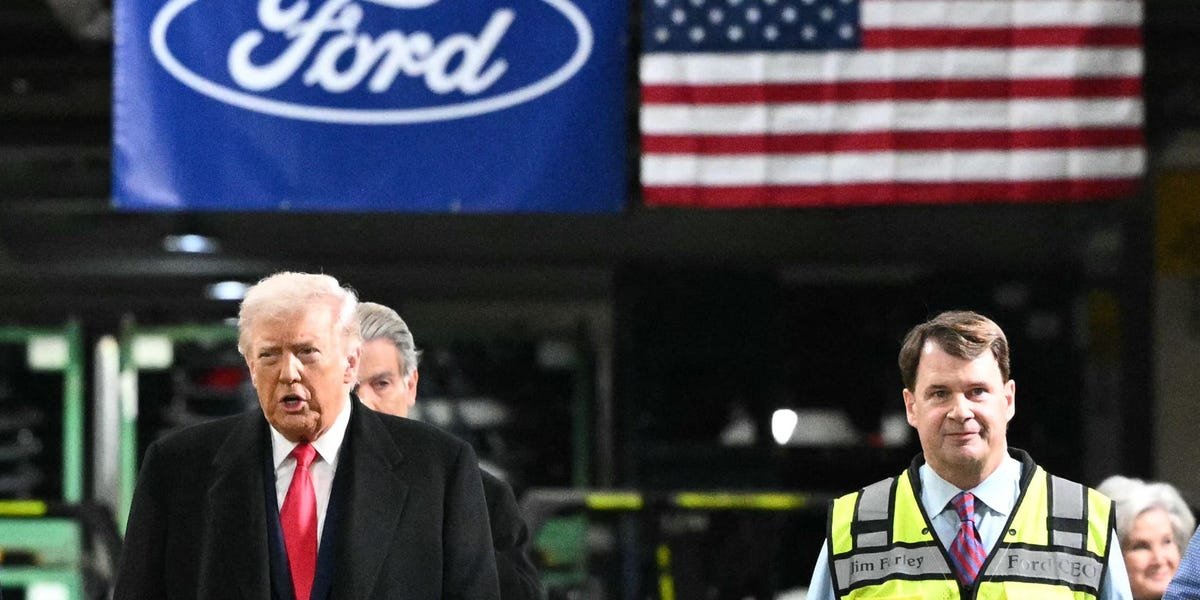
Hours after President Donald Trump toured a Ford pickup truck assembly plant, the big news story wasn’t about manufacturing jobs or the economy. It was about a Ford worker who heckled him and was later suspended.
The incident raised questions about the limits of free speech in the workplace — and when companies can discipline workers for political protest.
Business Insider spoke to five experts, including four employment lawyers and an HR executive, to find out.
Their conclusion was blunt: an employee’s words can quickly become fireable offenses.
‘An employer has the ability to discipline an employee for speech’
All four lawyers said workers retain legal free speech rights under the Constitution, but those rights rarely protect speech in their workplace.
“With very few exceptions, employees in the private sector don’t have free speech rights at work,” Mark Kluger, a co-founding partner at New Jersey-based law firm Kluger Healey, told Business Insider.
Jessica Childress, a managing attorney at Washington, DC-based The Childress Firm, said workers often confuse who the First Amendment actually applies to. The best way to think about it, she said, is to divide government action from a private company’s authority.
“The First Amendment’s right to freedom of speech only applies to government actors, not private employers, such as Ford,” she said. “A private company can — with certain exceptions — limit what their employees say.”
That distinction has played out in real-world cases before.
Juli Briskman, a former government contract worker, was fired from her job after a photograph lensed her flipping off Trump’s motorcade.
BRENDAN SMIALOWSKI/AFP via Getty Images
In 2017, Juli Briskman, a former marketing analyst for a government contractor, was fired from her job after professional photographers caught her giving Trump’s motorcade the middle finger.
Even though her action happened outside of the office, her lawsuit against her employer was tossed.
“Employers are legally allowed to regulate behavior that disrupts the workplace,” said Jared Pope, an employment law attorney and CEO at Work Shield. “That is why most organizations apply their codes of conduct consistently, even when speech happens off the clock or references public figures.”
Still, lawyers said workers generally have more protection if they express their political belief off-the-clock.
“If you are so inclined to protest, do it off-duty, off-premises, and off-company networks,” Eric Kingsley, a partner at Kingsley Szamet Employment Lawyers, told Business Insider. “An employer has the ability to discipline an employee for speech in matters of politics when it becomes misconduct.”
Ford decided to suspend the worker initially, not fire them. The UAW said it’s looking into the situation, while Ford said it doesn’t comment on personnel matters.
JEFF KOWALSKY/AFP via Getty Images
Why Ford likely suspended — not fired — the worker initially
Each lawyer we talked to said that Ford was well within its rights to suspend the employee, T.J. Sabula.
In fact, some said the automaker may have displayed restraint by not outright firing the factory employee after the decision.
“It implies Ford is buying time,” Kingsley added. “Suspending the employee gives them a chance to investigate and make a decision that may not be as rash as laying off an employee.”
On Wednesday, the United Auto Workers, the union representing the workers in Sabula’s plant, confirmed his suspension. Sabula, who has said he doesn’t regret heckling Trump and is set to receive over $800,000 in crowdfunded support, has not responded to requests for comment from Business Insider.
Laura Dickerson, a vice president for the UAW, said the union was reviewing Ford’s actions and said workers “should never be subjected to vulgar language or behavior by anyone — including the President of the United States.”
The union also said Sabula “believes in freedom of speech, a principle we wholeheartedly embrace, and we stand with our membership in protecting their voice on the job.”
Ford declined to comment on the suspension, saying it was “a personnel matter.”
“Ford is navigating a high-profile, politically charged moment,” Lauren Winans, CEO of the HR consulting firm Next Level Benefits, said. “The union’s involvement likely influenced Ford’s decision to suspend (not fire), because unilateral termination could lead to grievances and arbitration.”
For workers wondering if they can get fired for speaking their mind at work, Kluger made it clear the answer is yes.
“Try telling your boss what you really think of them and see how long you remain employed,” he said.
Do you think Ford should fire the employee? Let us know by taking our survey:
A new lawsuit from a Democratic senator and combat veteran at the heart of a free speech fight seeks to block the Pentagon’s intensifying crackdown.
Arizona Sen. Mark Kelly sued Defense Secretary Pete Hegseth on Monday, warning that the Pentagon’s effort to punish him “sends a chilling message” to veterans who speak out against the Trump administration.
Hegseth accused Kelly of “seditious” acts after Kelly publicly reminded US service members that they are not required to follow illegal orders. The Pentagon’s actions against Kelly have troubling implications for the political speech of millions ofveterans, military law experts said.
Hegseth’s effort to muzzle a US senator “places other retirees who have spoken up potentially in jeopardy,” said Rachel VanLandingham, a professor at Southwestern Law School who is a retired Air Force JAG. “Not knowing whether or not he’s going to come after you already has a chilling effect.”
Kelly said his lawsuit is about fighting back. The Democratic lawmaker announced the federal lawsuit on Monday. His suit also named the Department of Defense, Navy Secretary John Phelan, and the Navy Department as defendants. Kelly’s video urging troops not to follow illegal orders.
Veterans who serve 20 years or more are eligible for a military pension, but those benefits can be revoked or reduced if retirees are found to have violated military law while in uniform. By contrast, Hegseth’s move seeks to punish a veteran for his speech long after serving in uniform, an approach one expert on military law called baseless.
Every time Kelsey publishes a story, you’ll get an alert straight to your inbox!
Stay connected to Kelsey and get more of their work as it publishes.
Kelly’s lawsuit argues that using the military justice system to punish veterans’ political speech risks setting a precedent that abuses the First Amendment rights of other retired troops.
Defense Secretary Pete Hegseth’s prosecution of Kelly has implications for veterans’ speech, legal analysts said.
DoW photo by U.S. Air Force Staff Sgt. Madelyn Keech
Legal basis in question
The lawsuit argues that nothing in the law allows the Pentagon to revisit a retirement determination based on a veteran’s speech. Such a move, the filing says, would raise “serious constitutional concerns” and leave retired service members facing a constant threat to their earned benefits.
There’s no legal basis for Hegseth’s pursuit, VanLandingham said. The defense secretary initially sought to court-martial Kelly, threatening him with the military equivalent of a criminal trial. It later opted for a lesser administrative punishment.
“The process is the punishment,” said Frank Rosenblatt, a retired Army JAG and professor at Mississippi College School of Law. “The claim against Kelly had no merit.”
“Senator Kelly’s speech is not punishable under the UCMJ,” the National Institute of Military Justice nonprofit group said in a December statement in reference to the Uniform Code of Military Justice.
The lawsuit seeks to halt actions that could reduce Kelly’s military rank and retirement pay and characterizes that effort as “unlawful.”
After filing the lawsuit, Kelly requested a temporary restraining order and a preliminary injunction from the federal court, seeking to halt the Pentagon’s actions while the case is reviewed on its merits. Both are emergency measures that ask a judge to stop government action before permanent harm occurs.
The federal government has been increasingly pushing cases important to the Trump administration onto a “rocket docket,” Rosenblatt said, accelerating litigation toward higher courts. If the judge assigned to the case, US District Judge Richard Leon, issues a ruling the government doesn’t like, “this could move very quickly to the DC Circuit and potentially the Supreme Court.”
Leon has previously ruled against the military’s authority over retirees.
“I am not concluding today that Congress could never authorize the court-martial of some military retirees,” Leon wrote in a 2019 memorandum opinion that rejected the government’s argument that military jurisdiction over all retirees was necessary to maintain good order and discipline of its active force. The judge noted he had not seen a clear argument for “why the exercise of such jurisdiction over all military retirees is necessary.”
In a post on X last week, Hegseth called Kelly’s video with five other Democratic lawmakers “reckless and seditious” and said it was “clearly intended to undermine good order and military discipline.”
The military justice provisions that Hegseth accused Kelly of violating — Articles 133 and 134 of the Uniform Code of Military Justice — are not explicitly tied to sedition and can cover a wide range of alleged misconduct.
Kelly’s lawsuit argues that allowing the executive branch to punish a member of Congress for speech is a threat to the Constitution and erodes congressional oversight of the armed services.
“We are aware of the litigation,” a Pentagon spokesperson said Tuesday when asked for comment on the lawsuit. “However, as a matter of policy, the Department does not comment on ongoing litigation.” That same day, Hegseth took aim at Kelly’s military rank in an X post: “‘Captain’ Kelly knows exactly what he did, and that he will be held to account.”