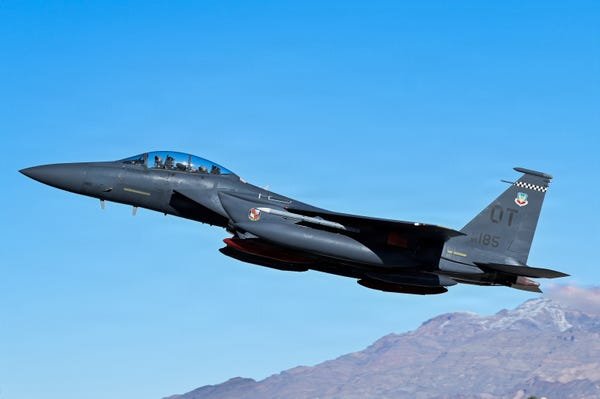
F-15E-Strike-Eagles-deployed-during-Operation-Epic-Fury-can-fly.jpeg

F-15E Strike Eagles, deployed during Operation Epic Fury, can fly 2.5 times the speed of sound. Take a closer look.

  • The US Air Force deployed F-15E Strike Eagles during Operation Epic Fury against Iran.
  • The fighter jets are designed for air-to-air and air-to-ground combat in all weather, day or night.
  • Kuwait mistakenly shot down three F-15E Strike Eagles in a “friendly fire” incident, CENTCOM said.

F-15E Strike Eagles, fighter jets designed for air-to-air and air-to-ground combat, are usually a dominating force in the skies.

When three F-15E Strike Eagles were mistakenly shot down by Kuwait during Operation Epic Fury, it brought renewed attention to one of the Air Force’s fastest, most versatile aircraft.

Here’s a closer look at the F-15E Strike Eagle, an advanced aircraft the US is using to destroy Iran’s missile arsenal and drone bases from the skies above Iran.

The F-15E Strike Eagle has been in service in the US Air Force for nearly 40 years.

An F-15E Strike Eagle at Nellis Air Force Base in Nevada. 

U.S. Air Force photo by Airman 1st Class Jasmine Thomas

The first F-15A model flew in 1972, and the first F-15Es were produced in 1988, according to the US Air Force.

It’s the fastest crewed aircraft in the US Air Force.


An F-15E Strike Eagle flies through the sky.

An F-15E Strike Eagle during an exercise at Gando Air Base in Gran Canaria, Spain. 

U.S. Air Force photo by Staff Sgt. Elizabeth Davis

The air-to-air and air-to-ground attack aircraft can fly at 1,875 miles per hour, or 2.5 times the speed of sound.

The F-15E Strike Eagle’s high thrust-to-weight ratio enables it to accelerate during vertical climb.


An F-15E Strike Eagle.

An F-15E Strike Eagle in flight. 

U.S. Air Force photo by Staff Sgt. Tylin Rust

The high thrust-to-weight ratio also allows the F-15E Strike Eagle to execute tight turns without sacrificing speed. It has two Pratt & Whitney F100 engines, each producing over 23,000 pounds of thrust.

Another distinguishing capability is the plane’s head-up display, which projects flight and tactical information directly on the windscreen.


The head-up display on a C-17 Globemaster III.

The head-up display on a C-17 aircraft. 

U.S. Air National Guard photo by Tech. Sgt. John Linzmeier

Pilots can track and attack targets, check the status of weapons, and see other tactical and flight information without taking their eyes off the windscreen.

The fighter jet also includes a low-altitude navigation and targeting infrared for night (LANTIRN) system.


The underside of an F-15E Strike Eagle.

The underside of an F-15E Strike Eagle. 

U.S. Air Force Photo by Airman 1st Class Olivia Gibson

The LANTIRN system allows the planes to fly in any weather and attack ground targets at low altitudes. The system consists of two pods, a navigation pod and a targeting pod, mounted under the plane.

F-15E Strike Eagles can carry both nuclear and conventional weapons.


Loading an AIM-120 missile onto an F-15E Strike Eagle

US Air Force crew members load an AIM-120 missile onto an F-15E Strike Eagle aircraft at Mountain Home Air Force Base in Idaho. 

Airman 1st Class Donovin Watson/366th Fighter Wing

Its armament includes an internally mounted 20-millimeter gun with 500 rounds of ammunition, AIM-9 Sidewinder missiles, and AIM-120 AMRAAMs, an acronym for the radar-guided Advanced Medium-Range Air-to-Air Missiles.

The F-15 also regularly carries ground attack weapons like the Joint Direct Attack Munition, or JDAM, a kit that adapts an unguided munition into a “smart” bomb with fins and GPS guidance.

F-15E Strike Eagles are flown by a pilot and a weapons systems officer.


The cockpit of an F-15E Strike Eagle.

The cockpit of an F-15E Strike Eagle. 

U.S. Air Force photo by Airman 1st Class Aidan Martínez Rosiere

The weapon system officer sits directly behind the pilot, and closely manages the plane’s sensors and weapons.

Two variants of the F-15 are single-seaters: the F-15A and F-15C.

The planes can fly 2,400 miles without refueling, and can be refueled in flight.


An F-15E Strike Eagle receives in-flight refueling from a KC-135 Stratotanker.

An F-15E Strike Eagle receives in-flight refueling from a KC-135 Stratotanker during an exercise over the Atlantic Ocean. 

U.S. Air Force photo by Senior Airman Cody J. A. Mott

F-15E Strike Eagles have a fuel capacity of 35,550 pounds.

The fighter jets can be refueled in flight by KC-135 Stratotanker aircraft, which Boeing developed from its “Dash 80” prototype in the 1950s.

KC-135s were also deployed to Israel as part of Operation Epic Fury. One crashed in western Iraq on Thursday, killing six US service members. United States Central Command said the circumstances of the crash were under investigation, but it “was not due to hostile fire or friendly fire.”

Each F-15E cost $31.1 million to produce in 1998, according to US Air Force figures. That would be around $62.3 million when adjusted for inflation.


F-15E Strike Eagles at Travis Air Force Base in California.

F-15E Strike Eagles parked at Travis Air Force Base in California. 

U.S. Air Force photo by Kenneth Abbate

Newer F-15 models cost around $100 million, The Wall Street Journal reported.

The newest version of the aircraft is the F-15EX Eagle II, which features more advanced controls and upgraded engines.

On March 1, Kuwait’s air defenses mistakenly shot down three American F-15Es during Operation Epic Fury in what US Central Command described as a “friendly fire incident.”


F-15E Strike Eagles in the Middle East.

F-15E Strike Eagles at an undisclosed base in the Middle East. 

U.S. Air Force photo by Senior Airman Jared Brewer

All six crew members ejected safely. The incident is under investigation.

“Kuwait has acknowledged this incident, and we are grateful for the efforts of the Kuwaiti defense forces and their support in this ongoing operation,” CENTCOM said.


Source link

Matthew Loh Headshot

Ukraine’s drone guru says the future of Russia’s Shahed warfare will be focused on speed

Ukraine has enough interceptor drone manufacturers, and now needs to prepare for the next phase of defending against Russia’s Shaheds, a prominent drone analyst said on Tuesday.

The new tech battle is going to be all about speed, said Serhii “Flash” Beskrestnov, an influential Ukrainian drone expert, in a Telegram post.

“There is no need to become the ‘one hundred and first’ manufacturer of drones against the current Shaheds,” he wrote. “We need to work for the future.”

Beskrestnov, who was recently appointed an advisor to Ukraine’s defense ministry, said the race would emerge as Ukraine gradually improves the effectiveness of its interceptor drones.

Interceptor drones are small uncrewed aerial systems primarily designed by Ukrainians to fly into the Kremlin’s Gerans, Russia’s mass-produced versions of the Iranian Shahed drone.

The interceptors have become a core pillar of Ukraine’s air defense network, offering a more cost-effective way to counter hundreds-strong waves of Gerans. Popular types of interceptor drones can cost around $2,500 to $6,000 each.

Beskrestnov predicted that Russia would soon adapt in three ways: installing evasion systems on its Gerans, building reliable flight corridors for the loitering munitions, and manually piloting them at extremely low altitudes to evade air defenses.

“We will cope with this and all the enemy’s bets will be on speed,” Beskrestnov wrote.

Russia’s most commonly used Geran is the Geran-2, based on the Shahed-136 and capable of about 115 mph. However, Moscow is. increasingly deploying jet-powered versions of the drone, dubbed Geran-3s, that can fly at speeds of up to 200 mph.

Now, Beskrestnov says it’s likely Russia will try to push those Geran-3s to 250 mph. The newer Geran-5, which is similar to Iran’s Karrar drone, is also feared to be capable of reaching 370 mph.

“At one point, all our interceptor drones may turn out to be useless,” the analyst warned.

Ukraine’s interceptor drones are typically first-person-view propeller-driven systems. Local engineers incrementally improved their designs to fly reliably at around 220 mph, but will likely be limited in how far they can push these aircraft, which are often built with inexpensive off-the-shelf parts.

“If you are a manufacturer, I ask you to begin developing interception systems for strike UAVs at such speeds right now, while we still have time,” Beskrestnov wrote.

His call echoes Ukraine’s initial research into interceptor drones in early 2024, when the tech was primarily used to destroy Russian reconnaissance drones.

As drone engineers realized at the time that Ukraine needed an answer to Russia ramping up Geran production, they spent months preparing their designs in anticipation of the growing threat.

By 2025, their present form began to emerge on Ukrainian drone markets, until Kyiv eventually set a production goal of at least 1,000 a day. As 2026 rolls on, it remains to be seen whether that could drastically change.


Source link

The-AI-boom-is-minting-startup-multimillionaires-at-an-unprecedented.jpeg

The AI boom is minting startup multimillionaires at an unprecedented speed

One of the wildest stories in tech right now is what’s happening at Anthropic. New data from Levels.fyi shows how some employees at this AI startup have effectively become multimillionaires about a year after joining.

One engineer who started in late 2024 got 60,000 stock options at a $13 strike price, when Anthropic was valued around $18 billion. At the time, the equity penciled out to roughly $200,000 a year on paper.

Fast forward to a recent share sale valuing Anthropic near $350 billion. Even after estimated dilution and other factors, this employee probably owns about $4 million to $5 million in vested stock now. The full equity grant, which typically vests in quarters over four years, is likely worth about $18 million to $20 million, according to Levels.fyi estimates.

Other examples, based on real compensation packages submitted to Levels.fyi by Anthropic employees: A senior software engineer with about $1.6 million in vested stock after a year; a more senior staffer with roughly $8 million after 18 months; and a business operations leader with at least $9 million after two years.

Tax can take a big chunk of this value, especially if you live in California. Still, outcomes like this used to take five to 10 years and an IPO. In frontier AI, it’s happening a lot faster now — as long as you get hired by the right startup.

“The biggest variable in maximizing your compensation will almost always be the company you work at, even beating out things like your job title,” said Hakeem Shibly, a data guru from Levels.fyi.

Sign up for BI’s Tech Memo newsletter here. Reach out to me via email at abarr@businessinsider.com.


Source link