Ciesla, a budding content creator, has gained over 129,000 TikTok followers and 190,000 Instagram followers who have watched her create this library. One of her most viral videos about the space has 7.8 million views.
Those viewers will be happy to know she plans to keep going. Ciesla hopes to add a porch, a decorated walkway outside, and landscaping.
In the meantime, though, she’s enjoying every second she gets to spend inside.
“As a mom and someone who has a loud brain that never really turns off, it’s so grounding to have a little escape from reality where I can do something I genuinely love,” Ciesla said.
“It’s honestly not just about the books,” she added. “It’s about having a space where I can reconnect with myself and breathe. Every person deserves to have a place like that.”
No one really tells you how to look for a home — and I don’t mean a structure with four walls and a front door.
I mean the place you’re proud to be part of, to describe to people who’ve never been, to bond over with strangers you’ve just met.
If I’m honest, my husband Cody and I started our search for a new home from vastly different perspectives: I’m a Guyanese-American Black woman raised by Caribbean parents in an eclectic corner of North Jersey.
I grew up proudly wearing my badge of independence as I took the bus and train between my hometown and New York City, the sound of different languages lulling me to sleep on the way home from Manhattan.
Cody, the firstborn in a blended, mostly evangelical family, jumped at the chance to leave rural Indiana as soon as he was able. He craved walkability, third spaces, and access to culturally diverse communities.
We met nearly 12 years ago in North Carolina and, for a while, found some common ground in Durham — its tight-knit community felt familiar to me, and the (semi) walkable neighborhoods suited him.
When remote companies became our sole source of work, we found ourselves with the freedom and opportunity to do what we hadn’t before: travel overseas.
Soon, we began to wonder if home might exist outside the contiguous US.
Throughout our summer of travel, we began looking for a place to settle
We spent time exploring London.
Ashley Stahm
We’d never been to Europe, so we took two months in the summer of 2023 to travel to Paris, Nice, and Cassis, France; Brussels, Belgium; Amsterdam, Netherlands; and London, England.
Those cities, of course, are as different as the four corners of the US, and perhaps even more so due to linguistic, cultural, and climate differences.
We packed a single checked bag and hauled it from city to city on trains and across cobblestones, shedding our crewnecks and rain jackets as we walked along Amsterdam’s canals for shorts and bathing suits in the south of France.
We loved the bicycle infrastructure in Amsterdam, the café culture in Paris, and the cultural diversity and ample green space in London.
However, our research taught us that the Netherlands, France, and the UK would not be particularly easy countries for us to immigrate to.
Not to mention, we stayed in each city during the summer, experiencing the most vibrant version of each. What would living in London feel like in winter, with the sun lost behind endless overcast skies? What would Paris be like when it rained days on end?
We enjoyed visiting Amsterdam during the summer.
Ashley Stahm
Around six weeks into our foray across those four countries that summer, we took a beat. What, exactly, were we looking for?
We’d seen Big Ben. We’d seen the Eiffel Tower. We’d biked across canals in Amsterdam, and had Belgian waffles in the place they originated because, well, of course we did.
The magic of our first European tour was captivating, sure, but we were looking for a home.
We realigned on the basics: We specifically wanted a place where we could build a childfree community. We craved places for adults to meet and support one another, with the intent of growing old together.
We never, ever wanted to own a car again. We wanted healthcare to feel accessible. We needed a feasible way to immigrate and integrate, language, bureaucracy, and all.
We wanted to be in this new home for the long haul.
As our travels continued, we found a not-so-great fit and one city that felt right
We spent our travels exploring new places and celebrating milestones.
Ashley Stahm
It was with that renewed direction that we went home and planned for our next trip across the Atlantic: this time to Lisbon, Portugal, and Barcelona, Spain.
Although their two countries shared a border, these two cities couldn’t have been more different to us.
In Barcelona, Catalan was spoken so widely that my high-school Spanish wasn’t as useful as I’d hoped. Between the stifling summer heat and what I perceived as a noticeable lack of visible representation of dark-skinned Black (and Afro-Caribbean) women like myself, the city just wasn’t a match for me.
I wasn’t expecting to see reflections of myself everywhere; I was in Europe, after all. However, knowing that Spain is home to millions of immigrants, I also hadn’t expected to feel so conspicuous and be pored over so much.
Although I left Spain feeling more alienated than ever, Portugal soon stole our hearts.
Everywhere I looked, I saw melanin. Throughout our time in Lisbon, I heard a mix of languages and accents — not just European Portuguese, but also Brazilian, Angolan, and Mozambican Portuguese, along with French and English — reflecting the diversity of the people around me.
I sat among greenery, quiosques, miradouros, and old ladies in crisp slacks with beers in hand at 11 a.m., gossiping with their neighbors before heading to the local tasca for almoço and a pastel de nata.
For us, Lisbon felt like it could be home.
After 2 years of searching, we’ve settled on Lisbon
From the north in Porto to the south in the Algarve, I couldn’t pick my jaw up off the floor.
Ashley Stahm
Eventually, we decided to move to Portugal’s capital city, where we had found walkable neighborhoods and a social community of both locals and expats — just as we’d hoped.
It’s warm and sunny year-round, so we didn’t need to worry so much about possible gloominess during other seasons.
Portugal also offers a universal public healthcare system that seems accessible, plus more visa routes than some other countries we’d considered.
Like most truly multicultural countries, though, it is grappling with geopolitical and economic friction that we’re still learning about.
However, there was what was on our list, and then there was what our hearts needed: A country willing to welcome us, teach us, and be patient (as we figured out how to file our immigration paperwork in a language we’re still learning).
We’re immigrants in a land whose respect we are still earning, alongside friends from all over the globe who are starting over, just like us. The effort is well worth it.
From where we stand, a full two years after we began our search, we’re finally home.
When Jordan Piluso went to a New Jersey estate sale in late January, she had one goal: to purchase a porcelain rabbit from the designer brand Herand.
She’d learned about the sale online and viewed photos of the items available. She didn’t plan to buy any other decorative animals.
But her mission quickly changed.
“When I walked into the house, this [ceramic] cat was sitting on a piano right in the entryway,” the 34-year-old stay-at-home mom told Business Insider. “No one was looking at it, so I just grabbed it. I thought it was such a whimsical, out-there decor piece, and that’s my style.”
She later purchased the $25 cat decoration, along with a few other pieces. She didn’t know it at the time, but her secondhand find was actually an Italian art piece from Fornasetti.
Every time Amanda publishes a story, you’ll get an alert straight to your inbox!
Stay connected to Amanda and get more of their work as it publishes.
“I love very eclectic, conversational pieces, and I just thought: I’ve never seen anything like this cat,” she added.
Jordan Piluso and the Fornasetti cat she bought at an estate sale.
Jordan Piluso
Hidden in plain sight
When Piluso purchased her cat statue, she didn’t immediately look for markings or a signature indicating the artisan who made it.
“I picked it up and was like, ‘You’re coming with me,'” she said. “It was just a no-brainer.”
The people running the estate sale were equally unaware of its origins.
“They were just happy to get rid of it,” she said.
The Fornasetti cat that Jordan Piluso found at an estate sale.
Jordan Piluso
It wasn’t until Piluso got home and did a Google image search that she realized it might be valuable. She saw photos of similar cat pieces by the Italian artist Piero Fornasetti and noticed that each had a stamp at the base of its tail.
Sure enough, her cat statue has one too. It reads “Fornasetti Milano, Made in Italy” and features an image of a hand holding a paintbrush.
The Fornasetti stamp at the base of the cat statue.
Jordan Piluso
Cats have been a signature motif for the late artist and his brand for decades.
Its modern feline pieces retail between $73 (€62) and $2,353 (€2000) each, while vintage cat statues like Piluso’s have sold for upward of $2,500 on secondhand sites.
Piluso confirmed with the brand via email that it’s authentic and was hand-painted between the late 1950s and early 1960s. Business Insider reviewed the email exchange.
Ken Farmer, an antique and fine-art appraiser, told Business Insider that Fornasetti created over 13,000 designs during his career and aimed to bring art into ordinary homes.
“This playful, smiling cat ceramic figure with black leopard spots on a white field, circa 1960, is likely worth $1,000 to $1,500 at auction and $3,000 retail,” he said.
Valuable, but priceless
The potential profit she could gain from her Fornasetti piece doesn’t matter much to Piluso. She has no intentions of selling it.
“It’s something that brings me so much joy,” she said. “I’m always going to be able to talk about this when people come over. I can tell my kids the story someday.”
“To me, that is a far more valuable gift than the monetary value this cat could bring,” she continued.
Her husband, a dog person, was less convinced that they should keep the decor piece when Piluso originally brought it home. However, he’s since come around, she said.
The couple is keeping the ceramic cat, which doesn’t have a name, on a tall mantle out of reach of their toddler.
Secondhand treasures
Don’t worry — Piluso didn’t leave the estate sale without the pink-and-gold embellished bunny she had initially gone there for.
She purchased the rabbit piece for $600 and a ceramic tiger for $50 — both of which will be displayed prominently in her home.
The decor pieces Jordan Piluso bought at a recent estate sale.
Jordan Piluso
Piluso said she’s relatively new to shopping secondhand. She was looking for a hobby after having her second child, and eventually landed on decorating her home with vintage pieces.
She said she loves the charm vintage decor adds to her home and the stories she can share with guests. That’s why her husband encouraged her to create a TikTok account to share her finds with a wider audience.
And clearly, she’s a natural at finding hidden gems.
“When you go to estate sales or thrifting, don’t be afraid of the oddities,” she said. “They can be the coolest, and in this case, some of the most valuable things you can find.”
We flew from London Gatwick Airport rather than Heathrow because the flights were about $1,000 cheaper.
Arriving at Gatwick, it was a luxury to have a dedicated check-in counter with barely any queue and then fast-track through security too.
After that, though, I wasn’t super blown away.
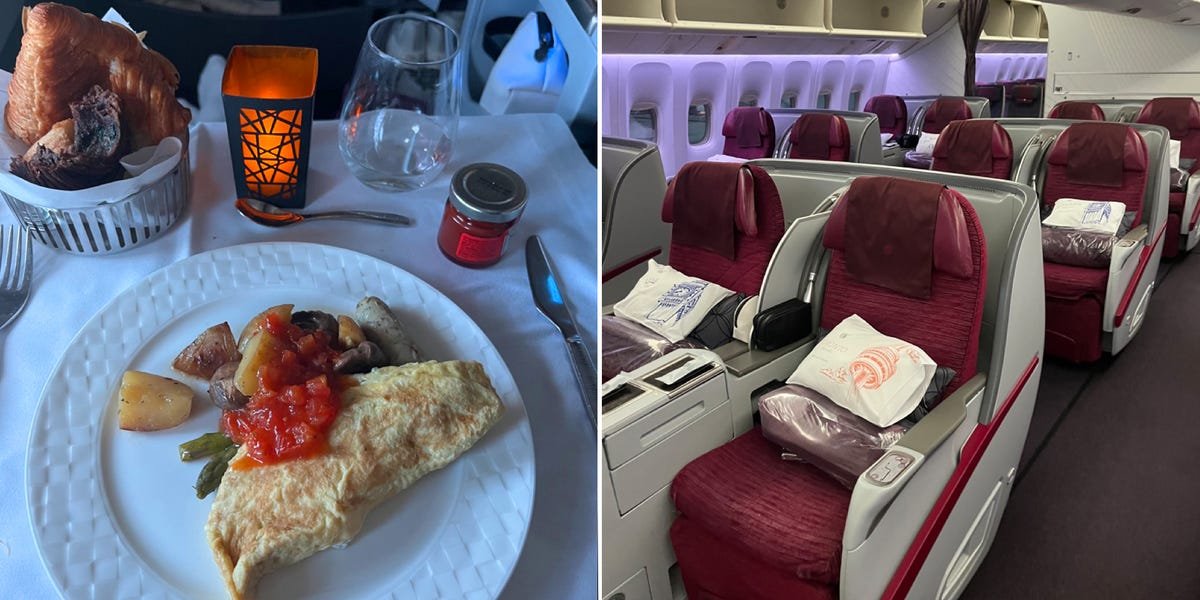
Qatar Airways doesn’t have a dedicated lounge at Gatwick, so its business-class travelers can use the Plaza Premium Lounge, which anyone can pay to use. I found it to be quite busy and a bit underwhelming, with a rather uninspiring view.
However, it has a separate area for Qatar Airways customers where we could order from a small à la carte menu. I got a burger, and my husband had a goat-cheese sandwich — it was nice to have complimentary food.
We were also given “premium” drinks vouchers for certain beverages, such as prosecco, though Champagne would’ve cost extra.
This story is available exclusively to Business Insider
subscribers. Become an Insider
and start reading now. Have an account? .
I sailed on Celebrity Constellation in interior, ocean-view, veranda, and concierge-class cabins.
Some lower-tier rooms felt similar to me, mostly just differing in configuration and floorspace.
Concierge class was great, but if I were paying full price I’d go for a standard veranda room.
Last fall, my husband and I sailed on the Celebrity Constellation for 51 nights in a row on six back-to-back cruises.
We did so using offers for discounted sailings that we received while playing in the onboard casino on a Celebrity cruise we’d taken earlier that year.
Our almost two-month journey began in Rome and ended in Tampa, and we spent each sailing in a different cabin trying the various room classes Celebrity offers.
Ultimately, we were able to sail in interior, ocean-view (standard and deluxe), and concierge-class cabins. Here’s how they compared, and which I’d book next time if I were paying full price.
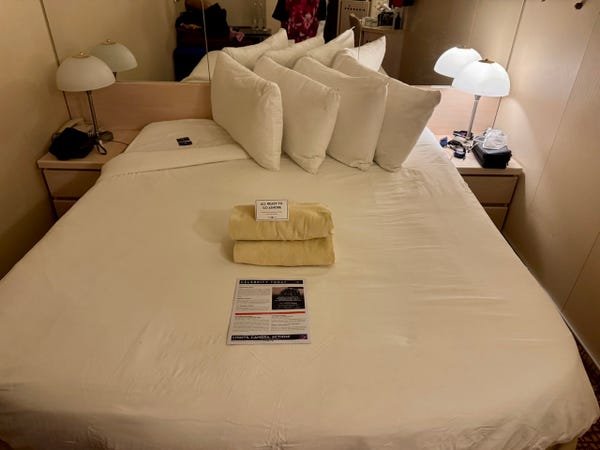
We started in a cozy interior cabin without windows.
Though it would’ve been nice to see the seas from our room, the lack of morning sunshine streaming in can be a blessing after a late night. Tammy Barr
On every cruise ship, interior staterooms tend to be cheaper and smaller than the other cabin types.
Prices vary widely depending on demand, itinerary, and dates, but I’ve generally seen these rooms listed on the Constellation for about $550 to $700 per person.
It was a well-appointed and basic room of 171 square feet that included a small desk area, refrigerator, television, closet, bed, and bathroom.
The king-sized bed was comfortable and the bathroom felt spacious. I especially liked the generous counter space and large rectangular shower.
After a late night, our interior room’s the lack of morning sunshine was a blessing. It was always easy to sleep in without windows, but I did miss seeing the stellar sunsets at sea from my bed.
I spent two voyages in ocean-view staterooms.
I liked that the ocean-view rooms tended to be lower on the ship. Tammy Barr
In my experience, upgrading from interior to ocean-view can add around $50 to $100 per person to the cost of the cruise.
This room was the same size as the interior one and elements of the space, from the bed to the nightstands, looked nearly identical.
However, the various ocean-view rooms can have different layouts. In one, the window was above the head of the bed, and in the other, we were able to use our window well as a bench or storage area.
These were appointed similarly to the inside cabin, but are located on the outside part of the lower decks, featuring windows of various sizes.
Lower floors tend to experience less movement, so these sailings felt especially quiet and smooth — this is one perk interior and ocean-view rooms tend to have over ones with balconies.
The deluxe ocean-view room offered more space and a larger window.
Our deluxe ocean-view cabin had a fairly large window. Tammy Barr
A cut above the regular ocean-view cabins, the deluxe room size took us from 171 to 242 square feet.
In comparison, this room felt massive, and the (slightly bigger) window provided outstanding views of the sea. The bathroom was similar-sized to the other classes, and the bed and vanity appeared to be the same.
It was nice to have space for in-room yoga and additional chairs that I used to host friends in the room.
These typically cost about $100 per person more than standard ocean-view cabins. Though it was a pleasant week, I am not convinced the larger room and window are worth the extra cost.
The veranda room featured an outdoor balcony.
I loved watching the sunset from our balcony. Tammy Barr
On one voyage we stayed in a standard veranda room, which is also commonly referred to as a balcony cabin. It was slightly longer than the previous staterooms, but at 175 square feet, it was not as large as the deluxe ocean-view.
The setups were quite similar, though I liked that the outdoor balcony added another 40 square feet for relaxing.
The best part of a balcony room is the access to fresh, salty air. I loved leaving the door open to hear the waves lap against the side of the ship.
Again, prices can vary, but I’ve seen balcony rooms on this ship cost about $300 more per person than a typical ocean-view cabin.
The cabin we most enjoyed was the concierge class.
The concierge-class room came with a full-sized couch for entertaining. Tammy Barr
The room itself is a balcony cabin, but is slightly larger than the basic veranda level at 191 square feet plus a 42-square-foot balcony.
Some of that extra space was used for additional shelving, and an even longer couch that could fold out to a queen-size bed.
Most notably, though, this class comes with access to a dedicated concierge to assist us with anything we need around the ship, such as booking excursions.
Our bathroom looked the same as it did in the other rooms.
The bathroom in our concierge-class room wasn’t anything special. Tammy Barr
The bathroom and closet we had in concierge class resembled the ones in the other rooms. All of them were simple and functional with a good amount of counter space and a decent-sized shower.
However, our bathrobes in here seemed to feel more plush than the ones in the regular cabins — but maybe we just imagined it.
This room class comes with an abundance of perks like complimentary binoculars to use and a bottle of sparkling wine, plus a menu of pillow options to choose from for the bed.
Throughout our week sailing in concierge class, we were able to attend exclusive events, like a lecture on our upcoming ports and a party on the ship’s helipad, where we enjoyed complimentary drinks with the officers as we sailed out of port.
As much as I enjoyed the in-room benefits of concierge class (especially the plush pillows), I do think these exclusive events would get old on a repeat cruise.
This luxe-feeling class can get pricey — and it’s not even Celebrity’s top offering.
We stayed in a concierge-class room on the Celebrity Constellation. Tammy Barr
Oftentimes, concierge class costs nearly twice as much as an interior cabin. I’ve seen rooms on this ship for about $928 a week per person to over $1,000.
Although the service we received felt like what we’d find at a fine hotel, this isn’t even the top class that Celebrity offers.
Next up is AquaClass, which offers similar balcony rooms, but with additional spa-related perks and better locations on the ship (like aft-facing balconies). I’ve seen these for a few hundred more than concierge.
Then, Celebrity has its highest-end suites in The Retreat, a ship-within-a-ship concept with a private restaurant, lounge, and team of dedicated employees. These can be double the price of a concierge room.
Ultimately, the sweet spot for me is the veranda room.
If I’m factoring in cost and value, my top pick would be the standard veranda room. Tammy Barr
Celebrity offers cabins for all budgets and I relished the opportunity to try several of them.
It’s no surprise that concierge class — the most expensive offering with the most luxurious perks — was my favorite. However, if I were paying full price for a sailing I’d book a standard veranda room.
In my opinion, it feels like a great value at a more reasonable cost, and paying a few hundred dollars to upgrade from ocean-view or interior room seems worth it.
And, at the end of the day, when the ship is sailing out of port, I just want to be able to watch from my private balcony — not looking through a window or crowding on a shared deck.
I’ve been to Disney World many times, and I like to think I know how to do it on a “budget” … at least, a loose one.
Recently, my partner and I planned a last-minute trip to the theme park on our way to visit family in Southern Florida for the holidays.
Between flights, transportation to and from the airport, lodging, park tickets, food, and souvenirs, we spent about $1,600, or $800 each … for about 48 hours in the Disney bubble.
Here’s a look at what we spent, ways we saved, and what we might do differently next time.
We stuck with a value resort since we wouldn’t be spending much time in our room
All-Star Music is a value resort at Disney.
Jordyn Bradley
We spent $237 on our flights from Fort Myers, Florida, to Orlando and landed a few hours before we planned to visit Disney World.
By the time we arrived at our value resort, All-Star Music, our room was ready for check-in ($319 for two nights).
We tend to choose value resorts because they are the cheapest hotels on Disney property. Plus, stays come with complimentary bus transportation to the parks and Disney Springs.
All-Star Music was the cheapest of the five Disney value resorts when we booked, and our room provided us with enough space for our short stay.
After grabbing some snacks at the hotel food court ($25), we took a much-needed nap and got ready to visit Magic Kingdom.
Since we attended a seasonal event, we didn’t need buy separate park tickets
Mickey’s Very Merry Christmas Party was fun.
Jordyn Bradley
Fortunately, past me unknowingly helped me save during the trip.
I had two unused tickets to last year’s Mickey’s Very Merry Christmas Party — an additional ticketed event held at Magic Kingdom — that I was able to put toward a new party date. I just had to pay the difference, which was $21 for both tickets.
These tickets typically run $169 to $209 per person, and they felt virtually free since I’d already paid for them in the past.
We also didn’t need to buy a park ticket because we were able to enter Magic Kingdom at 4 p.m. on our event day — and we could stay until midnight.
Several drinks and treats were included with our ticket
Our Mickey’s Very Merry Christmas Party tickets came with some freebies.
Jordyn Bradley
When we arrived at Mickey’s Very Merry Christmas Party, we each got an ornament and a Mickey-shaped peppermint marshmallow.
Our ticket also included festive treats and drinks, like cookies and hot chocolate, that we picked up throughout the evening. I’d estimate we consumed at least $30 worth of treats.
We got our sugar fill with those and purchased a few savory bites, like my favorite meal at Magic Kingdom, the ham-and-Gruyère croissant sandwich with chips ($11) at Gaston’s Tavern.
We also got popcorn for only $2.50 because we got a refill in our reusable popcorn bucket — it’s a must-pack item for every Disney trip.
I kept my souvenir purchases to a pair of mix-and-match character ears ($46 for a headband and two characters to go on it) and a commemorative event pin ($23).
The party also included performances, a holiday parade, fireworks, character meet and greets, and access to classic rides (which sometimes have shorter waits than a normal park day).
We got to ride all the Magic Kingdom rides we wanted to (some multiple times) without having to pay extra for line-skipping Lightning Lane passes.
A Magic Kingdom ticket on its own can run upwards of $200 depending on the day, so the special event add-ons, like unique character meet and greets and complimentary snacks, definitely make the ticket price worth it.
These events are my hack to a cheaper Disney day ifyou’re down to have a late night and stay in one park instead of opting for a flexible-but-pricier park-hopper pass.
If it’s your first time at Magic Kingdom and you can get a one-day ticket for the same price or less than the party ticket, I’d stick with the former so you can go at your own pace.
Our second day was focused on eating around the world at Epcot, and we didn’t spare any expense
I don’t regret buying the carrot cake.
Jordyn Bradley
We purchased two single-day tickets to Epcot for our second day, which cost us $381.
On longer trips, we normally opt for the flexibility of park-hoppers, but we didn’t want to spend our limited time traveling between parks. Plus, the flexible multi-park ticket would’ve cost over $70 more per person.
Since we were staying in Epcot, we didn’t buy Lightning Lane passes.
I don’t think they’re worth it here because the park doesn’t have many rides — plus, we could use single-rider lanes to skip large waits at both Remy’s Ratatouille Adventure and Test Track.
Most of our money was spent at on food and drinks from booths at Epcot International Food and Wine Festival.
We got a lot of drinks and bites during the Epcot International Food and Wine Festival.
Jordyn Bradley
We revisited festival classics, like the filet mignon with mashed potatoes ($20 for two orders) from the Canada pavilion, and tried some new favorites, like the flauta de barbacoa ($9) from the booth in Mexico. We loved the latter so much we got it twice.
Other favorites included the warm carrot cake with cream-cheese icing ($5), which I get every year, and my favorite drink, the Ottawa Apple ($16.50).
The chicken dumplings we had were just OK.
Jordyn Bradley
Some bites were just OK, like the chicken dumplings ($6) in the China pavilion.
However, I’m glad we looked into festival menus in advance to plan which booths we wanted to prioritize. This helped us save time and money while getting me more excited about our trip.
I shelled out the most money on collectible pins
I often meet characters and trade pins when I visit Disney.
Jordyn Bradley
Every time I go to Disney, I know I’m going to put most of my souvenir budget toward collectible enamel pins, and this trip was no exception.
Many of these pins can only be purchased at Disney parks, and collecting and trading them is a popular hobby.
On this trip, I was trying to complete a set and only needed one more pin, so I bought multiple mystery two-packs at about $23 each.
Ultimately, I spent $165 on mystery packs, which is more than my share of the hotel. I didn’t complete my set and I ended up with way more pins than I wanted (or needed).
Next time, I’ll buy one or two pins that I can pick out myself instead of mystery packs. I also plan to hold off on buying more until I can swap the ones I don’t want at one of the trading stations in the parks.
We ended our trip with a free activity
After our full Epcot day, our last afternoon was spent walking around Disney Springs.
The shopping and dining spot has free parking and is a nice place to wander if you’re wanting to be part of the Disney bubble without forking over hundreds for tickets.
Then, we headed to the airport for our flights home ($197).
All in all, we enjoyed ourselves and made the most of our 48 hours
I didn’t calculate what I spent until I got home, but I didn’t shy away from lots of snacks and mystery pin packs, so it’s not surprising how we got there.
Jordyn Bradley
Many people could spend what we did on our two-day trip and stay at resorts with nicer amenities or have more park days and sit-down meals.
However, because this trip was last-minute, we were happy with anything we made the time for, and since it was shorter, we felt better about having a higher food and souvenir budget.
Those were our priorities, especially since we never spend enough time at our hotel to justify booking a nicer one at a higher nightly rate.
We could’ve made the trip more affordable by spending less on souvenirs, which we will likely do next time. However, now I have more pins to trade for my next trip — and a way to remember one of our favorites.
I was living the dream — flying internationally nearly once a month for my work as a travel writer, crisscrossing the globe to cover incredible destinations.
Invitations like cruising the Norwegian coastline and then jetting off to a buzzy restaurant opening in Las Vegas were too good to refuse, even if they were happening back-to-back.
Meanwhile, the frequent long-haul flights, indulgent meals, packed itineraries, and erratic sleep schedules were quietly taking a toll on my health — I was gaining a substantial amount of weight and frequently feeling exhausted.
I just told myself that less-than-stellar health was just the price of admission for this sort of career. After all, my job consisted of bucket-list-worthy experiences, like hiking in Peru and going on safari in Kenya!
It took me several years to admit to myself that I couldn’t keep living this way.
Every time Meredith publishes a story, you’ll get an alert straight to your inbox!
Stay connected to Meredith and get more of their work as it publishes.
As much as I love traveling, doing it nonstop wasn’t great for my physical or mental health
I love traveling, but it can be exhausting.
Meredith Bethune
In reality, the job of my dreams consisted of overnight flights where I’d get little to no rest, then hit the ground running as soon as I arrived at my destinations.
After I’d fly back home from some trips, it would take me nearly a week to recover from jet lag. My stress levels were often cranked up, dealing with flight delays, deadlines, and navigation across different states and countries.
With grueling daily schedules on the road, I rarely had time to answer emails. I’d come home to a full inbox and even fuller calendar.
The regular exposure to dry air on planes wasn’t helping my immune system, and neither was all the stress. I felt like I was constantly getting sick with colds, flus, or whatever was going around.
Meanwhile, my diet wasn’t balanced or nutritious. It largely consisted of indulgent meals on press trips, where I felt pressure to try everything so I could write about it.
Saying no felt awkward, even when I knew I’d feel better if I could set firmer boundaries.
I’ve been able to see many places through my work as a travel writer.
Meredith Bethune
On top of all that, I wasn’t exercising. After all, press trips run on tight schedules. I’d return to the hotel late, wake up early, sit in a van for hours between stops, and finish the day with a multicourse dinner.
Some fellow writers managed to fit in workouts, but I didn’t. It wasn’t a priority for me then.
All the travel felt isolating at times, too. I was spending most of my days with publicists, fellow writers, and guides. They were all lovely people, but not permanent fixtures in my life.
My closest friends lived far away, and I kept postponing visits because I was always either traveling or catching up from being away.
Meanwhile, my parents were getting older and needed more support.
After nearly a decade of jet-setting, by 2019, it had become undeniable that my mother’s memory problems went beyond normal aging. Finally, I felt compelled to take my health seriously.
My mother’s diagnosis felt like a wake-up call to prioritize my well-being
Eventually, I realized I couldn’t travel so much without facing some consequences for my own health.
Meredith Bethune
By that time, my mother’s cognitive difficulties had progressed so much that she no longer seemed like herself. And though her official Alzheimer’s diagnosis came later, by then, it was just a formality. We had already known for years.
There wasn’t anything I could do to stop my mom’s Alzheimer’s from progressing, but I threw myself into researching the disease so I could know more about what the future held for her and, eventually, me.
I worried whether a similar diagnosis — one millions of Americans share — could be in the cards for me someday.
Though it’s not preventable, some studies and members of the medical community suggest that certain lifestyle changes, like being physically active and managing blood sugar and blood pressure levels, may lower one’s risk of developing some forms of the disease or delay its symptoms.
Even if I couldn’t prevent a future diagnosis, I knew finally taking care of my body and mind would be good for me. All that nonstop travel had been quietly wrecking my health, and the way I’d been living and working wasn’t sustainable.
I feel much better now that I’m traveling way less
I can’t control the future, but I can at least prioritize my health.
Meredith Bethune
It’s been over five years since I significantly cut back on travel.
I exercise almost every day and try to regularly follow a balanced diet. I’ve since lost over 50 pounds and sleep much better.
When I do go on trips, I do so with more intention and a lot of focus on the Northeast, close to home.
I probably take an overnight or weekend trip within driving distance about every six weeks. I still fly for work once or twice a year, but I’m no longer constantly on the road, and my body feels the difference.
When I go on bigger trips, I actually feel like I have more opportunities than I did before. Recently, I even hiked the Grand Canyon rim-to-rim, which I would never have attempted back when I was out of shape and constantly feeling drained.
Giving up on my dream job wasn’t easy, but I want to feel good and stay in great shape for as long as I can — even if that means finding peace at home instead of abroad.