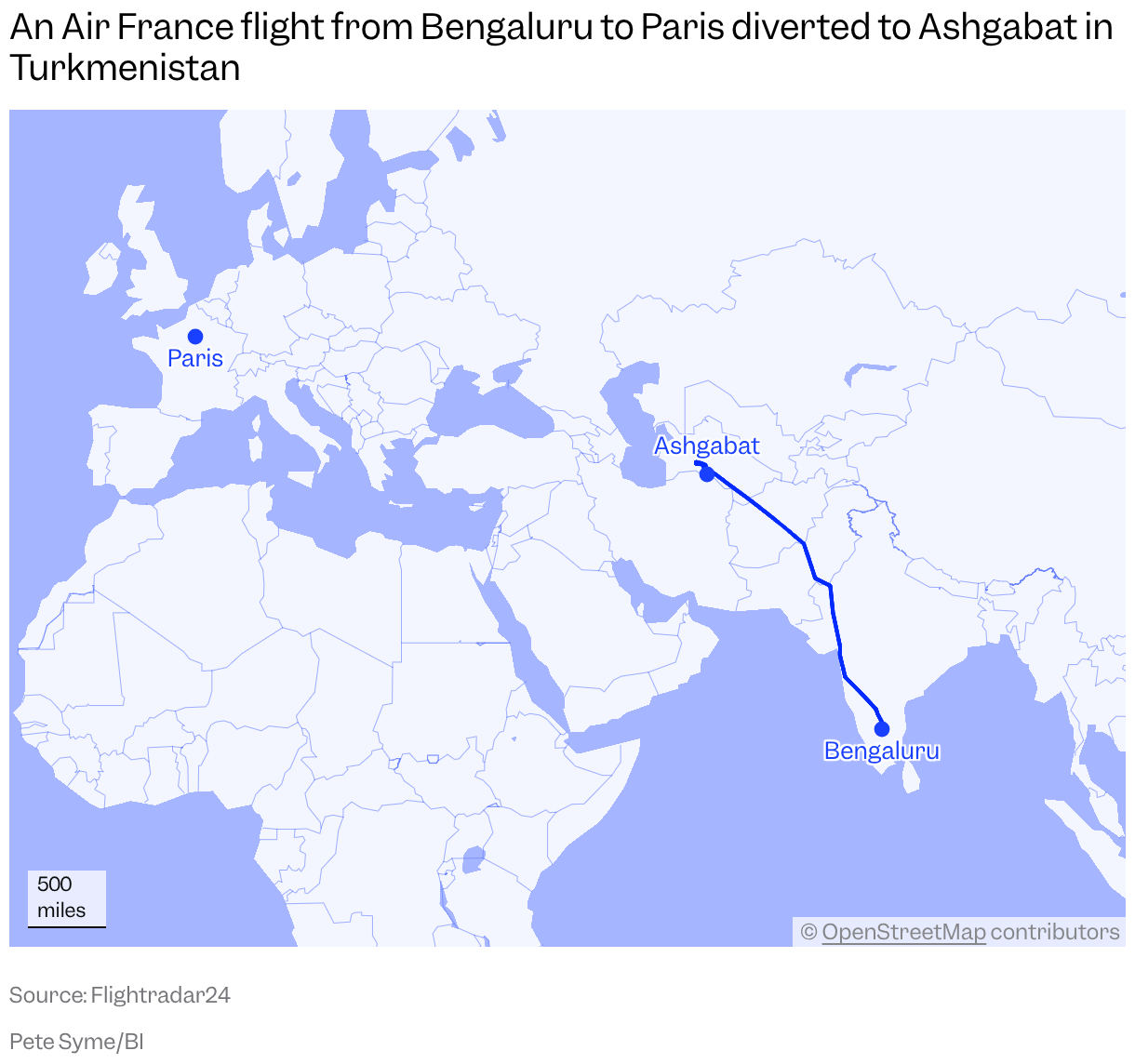
Air France passengers were delayed by nearly two days after they were diverted to Turkmenistan.
Monday’s Flight 191 was already running 21 hours late when it departed Bengaluru, India, shortly after 11 p.m., according to data from Flightradar24. It was supposed to land in Paris about 10 hours later.
However, four hours into the journey, the Boeing 777 started descending. It made a U-turn to land in Ashgabat, the capital of Turkmenistan, a sparsely populated nation in Central Asia.
Registered as F-GSPI, the jet is 26 years old. The cause of the diversion has not been confirmed, though The Independent reported that the plane suffered an engine issue.
Passengers then had to wait nearly another whole day to continue their journey to Paris. Turkmenistan is ruled by what Human Rights Watch has described as a totalitarian, hereditary governmentand is one of the world’s most politically secluded countries.
Every time Pete publishes a story, you’ll get an alert straight to your inbox!
Stay connected to Pete and get more of their work as it publishes.
Air France did not respond to a request for comment sent by Business Insider.
Given that the flight departed from India, there were a number of Indian nationals on board, who were hosted by the nation’s consulate in Turkmenistan. It is unclear where the majority of the passengers on the flight stayed during their time in Ashgabat.
Ultimately, a new aircraft was dispatched to collect the passengers. Flight-tracking data shows another Air France Boeing 777 left Paris on Tuesday morning and arrived in Ashgabat after a five-hour flight.
It spent about three hours on the ground before departing Turkmenistan shortly after 1 a.m. That’s nearly 22 hours after the passengers first arrived there.
The plane then landed in the French capital at 3:23 a.m. on Wednesday. Along with the departure delay, that’s 43 hours later than passengers initially expected to get there.
Flight-tracking data appears to show that the original plane is still on the ground in Ashgabat as of Thursday morning, three days after it landed there.
This wasn’t the first time that Air France has sent a plane to rescue stranded passengers.
In May 2024, one of its Boeing 787s was flying from Paris to Seattle when a burning smell was detected in the cabin.
The pilots declared an emergency and diverted to Iqaluit, the capital of Canada’s Nunavut territory. A different flight was canceled so a Boeing 777 could take the passengers to New York.
This story is available exclusively to Business Insider
subscribers. Become an Insider
and start reading now. Have an account? .
I travel to northern Italy often and have a good idea of what to pack.
However, I still find myself bringing along a few items I don’t need.
Some of my must-have items include a small umbrella, a good travel adaptor, and a tripod.
I’ve traveled to northern Italy for the past three years in a row, and there are a few things I never leave for my flight without. However, I still learn something new on every trip about what I need to bring and what I should have left at home.
This time, after two full weeks of trains, spritzes, hilltop towns, and cobblestone streets, I finally have a clear list of what actually earned its spot in my suitcase — and what I’m officially retiring from future Europe trips.
Here are five items I’m glad I packed for my trip to Italy, and a few things I could have done without.
A packable umbrella came in handy and didn’t take up too much space in my suitcase.
I always bring a small umbrella with me when I travel. Chloe Caldwell
It has rained at least one day on each of my trips to Italy, so this time, I prepared by ordering a compact umbrella that came with a small, packable case.
It was easy to fit in my purse or backpack during our outings, and I whipped it out more than once. It wasn’t the highest quality, but it was convenient and portable.
A tripod makes it easy to get group photos.
Having a tripod means I no longer have to ask strangers to take my photo. Chloe Caldwell
We’ve all asked a stranger to take our photo on vacation, and when we get the phone back, it’s fuzzy and there’s a thumb in the corner of the frame.
That’s why I bring a slim and easy-to-pack phone tripod with me on every trip. It fits in most small totes and can be propped up in seconds. The one I have also operates as a selfie stick.
Just set your phone on self-timer or download a remote shooting app, and you’re ready for finger-free group photos. This has also come in handy many times while I was solo traveling.
A backpack with a luggage flap is essential for seamless transportation.
I love my Beis travel backpack. Chloe Caldwell
Getting through airports, hopping on and off trains, and dragging my stuff across bumpy cobblestone walkways is the price I pay to visit such a beautiful destination.
One way I (literally) take some of the weight off my shoulders when moving from place to place is by using a backpack with a flap on the back that slips over the handle of my luggage.
I actually have more than one backpack with this feature now because it’s that much of a gamechanger for traveling. I regularly rotate between my Beis backpack and Portland Gear version.
I always bring a travel adaptor that works for multiple devices.
I have a Tessan adapter for several regions of the world. Chloe Caldwell
I love this Tessan adapter from Amazon because I can plug in multiple devices at once.
It has four outlets, two USB-A ports, and one USB-C port, so I know I can rely on it for charging my phone, plugging in my hair tools, and anything else I might need.
Plus, the plug folds down, making it even easier to pack. In addition to my universal adapter, I have this specific converter for several regions of the world.
I always travel with a small belt bag for daily essentials.
A belt bag makes it easy to stay hands-free during tours and activities. Chloe Caldwell
When wandering through major tourist cities, I always carry an over-the-shoulder belt bag to keep my money, passport, phone, and cards safe and within arm’s reach.
These bags are also practical for sightseeing. For instance, I went on a three-hour walking tour of St. Mark’s Basilica in Venice, and wanted to participate without worrying about carrying or keeping track of my things.
Being hands-free for big activities like this always makes the experience more convenient and enjoyable.
On the other hand, I’m done bringing outfits I’ll only wear once.
From now on, I’m prioritizing versatile clothing options. Chloe Caldwell
Planning outfits for a trip is one of my favorite parts of travel prep. I love to dress on theme and get a snapshot of the moment.
However, on my last trip, I realized that packing items I’ll only wear once for a couple of hours just isn’t worth the hassle. For example, I packed a long red gown to wear just in case we went to a fancy dinner. And, yes, it did sit folded in my suitcase for two weeks.
Next time, I’ll bring more versatile items that I can mix and match for various occasions throughout the trip.
I also brought too many pairs of similar shoes.
I don’t know why I brought two pairs of white sneakers with me. Chloe Caldwell
Don’t ask me why I packed two pairs of white sneakers. It seems silly now, but my logic was that one pair was for active outings and one was for more fashionable outfits.
However, this was unnecessary, and I could have just brought one pair and been fine. In fact, I’d avoid white shoes altogether in the future, as they can get dirty and matted on the cobblestone streets.
I’ve listened to and interviewed more than 50 tech leaders this year, from executives running trillion-dollar firms to young founders betting their futures on AI.
Across boardrooms, conferences, and podcast interviews, the people building our AI future kept returning to the same four themes:
1. Use AI, because someone who understands AI better might replace you
This is the line I heard most often. Nvidia CEO Jensen Huang has said it multiple times this year.
“Every job will be affected, and immediately. It is unquestionable. You’re not going to lose your job to an AI, but you’re going to lose your job to someone who uses AI,” he said at the Milken Institute’s Global Conference in May.
Other tech leaders echoed his view, with some saying that younger workers may actually have an edge because they are already comfortable using AI tools.
OpenAI CEO Sam Altman said on Cleo Abram’s “Huge Conversations” YouTube show in August that while AI will inevitably wipe out some roles, college graduates are better equipped to adjust.
“If I were 22 right now and graduating college, I would feel like the luckiest kid in all of history,” Altman said, adding that his bigger concern is how older workers will cope as AI reshapes work.
Fei-Fei Li, the Stanford professor known as the “godmother of AI,” said in an interview on “The Tim Ferriss Show” published earlier this month that resistance to AI is a dealbreaker. She said she won’t hire engineers who refuse to use AI tools at her startup, World Labs.
This shift is already showing up in everyday roles. An accountant and an HR professional told me they’re using AI tools, including vibe coding, to level up their skills and stay relevant.
2. Soft skills matter more in the AI era
Another consensus I’ve heard among tech leaders is that AI makes soft skills more valuable.
Salesforce’s chief futures officer, Peter Schwartz, told me in an interview in May that “the most important skill is empathy, working with other people,” not coding knowledge.
“Parents ask me what should my kids study, shall they be coders? I said, ‘Learn how to work with others,'” he said.
I interviewed Salesforce’s chief futures officer, Peter Schwartz, in May.
Lee Chong Ming/Business Insider
LinkedIn’s head economist for Asia Pacific, Chua Pei Ying, also told me in July that she sees soft skills like communication and collaboration becoming increasingly important for experienced workers and fresh graduates.
As AI automates parts of our job and makes teams leaner, the human part of the job is starting to matter more.
3. AI is evolving fast — and superintelligence is coming
As the year went on, the stakes around AI’s future began to feel bigger and more real. Tech leaders increasingly spoke about chasing artificial general intelligence, or AGI, and eventually superintelligence.
AGI refers to AI systems that can match human intelligence across a range of tasks, while superintelligence describes systems that surpass human capabilities.
Altman said in September that society needs to be prepared for superintelligence, which could arrive by 2030. Mark Zuckerberg established Meta’s Superintelligence Labs in June and said that the company is pushing toward superintelligence.
These leaders don’t want to miss the AI moment. Zuckerberg underscored that urgency in September, saying he would rather risk “misspending a couple of hundred billion dollars” than be late to superintelligence.
Some tech leaders, such as Databricks CEO Ali Ghodsi, argued that the industry has already achieved AGI. Others are more cautious. Google DeepMind’s cofounder, Demis Hassabis, said in April that AGI could arrive “in the next five to 10 years.”
Even when tech leaders disagree on timelines, they tend to agree on one thing: AI progress is compounding.
I saw this acceleration from the outside as a user. New tools are rolling out at a dizzying pace — from ChatGPT adding shopping features and image generation to China’s “AGI cameras.”
Things that would have felt magical in January now feel normal.
I tried Ant Group’s vibe coding app LingGuang’s AGI camera last month.
Lee Chong Ming/LingGuang
4. The human needs to be at the center of AI
Many leaders also circled back to the need for human control amid AI acceleration.
Microsoft AI chief Mustafa Suleyman said superintelligence must support human agency, not override it. He said on an episode of the “Silicon Valley Girl Podcast” published in Novemberthathis team is “trying to build a humanist superintelligence,” warning that systems smarter than humans will be difficult to contain or align with human interests.
Anthropic CEO Dario Amodei has been blunt about the risks AI poses if it’s misused.
While advanced AI can lower the barrier to knowledge work, the risks scale alongside the rewards, Amodei said on an episode of the New York Times’ “Hard Fork” published in February.
“If you look at our responsible scaling policy, it’s nothing but AI, autonomy, and CBRN — chemical, biological, radiological, nuclear,” Amodei said.
“It is about hardcore misuse in AI autonomy that could be threats to the lives of millions of people,” he added.
Geoffrey Hinton, often referred to as the “godfather of AI,” said in August that as AI systems surpass human intelligence, safeguarding humanity becomes the central challenge.
“We have to make it so that when they’re more powerful than us and smarter than us, they still care about us,” Hinton said at the Ai4 conference in Las Vegas.