
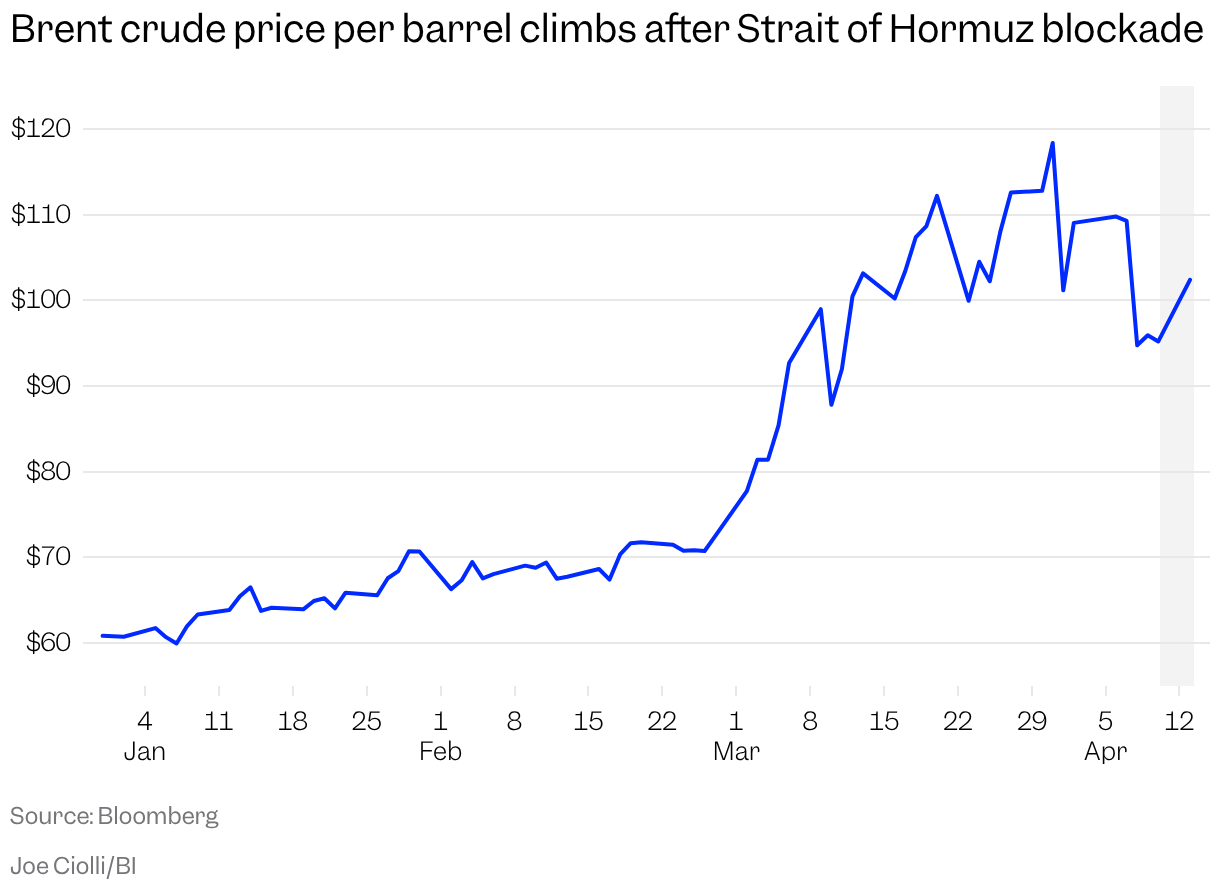
Line chart

Oil prices spike after failed US-Iran peace talks and Trump’s blockade of the Strait of Hormuz

Oil prices spiked past $100 per barrel after President Donald Trump imposed a blockade of the Strait of Hormuz in response to failed peace talks between Iran and the US.

Brent crude oil futures reached $102 per barrel on Sunday evening, up $7 from the previous close price. West Texas Intermediate also rose $7 to reach $104 a barrel.

Oil prices have skyrocketed globally since the US and Israel’s war on Iran began in February. Iran retaliated by effectively closing traffic through the Strait of Hormuz. Around 20% of the world’s oil supply and liquefied natural gas passes through the waterway off Iran’s coast.

Major oil hubs across the Middle East have also been damaged amid the ongoing military conflict, further compounding the oil supply chain. The fallout is being felt globally, prompting some countries to shorten workweeks and implement other energy-saving tactics. The national average price of gas surpassed $4 in the US in late March.

Trump agreed to a two-week ceasefire on April 7, dependent on Iran immediately reopening the Strait of Hormuz. However, as the war approaches its seventh week, there is no end in sight.

US Vice President JD Vance traveled to Pakistan on Saturday to engage in peace talks with Iran. After nearly 24 hours, though, the two countries failed to reach an agreement.

In response, Trump said the US will enact a blockade of the Strait of Hormuz in a Truth Social post on Sunday.

“Effective immediately, the United States Navy, the Finest in the World, will begin the process of BLOCKADING any and all Ships trying to enter, or leave, the Strait of Hormuz,” Trump wrote.


Source link

The-oil-price-spike-wont-fix-Russias-strained-finances-an.jpeg

The oil price spike won’t fix Russia’s strained finances, an analyst says

Oil prices have surged after fresh conflict in the Middle East raised fears of supply disruptions through the Strait of Hormuz — a move that would normally be a windfall for Russia.

But this time, it may not be enough, according to an analyst.

“The current temporary spike, filtered through sanctions discounts and an unfavorable exchange rate, is unlikely to change the fundamental arithmetic,” wrote Alexander Kolyandr, a senior fellow at the Center for European Policy Analysis, in a Wednesday post.

International benchmark Brent crude and US West Texas Intermediate were more than 3% higher, trading around $84 and $77.50 per barrel respectively late on Wednesday. Both grades are around 35% higher this year.

Russia is one of the world’s largest energy exporters, and its federal budget — and by extension President Vladimir Putin’s war in Ukraine — relies heavily on oil and gas revenue.

Yet Moscow does not receive international benchmark prices for its crude. Its Urals oil trades at a sanctions-driven discount, and the strong ruble means each dollar of oil revenue converts into fewer rubles for the budget.

As a result, Brent above $80 does not automatically deliver the revenue Russia needs.

Oil and gas revenues plunged 50% in January from a year earlier, falling to levels last seen during the pandemic shock in 2020. Meanwhile, the federal budget ran a deficit of 1.72 trillion rubles — about 0.7% of GDP, according to Russian Finance Ministry data.

“Unless oil prices stay higher for longer and the ruble weakens significantly, the Kremlin’s budget problems are here to stay,” Kolyandr wrote.

Kolyandr’s analysis comes as investors weigh whether the latest Middle East escalation will trigger a sustained oil shock, particularly for Asian countries that are reliant on heavily reliant on Middle Eastern energy.

China and India — now two of the biggest buyers of Russian crude — still source a large share of their oil from the Middle East, leaving both exposed to disruptions in the Strait of Hormuz.

Any prolonged disruption in the Strait of Hormuz could shift trade flows, potentially increasing scrutiny on whether Asian importers turn further to discounted Russian oil.

Markets have been volatile following the US and Israeli attacks on Iran over the weekend. On Wednesday, stocks in Asia slumped on energy security fears before rebounding on Thursday.


Source link