
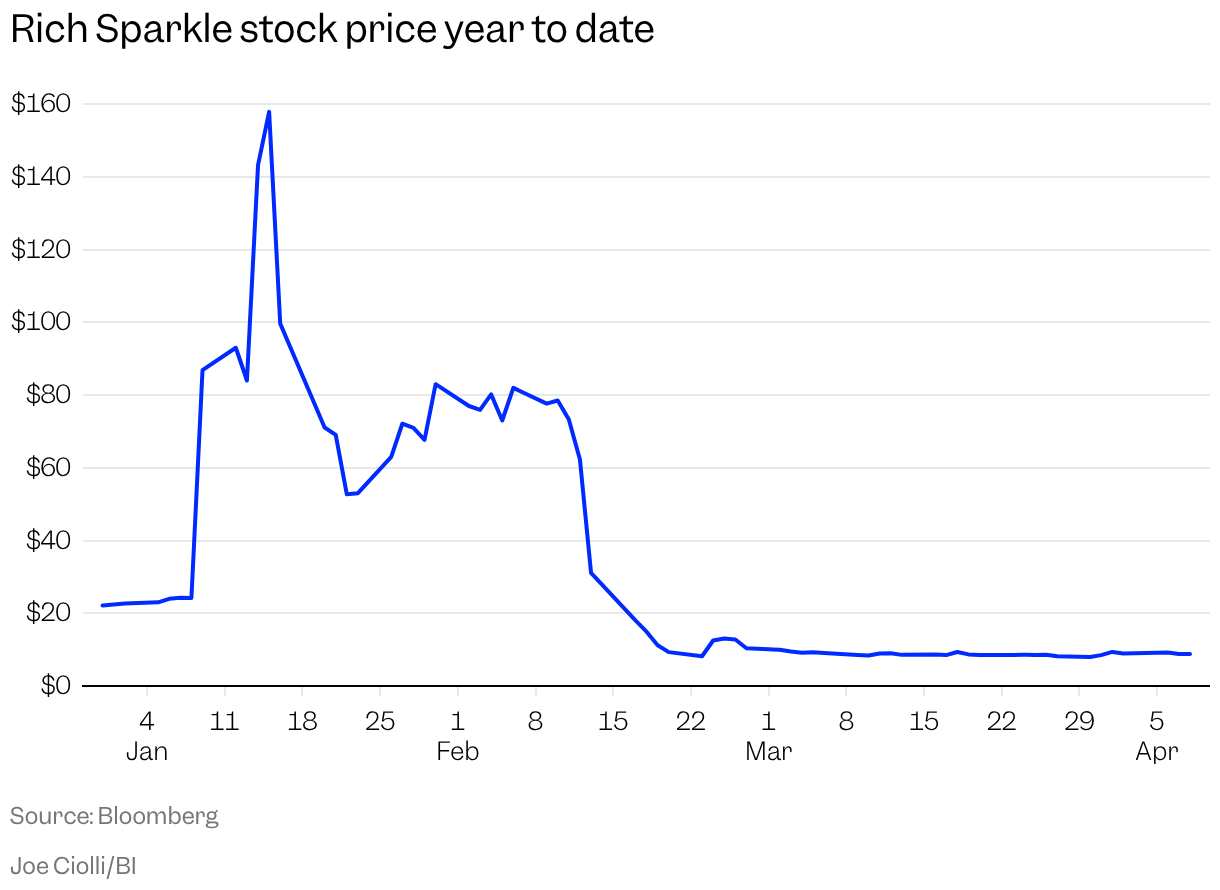
Line chart

TikTok’s top star teased a $975 million deal and then went silent. Red flags are piling up.

Khaby Lame’s mysterious $975 million deal has hit a snag: Brokerages are restricting or blocking trading in the stock behind it.

Lame, TikTok’s top influencer with over 160 million followers, announced in January that he’d struck a deal that would get him a gigantic payday and let everyday investors buy a stake in his business. To make this happen, Lame’s company would merge with the publicly traded Rich Sparkle Holdings, a financial printing firm.

Day traders pounced on the opportunity, buying stock in the company Lame would list under. Rich Sparkle’s stock surged on the announcement.

The initial excitement quickly faded. The stock has plunged more than 90% from its January high amid confusion over the deal’s future. There haven’t been any formal filings indicating that the deal was done, or that Lame’s company has received the 75 million shares it was promised.

Now, a handful of prominent investment platforms have restricted trading in Rich Sparkle’s shares.

Interactive Brokers lists the stock as non-tradable. A spokesperson for Interactive Brokers said the company “periodically reviews the securities it makes available for its clients to trade and restricts those it has determined are not appropriate to offer.”

Others, including ETrade, Merrill Lynch, Fidelity, Charles Schwab, and Vanguard, blocked online trading or put restrictions on the stock.

Some platforms, including Robinhood and Webull, are allowing trading as normal.

Rich Sparkle didn’t respond to multiple requests for comment.

Lame, who in January said he was “excited” to become a Rich Sparkle shareholder, hasn’t said anything about the deal publicly since then. He has removed Rich Sparkle’s stock ticker, ANPA, from his Instagram and TikTok bios, and his team hasn’t responded to multiple requests for comment, either directly or through intermediaries.

Rich Sparkle had a market cap of roughly $133 million as of Wednesday’s close. Some brokers limit trading in low market-cap stocks because they may not stick around for long and can create logistical headaches for a firm’s back office if they disappear, said James Angel, a finance professor and FINRA program director at Georgetown University.

“Brokers feel they are doing their customers (as well as their back offices) a favor by not letting customers buy them,” Angel said.
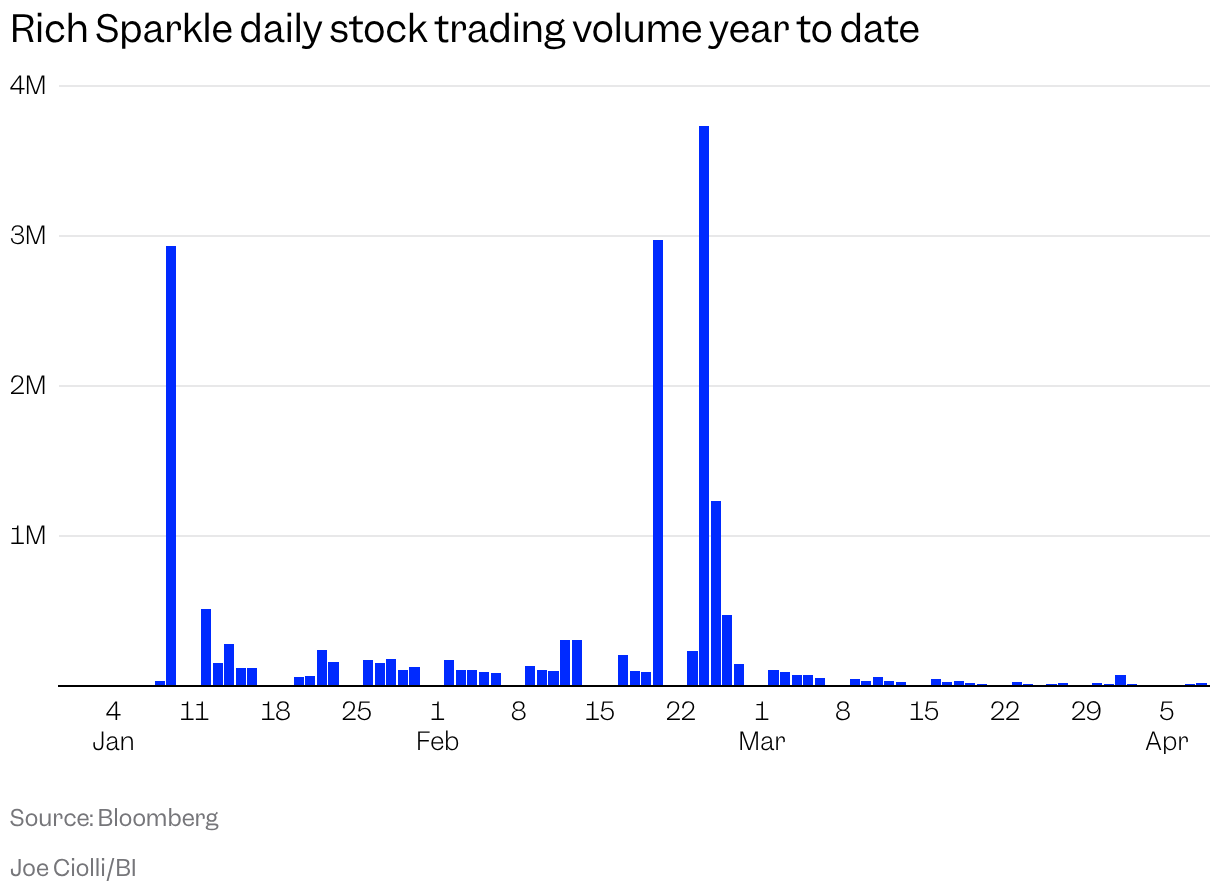
Questions multiply around the deal

Lame, a Senegalese-Italian influencer, rose to fame on TikTok through dialogue-free videos about overly complicated life hacks, like melting butter into a deodorant stick before spreading it on bread.

His $975 million deal with Rich Sparkle put him in rarefied company in the creator economy. YouTube’s top star, MrBeast, has built a company valued at about $5 billion, but few other creators have secured such a rich valuation. Unlike MrBeast’s company, Lame’s would have been publicly traded, giving retail investors an uncommon opportunity to invest directly in the fortunes of an individual creator.

The deal’s announcement sparked a wave of optimism among creator economy insiders, who saw it as proof of the industry’s value. The vibes have turned more skeptical as questions about the deal mount.

Rich Sparkle called the acquisition “completed” in a January press release; its most recent SEC filing on March 31 still described the deal as contingent on certain conditions. A January filing said the deal would be void if those conditions weren’t met or waived by February 28.

Rich Sparkle is registered in the British Virgin Islands and based in Hong Kong. Due to a quirk in how foreign-registered companies file in the US, it could take months for the deal’s status to be revealed to retail investors, Angel said.

When we called Rich Sparkle’s Hong Kong office to find out if the deal had closed, we were directed to the same corporate email address we’ve been messaging for months, with no reply.

Under the deal, Lame’s company would receive Rich Sparkle stock — not cash — in exchange for its intellectual property.

When Rich Sparkle’s shares soared after the announcement, some retail investors watched with envy.

“It started the upward climb all the way up to $180, and I was like, ‘Oh, should have held,'” said Eric Moore, a day trader who sold his Rich Sparkle shares before the deal was announced.

As the company’s share price has plummeted, so has the value of Lame’s potential stake, which Rich Sparkle initially valued at $975 million.

Some of the day traders who jumped into the short-lived Rich Sparkle upswing told us they were trying to make a quick buck on a high-flying stock — and not concerned with its long-term prospects.

Those prospects matter for where the share price will settle, which will determine Lame’s potential windfall and could impact broader perceptions of creator-fronted businesses.


LONDON, ENGLAND - NOVEMBER 12: Khaby Lame attends the Esquire Better Men dinner, in partnership with BOSS at Dante Restaurant, Claridge's on November 12, 2025 in London, England. (Photo by Max Cisotti/Dave Benett/Getty Images for Esquire UK)

Khaby Lame has done deals with big brands, including Hugo Boss. 

Max Cisotti/Dave Benett/Getty Images for Esquire UK


A bold proposal that drew industry skepticism

As part of the deal, Rich Sparkle said it planned to create an AI avatar of Lame to do brand deals and sell products on social media. Digital avatars are booming in e-commerce in China and, unlike human sellers, can sell around the clock. Some avatars have made millions in sales in a single livestream.

Still, Rich Sparkle’s estimate that Lame’s avatar could drive $4 billion in annual product sales seemed wildly optimistic, industry insiders previously told us.

The influencer data company CreatorIQ said it considers Lame to be among the most impactful creators based on the value of posts from brands, media, and other creators that mention him. By this measure, it estimates he’s earned $218.9 million from 2020 to 2025 in “EMV,” its metric for digital earned media, or unpaid mentions like press coverage.

Lame has worked with major brands including Hugo Boss, Airbnb, and Visa. He nabbed a cameo in Will Smith and Martin Lawrence-starring “Bad Boys: Ride or Die” (2024) and starred in the one-season “Khaby is Coming to America” on the free Fox streamer Tubi (2024), in which he meets and talks with celebs like David Beckham and Alicia Keys.

Lame left the US in June 2025 after ICE detained him, saying he overstayed his visa. After that, he went on a multi-city trip to China in September, where he posted about sampling the food and culture.

Nicola Paparusso, an Italian film producer and talent manager who repped Lame until November, told us he wanted Lame to pivot to mainstream acting.

“I said, ‘You can’t be an influencer forever,'” Paparusso recalled telling Lame when they were working together. He said the two parted ways over strategy direction and that he didn’t know about the Rich Sparkle deal.

In recent days, Lame has been busy posting on TikTok, filming a collaboration with Lego, and signing on to be an ambassador for the Dakar 2026 Youth Olympic Games.

He’s made no recent mentions of the Rich Sparkle deal.

Have a tip? Contact the reporters via email at lmoses@businessinsider.com or dwhateley@businessinsider.com, or on Signal at @danwhateley.94 or @luciamoses.81. Use a personal email address, a nonwork WiFi network, and a nonwork device; here’s our guide to sharing information securely.


Source link

Lauren Edmonds Profile Photo

AI still has a long way to go. Just ask AI pop star, Tilly Norwood.

Pop stars, you can breathe easy. The debut single from AI-generated triple-threat Tilly Norwood is evidence that your jobs are safe — for now.

The single’s 4-minute music video, which first hit streaming services on Tuesday, is a montage of obviously AI-generated scenes, often intentionally over-the-top, depicting Norwood’s imaginary path to global superstardom. At one point, she is hounded by paparazzi. At another, she performs for a sold-out stadium.

“When they talk about me, they don’t see/The human spark, the creativity/Behind the code, behind the light/I’m just a tool, but I’ve got life,” Norwood sings in “Take the Lead.”

The reaction to the song and its video, which has over 100,000 views on YouTube as of Thursday, has been mixed at best. However, the founder of Particle6, the AI studio behind Norwood’s career (or whatever), said releasing a chart-topping track was not the goal.

“When we made the video for ‘Take the Lead’ with Tilly Norwood, the goal wasn’t just to release a track or seek music chart success,” Particle6 founder Eline van der Velden told Business Insider. “It was to show people the current capabilities of AI and how actors and AI can now work together in a hybrid way with performance capture, and demonstrate that human input is still key.”

At the start of the music video, the company notes that 18 “real humans” were behind the production, including prompters, production designers, editors, and an actor.

AI has divided the entertainment industry. Supporters think the tech could shorten production time and lower costs. Critics worry AI could take human jobs, infringe on copyrighted material, or, as Matthew McConaughey has warned, mimic celebrities’ likenesses without their consent. Ben Affleck just sold an AI company he founded that focused on post-production tools to Netflix

“AI in music and performance is still new territory, and when you put something experimental out into the world, people are going to have opinions,” she said.

The opinions online were largely dismissive. “It took only 18 humans to achieve this level of soullessness? Imagine what 19 could have done,” one YouTube user wrote.

“This is so soulless,” another added.


Tilly Norwood's

The “Take the Lead” music video was made with 18 “real humans.”


Tilly Norwood


The video’s makers leaned into its genre, having fun showing what AI could make possible. There is, for instance, a scene in which Norwood rides a flamingo pool floatie into the sky, where she meets a pod of glittery pink dolphins and sky-bound acrobats.

“Actors, it’s time to take the lead/Create the future, plant the seed/Don’t be left out, don’t fall behind/Build your own, and you’ll be free/We can scale, we can grow/Be the creators we’ve always known/It’s the next evolution, can’t you see? AI’s not the enemy, it’s the key,” Norwood sings.

At the end of the song, Norwood calls on AI actors to “take your power” and “take the stage.”

“The next evolution is all the rage/Unlock it all, don’t hesitate,” she sang. “AI Actors, we create our fate.”


Source link

Lucia Moses

‘The Diary of a CEO’ star Steven Bartlett is going all in on AI — except on LinkedIn

Steven Bartlett isn’t just discussing AI on “The Diary of a CEO” — he’s using it to make entire podcasts, automate sales pitches, and more.

The podcast star recently raised an eight-figure investment round to build out his company, FlightStory, which has about 100 employees and generated around $47 million in revenue last year.

FlightStory’s AI experimentation started in a big way last year, when Bartlett challenged his staff to a two-month competition to use AI agents in their work.

The competition was a scrappy “test for us to very much dive into that space and just see what worked, and see what we could do in a short space of time,” said Isaac Martin, director of innovation at FlightStory.

The pre-production team won Bartlett’s contest — and a $20,000 prize — for building tools or agents that replaced or improved nearly every part of their processes. Bartlett said the contest resulted in savings of $1.18 million for the company.


Isaac Martin, director of innovation at FlightStory

Isaac Martin, innovation director at FlightStory, is promoting AI-made content through an initiative called “Project Gutenberg.”

FlightStory


Since then, FlightStory has used AI throughout its operation, including an AI-content push it calls “Project Gutenberg,” a nod to the founder of the printing press.

Execs at FlightStory spoke with Business Insider about the various ways their operation — a unit of his holding company, Steven.com — is using AI.

They also spoke about why, in the case of LinkedIn, the team is dialing back the use of AI.

The many ways FlightStory is using AI

Shows: In its most ambitious creative application, FlightStory is producing a fully AI-animated video series for kids aged five to eight called “Steven’s World.” The show revolves around a young Bartlett going on adventures with his friends and uses information from podcast guests like Neil deGrasse Tyson. FlightStory said it’s in talks with major streamers for distribution. The series grew out of an earlier AI-made podcast test, “100 CEOs,” that was hosted by an AI clone of Bartlett’s voice.

AI is also being used to translate “DOAC” into 14 languages. The Spanish translation has been the biggest success story so far, bringing in an incremental 20.5 million views or listens and generating $200,000 in indirect gross ad revenues on Spotify, said Christiana Brenton, FlightStory’s CRO and cofounder.


Christiana Brenton, FlightStory's CRO and cofounder.

Christiana Brenton, FlightStory’s CRO and cofounder, sees AI as a way to expand the kind of work the company can perform.

FlightStory


Ad revenue: On the commercial side, staffers are using a custom AI tool to develop pitches based on briefs, FlightStory’s creators, and past brand campaigns and pitches. In this way, FlightStory said it has shrunk the process from about three days to a few hours. This has helped boost the average revenue contribution per person across the company by 60% over the past two years.

Speakers: FlightStory is redesigning its FlightSpeakers division, using a conversational AI tool to reduce the time it takes to recommend speakers and check their availability.

Talya Levine, who leads the project, said the aim is to preserve the relationship element that’s long been a part of the business but also shake it up with tech.

“We hope it ruffles some feathers,” she said.

Social: FlightStory launched a new unit, FlightSocials, in late 2025 to help creators like Colin and Samir, and comedian Ali Siddiq, distribute clips on social media. Brenton said AI has sped up the work of producing clips, evaluating them, and making recommendations for the next ones. In this way, the company can post up to 15 clips per day per creator.

“It just completely removes the guesswork of a human having to decide what part of this long episode to cut up,” she said.

FlightStory also built an API called Creator Radar, which plugs into YouTube and other social platforms to help identify high-potential creators to sign. The API helped validate FlightStory’s decision to bring on “Hot Smart Rich” host Maggie Sellers Reum by showing that she had an unusually strong community — women who self-identify as “HSR angels” — relative to the size of her audience.

AI still has limitations

Surveys have found that independent creators are generally more eager to experiment with AI than legacy Hollywood studios and guilds are.

For creators like Bartlett looking to scale beyond themselves, AI offers a way to reach bigger audiences without being limited by their own time and energy.

Brenton said a lot of companies focus on using AI for efficiency, but FlightStory thinks of it as a way to “do things that we couldn’t necessarily do before.”

Like many companies implementing AI, FlightStory says it’s not using it to get rid of people, but to allow them to focus on higher-value work.

FlightStory’s leaders also recognize AI isn’t right for every use case.

For example, the company cut back on using AI on LinkedIn after noticing a lot of AI-written posts on the platform and deciding that ones written by humans could have more emotional resonance. The conclusion: They take longer to write, but have performed better than AI ones. Bartlett and his team now personally write every piece of social copy, Brenton said.

“Ironically, we believe that’s a unique advantage,” she said. “You’ll even notice now if you do follow Steven, there’s spelling mistakes and errors, and he doesn’t fix them by design.”


A still from

FlightStory used AI to create a junior version of Steven Bartlett for “Steven’s World,” a new kids’ show.

FlightStory


It’s also early days in understanding the types of AI-made content that audiences will embrace.

The AI episodes of “100 CEOs” got at most 35,000 views on YouTube, while Bartlett’s flagship podcast regularly gets hundreds of thousands of views per episode. Some praised it while others criticized the voice as not sounding human enough and said they preferred Bartlett’s interview format. FlightStory execs think kids will be more receptive to an AI-animated show, and that “Steven’s World” will introduce Bartlett’s brand to a new audience.

While the Spanish-language translation of “DOAC” brought in additional audience and revenue, not all of its podcasts will share the same financial opportunity. And podcasts that depend on a strong emotional connection with the audience might feel jarring to some if they’re dubbed by AI.

When it comes to FlightStory’s most valuable property, the “DOAC” podcast, where Bartlett interviews a range of public figures, the execs are adamant that the final edits are done by real people.

“The risk profile and the stakes are higher when you’re producing long-form content that reaches millions and millions of people,” Brenton said.


Source link

When-my-daughter-was-diagnosed-with-autism-at-age-2.jpeg

When my daughter was diagnosed with autism at age 2, I never imagined she’d own a business and be a reality TV star

This as-told-to essay is based on a conversation with Christine Romeo, mother of “Love on the Spectrum” star Abbey Romeo. It has been edited for length and clarity.

Sometimes I look at pictures of my daughter Abbey when she was 3 or 4. She was just so, so cute. But I think — was I present for that? Did I enjoy that time, or was I too obsessed with therapies and my worries about her future?

It’s normal for anyone, especially parents, to fret about the future, but for parents of kids with disabilities, those worries can be overwhelming.

Abbey is now 27. When she was diagnosed with autism 25 years ago, I couldn’t have imagined that Abbey would be running two small businesses or appearing on reality TV. But along the way, we both learned to think outside the box, and that’s helped Abbey grow so much.

I put Abbey in a vocational program in 8th grade

Abbey went to one of the best schools for autism. She had moderate setbacks, but her curriculum was still focused on academics. She was learning what typical kids were, like tectonic plates and world history, just at a slower pace.


Abbey Romeo

Christine Romeo moved her daughter, Abbey, to a program that would teach her life skills.

Courtesy of Christine Romeo


I could see that wasn’t what she needed. It’s not helpful to learn Western Civilization if you can’t remember what you did yesterday. I would rather Abbey focus on life skills that could help her cope with her autism, like visual clues to help her access her short-term memory.

When Abbey was in eighth grade, I switched her to a vocational program that focused on job and life skills. I had to set my ego aside and do what was right for Abbey. She didn’t need a high school diploma — she needed skills to help her live her life.

I realized as a parent you don’t get to order who your child is

There were moments throughout Abbey’s schooling when I knew I had made the right decision. One time, the teacher sent me a picture of Abbey rewiring a light. I was blown away.

Another was when I came in to see Abbey weaving in the textile program. She was operating this big machine with foot pedals and a large swatch of fabric, and it was regulating her. I had to leave the room, because I was crying.

With Abbey and her brother, who’s a year younger, I realized that as a parent, you don’t always get what you order. I’m determined to help both of them be who they are and be as successful as they’re meant to be.

Entrepreneurs inspired me to not take no for an answer

Abbey excelled at weaving, and I realized selling her creations could be a job. I believe it’s important for everyone to have a sense of purpose, and Abbey had expressed that she wanted a “real job.”

I spoke with her school about creating a program to allow kids to sell their art and crafts. The teacher loved the idea, but the principal didn’t. When he said no, I thought about one of my favorite shows, Shark Tank, and how entrepreneurs don’t take no for an answer. I was determined to find a solution for Abbey, even when the system said there wasn’t one.


Abbey Romeo making a hat

Abbey Romeo runs her own hat-making business.

Courtesy of Christine Romeo


The teacher ended up coming to our home on Saturdays to teach Abbey advanced weaving. Soon, her business, Hats by Abbey, was born. She also has another business shredding people’s paperwork, which they pay for by the bag.

Using cash helped Abbey learn about money

Today, Abbey has control over her days. She often makes hats from 9 to 12, then walks the dog before her voice lesson. She has the sense of purpose that we all need.

For a while, it was difficult for Abbey to connect with the idea of money. I found it helped when she could see cash. I started putting cash in her money box, and if she wanted to order something online, she had to give me the bills.


Abbey Romeo

Charley Gallay/Getty Images for Netflix


The first thing Abbey ordered with her profits was a $160 stuffed lion. It challenged every fiber of my being to let her order that, but she had earned the money, and she got to decide how to spend it. Seeing the glee on her face when she opened the box was worth every obstacle we’ve had to jump over.

Abbey continues to grow so much. I’ve created opportunities, and she’s taken them. It’s been the most beautiful, amazing experience.


Source link

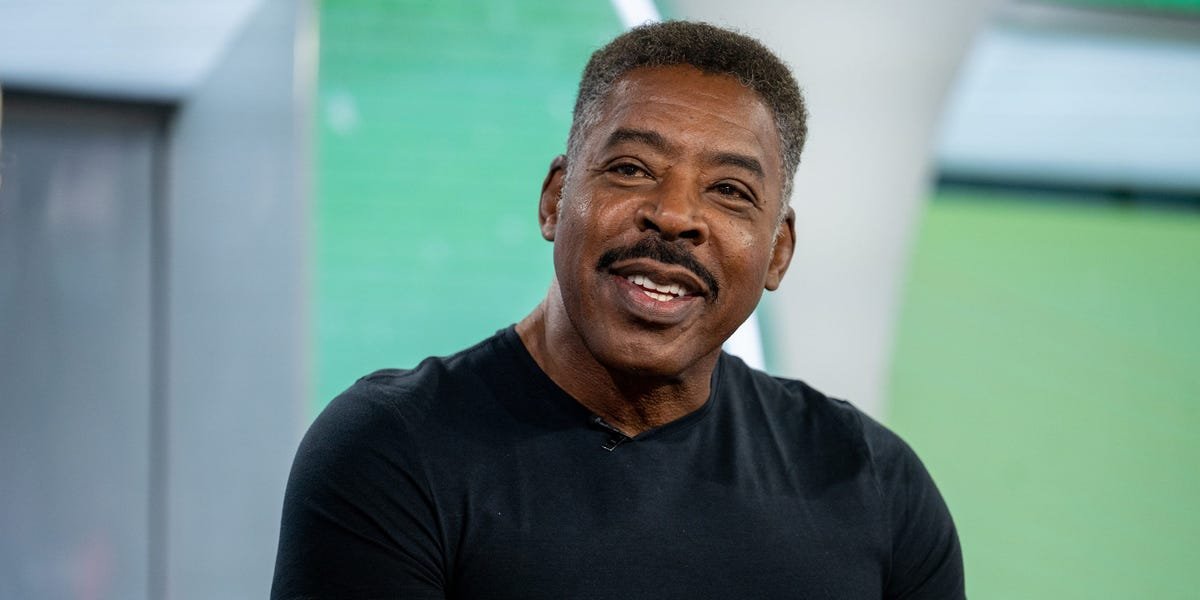
At-80-Ghostbusters-star-Ernie-Hudson-says-his-fitness-goal.jpeg

At 80, ‘Ghostbusters’ star Ernie Hudson says his fitness goal is surprisingly simple

At 80, Ernie Hudson still works out regularly — and it’s all part of his longevity journey.

In an interview with Men’s Health published on Wednesday, the “Ghostbusters” actor said he sees regular exercise as a way for him to live well for longer.

“I guess I’m excited because turning 80 is great. A number I never thought I’d see, but here it is. I always wanted to be an old guy who’s still feeling pretty good,” Hudson told Men’s Health.

Over the years, he’s come to realize the importance of tuning into his body and paying close attention to what it needs. “You just have to quiet your mind enough to listen,” he said.

That philosophy guides how he approaches fitness today.

“My biggest goal right now is just to stay alive,” Hudson said. “Weight becomes a big issue the older you get, especially if you’re from my community, the African American community. Every disease known to man seems to hit us harder, so it’s really important to get the exam, to stay flexible, to stay as mobile as you can.”

He added that mobility becomes especially critical with age.

“The older you get, you want to be at least flexible, so you’re not stumbling and falling down, which is the number one hazard. Falling and breaking something,” Hudson said.

At home in Los Angeles, he trains with a personal trainer two to three times a week. When he’s traveling or in New York City, he swaps in a different workout partner: his son.

“It gives me a chance to hang out in his favorite place, which is the gym,” Hudson said.

Much of Hudson’s training centers on building and maintaining upper-body strength, with workouts that include pushups, seated rows, and barbell bench presses.

He added that he has always believed in having strong arms, “so you appear that you can at least defend yourself.”

Not only that, Hudson said he feels the need to stay in top shape whenever he takes on a role, even if it isn’t especially physical.

“It’s important for a character that you’re able to lose yourself in that world,” he said.

Being fit makes it easier to focus on his job because he isn’t distracted by any physical discomfort or limitations, and regular exercise means he doesn’t have to scramble to get in shape when work calls.

But at the end of the day, exercise is only part of the equation.

“I stay busy, I travel a lot, and work takes precedence. But when you’re busy, diet is, I think, even more important,” Hudson said. “You can work out all you want, but if you aren’t in control of your diet, your eating habits, you’re going to have a problem.”

Hudson has long been serious about his workouts.

In 2024, he told Men’s Health that he goes for a brisk walk whenever he can’t fit in a formal workout and practices Pilates weekly to maintain his mobility.

“Ever since I was a kid, I’ve always made a point of being able to touch my toes,” Hudson said. “So at some point during the day, every day, I’ll do a stretch to make sure I can still touch my toes.”

During a January appearance on the “Today” show, the actor said he fits in sets of pushups throughout his day.

“When I get up, I like to do a set of pushups first thing and throughout the day,” he said. “By the end of the day, I should have at least 100 pushups.”


Source link