My-husband-and-I-were-laid-off-at-the-same.jpeg

My husband and I were laid off at the same time. Instead of panicking, we started our own business that now has 600 employees.

This as-told-to essay is based on a conversation with Marina and Ricardo Larroudé, cofounders of Larroudé. It has been edited for length and clarity.

My husband and I both had successful careers, me in fashion and Ricardo in finance. Yet living in New York with our two kids — who are now 12 and 16 — was incredibly expensive. We were never able to acquire wealth, and we didn’t own our home. So when we were both laid off in the early days of the pandemic, our financial security disappeared.

At the time, it felt like there was no option for finding new work, so we decided we had to try to create something ourselves. We were in a unique position to be at home together, and although there was a lot of economic uncertainty in 2020, we had hope. Ricardo and I had both come into the workforce during the 2008 financial crisis, and working through that recession taught us that better days always followed.

If we knew what we know now, we might not have started our shoe company, Larroudé. But we didn’t know a thing at the time, which probably helped us. Soon, our kids were wearing sweatshirts with the brand’s name — our last name — and there was no going back.

We ran the business from home, with our kids watching

Although we launched the company together, Ricardo and I have always had distinct roles. I’m the creative director, and he’s the CEO. We joke that he’s the boss at work, and I’m the boss at home. Although I wear many hats, it’s important for the business that there’s one ultimate boss.


Larroudé couple posing for photo

Marina and Ricardo Larroudé started their company after being laid off. 

Courtesy of Larroudé


For the first two years of the company, our office was our home. The kids got to see every step of the process. When we got an order, the Shopify app used to make a little “cha-ching” noise. Some days, we only had five orders, and hearing that notification was a thrill.

Then, my son said, “Isn’t it going to be amazing when you have to turn off that sound?” He was right — today the noise would be constantly playing if we heard it for each sale. Larroudé now has about 600 employees (most of them in Brazil) and generates millions in revenue.

I’m proud that we’ve provided security to other families

Over the past five years, the company has been growing almost faster than we can keep up. Larroudé is like our third child. We maintain our relationship, but there’s no life outside work. If we’re on a dinner date, we’re talking about the company. It’s very efficient for the business.


Larroudé factory

Larroudé has about 600 employees, mostly in Brazil. 

Courtesy of Larroudé


The one time we stop talking about the company is if the kids ask us to. For us, it’s our passion, so it’s natural to be constantly working. We can’t help ourselves, because we have a sense of mission. I was collecting unemployment when we first started the company (Ricardo found another job temporarily), so providing jobs to hundreds of families is one of my biggest accomplishments.

I don’t want my kids to take over the business

Despite running Larroudé together, Ricardo and I don’t see it as a family business. The people running it after us won’t be our children — they’ll be the people most qualified to bring the company where it needs to go. Sometimes our daughter will say, “If I don’t get another job, can I work at Larroudé?” and we tell her no, we won’t just give her a job.

Although we’re not raising our kids to run the company, we’re raising them to work hard. They’ve watched the business from the beginning, and we’ve talked to them about what happens when things go wrong.


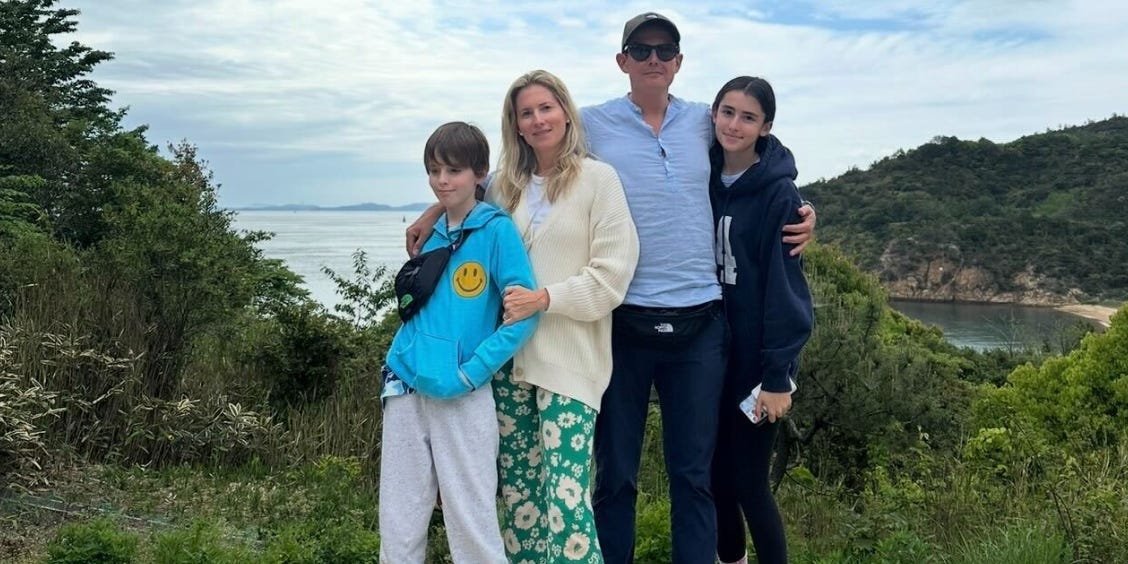
family posing for photo

Marina doesn’t want her kids running in the business. 

Courtesy of Larroudé family


Most of all, I want them to know they have a choice in how they respond when difficult things happen. Ricardo and I didn’t panic when we both lost our jobs — instead, we created something amazing. I want my children to have that grit and resilience. That’s the most important thing, at the end of the day.


Source link

Trump-says-US-has-started-major-combat-operations-against-Iran.jpeg

Trump says US has started ‘major combat operations’ against Iran as strikes hit Tehran

President Donald Trump announced early Saturday that the US had begun “major combat operations in Iran.”

“Our objective is to defend the American people by eliminating imminent threats from the Iranian regime, a vicious group of very hard, terrible people,” he said in a video statement posted on Truth Social.

The US and Israel carried out airstrikes against Iran on Saturday, following months of tensions between Tehran and Washington.

The Israeli government first announced the airstrikes, which were carried out in broad daylight, as “preemptive.”

“The government of Israel has carried out a preemptive strike against the Islamic Republic to eliminate threats against the country of Israel,” Israeli Defense Minister Israel Katz said in a statement carried by government channels.

“As a result, a missile and drone attack against Israel and its civilian population is expected in the near future,” he added.

A US official confirmed to Business Insider that American forces were involved, adding that the strikes were ongoing.

Footage circulating on social media appeared to show explosions and plumes of smoke in Iran.

The attack marks the second time that the Trump administration has taken military action against Iran. In June 2025, the US bombed the country’s nuclear facilities as part of Operation Midnight Hammer, and Trump said at the time these had “obliterated” Iran’s nuclear sites.

This new round of strikes comes on the heels of negotiations between the US and Iran, part of the Trump administration’s efforts to pressure Tehran into a deal that would severely limit its nuclear and military capabilities. It also follows the withdrawal of Western diplomats from several Middle East countries.

In recent weeks, as Trump has issued repeated threats and warnings to Iran, pushing it to make a deal, the US has built up a large military footprint in the Middle East and nearby European waters.

The Pentagon has surged hundreds of fighter jets, aerial refueling tankers, reconnaissance planes, support aircraft, and warships into the region.

One complicating factor has been public resistance from US allies to operations against Iran. The UK barred the US from using its nearby bases, and Jordan said its bases couldn’t be used for attacks on Iran, despite imagery showing the US has shifted cargo planes and F-35 stealth fighters to one of its bases.

The significant US naval presence on station or taking up position in the area includes at least two aircraft carriers, more than a dozen guided-missile destroyers, and three littoral combat ships, which are designed for near-shore operations.

The two aircraft carriers — USS Abraham Lincoln and USS Gerald R. Ford — are each equipped with dozens of embarked fighters, electronic attack jets, early warning planes, and helicopters. The Lincoln’s air wing includes F-35 stealth fighters.

On Friday, a day after the Trump administration’s negotiations with Iranian officials in Geneva, White House official Dan Scavino posted a photograph on social media of eight B-2 Spirit stealth bombers on a runway, suggesting these aircraft could be used to strike Iran again.

This story is breaking. Please check back for updates.


Source link

I-started-drinking-when-I-was-14-When-I-finally.jpeg

I started drinking when I was 14. When I finally got sober, I lost 100 pounds and saved over $55,000.

This interview is based on a conversation with Emily Susman, 42, a chef and cookbook author from Tulsa, Oklahoma. It has been edited for length and clarity.

I don’t blame anyone else for my alcoholism — it was all on me — but I grew up in a family where beer, wine, and liquor were part of the culture.

I’m half Lebanese, and every holiday and other social occasion centered on eating and drinking.

At 14, my grandfather handed me a vodka and tonic and said, “This is the way to drink responsibly, surrounded by your family in the safety of home.”

I dealt with stress by reaching for the bottle

In college, I joined a sorority where we partied hard. During rush season, our older sisters presented us with bottles of hard liquor covered with ribbons.

I was never far away from alcohol, whether I was working for my uncle as a bartender or establishing my own successful restaurant and catering firm in Dallas in my thirties.

But the bad habits really set in after I sold the business and started working with my husband, Drake, 43, at his gas-and-oil brokerage. I was in charge of the books and dealt with the ongoing financial stress by reaching for the bottle.


A woman in a sombrero taking a shot of tequila.

Susman was an emotional drinker who spent an average $30 a day on alcohol.

Courtesy of Emily Susman.


It got to the point where I was getting through a large bottle of vodka every few days. I’d hide the evidence in the pantry because I didn’t want Drake to see how often it was happening.

I’d use any excuse to drink, whether it was to celebrate the good times or commiserate with myself when something went wrong.

The tell-tale signs were there. I was overweight from all the wasted calories and my habit of eating more when I was drunk. I’d experience crushing hangovers, get the shakes, and vomit the morning after.

My family started to get on my case. “This is a problem for you,” they would say. “You need to get your act together.” Every time, I’d make an excuse. I’ll tell them that I’d cut down after Thanksgiving or give up entirely on New Year’s Day.

I tried fad diets and didn’t exercise

Inevitably, I’d be back drinking by Blake’s birthday in the middle of January.

Things got even worse when the pandemic began in March 2020. I was often confined to the house and passed the time drinking. I disregarded the needs of my body by not exercising and trying fad diets that weren’t sustainable.

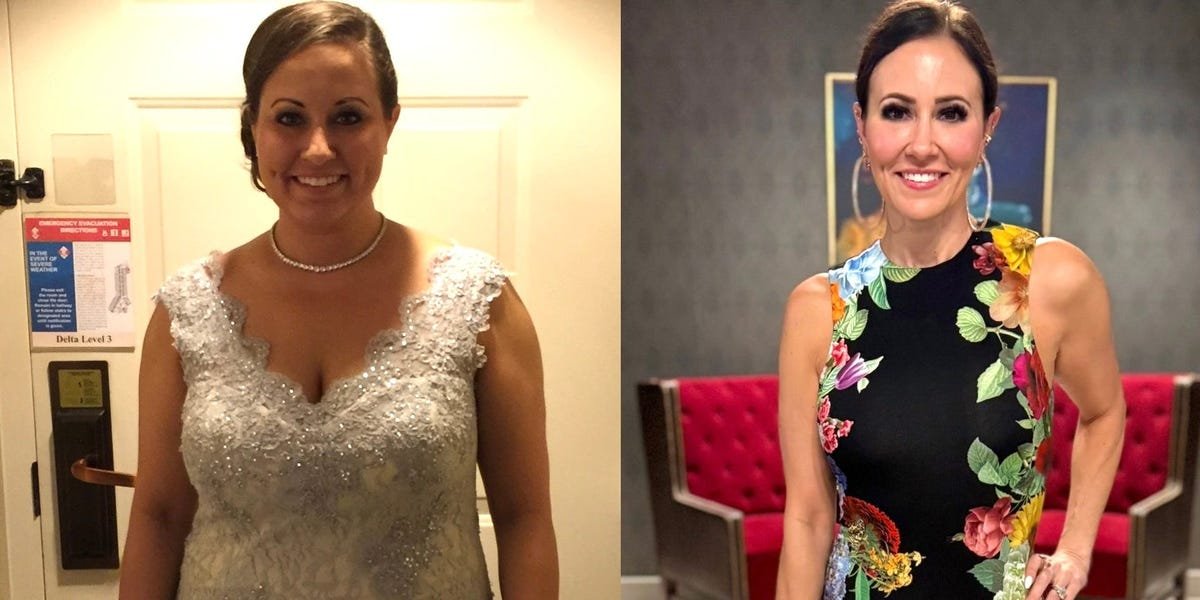
Then, a month into 2021, I awoke from a particularly bad episode and stared at myself in the mirror. At 5ft 8in, I was 230 pounds and a size 16. I bawled my eyes out because I was so miserable.


A before-and-after photograph of a woman who lost 100 pounds in weight

Susman before and after she quit drinking and lost almost half of her body weight.

Courtesy of Emily Susman


Something changed. I came downstairs and said to Blake, “I can’t do this anymore.” I sought therapy and had my last drink in early February.

I realized the all-or-nothing approach that fueled my alcoholism could be redirected to something positive.

It was a simple process without frills. I took pride in reaching each milestone: five days, then 30 days, then 120 days, and so on.

My weight-loss journey was slow and steady

Distractions made all the difference, whether I was using adult coloring books, painting with acrylics, or even sucking on lollipops when I craved sugar or the oral fixation of drinking.

Best of all, I reignited my love of cooking. I relied on my professional culinary background to make nutritious, balanced meals, which broke the cycle of binge-eating, restricting, and guilt.

My sensible diet, combined with simple exercises such as walking and strength training, helped me lose 100 pounds. I did it slowly and surely — losing around one pound a week — and now weigh 126 pounds.


A man and woman holding two dogs in front of the ocean.

Susman with her husband, Blake, and their Pomeranians, Bonnie and Clyde.

Courtesy of Emily Susman.


I’m a size zero to two and no longer hide my figure in baggy clothing. I’ve been sober for five years.

Another benefit is the amount of money I’ve saved. I found an app that took my average spending on alcohol of $30 a day to calculate that I’ve saved nearly $55,500 since 2021.

Meanwhile, I launched my company, Emma Claire’s Kitchen, the same year I got sober. It offers practical, tasty recipes and products, such as spices and, soon, mocktail powders.

I’m so grateful to my husband and my family

I’m a completely different person from the wreck I saw in the mirror that terrible morning. I love and value myself and am so grateful to Blake and the rest of my family for staying by my side.

It’s scary to think that I nearly lost everything — including my life — to alcohol. I’ll never go back to what passed as an existence, just getting through the day.

I have a bright future ahead of me now.


Source link

I-started-a-business-with-AI-and-no-tech-background.jpeg

I started a business with AI and no tech background. Here’s what it still can’t replace.

This as-told-to essay is based on a conversation with Tim Desoto, a 49-year-old founder and CEO, based in San Francisco. The following has been edited for length and clarity.

I’ve been working on my startup, an AI-powered shopping platform, since late 2024. With all the advancements in the tech industry, people might think of AI as a hammer, treating everything else as a nail, and in my experience, that just doesn’t work.

I don’t have a tech background, and since starting my business, I’ve learned a lot about where to leverage AI, and where not to. I’m always trying to be flexible about when to switch from AI to human intervention, and vice versa.

Over time, it’s become clearer to me where and where not to use AI for my business.

I rely on my network and social media to help me decide which AI tools to use

I’m fortunate to live in San Francisco. I go to meetups to hear what people are using, and I’ve attended some developer conferences. My ears always perk up when I hear that a new tool or version of something is working for somebody else in my network.

Right now, there’s a strong focus on agentic workflows. OpenClaw generated buzz as an open-source autonomous agent project, and Moltbook amplified that attention by making agent-to-agent interaction visible in a social environment. Claude Cowork is also gaining traction, particularly among teams looking for enterprise-ready agent workflows with clearer guardrails.


Tim Desoto

Desoto’s startup, Goodlife, is an AI-powered shopping platform.

Zachary Fineberg for BI


Beyond the agents themselves, the focus is moving from “what can agents do?” to “how do we run them reliably and securely at scale?”

Whether I’m looking at X, LinkedIn, or other platforms, there’s a lot of really great work being done to share these updates.

I use AI for all the typical time-saving tasks

My paid stack includes business plans for models such as Claude Max, Gemini Ultra, and ChatGPT Business, along with AI-powered development and productivity tools such as Cursor, Figma Make, Notion AI, Superhuman Ask AI, and Lovable.

Gemini’s image models have become incredible. The latest updates to the new model have really improved everything. I noticed faster performance, more stable reasoning, and stronger multimodal capabilities, especially in image generation. I was impressed by how consistent the images remained during modifications. I’ve even noticed some improvements in the responses it gives about real-time information.


Tim Desoto

Desoto uses AI models like ChatGPT and Gemini every day to help him run his business.

Zachary Fineberg for BI


I divvy up which tools I’m using based on where the latest developments are, and use them either as they’ve been designed or as I think I can use them in my current operational flow. For example, I use Lovable, an AI website builder, to make slide decks.

My ‘AI conveyor belt’ exercise helps me test different AI models

Usually, I start with a written prompt, then go multimodal, talking out loud to the model. I’ll talk back and forth with it about my idea and try to get the agent to push back because I know that some AI models tend to be more agreeable.

Once I get an output that I’m happy with, I use a different model to get a different view. For long-form analysis and structured insights, I lean toward Claude and Gemini. Gemini’s inline source linking is particularly useful for verification and deeper research. For structured reasoning and formal writing, I primarily use ChatGPT and Claude.

Sometimes, I’ll push a document out to multiple models at the same time and see what comes back simultaneously. For creative exploration and multimodal work, I use both Gemini and ChatGPT to generate early-stage concepts, mockups, and visual inputs. Some models are better than others at certain tasks, but I’m always getting a more well-rounded perspective by feeding content to multiple models.

The process can take as little as 15 minutes, or higher-impact decisions can span several hours to a couple of days, depending on complexity.

I eventually needed human developers


Tim Desoto

Desoto vibe coded the alpha of his product before bringing in developers to speed up production.

Zachary Fineberg for BI


When I was vibe coding the alpha version of my product, I would hit spots where 30 or 40% would be wrong. I didn’t know what exactly the problem was. I would have multiple screens running the code to figure it out, and I’d continue to use AI against AI until I could get to about 95% confidence.

I contracted a few developers to help move my product forward. Now I have a product developing at a faster, much more robust, and scalable rate.

As much as I can do with AI, it’s amazing what technical people can do with AI tools that a non-technical person can’t.

The human perspective is still irreplaceable in my business

I reached out to a lot of informal mentors and friends in the space who could be helpful early on in my process, but recently I formalized having advisors to bounce things off of. That has been a huge feather in my cap.

These advisors have their own expertise to draw on, and they know many smart people in this space working on projects that have helped us identify potential blind spots. It’s helped me connect with potential partners in ways that I think would be more difficult as a solo founder.


Tim Desoto

AI does a lot for Desoto, but it can’t replace human judgment.

Zachary Fineberg for BI


I feel like I have a clearer view now of what I can trust AI for, compared to what I thought at the beginning of my journey. While issues like hallucinations and agreeability can be mitigated, long-term strategic judgment and taste still require human oversight.

AI can generate possibilities, but choosing the right direction remains a human responsibility.

Do you have a story to share about running an AI-powered business? Contact this reporter, Agnes Applegate, at aapplegate@businessinsider.com.


Source link

My-husband-and-I-started-doing-adult-paint-by-numbers-to-get.jpeg

My husband and I started doing adult paint-by-numbers to get off our phones. The hobby’s benefited us more than we expected.

I’m stuck in a doomscrolling loop again.

My algorithm drags me down the rabbit hole of videos people posted to social media to declare 2026 as the year they … get off social media.

I see more and more videos with mass declarations to “go analog” and focus on screen-free activites. The irony is thick, but with the world on fire around me the sentiment has appeal.

I’m not naive enough to think this movement is new or will last in any meaningful way, but participating seems like a nice way to take a breath and find some good in the rubble.

As I watch another video and then one more, an idea starts to take root. What if I start a new hobby to get off my phone, even if just for a little while each day?

And what if my husband joins me?

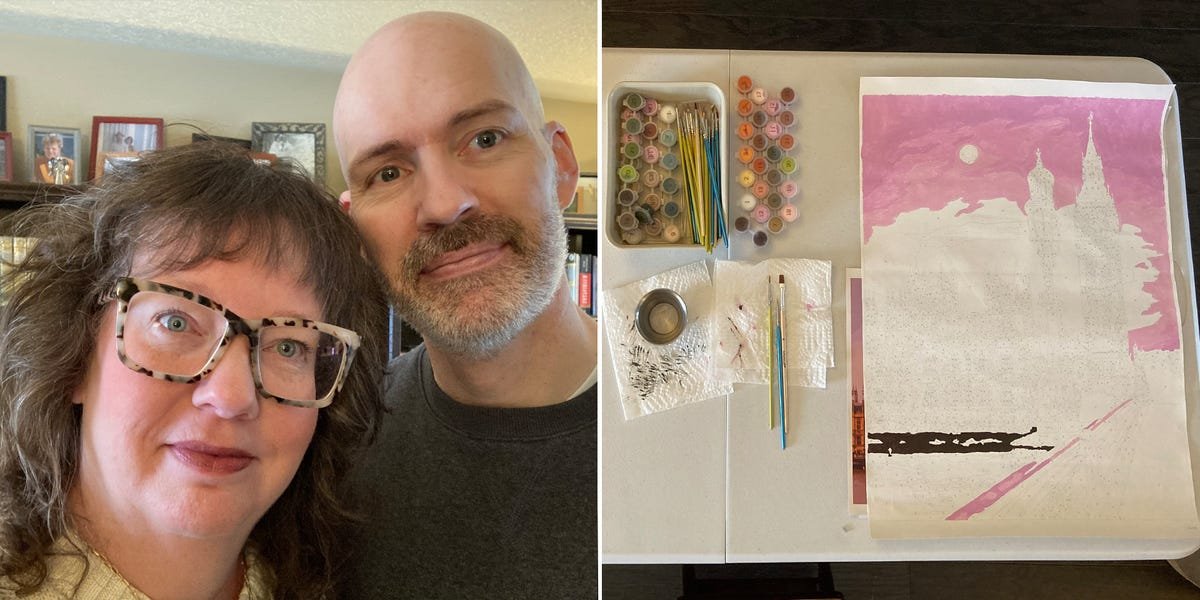
Although it felt out of our comfort zone, we bought paint-by-number kits


Table with paints, papers with partially painted artwork

I started doing paint-by-number canvases with my husband.

Tawnya Gibson


When I share this idea with my husband, he brings up the idea of buying paint-by-number kits that are designed for adults.

It’s far out of our comfort zone. But before either of us have a chance to talk ourselves out of this, we pop into an art store.

We both decide to buy larger canvases mostly to have a longer-term project, not because we are certain we have the right abilities. About $30 later, we’re still wondering what we are thinking.

When we get home, we bring down a folding table from our office. It’s just the right height to share as we sit on our loveseat, water, brushes, and paper towels between us.

Keeping our paints separated, we turn on reruns of “New Girl,” grab our reading glasses and glob the colors on our canvases — him a streetscape of Brooklyn, me a skyscape of London — both quietly hoping they’ll be nice enough to hang on our bedroom wall when we’re done.

These nights off our phone become our lifeline to feeling lighter, like when we were first married


Man and woman wearing hats, smiling

It’s nice that a simple hobby has helped us talk and laugh more.

Tawnya Gibson


Several things soon become clear. First, we may have overestimated our abilities and how difficult an adult paint-by-number could be.

Next, we are taking vastly different approaches to the task. I am starting with the larger areas, swirling my brush and not coming close to the canvas edge until the very last minute, desperate to not make a mistake.

My husband goes for the smaller details in the darkest color. He has read all the instructions. I’ve tossed mine straight into the recycle bin.

Our personalities are similar until they aren’t. I have a need to catastrophize before I build a plan. My husband is logical with a more black-and-white way of thinking. I feel these differences highlighted as we paint.

Over the span of two or three episodes of “New Girl,” I’ve delayed starting, given up, and restarted a dozen times. My sky looks terrible, punctuating my lack of artistic talents.

I declare total disaster in between every laugh, fret about running out of pink sky No. 12, and stop long before the last episode of the night comes to an end.

Still, we continue painting night after night.

The progress is slow and neither of us are sure when we’ll be done. But something happens on the nights we choose painting over retreating with phones in hands: Our home is kinder. We talk. We laugh.

The stress of getting the strokes within the lines is the lighter type of stress we used to have when our marriage was young.

On our way to bed, we stand up. Assess. Comment on our progress and sleep a little easier.

We’re remembering what it’s like to do something with no goal or agenda. We’re enjoying our time together less online.

Maybe when we’re all done, I’ll post a picture in a hazy filter and show off my pink-skyed London, mistakes on full display — a little analog badge to celebrating remembering how to live.


Source link

I-started-a-list-of-Black-owned-businesses-in-Maine-6.jpeg

I started a list of Black-owned businesses in Maine 6 years ago. I took it down when ICE showed up.

This as-told-to essay is based on a conversation with Rose Barboza, founder of Black Owned Maine. It has been edited for length and clarity.

In the summer of 2020, I started a directory of Black-owned businesses in Maine. I was looking for a way to support the Black community for people who couldn’t attend protests. I also wanted to make a longer-term economic impact.

It immediately took off. These were my neighbors and local businesses that I just hadn’t heard about. That’s the thing: People joke about Maine being the whitest state, but there are actually plenty of Black-owned businesses here. They’re just not in Maine’s heritage industries, so they don’t necessarily get a lot of attention.

The directory took off like a rocket ship. Black Owned Maine now has four employees, including me, and an annual operating budget of about $250,000. In addition to the directory, we host events and business advising to support Black Business owners. As of late 2025, we had 423 businesses on the list, including a gym, beauty salons, restaurants, translation services, and more. About half of them were owned by immigrants.

I felt the directory became too dangerous when ICE arrived in Maine

I’ve always worried about what could happen if the list got into the wrong hands. My concern grew as there were rumors of ICE coming to Maine to do a large-scale raid. I was worried about agents being able to scrape our website and target the businesses that were listed.

My community was hesitant to bring the list down. Many businesses rely on us for free advertising. One beauty salon owner recently told me she got four new clients in one week after we featured her on our social media. I didn’t want to take that away if I didn’t need to.

When ICE arrived in Maine in January, I decided it was too unsafe to have a public-facing list of Black businesses. We took down the directory in late January.

We’re considering putting the list behind a paywall

Creating Black Owned Maine is the biggest thing I’ve ever done, aside from having children. Taking it down felt like a defeat of my life’s work.

When I feel discouraged — which is often these days — I have to remind myself we’re not at the end. There’s a path forward from here, and we just have to see what it is.

One option we’re looking at is putting the directory behind a paywall. It’s expensive to run this nonprofit, and in recent years, grants for this type of work have been hard to come by. We believe people should be compensated for doing social justice work, and charging to access the directory feels like a way to practice what we preach about economic empowerment.

It would take about $100,000 to rebuild the website in a way that can keep information secure. That includes the cost of staff needed to operate it for about two to three years. Still, it’s a lot of money to ask for. Right now, we’re encouraging people who have used our list to donate.

Despite everything, I’m still hopeful

Maine is such an accepting place. And yet, I’ve had business owners reach out to ask me to take down social media posts featuring them. People are scared. It feels like they’re being forced into hiding.

I’m hoping people will continue to support Black and immigrant communities in Maine. Recently, I booked an appointment with a new dentist, an immigrant from Southeast Asia. Her clinic is a little further away, but I want to support her. If we’re all more intentional about where we spend our money, we can make a difference.

Sometimes I think, “Why are we even doing this?” But underneath the difficulties, I’m still hopeful.

Editor’s note: Business Insider reached out to ICE for comment.


Source link