
Israel-says-an-F-35-shot-down-an-Iranian-jet-in.jpeg

Israel says an F-35 shot down an Iranian jet in air-to-air combat, a first for the stealth fighter

An Israeli F-35 just scored the stealth fighter jet’s first-ever air-to-air combat victory against a crewed aircraft.

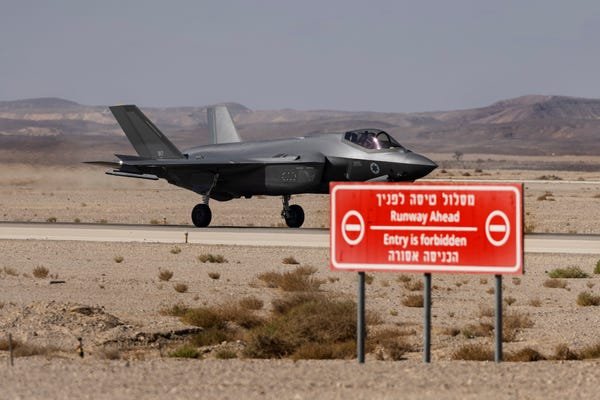
An F-35I “Adir” shot down an Iranian Air Force Yak-130 over Tehran, marking its “first shootdown in history of a manned fighter aircraft,” the Israeli military said in a statement on Wednesday.

Lockheed Martin’s F-35 Lightning II entered service in 2015 and is operated by around a dozen countries, including Israel, which fields its own variant of the fighter jet called the “Adir.”

The F-35 has intercepted missiles and drones in combat in the Middle East, but it had never shot down a crewed jet — until now. The incident also marks the first time in more than 40 years that Israeli fighters have downed a crewed enemy aircraft.

The Yakovlev Yak-130, which NATO calls the “Mitten,” is a subsonic twin-seater light combat aircraft that also serves as a training jet. Russia has built hundreds of these planes, which entered service in 2010. Several have been delivered to Iran.


An Israeli Air Force F-35I Adir takes off for a mission during Red Flag-Nellis 23-2 at Nellis Air Force Base, Nevada, March 20, 2023.

Israel operates its own variant of the F-35 called the “Adir.”

US Air Force photo by William R. Lewis


Since the start of operations on Saturday, Israeli fighter jets have bombed targets across Iran, hitting air defense systems, missile launchers, and military facilities across the country. Hundreds of people have been killed, including dozens of military and government officials, as well as Iranian Supreme Leader Ayatollah Khamenei.

Israeli F-35s are operating in the Middle East alongside US and British F-35s. The UK Ministry of Defense said Monday that Royal Air Force F-35s shot down drones over Jordan, marking the first time one of its stealth fighters has destroyed a hostile target in combat.

American F-35 fighters are one of many US combat aircraft participating in the operations against Iran, including other stealth fighters, electronic attack jets, surveillance planes, airlifters, refueling tankers, and bombers.

US Central Command, which oversees Middle East operations, said on Monday that American forces have bombed more than 1,700 targets in Iran since the strikes began on Saturday.

The US military has targeted Iranian command and control facilities, air defense systems, ballistic missile sites, naval infrastructure, and communications capabilities.


Source link

Israel-struck-Iran-with-F-35I-Adir-stealth-fighter-jets-that.jpeg

Israel struck Iran with F-35I Adir stealth fighter jets that cost $44,000 per hour to fly

Updated

  • Israeli Air Force F-35I planes struck Iranian missile systems and military leaders on Saturday.
  • The Israeli F-35 variant is known as “Adir,” meaning “Mighty One” in Hebrew.
  • The planes also struck Iran in June and aided defenses against Iranian missiles in 2023 and 2024.

Israel launched what it called “the most extensive aerial operation ever conducted by the Israeli Air Force” on Saturday, targeting Iranian missile systems and military leaders in tandem with US forces. Israel’s F-35I stealth fighter jets were on the front lines.

The Israeli variant of the US-made Lockheed Martin Lightning II Joint Strike Fighter plane is known as “Adir,” meaning “Mighty One” in Hebrew. With advanced stealth capabilities and a customized electronic warfare system, the F-35I is one of the most powerful tools in Israel’s air defense arsenal.

In addition to Israel’s newest assault on Iran, the Israeli planes also conducted preemptive strikes against Iran’s nuclear program in June, intercepted hundreds of drones, missiles, and rockets fired by Iran in a retaliatory attack in 2024, and took down a missile fired by an Iran-backed group in Yemen in 2023, according to the Israel Defense Forces.

Here’s a closer look at the “Mighty One” military aircraft.

F-35 Lightning II stealth fighter jets, produced by Lockheed Martin, are some of the most advanced military aircraft in the world.

An Israeli F-35I lands at Ovda airbase near Eilat, southern Israel.

Tsafrir Abayov/AP

The F-35 stores its weapons and fuel internally, and its aligned edges and radar-absorbent coating also help the aircraft evade detection. The planes cost $44,000 per hour to fly, The National Interest reported.

They feature advanced stealth and information-processing capabilities and can reach supersonic speeds of Mach 1.6, or 548.8 meters per second.


An Israeli Air Force F-35I Adir multirole fighter aircraft

An Israeli Air Force F-35I Adir fighter aircraft flies over the Negev Desert.

YURI CORTEZ/AFP via Getty Images

Lockheed Martin CEO Marillyn A. Hewson said in 2018 that the planes “can fly in what we call ‘beast mode,‘ carrying up to 18,000 pounds of internal and external ordnance, in a mix that can include 5,000-pound-class weapons.”

In 2016, Israel became the first country other than the US to acquire F-35 fighter jets.


Israeli Prime Minister Benjamin Netanyahu stands next to a F-35 fighter jet just after it landed in Israel at Nevatim air base  in 2016

Israeli Prime Minister Benjamin Netanyahu stands next to an F-35 fighter jet just after it landed in Israel at Nevatim air base.

Amir Cohen/Reuters

Israel was the first country to select the model through the US Foreign Military Sales process and bought 50 planes, according to Lockheed Martin.

Israel has made significant modifications to the jets.


A new production line for F-35 wings is seen in Israel Aerospace Industries' (IAI) campus, near Tel Aviv

A production line for F-35 wings in Israel Aerospace Industries’ (IAI) campus near Tel Aviv.

Amir Cohen/Reuters

Israel manufactures its own wings and electronic warfare system for the F-35I. It also developed its own version of the high-tech helmet that displays the plane’s airspeed, altitude, targeting information, and other crucial stats directly on the pilot’s visor.

The Israeli Air Force named its F-35I variant “Adir,” meaning “Mighty One” in Hebrew.


Israeli Air Force technicians customize an F-35I plane with a Star of David symbol.

Israeli Air Force technicians customize an F-35I plane with a Star of David symbol.

Israeli Air Force

The Israeli Air Force also added a six-pointed Star of David to the design, a Jewish symbol that also appears on the Israeli flag.

In 2018, Israel became the first country to use the F-35I in combat, its air force chief said.


An Israeli Air Force F-35 flies during an aerial demonstration

Israeli Air Force F-35 flies during an aerial demonstration.

Amir Cohen/Reuters

“We are flying the F-35 all over the Middle East and have already attacked twice on two different fronts,” then-Israeli Air Force chief Major-General Amikam Norkin said in a speech at a gathering of foreign air force leaders, Reuters reported.

In July 2023, Israel acquired an additional 25 Adir planes in a $3 billion deal.


Israeli F-35I planes at Nevatim airbase in Israel.

Israeli F-35I planes.

Israeli Air Force

The deal was financed through the military aid Israel receives from the US, Reuters reported.

In November 2023, Israel’s F-35I Adir fighter jets took down a missile fired by an Iran-backed group in Yemen, according to the IDF.


An Israeli F-35 fighter jet

A F-35I fighter jet flies during a graduation ceremony for Israeli Air Force pilots in southern Israel.

Amir Cohen/Reuters

It was the first known intercept of a cruise missile by an F-35 plane.

The Israeli Air Force released footage of the encounter on X, writing in Hebrew that its personnel are “preoccupied at every moment with planning and managing the defense response and are prepared for any threat in any area.”

Iran appeared to target the Nevatim air base, which houses Israel’s fleet of F-35I jets, during an attack in April 2024.


An Israeli F-35 combat aircraft is seen in the skies over Israel's border with Lebanon

An Israeli F-35 combat aircraft in the skies over Israel’s border with Lebanon.

Ammar Awad/Reuters

Out of the over 350 ballistic missiles, cruise missiles, and UAVs, or unmanned aerial vehicles, launched at Israel by Iran and its proxies in Iraq, Yemen, and Lebanon, around 99% were intercepted by Israel and its allies. The IDF released photos showing minor damage near a runway at the Nevatim Airbase and to a road in Hermon caused by the few projectiles that landed.

The missiles appeared to target Israel’s Nevatim Airbase in the Negev desert, which houses its fleet of F-35I stealth fighter jets. The base remained operational throughout the attack, according to the IDF, with the Adir fighter jets aiding the defensive mission.

“Iran thought it would be able to paralyze the base and thus damage our air capabilities, but it failed,” IDF spokesperson Rear Adm. Daniel Hagari said in a statement.

In June 2025, the Israeli Air Force launched around 200 fighter jets, including F-35Is, in a preemptive strike targeting Iran’s nuclear program.


An F-35I Israeli fighter jet used in strikes against Iran.

An F-35I Israeli fighter jet used in strikes against Iran.

Israel Defense Forces

An IDF spokesperson said that Israeli fighter jets struck over 100 sites across Iran to prevent it from developing a nuclear weapon, including military targets and its largest uranium enrichment site in Natanz.

The IDF said that Iran’s nuclear program had “accelerated significantly” in recent months and called it “clear evidence that the Iranian regime is operating to obtain a nuclear weapon.” Iran maintains that its nuclear program is solely for civilian purposes.

“This is a critical operation to prevent an existential threat by an enemy who is intent on destroying us,” Lt. Gen. Eyal Zamir, the IDF’s Chief of the General Staff, said in a statement.

The IDF released photos showing planes used in the large-scale operation, including F-35I jets.

F-35Is struck Iran over the weekend in what the IDF called “the largest military flyover in Israeli Air Force history.”


US and Israeli F-35s flying together during a training exercise.

US and Israeli F-35s flew together during a training exercise. The two countries launched new strikes against Iran using land, air, and sea assets.

U.S. Air Force photo by Senior Airman Duncan C. Bevan

As part of Operation Roaring Lion, Israel’s moniker for Operation Epic Fury, around 200 Israeli fighter jets, including F-35Is, struck 500 Iranian missile launchers and aerial defense systems on Saturday. IDF spokesperson Lt. Col. Nadav Shoshani characterized the operation as “the most extensive aerial operation ever conducted by the Israeli Air Force.”

The strikes “significantly degraded” Iran’s offensive capabilities, the IDF said. The strikes also killed Iranian military leaders, including Iranian Defense Minister Aziz Nasirzadeh and Mohammad Pakpour, commander of the IRGC.

The war in Gaza prompted new scrutiny of US military aid to Israel.


An Israeli soldier sits inside a F-35 fighter jet

An Israeli soldier sits inside an F-35I fighter jet after it landed in Israel at Nevatim Airbase.

Amir Cohen/Reuters

The October 7 terrorist attacks carried out by Hamas killed around 1,200 Israelis and captured over 240.

Israel’s counteroffensive airstrikes and military actions in Gaza resulted in over 72,000 Palestinian fatalities, according to figures provided to the United Nations Office for the Coordination of Humanitarian Affairs by the Hamas-run Ministry of Health in Gaza. The IDF reports that at least 17,000 of these fatalities were Hamas militants. A ceasefire agreement was reached in October.

According to the United Nations Relief and Works Agency, over 1.9 million Gazans, around 90% of the population, have been displaced by the war.

The devastating human toll of the war in Gaza with US-funded planes like the F-35I has prompted new scrutiny of US aid to Israel, with some lawmakers in Congress raising the possibility of conditioning military and economic aid.


Source link

US-military-Stealth-bombers-fighters-and-special-capabilities-used-in.jpeg

US military: Stealth bombers, fighters, and ‘special capabilities’ used in first 24 hours of Iran mission

The US has been battling Iran for more than 24 hours, and the scale of what the American military brought into the fight is now coming into focus.

After a slow but steady drip of details, we now have a clearer, more comprehensive picture of the kind of US combat platforms involved and the targets struck on the opening day of combat, executed alongside the Israeli military.

US Central Command said forces involved in Operation Epic Fury struck over 1,000 Iranian targets with destroyer-launched Tomahawks, stealth B-2 Spirit bombers armed with 2,000-pound bombs, and US-made drones modeled after Iranian Shaheds, among other assets and munitions. It called the drones “American-made retribution” as the US struck Iran with a weapon Tehran designed.

Here’s the breakdown from US Central Command, which oversees US operations in the Middle East, on what went into the fight. It’s extensive, though some things are left off, covered by a note that says the operation also includes “special capabilities we can’t list.”


A graphic breaking down the weapons used in Operation Epic Fury from US Central Command

A graphic breaking down the weapons used in Operation Epic Fury from US Central Command

US Central Command


Beyond the B-2 bombers, the list of aircraft includes fifth-generation fighters like the F-35 Lightning II Joint Strike Fighter and F-22 Raptor, as well as a mix of attack aircraft and fourth-gen fighters.

There are also electronic attack planes, airborne early warning and control aircraft, surveillance platforms, and logistics aircraft, such as airlift and refueling planes, listed. The Airborne early warning aircraft can detect and track targets that can be passed off in real-time to fighter jetss like the F-22 and F/A-18.

Drones include the MQ-9 Reaper, a combat and reconnaissance system, and the new Low-Cost Unmanned Combat Attack System, or LUCAS, drones. The former is intended to return home, while the latter is purposefully expendable.

Suppression operations aimed at breaking down Iranian defenses set the conditions for air superiority and permitted damaging strikes across Iranian territory. There have been no credible reports of aircraft losses.

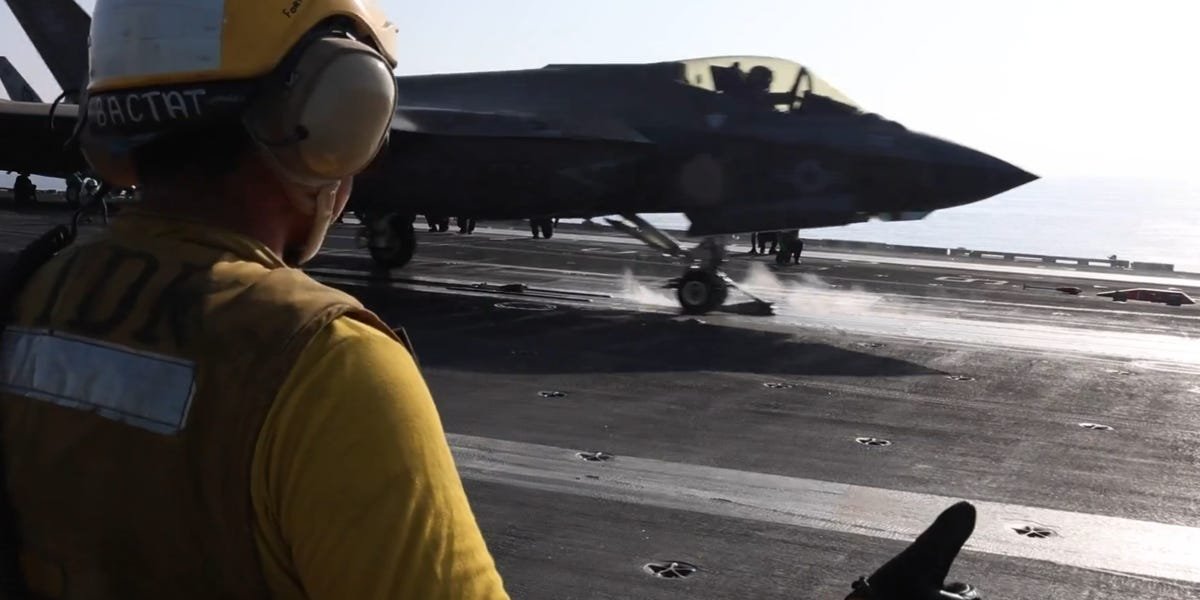
Other assets involved include High Mobility Artillery Rocket Systems, or HIMARS, weapons that can fire both guided rockets and missiles. They gained notoriety for their combat effectiveness in Ukraine. In addition to destroyers, American aircraft carriers are in the area, launching fighter aircraft like the F/A-18 Super Hornet and F-35C, the carrier-based variant of the stealth fighter.

While much of the weaponry on the list is offensive or intended to support offensive operations, some assets are strictly defensive. These include Patriot surface-to-air missile systems and Terminal High Altitude Area Defense, or THAAD, batteries. These have been used in air defense battles as Iran launched its missiles.

Prior to the beginning of “major combat operations” against Iran, which President Donald Trump announced early Saturday morning in a video message, the US spent weeks building up its military presence not seen in the area in decades.

The impact of operations, in which the US has suffered some personnel losses, has been felt across Iran. The US has hit command and control centers, operational centers of Iran’s Islamic Revolutionary Guard Corps, missile sites, navy warships, and critical communication sites.

The Israeli military, as part of Operation Roaring Lion, has also struck hundreds of targets across the country, which has seen much of its military and political leadership killed.


Source link