

Jake Epstein

NATO is stepping up its Arctic patrols. A key goal is getting eyes on Russian subs before they can disappear into deep water.

NATO is expanding its footprint across the Arctic and North Atlantic, increasing patrols and joint operations as Russia’s submarine forces grow more active, two Western officials told Business Insider.

Across air, land, and sea, NATO’s presence and overall activity in the region have more than doubled over the last two to three years, said Vice Adm. Rune Andersen, chief of the Norwegian Joint Headquarters.

Andersen said that the surge is “partially a response to increased Russian out-of-area deployments with the submarines” and “a need to keep track of that.”

Russia maintains one of the world’s largest submarine fleets, with an estimated 64 active boats. The Northern Fleet, based in the Murmansk region on the Barents Sea, operates dozens.

To get from Murmansk to the Atlantic Ocean or the Mediterranean and Baltic seas, Russian submarines often sail west through the Arctic before turning south and going through the North Sea or the waters in between Greenland, Iceland, and the UK — a naval chokepoint known as the GIUK gap.

In recent years, Western military officers have increasingly called attention to the growing Russian naval presence — specifically its submarines — in the Arctic and the North Atlantic, and have stressed the need to monitor this activity to avoid surprises.


Royal Navy ships track a Russian submarine through the English Channel in December 2025.

The Royal Navy tracks a Russian submarine through the English Channel.

Royal Navy


If the Russian submarines make it out of the relatively “shallow water and out into the deep Atlantic sea, it becomes more difficult once they’re out in the really big ocean to track them,” said Col. Martin O’Donnell, the spokesperson for Supreme Headquarters Allied Powers Europe, or SHAPE, which commands all NATO operations.

“Not that they can’t be tracked, but the difficulty — if you don’t pick them up, if you’re not sensing, if you’re not monitoring things — that increases exponentially and poses a threat not just to Europe, but also to the United States in that regard,” O’Donnell said.

NATO militaries have a range of tools for anti-submarine operations, including frigates, other submarines, helicopters, and other patrol aircraft, and some allies have recently invested in acquiring additional capabilities.

Last month, European nations participated in NATO’s Arctic Dolphin 26 exercise off the coast of Norway, with defense of the North Atlantic and GIUK gap top of mind.

There are, however, other reasons behind NATO’s expanded footprint in the North Atlantic beyond just the Russian naval concerns, O’Donnell and Andersen acknowledged.

The back-to-back accession of Finland and Sweden into NATO, which was triggered by Russia’s full-scale invasion of Ukraine, increased the number of Arctic states within the alliance from five to seven. Helsinki and Stockholm brought more troops, ships, and aircraft into the alliance’s Arctic defense.


A US Air Force KC-135 Stratotanker aircraft provides aerial refueling to a US Navy P-8 Poseidon aircraft assigned to US Air Naval Station Keflavik Base, Iceland, over the North Sea region, Royal Air Force Mildenhall, England, June 21, 2023.

NATO militaries, including the US, use P-8 Poseidon aircraft to monitor Russian naval activity.

US Air Force photo by Senior Airman Viviam Chiu


O’Donnell also said that alliance activity in the North Atlantic has increased since December, when JFC Norfolk — NATO’s newest joint force command — added Finland, Sweden, and Denmark to its area of responsibility. It now leads the alliance’s new Arctic Sentry deterrence operation.

More generally, there is a greater understanding among NATO states that the North Atlantic and Arctic regions are becoming more strategically valuable, making it critical for allies to maintain a strong deterrent posture there, Andersen said.

The region is full of natural resources, and melting sea ice is creating new trade routes. To prevent Russia and China from gaining military and economic influence in the High North to the detriment of alliance states, NATO’s leadership wants allies to continue prioritizing Arctic security.

One of the key benefits of Arctic Sentry, NATO Secretary General Mark Rutte said last month, is that “we now have a one Arctic approach, where allies synchronise activities, enhance and expand regular presence throughout the region.”

“It is bringing together what you already have, and adding on top, based on a gap assessment, what we need to do more,” Rutte said.


Source link

Meet-Jay-Graber-who-is-stepping-down-as-Blueskys-CEO.jpeg

Meet Jay Graber, who is stepping down as Bluesky’s CEO to transition to a role made just for her

Updated

  • Jay Graber is stepping down as the CEO of Bluesky to transition into a position made just for her.
  • Bluesky’s open protocol offers a decentralized alternative to X and Meta platforms.
  • Here is a look at Graber’s career and her unconventional path to Silicon Valley.

Jay Graber is the engineer behind one of the most ambitious experiments in reimagining social media.

The Tulsa-born technologist is best known for steering Bluesky between 2021 and 2026, the decentralized platform she describes as a “billionaire-proof” alternative to X and Meta-owned platforms.

On March 9, Graber announced in a statement that she will be leaving her role as CEO of Bluesky and that someone “focused on scaling and execution” will take over. Meanwhile, she will return to her passion for “building new things” as the chief innovation officer, which is a role made just for her.

She will also remain on Bluesky’s board and have a say in picking her successor.

Graber’s emergence as a Silicon Valley power player was unconventional. In 2021, former Twitter CEO Jack Dorsey tapped her to lead the Bluesky project, which was spun off as an independent public benefit company, just before Elon Musk’s takeover of Twitter.

Since then, Bluesky’s user base has grown to over 40 million as of November 2025, powered by its open protocol, customizable moderation system, and promise of a more democratic digital ecosystem.

Here’s a look at Graber’s career timeline, from her early work in cryptocurrency to her rise as the architect of a new, user-owned social media platform:

Early life

Jay Graber was born Lantian Graber in Tulsa, Oklahoma.

Kimberly White/Getty Images for WIRED

Jay Graber was born Lantian Graber in Tulsa, Oklahoma, to a mother who is an immigrant from China during the Cultural Revolution and a father of Swiss descent. Her mother, who is an acupuncturist, named Graber “Lantian”, which means “blue sky” in Chinese, as a wish that she would have “boundless freedom.” She was aptly named for the job she would eventually be given.

Her father is a mathematics teacher, and in a 2024 profile of Graber in Cosmico, he is cited as a source of intellectual and academic influence for Graber.

Education


JULY 17: A general view of the Penn Shield University of Pennsylvania logo on July 17, 2025, at the University of Pennsylvania, in Philadelphia, PA. (Photo by Erica Denhoff/Icon Sportswire via Getty Images)

Jay Graber studied Science, Technology & Society at the University of Pennsylvania.

Erica Denhoff/Icon Sportswire via Getty Images

At the University of Pennsylvania, Graber studied Science, Technology & Society, which is an interdisciplinary program that examines how technological innovation intersects with culture, politics, and ethics.

Rather than focusing solely on coding or engineering, the program allowed Graber to explore the broader systems that shape how technology is developed and utilized, an approach that later influenced her views on social networks and digital governance.

Some of her key guiding views include a decentralized internet and open source social media protocols. “We believe that the protocol is the fundamental guarantee on freedom of speech,” Graber said once during an interview with Fast Company.

Before Bluesky


A bitcoin illustration

Jay Graber is well known in crypto circles for her work on Zcash.

Peter Dazeley/Getty Images

Graber’s early career unfolded during the first wave of blockchain innovation in the mid-2010s. After graduating from the University of Pennsylvania, she began her career as a software engineer at SkuChain, a startup focused on utilizing blockchain for supply-chain management. Around the same time, she also built and soldered bitcoin-mining rigs, deepening her technical grasp of decentralized systems beyond software.

Between 2016 and 2018, Graber joined the privacy-focused cryptocurrency project Zcash as a junior developer, contributing to one of the most advanced implementations of zero-knowledge proofs. Later, in 2019, she founded Happening, Inc., an events app that aimed to help communities organize and connect through shared experiences.

Happening, Inc. never really took off, but these early roles grounded Graber in both the engineering and ideological foundations of decentralized technology, which later shaped the vision for Bluesky as an open, user-controlled social network.

Joining Bluesky


Bluesky logo

Jay Graber negotiated a formal spin-out of Bluesky from Twitter as a Public Benefit Company.

Illustration by Omar Marques/SOPA Images/LightRocket via Getty Images

When Jack Dorsey, then CEO of Twitter, first announced Bluesky in late 2019, it was a small, Twitter-funded initiative tasked with researching an open and decentralized standard for social media.

By August 2021, Dorsey decided to onboard Graber, who was then known in crypto circles for her work on Zcash and decentralized community tools, to lead and accelerate the effort. However, according to an April 2025 profile of Graber in the New Yorker, she quickly realized that for Bluesky to fulfill its mission, it needs to create a social protocol separate from any single corporation and maintain independence from Twitter.

With Dorsey’s backing, Graber negotiated a formal spin-out by October 2021 and incorporated Bluesky as a public benefit corporation, a legal structure that allowed it to prioritize user benefits and open standards over shareholder profit.

Twitter provided an initial $13 million in funding to give the new entity “freedom and independence to get started,” as Dorsey publicly described at the time.

Bluesky’s rise


Bluesky app

Jay Graber separated Bluesky from Twitter just before Elon Musk’s takeover.

Illustration by Thomas Fuller/SOPA Images/LightRocket via Getty Images

Graber’s early move to separate Bluesky from Twitter may have saved it.

When Elon Musk acquired Twitter in 2022 and renamed the platform X, Bluesky’s independence allowed it to thrive and emerge as a competitor to X as droves of users left the platform.

In September 2023, Bluesky only had around 1 million registered users, but this figure climbed to more than 20 million by the end of November 2024. The meteoric rise came after a user surge in Brazil after X was temporarily restricted there, as well as 1.25 million user gains the week after Donald Trump won the 2024 presidential election.

As of November 2025, Bluesky has around 40 million registered users. That is no match for X’s roughly 560 million users, but it provided an alternative for those dissatisfied with X’s ownership and content moderation.

Calling out Big Tech


Jay Graber at the Keynote

Jay Graber wore a black T-shirt that reads “Mundus sine caesaribus,” meaning “a world without Caesars.”

Samantha Burkardt/SXSW Conference & Festivals via Getty Images

Graber has taken a subtle dig at Mark Zuckerberg, the CEO of Meta, which owns Facebook, Instagram, and Threads.

During SXSW in Austin in March 2025, Graber wore a black T-shirt that reads “Mundus sine caesaribus,” meaning “a world without Caesars.” The design and font are widely interpreted as a response to Zuckerberg’s own Latin slogan shirt, which reads “Aut Zuck aut nihil,” meaning “either Zuck or nothing.”

The shirt drew public curiosity, and Bluesky began selling the same shirt. A spokesperson for the company told Business Insider at the time that the shirts sold out in 30 minutes, representing the company’s “democratic approach, where no single CEO or company controls your experience online.”

A modest net worth


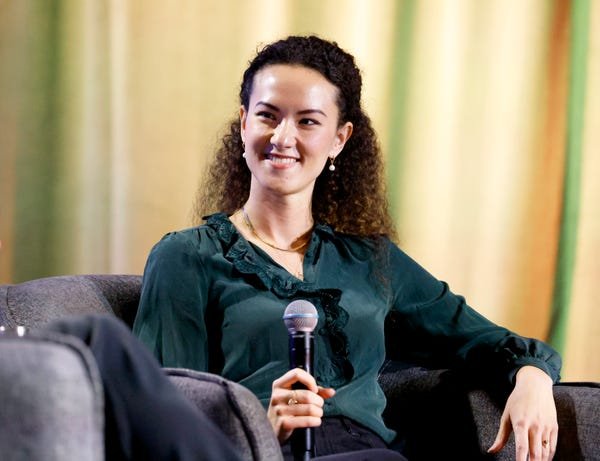
Jay Graber

Compared to most tech CEOs, Jay Graber has a modest net worth.

DON MACKINNON/AFP via Getty Images

Compared to other Silicon Valley CEOs who run major social media platforms, all of whom are billionaires, Graber has a very modest net worth.

Estimates of Graber’s net worth fall between $2.95 million and $5 million, mostly depending on her equity in Bluesky. Since Bluesky is not a publicly traded company, Graber’s stake in the company and her annual compensation are not publicly disclosed.

As of early 2025, Bluesky’s valuation is estimated to be around $700 million.

A ‘billionaire-proof’ platform


Jay graber

Jay Graber positions Bluesky as a “billionaire-proof” platform.

Sam Barnes/Web Summit via Sportsfile via Getty Images

Graber positions Bluesky as a new kind of social network.

Bluesky is built on an open-source Authenticated Transfer Protocol, which decentralizes social networking and hands more control to users rather than a single company or executive.

“The billionaire proof is in the way everything is designed, and so if someone bought or if the Bluesky company went down, everything is open source,” Graber told CNBC in an interview in November 2024.

“What happened to Twitter couldn’t happen to us in the same ways, because you would always have the option to immediately move without having to start over,” Graber added, referring to Musk’s purchase of the platform that is now named X.

Unlike traditional social platforms like X or Facebook, Bluesky is built on an open-source ecosystem called the ATmosphere, powered by the Authenticated Transfer Protocol. The system gives users the ability to design and customize their own ranking algorithms, carry their posts and followers with them across different apps, and avoid being subject to any platform’s arbitrary or politically driven moderation decisions.

Activism on Bluesky


Protesters from the Tesla Takedown movement gather outside a Tesla pop-up store

Protesters from the Tesla Takedown movement gather outside a Tesla pop-up store

Thomas Krych/Anadolu via Getty Images

Bluesky became a platform widely used by progressive activists and community organizers.

The Tesla Takedown movement, a pushback against Tesla CEO Elon Musk’s involvement with Donald Trump and the White House’s DOGE office, famously spread via Bluesky when actor Alex Winter contacted a sociologist in Boston to build a website where people could organize local protests.

But the progressiveness of Bluesky also seems to have spooked some politicians. Semafor’s media reporter Max Tani wrote in May 2025 that some congressional staffers told him that they gave up on using Bluesky as an alternative to X, because “their bosses kept getting yelled at by Democratic users angry at their impotence.”

Changing the ecosystem


Jay graber in conversation with Fast Company

Jay Graber is not worried about Bluesky’s slower growth in terms of registered and active users

Eugene Gologursky/Getty Images for Fast Company

Graber is unfazed by Bluesky’s slower growth in terms of registered and active users.

In an interview in May with Fast Company, Graber said that reports of Bluesky’s death are “greatly exaggerated” and that growth “comes in waves,” with new communities being established at each stage.

“We’re still seeing a lot of community formation, and one of the most exciting things is how structurally different this is,” said Graber. “It’s not just another social site that has to be a singular winner-take-all in an ecosystem with existing incumbents.”

In 2025, Bluesky still added around 10 million newly registered users.

A warning against AI over-reliance


Jay Graber

Jay Graber warns you shouldn’t “fully outsource your thinking” to AI.

Eugene Gologursky/Getty Images for Fast Company

Graber has tips on how to thrive in an era of AI, and reliance is not the answer.

“AI can handle many reasoning tasks, but if we fully outsource our thinking, it’s not good enough,” Graber told Business Insider.

She added that for students, that might mean writing essays by hand to “build the muscle for critical thinking.”

At Bluesky, Graber said AI is used for moderation and curation but never runs on its own, because while AI delivers packaged expertise, human value lies in judgment and adaptability.

For job seekers, Graber encourages workers to adopt a generalist mindset and master core skills such as writing and coding.

“If you don’t know what good code looks like,” she said, “you won’t be able to evaluate AI’s output.”

Stepping down as CEO of Bluesky


Jay Graber

Jay Graber is starting a new era in 2026 as Bluesky’s chief of innovation.

Samantha Burkardt/SXSW Conference & Festivals via Getty Images

Graber is starting a new era in 2026.

On March 9, Graber said in a public statement that she will be stepping down as Bluesky’s CEO and transitioning into a position made just for her: chief innovation officer.

“As Bluesky matures, the company needs a seasoned operator focused on scaling and execution, while I return to what I do best: building new things,” Graber wrote in a blog on Bluesky.

“As we’ve grown, I’ve found that people thrive when they’re in a role where their passions overlap with their strengths. This is as true for me as it is for our team,” Graber added. “Transitioning to a more focused role where I can do what brings me energy is my way of putting that belief into practice.”

Graber’s new role focuses on Bluesky’s technology stack rather than on growth and business operations. She will also play a role in choosing her successor. For now, venture capitalist Toni Schneider will be Bluesky’s interim CEO.


Source link

The-CEO-of-the-World-Economic-Forum-is-stepping-down.jpeg

The CEO of the World Economic Forum is stepping down after a review of his Epstein ties

  • Børge Brende, the long-serving head of the World Economic Forum, is stepping down.
  • His resignation comes after the WEF launched an independent review into his ties to Jeffrey Epstein.
  • Emails released by the Department of Justice appeared to show Brende had dinner with Epstein three times.

The president and CEO of the World Economic Forum, Børge Brende, has announced he will step down in the wake of an investigation into his relationship with Jeffrey Epstein.

“I believe now is the right moment for the Forum to continue its important work without distractions,” Brende, who led the organisation behind the annual Davos conference for over 8 years, said.

The WEF co-chairs, André Hoffman and Larry Fink, said the independent review, which was made public earlier in February, found “there were no additional concerns beyond what has been previously disclosed.”

Emails released by the Department of Justice appeared to show Brende had dinner with Epstein three times in 2018 and 2019.

In a statement to Reuters earlier this month, Brende said he was “completely unaware of Epstein’s past and criminal activities.”

Hoffman and Fink said Alois Zwinggi will serve as the WEF’s interim president and CEO.

This is a breaking news story. Check back for updates.


Source link

Lululemon-CEO-Calvin-McDonald-is-stepping-down.jpeg

Lululemon CEO Calvin McDonald is stepping down

  • Lululemon CEO Calvin McDonald will step down at the end of January, the company said.
  • The board is launching a comprehensive search for Lululemon’s next CEO.
  • Lululemon’s stock spiked after the announcement and an earnings beat.

Calvin McDonald, CEO of Lululemon, is stepping down from that role at the end of January, the company announced Thursday.

McDonald is also stepping down from the board of directors and will serve as an advisor to the company through March.

Lululemon’s board is conducting a “comprehensive search process” for its next CEO, the company said.

Lululemon’s stock spiked in after-hours trading following an earnings beat and the announcement about its CEO. The company’s third-quarter results, posted Thursday, surpassed Wall Street expectations, including a reported revenue of $2.57 billion.

Marti Morfitt, the board chair, will immediately take on the role of executive chair to “to ensure the continued execution of the company’s near- and long-term growth strategy during the leadership transition,” the company said.

Lululemon CFO Meghan Frank and CCO André Maestrini will be interim co-CEOs after McDonald steps down.


Source link

Meet-the-new-leaders-wholl-be-stepping-up-at-Greg.jpeg

Meet the new leaders who’ll be stepping up at Greg Abel’s Berkshire Hathaway

Berkshire Hathaway is reshuffling its top ranks ahead of the departure of its legendary CEO, Warren Buffett, in January.

The company announced on Monday that Todd Combs, one of Buffett’s key deputies and CEO of Berkshire-owned Geico, is departing the company to take on a role at JPMorgan.

Alongside Combs’ departure, Berkshire Hathaway announced a series of new leadership appointments.

The company said that the new leaders are “stewards of the company’s culture, demonstrate strong business acumen and judgment, and enable Berkshire’s distinctive way of operating.”

The shake-up of Berkshire Hathaway’s top ranks comes weeks before Greg Abel is due to take over from Warren Buffett as CEO in January. 95-year-old Buffett will remain as chairman of the business that he has led for the past 60 years.

Here’s the full list of appointments, most of which are effective immediately, according to Berkshire Hathaway’s Monday announcement.

Nancy Pierce becomes Geico CEO


Berkshire Hathaway pose with the Geico Gecko, the insurance company's mascot.

The Geico Gecko is one of America’s best-known corporate mascots.

Scott Olson/Getty Images


Nancy Pierce is succeeding Todd Combs as CEO of Geico, the auto insurer owned by Berkshire Hathaway and one of the conglomerate’s core subsidiaries.

Pierce joined Geico in 1986 and was chief operating officer of the company before being tapped as CEO. She has held leadership roles across claims, underwriting, product management, and regional operations.

“Nancy knows the business inside and out. She’s practical, decisive, and focused on results,” said Ajit Jain, vice chairman for insurance operations.

Adam Johnson takes over as head of Berkshire’s consumer division

Adam Johnson has been appointed president of Berkshire Hathaway’s consumer products, service, and retailing businesses.

Johnson has been CEO of the Berkshire-owned private jet company NetJets for over 10 years — a role he’ll continue alongside the new appointment.

“Adam is an accomplished leader with a proven ability to deliver long-term shareholder value,” said Abel, Berkshire’s incoming CEO, in Monday’s press release.

“In his new role, he will support the outstanding CEOs of our 32 consumer products, service, and retailing businesses, and uphold Berkshire’s culture and values.”

Johnson’s new role hints at Abel’s plans for Berkshire. Under Buffett, the incoming CEO oversaw all non-insurance businesses.

The new CEO is splitting up the non-insurance businesses owned by the company.

Johnson will be in charge of consumer firms like See’s Candies and Fruit of the Loom, while Abel will manage the rest, including BNSF Railway, BHE, Pilot, and McLane, alongside his CEO duties.


A man and woman walk alongside each down a path looking to the left

Greg Abel will succeed Warren Buffett as Berkshire Hathaway CEO in January.

Kevork Djansezian/Getty Images


Marc Hamburg retires as chief financial officer

Marc Hamburg, the long-serving senior vice president and chief financial officer of Berkshire Hathaway, will retire on June 1, 2027.

Now 75 years old, Hamburg joined Berkshire in 1987.

Hamburg’s role was to oversee the conglomerate’s finances. The company hit a record $1 trillion market value in August 2024 and is currently valued at $1.09 trillion.

“Marc has been indispensable to Berkshire and to me. His integrity and judgment are priceless. He has done more for this company than many of our shareholders will ever know,” said Buffett in Monday’s press release.

“His impact has been extraordinary.”

Charles Chang replaces Hamburg

Stepping into Hamburg’s shoes when he retires in June 2027 is Charles Chang.

Chang has been a senior vice president and chief financial officer of Berkshire Hathaway Energy since 2024, and will take over as finance chief of Berkshire. He will be based in Omaha.

Chang is a former partner at the Big Four professional services firm PwC, where he developed over three decades of experience in public company financial reporting and mergers and acquisitions for some of PwC’s largest clients.

Michael O’Sullivan joins as general counsel

A new position has been created for Michael O’Sullivan when he joins Berkshire on January 1, 2026.

O’Sullivan will become senior vice president and general counsel at Berkshire and will be based in Omaha. The company has historically relied primarily on external legal counsel for corporate matters.

O’Sullivan was formerly an attorney at Munger, Tolles & Olson — the firm founded by Buffett’s late right-hand man, Charlie Munger — for over twenty years.

The law firm has been Berkshire’s go-to law firm for decades, meaning O’Sullivan knows the company well. He joins from Snap, where he has served as general counsel since 2017.


Source link