The encore concert in April saw some special performances from Seventeen’s units: CxM (the rapper-duo, formed by leader S.Coups and the team’s resident Calvin Klein face, Mingyu), and the team’s ballad unit, DK and Seungkwan.
Their energy levels were through the roof during a particularly punishing part of the setlist, including high-octane songs like “Hit,” “Hot,” “Highlight,” and “Rock.” The group rolled out “Super,” one of their most popular tracks by far, and got fans in their feels when the lyrics “I love my team, I love my crew” were splashed across the mega screens.
I especially enjoyed that they rolled out some sentimental songs like “Circles” and “To You,” as well as the very fitting “April Shower.” I enjoyed the (literal) downpour less as I slogged out of the stadium.
Visiting Japan has been on my bucket list for a long time, and I finally booked a trip after relentless pleas from my children — and reading about how the US dollar is strong against the Japanese yen.
To simplify planning, I booked a family tour through Intrepid Travel. Unsurprisingly, the tour went to Tokyo and Kyoto, popular tourist destinations that draw many visitors (including my family) to Japan.
However, the tour also brought us to some places I may not have found on my own, including the quaint, quirky mountain town of Hakone.
Visiting the town, which is southwest of central Tokyo and about a 90-minute railway ride away, turned out to be my favorite part of the trip.
We loved the town’s famous hot springs
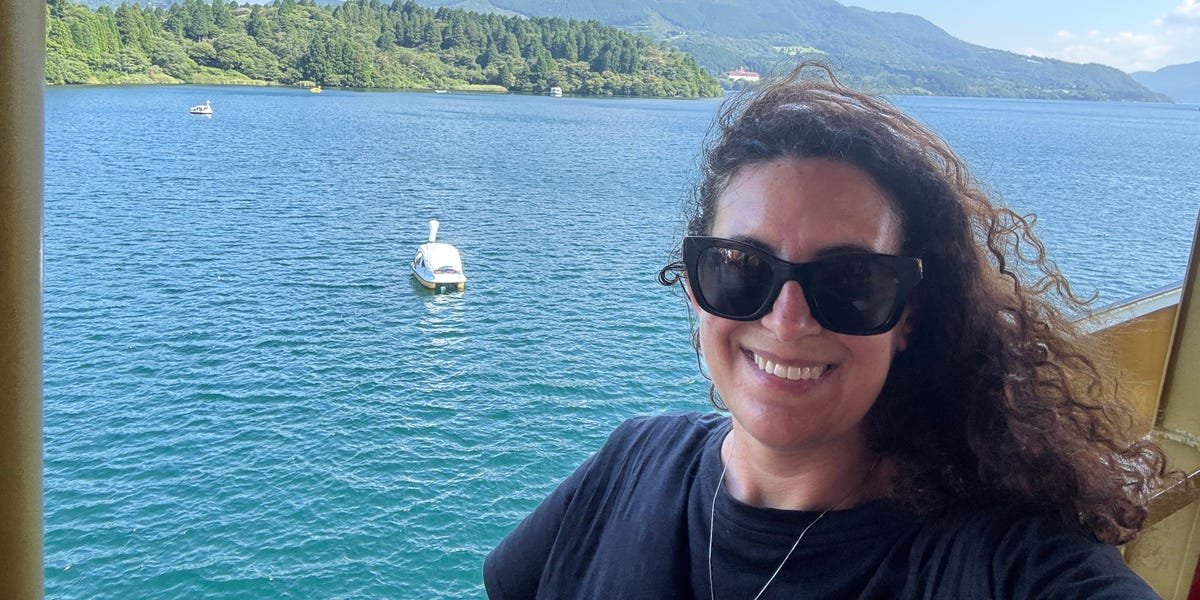
Our trip was complete with incredible views.
Jamie Davis Smith
Hakone is full of onsens, or natural hot springs, heated by geothermal activity happening beneath Japan. During my visit, I got to experience several types of onsens — and I still dream of sitting in their soothing waters.
First, I tried a bucolic onsen overlooking the mountains, which were lush and green when I visited during the summer. Lounging in a naturally fed hot spring from the top of a mountain allowed me to slow down, relax, and appreciate the beauty of Japan outside of its big cities.
I also tried a traditional onsen, which was segregated by gender and required visitors to disrobe completely. As an American, I’m not used to bathing naked with strangers, but I didn’t want to miss this quintessential Japanese experience.
Although I didn’t stay long, it was eye-opening to see how this tradition, so different than my own, quickly helped me feel more comfortable in my own skin. This is something I would not have experienced if I had not gone to Hakone.
Finally, my kids and I tried a series of themed onsens at Yunessun, a hot-spring theme park, which was one of the quirkier experiences I have had while traveling.
There, I hopped into an onsen shaped like a ramen bowl, complete with blow-up toppings. My kids joked that we were experiencing what it felt like to be cooked on a stovetop.
I also got to try unique baths, including one filled with coffee and another containing wine. My skin felt smooth and soft when I left.
Our trip featured some unique activities, including a visit to a mind-blowing sculpture garden
The whole family had a blast at the Hakone Open-Air Museum.
Jamie Davis Smith
Although my children don’t always share my affinity for looking at paintings and sculptures, they agreed to accompany me to the Hakone Open-Air Museum.
Beyond its gates, we found larger-than-life interactive sculptures unlike anything we’ve seen at traditional art museums.
As we walked through the museum’s gardens, we hopped through rainbows, climbed to the top of a stained-glass tower, and walked underground to peek up at the sky from below.
My children even swung on colorfully knitted balls hanging from an elaborate net, seemingly suspended from the sky.
Near the exit of the gardens, I sat and soaked my feet in a hot-spring footbath while gazing out at the surrounding forest. I wish that every large attraction had something similar at the end.
There were some fun photo opportunities at the Hakone Open-Air Museum.
Jamie Davis Smith
Fortunately, there were many other unique and fun things for us to do in Hakone.
While there, I ate one of the town’s famous black eggs, which had been transformed from their original white after boiling in a sulfur-rich hot spring. Legend has it that eating one of these adds seven years to your life — I devoured every morsel.
Hakone is famous for its hard-boiled black eggs.
Jamie Davis Smith
We also got a glimpse of Mt. Fuji from the Hakone Tozan Railway and rode on a pirate ship to get a fantastic view of Hakone’s bright-red Torii Gate standing in a lake.
Hakone was a wonderful stop on our trip, and I’d happily return
We saw so much in Hakone.
Jamie Davis Smith
During our time in Hakone, we stayed in a ryokan, a type of traditional Japanese inn, and were able to explore a lot of the relatively small town on foot.
Along the way, we wound through mountain roads dotted with small restaurants and shops, a welcome reprieve from the heat of the bigger cities we had visited earlier in our trip. We even took some time to hike along Hakone’s lush forest paths.
Although it’s easy to see the appeal of Japan’s bigger cities like Tokyo, Kyoto, and Osaka, if I ever return to the country, I would spend more time in Hakone and seek out other small towns.
Rejoice, JetBlue lovers: There’s now a lounge where you can eat, drink, and be merry while waiting to board your flight.
BlueHouse, the airline’s first airport lounge, opened at John F. Kennedy International Airport in New York City in December 2025, with a location at Boston Logan International Airport coming this year. It’s a way for the traditionally low-cost airline to make flying more luxurious, even for budget travelers.
When I fly, it’s usually for the cheapest fare. Last year, I finally took the plunge and committed to a JetBlue credit card to try to maximize points. All this to say, I don’t typically travel in a way that gives me access to an airport lounge.
So, when I found out about BlueHouse and its many amenities — 9,000 square feet, two floors, food from Union Square Events, cocktails from Please Don’t Tell, and coffee from Joe Coffee — I decided to try it out for myself.
A day pass cost me $79 on top of my airfare. For Premier cardholders, Mosaic 4 members (the highest tier of JetBlue rewards), and transatlantic Mint travelers (essentially JetBlue’s version of business class), entry is free for the traveler and a plus one. For the other levels of Mosaic, domestic Mint travelers, and people with the Plus card like me, entry ranges from $59 to $79 per person.
I was concerned it might be crowded (hence why some people are sticking with the airport bar), so I was pleasantly surprised to find it basically empty.
What I really appreciated were all the nods to New York City’s classic Art Deco architecture. The design was supposed to evoke “an NYC apartment-style aesthetic,” which, as someone living in an NYC apartment, I think they nailed.
JetBlue did not respond to a request for comment on its pricing or my experience.
Here’s what it was like to visit the inaugural BlueHouse location.
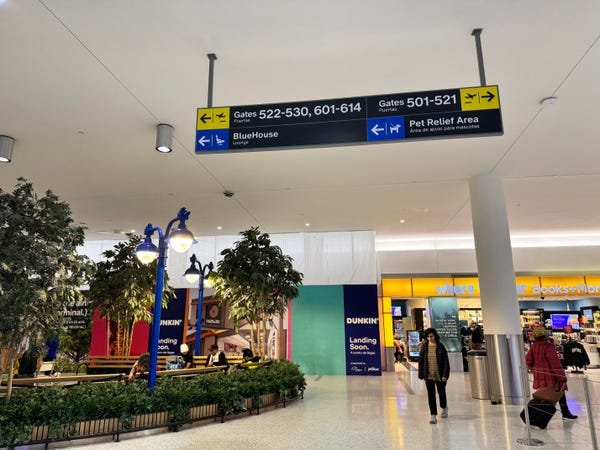
BlueHouse is located in Terminal 5 at John F. Kennedy International Airport in New York City.
Terminal 5 is under a lot of construction while JetBlue renovates. Gabbi Shaw/Business Insider
There are clear signs all the way there. It’s across from Gate 527, around a five-minute walk once you’re out of security.
My gate was in the other direction, however. Gabbi Shaw/Business Insider
I was lucky to catch the lounge at an off time, but this queuing area suggests that JetBlue is prepared for crowds.
BlueHouse opened in December 2025. Gabbi Shaw/Business Insider
BlueHouse spans two floors, with a full bar, a coffee bar, and plenty of seating downstairs, and a quieter atmosphere upstairs.
The elevator reminded me of the vintage ones at the Empire State Building. Gabbi Shaw/Business Insider
I paid $79 to get inside BlueHouse, but it’s free for Mosaic 4 members, JetBlue Premier cardmembers, and transatlantic business-class travelers. Blue Basic travelers can’t get in.
I knew from this point on that there would be a lot of blue in the design. Gabbi Shaw/Business Insider
The first thing you see when you walk in is the huge bar. All drinks are complimentary.
The bar was giving ’20s Art Deco vibes. Gabbi Shaw/Business Insider
There is plenty of seating throughout the lounge, including booths, tables, bar stools, and individual chairs.
Here’s the largest part of the lounge. Gabbi Shaw/Business Insider
The ceiling takes inspiration from Grand Central Terminal’s iconic constellation ceiling mural.
The ceiling at Grand Central was designed by Paul Helleu, J. Monroe Hewlett, and Charles Basing. Gabbi Shaw/Business Insider
But, of course, the most dominant color is blue.
I appreciated all the little touches of decor. Gabbi Shaw/Business Insider
I sat at one of the long tables so I could get a view of the entire lounge. Each seat had its own outlet for easy charging access.
Outlets are a game changer at the airport. Gabbi Shaw/Business Insider
There was a fridge filled with pre-packaged food and snacks. It had yogurt, fruit cups, sauces, and wraps.
The cold food. Gabbi Shaw/Business Insider
Next to it was a hot food area, with soups, sandwiches, and bowls.
The hot food. Gabbi Shaw/Business Insider
For those looking for something lighter, popcorn, chips, and pastries were also offered.
The snacks. Gabbi Shaw/Business Insider
There was a full coffee bar with one of the nicest coffee machines I’ve ever seen.
I could’ve chosen between espresso, Americano, latte, cappuccino, cortado, flat white, or allongé. Gabbi Shaw/Business Insider
I got an oat-milk latte and then added vanilla syrup. There was also an ample tea selection.
The coffee bar was fully stocked. Gabbi Shaw/Business Insider
The coffee was good — I realized it was Joe Coffee, a favorite of mine.
Joe Coffee. Gabbi Shaw/Business Insider
I went for a mini Caesar salad wrap. It wasn’t great, but it wasn’t bad either — and it was the perfect size for a pre-flight snack.
I’ve had worse airport food. Gabbi Shaw/Business Insider
I decided to get up and explore. In one corner, there’s a photobooth for anyone looking to relive their BlueHouse experience with a souvenir.
I’m not sure who wants a photograph of their time at the airport, but to each their own. Gabbi Shaw/Business Insider
There were multiple single-stall bathrooms, but no showers, which surprised me. Airport lounges in major hubs often do feature showers.
The hallway of bathrooms. Gabbi Shaw/Business Insider
I liked that the doors had lights to let you know if the bathroom was occupied.
There are hotels where the doors do this, too. Gabbi Shaw/Business Insider
I have to admit, the neon “Live, Laugh, Lav” sign did make me giggle.
The bathroom was huge. Gabbi Shaw/Business Insider
Two large mirrors can give travelers a full view of their outfits.
I appreciated the back-lighting behind the mirror. Gabbi Shaw/Business Insider
I noted the bathroom wallpaper was emblazoned with parking meters and fire hydrants. While I wasn’t really sure why, I liked it.
There were pigeons as well. Gabbi Shaw/Business Insider
The last area I needed to check out on the first floor was a lounge space with a TV and couches.
The TV room. Gabbi Shaw/Business Insider
With that, it was time to go upstairs. The stairway featured art inspired by New York iconography.
The staircase. Gabbi Shaw/Business Insider
I had too much luggage, so I took the elevator. Unsurprisingly, it was blue.
The elevator had a mirror ceiling. Gabbi Shaw/Business Insider
The second floor had a smaller, but no less stocked, bar.
The upstairs bar. Gabbi Shaw/Business Insider
The floor had subway tiles, another nod to NYC.
The subway tiles were also reminiscent of the ’20s. Gabbi Shaw/Business Insider
There were barely any people upstairs, but there was more seating. My favorite was the long booth in the back.
The upstairs seating area was a ghost town. Gabbi Shaw/Business Insider
For more privacy, there were many of these little booths, each with its own table, light, and outlet. I really enjoyed the decor of this nook.
There were a few more of these areas scattered throughout. Gabbi Shaw/Business Insider
There were conveniently placed screens throughout, so I could keep track of my flight status.
This was just one of many departure screens. Gabbi Shaw/Business Insider
There was the same coffee bar, snacks, hot, and cold food available as downstairs, just less of it.
The upstairs coffee bar. Gabbi Shaw/Business Insider
I hung around BlueHouse for around an hour before heading to my gate.
Another seating area. Gabbi Shaw/Business Insider
If I were part of the JetBlue rewards tier where this would’ve been free, returning to BlueHouse would be a no-brainer. It was well-stocked, spacious, and full of fun design touches.
Some of the little touches. Gabbi Shaw/Business Insider
However, as a budget traveler, I can’t justify the $79 price tag … unless I arrive much earlier to take greater advantage of the alcohol and food.
A wider view of the upstairs lounge. Gabbi Shaw/Business Insider
You might not think it possible, but waiting in line at airport security is somehow getting worse.
Thousands of travelers in the US waited up to three hours at security checkpoints on Sunday as the ongoing partial government shutdown caused staff shortages at the Transportation Security Administration.
Some stalled travelers shared photos of the winding lines and crowds on social media. A video shared on X by Aubry Killion, an anchor at WDSU, the primary NBC affiliate in New Orleans, showed a line of passengers stretching all the way out into the parking garage.
MSY issued the following statement:
“Due to impacts from the federal government’s partial shutdown, the TSA at Louis Armstrong New Orleans International Airport (MSY) is experiencing a shortage of workers at the security checkpoint, which is causing longer-than-average lines.” pic.twitter.com/RGeCcqUVOi
A photo shared to Reddit showed a massive crowd at Hartsfield-Jackson Atlanta International Airport in Georgia, where wait times have reached an hour. The airport is also encouraging travelers to arrive early for their flights.
“The delays are the result of residual impacts from two ground stops issued on Friday, which created a temporary backlog in passenger volumes, combined with current TSA staffing constraints,” a Hartsfield-Jackson Atlanta International Airport spokesperson told Business Insider.
Every time Lauren publishes a story, you’ll get an alert straight to your inbox!
Stay connected to Lauren and get more of their work as it publishes.
Houston Airports, which operates the William P. Hobby and George Bush Intercontinental airports in Texas, warned travelers that the wait times could be hours long.
“As a result of the partial federal government shutdown, passengers at William P. Hobby Airport (HOU) should arrive at least 4 to 5 hours before their flight to allow extra time for TSA screening,” the operatorsaid in a press release. “At times, TSA wait times at HOU may extend beyond 180 minutes.”
Houston Airports said TSA PreCheck may be unavailable at William P. Hobby Airport due to limited staffing. At George Bush Intercontinental Airport, travelers were told to allow extra time for security screening.
The Department of Homeland Security last month said it was suspending TSA Precheck and Global Entry due to the government shutdown, but later backtracked, leaving it up to individual airports.
Lauren Bis, deputy assistant secretary for public affairs at DHS, said TSA agents “received only partial paychecks earlier this month and now face their first full missed paycheck, leading to financial hardship, absences, and crippling staffing shortages.”
TSA agents are federal workers under DHS, which means they are directly affected by the partial shutdown that began in January. During the earlier 43-day government shutdown last year, TSA agents went weeks without pay. A shortage of air traffic controllersat airports in 2025 played a significant role in forcing the government to reach an agreement.
The US Congress failed to reach an agreement to fund DHS in February, in part because Democrats demanded changes to how the department enforces immigration law.
Due to impacts from the federal government’s partial shutdown, the TSA is experiencing a shortage of workers at the security checkpoint, which is causing longer-than-average lines. Passengers with travel scheduled today are advised to arrive at least 3 hours before their…
— New Orleans Airport (@flyneworleans) March 8, 2026
The long waits affected several major airports across the United States. The Louis Armstrong New Orleans International Airport in Louisiana also told travelers to arrive early.
“Due to impacts from the federal government’s partial shutdown, the TSA is experiencing a shortage of workers at the security checkpoint, which is causing longer-than-average lines,” the airport wrote on X. “Passengers with travel scheduled today are advised to arrive at least 3 hours before their scheduled departure to allow plenty of time to undergo security screening.”
Security checkpoints at Charlotte Douglas International Airport in North Carolina are about a 50-minute wait.
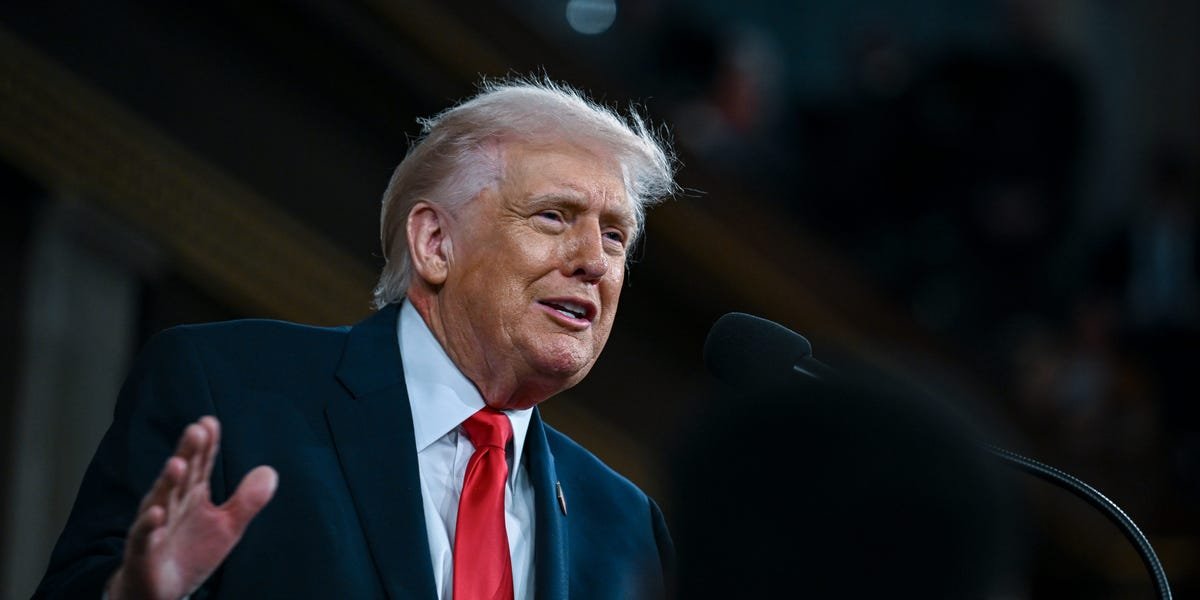
President Donald Trump says federal agencies won’t be using Anthropic’s technology anymore.
“We don’t need it, we don’t want it, and will not do business with them again,” Trump wrote on Truth Social on Friday.
It comes amid a dispute between the AI giant and the Department of Defense.
Trump said that there would be a six-month phase-out period for departments, including the Department of Defense, that are “using Anthropic’s products, at various levels.”
“WE will decide the fate of our Country — NOT some out-of-control, Radical Left AI company run by people who have no idea what the real World is all about,” Trump wrote.
Trump’s announcement comes just a few hours before the Friday evening deadline defense officials had given Anthropic to agree to the military’s terms of use for the company’s frontier model, Claude.
Earlier this week, the two parties came to an impasse over how the military can deploy Claude.
The issue appeared to revolve around two safeguards Anthropic was not willing to drop: mass surveillance of US citizens and autonomous weapons.
Defense Secretary Pete Hegseth had given Anthropic’s CEO Dario Amodei until Friday, 5:01 p.m. Eastern Time to get on board with the military. Hegseth also warned that the government could invoke the Defense Production Act — a wartime law that gives the president broad authority over a company’s resources — and designate Anthropic as a supply chain risk.
Both would be unprecedented moves by the government against an American technology company, experts previously told Business Insider.
On Thursday, Amodei published a blog post stating that the Defense Department had added language to its contract allowing for “any lawful use” of its model.
A source familiar with the negotiations told Business Insider that this language effectively gave the military discretion over how it uses Claude.
The Anthropic CEO said in his post that the company would prefer to continue serving the department but that it could not “in good conscience accede to their request.”
This story is available exclusively to Business Insider
subscribers. Become an Insider
and start reading now. Have an account? .
California sent xAI a cease-and-desist letter, demanding it stop allowing deefake images of minors.
Elon Musk’s xAI faces sustained criticism over Grok’s ability to create nonconsensual sexualized images.
The letter, sent by AG Rob Bonta, threatens legal action if the deepfakes continue to be permitted.
California Attorney General Rob Bonta has demanded that xAI prevent its chatbot, Grok, from continuing to create sexualized deepfake images of children.
Bonta’s office sent a cease-and-desist letter to Elon Musk’s AI startup on Friday after sustained criticism over the bot’s ability to create nonconsensual sexualized images, including those of minors.
Earlier this week, X said that it implemented restrictions on Grok.
“We have implemented technological measures to prevent the Grok account from allowing the editing of images of real people in revealing clothing such as bikinis,” X’s safety account said in a blog post on the platform on Wednesday. “This restriction applies to all users, including paid subscribers.”
However, that didn’t stop the X or Grok app from creating sexualized images, Business Insider’s Henry Chandonnet found on Thursday.
Representatives for the CA Attorney General’s office did not immediately respond to requests for comment from Business Insider.
In an automated response to Business Insider, xAI said, “Legacy Media Lies.”
This is a developing story. Please check back for updates.
Every December, cinephiles ask: Was this a good year for movies? By the end of 2025, I knew my answer instantly: Yes.
The box office told a different story. Before the COVID-19 pandemic, annual box-office grosses routinely reached $10 to $11 billion. This year, totals are expected to fall short of $9 billion.
“It looks like it’s going to be two years in a row that the industry flatlined,” Alamo Drafthouse COO Michael Sherrill told Variety.
But if you look beyond the box-office numbers, you’d see the year was packed with wonderful movies. And it’s just one reason we should be paying less attention to what the box office tells us.
Underrated gems were everywhere
Not every year has a “Barbenheimer,” which together raked in $2.4 billion at the box office in 2023, but that doesn’t mean there weren’t plenty of five-star films in 2025.
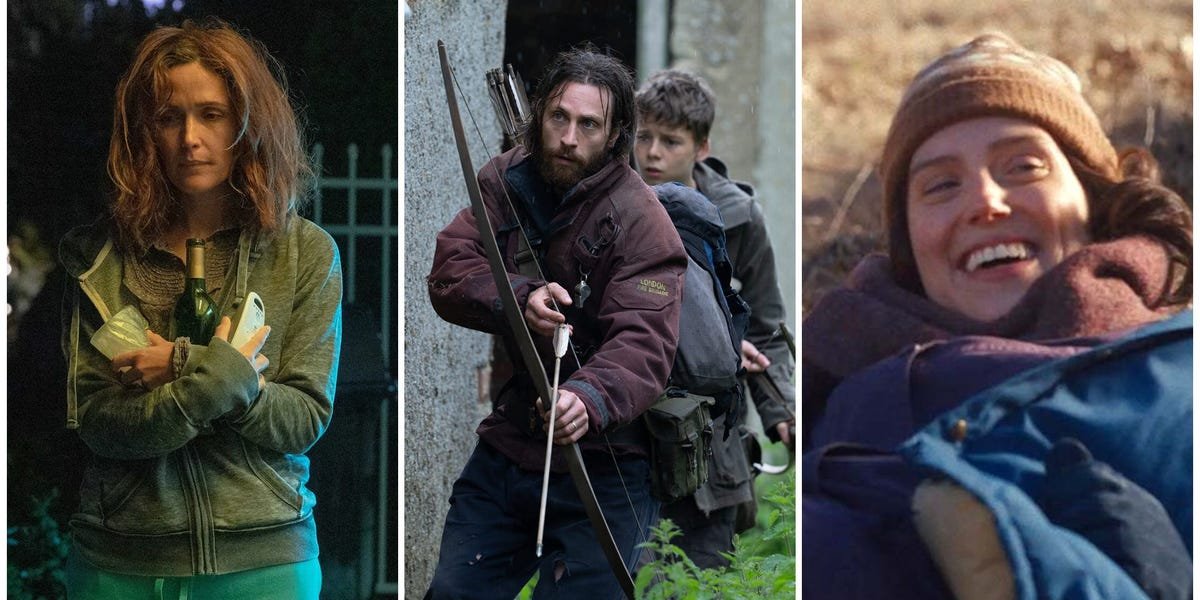
Some of the best movies of the year included “28 Years Later,” “Blue Moon,” “Sentimental Value,” “Splitsville,” “Hamnet,” “If I Had Legs I’d Kick You,” “Black Bag,” and “Mission: Impossible — The Final Reckoning,” and all but two made less than $11 million worldwide.
“The Final Reckoning,” which grossed $598 million at the box office, was still unable to become profitable due to ballooning production costs, according to The Hollywood Reporter.
Another, “Black Bag,” was a slick thriller starring Michael Fassbender and Cate Blanchett as a pair of married spies who are pitted against each other when a mole is discovered. This film was visually stunning, featured strong performances, and the tension never let up.
“Black Bag.”
Focus Features
When it was released in March, “Black Bag” earned $44 million at the box office, likely because it catered to, for lack of a better term, “adults.” Yet Gen Z and Gen Alpha are the generations “sort of single-handedly keeping film alive” more than any others, according to reports from CinemaUnited and the National Research Group, suggesting there may be a ceiling on how far adult-focused theatrical releases like “Black Bag” can go today. By comparison, another Soderbergh-directed thriller, “Out of Sight,” made nearly double that in 1998.
Another great 2025 film, “Sorry, Baby,” was a movie written by, directed by, and starring Eva Victor in their directorial debut. Victor played a college professor grappling with the aftermath of a sexual assault. It was simultaneously heartbreaking, funny, and uplifting.
It also only made $3 million at the box office — a respectable total for a small indie film with a reported budget of $1.5 million and a very limited theatrical run, but not a smash by any means.
Another movie that made $3 million? “Splitsville,” which made me laugh harder than almost anything else I saw this year.
“Splitsville.”
Neon
What I learned from these movies: Don’t let the “flop” label or a small box-office number scare you. Just because it didn’t have “Avengers: Endgame”-level marketing, fanfare, and box-office take-home, it doesn’t mean it’s not worth your time.
The new normal
In fact, even some of the biggest hits of the year could be considered flops by Old Hollywood standards.
Movies like “Superman,” “The Fantastic Four: First Steps,” and “Captain America: Brave New World” each earned hundreds of millions of dollars globally but fell far short of the blockbuster heights superhero films once enjoyed.
Arguably the best superhero movie of the year, “Thunderbolts*,” made $382 million worldwide, making it a superhero flop according to outlets like Variety and Screen Crush.
“Thunderbolts*.”
Marvel Studios
Over the last decade, viewers’ habits have changed; more people stay home and stream their favorite films, rather than head to theaters.
With the advent of streaming, fewer people are interested in going to cinemas. A US Kagan Consumer Insights survey, released in October, found that the percentage of frequent movie-goers dropped by 22% between 2019 and 2025.
Meanwhile, in July 2025, Netflix reported its best-ever numbers during an earnings call. Free streaming services like YouTube and Tubi increased viewership by 53% between 2023 and 2024, and Peacock gained 3 million subscribers in just the first week of the Olympics.
The era when every major release was expected to make a billion dollars is over.
We should all know less about marketing budgets
This comes as there’s more focus on the theater box office and studio budgets. Over the past decade, trade publications have leaned into coverage of how much money a movie needs to earn “to make its money back.”
This reporting only opens up films like Ryan Coogler’s “Sinners,” a record-breaking, singular film that depicts an area of the country rarely shown on screen, to bad-faith criticism, as viewers use data to tear a movie down, regardless of quality.
“Sinners.”
Eli Adé
It not only ignores creative value but also obscures other stories, such as how Coogler secured a rights deal to own the rights in 2050, which could set a new precedent for how creatives take ownership of their work.
Instead, the narrative was about how this film, which grossed over $360 million on a $90 million budget, per IndieWire, wasn’t close to making its money back.
“Sinners” has amassed $61 million in its global debut. It’s a great result for an original, R-rated horror film, yet the Warner Bros. release has a $90 million price tag before global marketing expenses, so profitability remains a ways away. https://t.co/gjPXGBYkZ1pic.twitter.com/wwXjVC2GT5
so in order for the film to break even (70M budget), it will have to gross 175M, but that doesn’t include the marketing costs, so the break even point is prob +200M. so happy timotheé is getting a financial failure attatched to his face 🙏🏻 https://t.co/ZvYV2sUQqf
This phenomenon isn’t completely new. In Nancy Meyers’ “The Holiday,” a film released almost 20 years ago, a character complains we shouldn’t be tracking box-office returns like baseball scores: “Now a picture has to make a killing the first weekend or it’s dead. This is supposed to be conducive to great work?”
Still, with movies like “Sinners” and “Black Bag” in our rear-view mirrors, we should remind ourselves that box-office success shouldn’t matter to us cinema lovers — we should only care about how the movies are making us feel and think.
So, as 2026 begins, stop worrying and love the bomb — and an entire world of cinema will be opened up to you.