Photos-appear-to-show-destroyed-US-aircraft-left-in-Iran.jpeg

Photos appear to show destroyed US aircraft left in Iran after special forces rescued a stranded F-15E airman

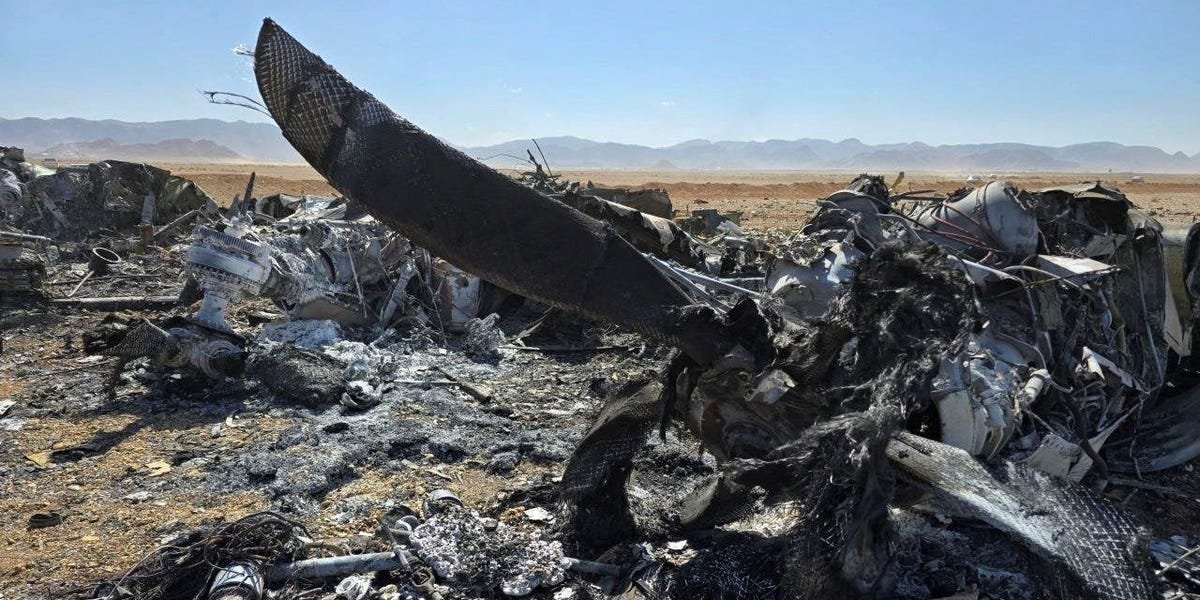
Several photos appear to show the remains of the turboprop planes and helicopters that US special forces used while rescuing an F-15E weapons system officer stranded in Iran.

The images, which emerged on social media on Sunday evening and were spread by Iranian state media, appear consistent with multiple Western reports that US forces ditched and destroyed the aircraft near the end of the mission.

Some of the photos appear to show wrecked propellers and the nose of at least one turboprop plane.


Aircraft wreckage lies in the open desert.

Two destroyed propellers are visible in this image taken in the desert. 

SOCIAL MEDIA/via REUTERS


It’s unclear exactly when the photos were taken.


Two turboprop plane propellers lie in shambles on the desert sand.

The wreckage appears consistent with the propellers of a turboprop transport aircraft. 

SOCIAL MEDIA/Social Media via REUTERS


Another image appears to show a destroyed helicopter main rotor that would have been fitted with six blades.


A destroyed helicopter rotor is nestled in the desert sand.

This destroyed helicopter rotor likely had six blades. 

SOCIAL MEDIA/via REUTERS


William Goodhind, an independent open-source investigation researcher, told Reuters that the images appeared to show distinct features of a destroyed Lockheed Martin MC-130.

The medium-sized transport plane, which features four propellers, is based on the C-130 Hercules and used by US special forces, often for exfiltration and infiltration.


Aircraft wreckage sits on the desert sand.

Photos of the aircraft wreckage emerged on Sunday. 

SOCIAL MEDIA/Social Media via REUTERS


Multiple American media reports have said that during the rescue mission, US commandos retrieved the F-15E airman but were unable to take off with two MC-130s from a remote airstrip established in the nearby desert.

To keep the aircraft from falling into Iranian hands, US forces destroyed the planes, instead calling in replacement aircraft to exfiltrate the ground teams, officials told US media.


Metal debris lies in the desert.

This metal debris appears consistent with aircraft parts. 

SOCIAL MEDIA/Social Media via REUTERS


The New York Times also reported that four Boeing MH-6 Little Birds — helicopters with six-bladed rotors used by US forces to fetch the stranded officer from their hiding position — were left behind and intentionally destroyed by American warplanes.

On Sunday evening, President Donald Trump announced that the airman had been rescued, calling the operation “one of the most daring” search-and-rescue missions in US military history.

The weapons system officer was one of two US Air Force service members who ejected from an F-15E Strike Eagle shot down on Friday in Iran, about two days before his rescue.

His crewmate, the F-15E’s pilot, was retrieved separately by US forces several hours after they ejected. Several reports indicated that two search-and-rescue helicopters were hit during the operation to exfiltrate them, but returned safely to base.

The loss of the F-15E marks the first time that a US aircraft was destroyed over Iran since the Pentagon and Israel began Operation Epic Fury on February 28.

Other American warplanes have been lost during the war, however, and several others have been severely damaged. On Friday, an A-10 Warthog crashed in friendly territory after being hit, with its pilot safely ejecting.

Three other F-15s were also destroyed last month over Kuwait, in what US Central Command said was likely a friendly-fire incident involving local air defenses. The six pilots and weapons systems officers ejected and survived.

On March 12, all six crew members of a KC-135 died after the refueling aircraft crashed in Iraq. The US says that at least 13 of its troops have been killed during this year’s combat operations with Iran, with roughly 350 service members also wounded.

Human rights organizations have published differing estimates for casualties in Iran, with rough death tolls last week ranging from 1,900 to 3,500 deaths.


Source link

These-airlines-are-sending-special-flights-to-the-Middle-East.jpeg

These airlines are sending special flights to the Middle East to rescue stranded travelers

It’s been a confusing six days since missile attacks across the Middle East stranded travelers and planes in airports across the world.

Things are still far from normal as of Wednesday, but some travelers are getting home.

There is a slow-growing recovery in the United Arab Emirates, which has partially opened its skies and designated “safe” corridors for rescue planes to use.

There are a lot of people to move: cities like Dubai and Abu Dhabi host large expat populations and tourists, and their hubs usually handle tens of thousands of transit passengers a day.

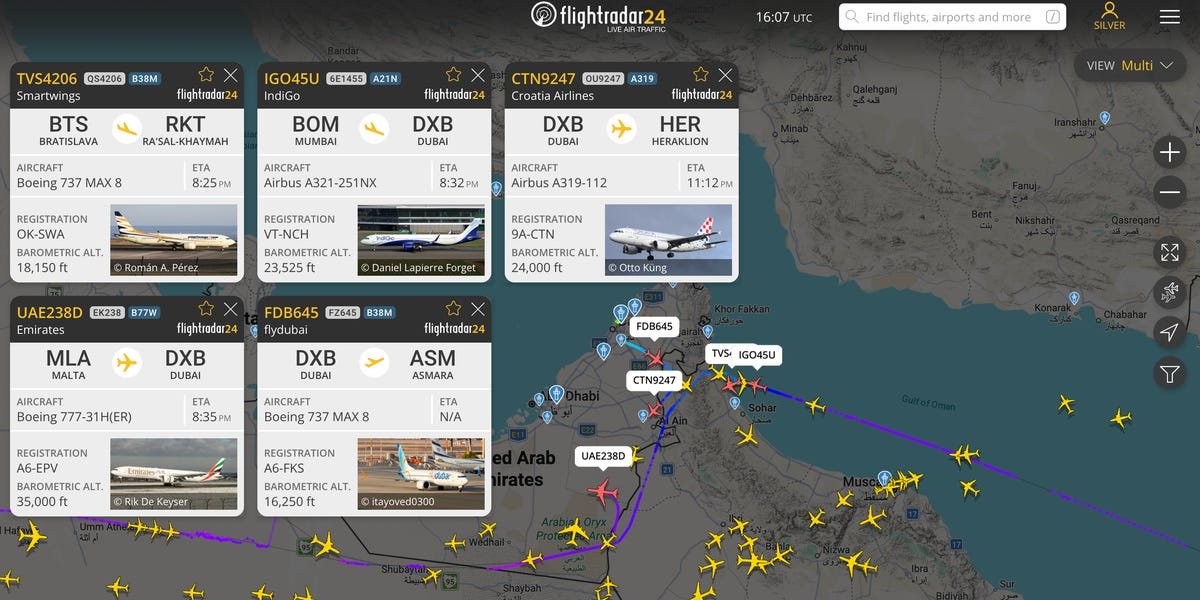
Working with local officials, Emirates, Flydubai, IndiGo, and Etihad Airways were among the first airlines to depart the UAE with passengers, crews, and cargo. Over 100,000 people followed these aircraft live on the aviation tracking website Flightradar24.

Even as Iranian threats continue to disrupt flying — forcing diversions, holds, and U-turns — airlines are still transporting passengers to destinations across Europe, Asia, and Africa.

Fortunately, Emirates and Etihad have big planes: many of their Airbus A380s, capable of carrying up to 615 passengers, have flown to cities such as London, Istanbul, Jeddah, Singapore, Paris, and Düsseldorf.

Although these flights don’t always take travelers all the way home, they offer a crucial escape from limbo — getting people into countries with open airspace and far more onward flight options.

Flightradar24 data shows several other carriers have joined the crowd: Air India, Air Arabia, Uzbekistan Airways, Kenya Airways, Morocco’s Royal Air Maroc, Saudi airline Flynas, Royal Jordanian, and India’s SpiceJet are all flying from Dubai to their respective hubs.


People hugging at an airport after being stuck in Dubai.

Passengers on a Kenya Airways rescue flight from Dubai arrive back home.

Thomas Mukoya/Reuters


European carriers, including Lufthansa, Swiss International Air Lines, Prague-based Smartwings, Aegean Air, and British Airways, are running special rescue flights from neighboring Muscat, Oman. Smartwings and Croatia Airlines are running select flights from Dubai.

Air France scheduled a repatriation flight from Dubai to Paris on Thursday evening, but suspended the plan shortly after the announcement due to “the ongoing security situation.”

Russian carriers Aeroflot and S7 Airlines have similarly departed with passengers, though their flights to Moscow are taking up to three hours longer because they have to fly the long way around closed airspace rather than fly directly over it.

Still, most airlines’ regular schedules to and from much of the Middle East remain suspended until at least the weekend, and they have asked passengers not to go to the airport unless they have been specifically notified.

No US airlines have sent rescue planes as of Thursday. Mark Dombroff, an aviation attorney with the law firm Fox Rothschild, told Business Insider that even if US carriers like United or American wanted to help, they legally can’t.

“The decision-making resides with the Federal Aviation Administration,” he said. “If the FAA says you can’t fly there as a US certificated carrier, that’s it. And in a sense, it’s no different than any other restricted airspace in this country, like Washington, DC.”

Some Americans have gotten home with the help of the State Department; it previously told those in over a dozen Middle Eastern countries to evacuate. The agency said it flew a charter flight to the US on Wednesday, and that more will be “surged across the region.”

It added that, as of Wednesday, “nearly 18,000 Americans have safely returned to the US,” including 7,300 helped by the State Department. It said thousands of others made it to Europe and Asia and are in transit back, and told those still stuck to get in touch for help by calling +1 (202) 501-4444 or filling out this form.

Some airlines remain effectively frozen. Qatar Airways has not flown a plane since Saturday due to Qatar’s airspace closure, leaving practically no options for those in Doha except to wait or drive hours to Saudi Arabia and fly out from there.

Flight options are still extremely limited

While some flights are better than none at all, special airline operations remain limited to certain routes and airports.

Flightradar24 data shows that Dubai International has seen just 100 takeoffs and landings since Saturday. Operations ramped up from Monday to Tuesday — but that was still less than 10% of the roughly 1,200 flights in and out on a usual day.

Rescue flights are largely restricted to the UAE, Oman, and Saudi Arabia: the skies over Iran, Kuwait, Iraq, Syria, Israel, Qatar, and Bahrain remain closed.


An Emirates A380 landing in Germany.

An Emirates A380 ferried hundreds of stranded people back to Germany.

Andreas Rentz/Getty Images


Aviation analytics Cirium estimates there are normally about 900,000 daily seats to, from, and within the Middle East; it said about 4.4 million seats in and out of the Middle East have been canceled since Saturday.

While airlines are actively adding flights to the schedule — despite the on-and-off missile threats in the region — there are nowhere near enough rescue seats yet to accommodate the tens of thousands of stranded travelers. British Airways said on social media on Wednesday that the rescue flights it planned through Saturday are already full.

Some wealthy travelers have abandoned commercial flying altogether, instead paying hundreds of thousands of dollars to charter private jets. Flightradar24 data shows a number of business aircraft flying to and from Oman, Saudi Arabia, and the UAE since Sunday.

Those with less deep pockets have chosen to travel by bus to Oman and Saudi Arabia, hoping to secure seats from airports still operating flights as normal.

But the drives are hourslong, and Oman Air warned Muscat-bound travelers crossing in from the UAE to arrive 12 hours early as traffic backs up for miles.


Source link

My-flight-U-turned-midair-as-war-broke-out-Now-Im.jpeg

My flight U-turned midair as war broke out. Now I’m stranded in Doha, and it feels like Covid.

This as-told-to essay is based on a conversation with Peter Wozny, head of legal at Btomorrow Ventures, the corporate VC arm of British American Tobacco. This piece has been edited for length and clarity.

I was flying home to Europe over the weekend from a business trip in China, connecting through Qatar, when my journey took an unexpected turn.

I landed in Doha in the early hours of Saturday morning, made my transfer, and boarded the onward flight. We took off as normal at 9:15 a.m. local time.

About an hour later, everything changed. As we approached the airspace between Israel and Iran, the plane abruptly turned around and headed back to Doha.

When we landed, we sat on the tarmac for roughly 90 minutes as the crew tried to figure out the next steps. Eventually, they sent us back into the terminal.

By then, anxiety had started to spread. Passengers were glued to their phones, reading reports that war had broken out that morning.


Peter Wozny boarded a flight to Warsaw at Doha's Hamad International Airport on February 28.

Peter Wozny boarded a flight to Warsaw at Doha’s Hamad International Airport early on Saturday morning.

Courtesy of Peter Wozny


Stranded in Doha

Inside the airport, it was chaotic.

Since I was traveling for work, I headed to the Al Mourjan Business Lounge, where I ran into my friend Stuart. We ended up waiting there for a few hours, trying to figure out what was happening.

While we were sitting there, we started hearing loud bangs outside. At first, I wasn’t sure what they were. Then it became clear they were missiles being fired. That’s when it really hit me — it felt ominous.


Stuart McClure and Peter Wozny at Doha's International Airport's lounge on February 28.

Stuart McClure and Peter Wozny at Doha’s International Airport’s lounge on February 28.

Courtesy of Peter Wozny


Qatar Airways moved us to the Fraser Suites in Doha’s West Bay area. It wasn’t great, so I decided to book my own room at the Mondrian Doha, where I’ve been staying since Sunday. It’s about $220 a night.

The authorities have said stranded passengers will be able to claim refunds for their hotel stays from Saturday until the airports reopen.

Once this is all over, I’ll need to submit expenses for flights, taxis, food, the hotel, and even basic things like toiletries and clothes.

For the first four days, we didn’t have our suitcases. I just had the clothes I was wearing and a rucksack with my work laptop.

The explosions woke me up

From the hotel, which overlooks Doha’s port, you can hear the explosions. You’ll be sitting there, and suddenly there are these loud bangs outside. Then you look up and see flashes lighting up the sky. It’s scary.

On Saturday night, I actually slept through most of the noise because I was exhausted.

But at 7:30 a.m. on Sunday, the noise woke me up. On other days, it’s sounded more distant, more muffled.

Sunday was noticeably quieter. From what I understand, Qatar has been intercepting missiles over the Gulf before they reach land. It’s not that they haven’t been fired — it’s that they’re being taken out at sea.

Even so, you can still hear them.


Stuart McClure and Peter Wozny in their hotel room on March 3.

Stuart McClure and Peter Wozny in their hotel room on Tuesday.

Courtesy of Peter Wozny


It feels a little bit like Covid

It feels a bit like lockdown. I’m stuck, and I don’t know what’s going on. I look out on the streets, and there are barely any cars driving around.

I feel nervous. A bit unsettled. I do feel safe, but I just don’t know what’s happening.

I’m generally a glass-half-full person, but all my plans have been turned upside down. I don’t know whether it’s going to be a few more days or a few more weeks stuck out here.


Peter Wozny and other flight passengers received alert messages upon returning to Doha.

Peter Wozny and other flight passengers received alert messages upon returning to Doha.

Courtesy of Peter Wozny


Reassuring friends and family

The hardest part has been friends and family constantly checking in. They’re obviously concerned and want to get updates.

They’re reading things in the news, and there’s misinformation out there. So you’re constantly responding to messages and telling everyone you’re OK.

That’s intense. But when you’re sitting in the hotel, and you’re just hearing explosions around, or you’re looking up, and you just see all the light, the sky kind of lighting up, it’s also a bit scary.


Peter Wozny in the Mondrian Doha Hotel on March 2

Peter Wozny is shown in the Mondrian Doha Hotel on Monday.

Courtesy of Peter Wozny


From my company’s perspective, the guidance has been straightforward: stay in touch, keep people updated, and don’t leave the hotel unless necessary.

Beyond that, we’re just waiting to see whether the situation escalates.

The last update from Qatar Airways was that there won’t be any flights out of Doha until at least Friday.

I’m now considering getting a car and driving to Riyadh in Saudi Arabia, and then flying to London from there.

For now, I’m just hoping it doesn’t escalate further, that no one gets hurt, and I can head home soon.


Source link

I-flew-to-Dubai-for-my-30th-birthday-Now-Im.jpeg

I flew to Dubai for my 30th birthday. Now I’m stranded 8,000 miles from home and terrified after the US strikes on Iran.

This as-told-to essay is based on a conversation with Shanice Day, a 30-year-old stylist based in Houston, who is stuck in Dubai after traveling there to celebrate her birthday with a friend. It’s been edited for length and clarity.

I came to Dubai with one of my best friends. We left Texas on February 23 and arrived in Dubai early on the 24th, the day of my 30th birthday.

The hotel staff gave me a cake, roses, and drinks. They even sang “Happy Birthday.” It was wonderful. Every time I told someone it was my birthday, they made me feel special.

February 28 was meant to be the last full day of my birthday trip to Dubai. That was when the Iranian strikes started. Since then, we’ve been trying to get back to the US, but we’ve hit so many roadblocks.

I planned my birthday trip to Dubai about 5 months ago

I had planned this trip for my best friend and me about five months ago. We usually travel everywhere together. We decided that this time, Dubai would be a good place to go for such a big birthday. I’d always wanted to visit the Middle East.

At the start of our trip, we did a lot of cultural things. We visited a mosque, the Miracle Garden, and the beaches. We really indulged ourselves and tried so many different kinds of food.

Dubai is a beautiful city. Everyone here is very kind, and in my first few days, I felt the safest I’d ever felt. I never expected anything like this would happen here.

The final day of my trip

On Saturday, the 28th, I was shopping at the Dubai Mall. My best friend stayed behind to go to the beach at our resort.

When I went into a store, I asked the clerk if I could come back before my flight. He told me I might not be able to, and I didn’t understand why. I checked my phone and immediately saw that the US and Israel had struck Iran. My best friend called me and told me that I needed to get back to the resort.

I was shaken up by the strike in Dubai

We’re staying at a five-star hotel in the Jumeirah Beach Residence area. It’s not too far from the Fairmont The Palm, which caught on fire during an Iranian air attack on Saturday night. I didn’t see the smoke, but I heard the sounds from the air-defense systems.

In the US, we don’t hear things like that. It really shook me up. A lot. It felt like an out-of-body experience.

Sunday in Dubai felt very eerie. On Monday, we went out just to get a bite to eat, but the energy still felt off. I think people are trying to make the best of the situation, but the mood has shifted.

We broke down in tears when our flights from Dubai were canceled

Our flight was meant to depart on March 1 at 5.30. The night before, we were notified that it had been canceled. We broke down in tears. We’re 8,000 miles away from our family and friends. We don’t know when this will be over. We didn’t know how we were going to get out.

We immediately started looking for any way out. When we realized we couldn’t find one, our hearts broke. We were devastated and scared. I’m very spiritual, so we both started to pray.

My friends and family back in Texas are concerned about us. I had to tell my immediate family that I don’t know when we’ll make it home.

I feel traumatized and am hesitant to travel overseas right now

I’m trying to see the positive now: We’re still in Dubai, and we’re still safe. Our hotel has taken precautions to make us feel at home, but it’s still very traumatic.

I’ve been traveling since I was 14. I love experiencing different cultures, but this has been overwhelming. I’d say that traveling overseas will not be at the top of my priority list after this.

I’ll probably get therapy after this experience. I know it’s going to take me a while to build up the courage to travel again.

All I want is to get home to my dog, my cat, my mom, and my friends, and honestly, I even miss my job as a personal stylist.

I love Dubai, but I want to be home and at ease

My friend, who is watching my cat and dog while we’re away, FaceTimed me with my pets. I got to see my babies. I just want to see them again. I just want to feel normal again.

I’m not at ease, and I don’t think I will be until I cuddle up with my animals again.

But despite all this, I still love Dubai.

Do you have a story to share about leaving or trying to leave the United Arab Emirates? Contact this reporter at jzitser@businessinsider.com.


Source link

Photos-show-chaos-at-airports-as-passengers-are-left-stranded.jpeg

Photos show chaos at airports as passengers are left stranded due to canceled flights

  • Airports across the Middle East have suspended all flight operations until further notice, leaving many stranded.
  • The US and Israel launched strikes against Iran on Saturday, with Iran launching retaliatory strikes across the region.
  • One Emirates passenger told Business Insider he was stuck on a plane for five hours without food before everyone was deplaned.

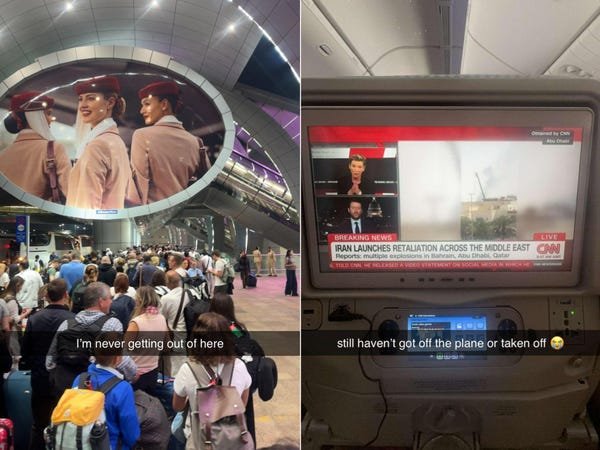
Travelers are in limbo as airport departure boards flip to red after air strikes in Iran resulted in closed airspace and triggered mass flight cancellations.

The heart of the chaos is in the Middle East, where airports in Dubai, Doha, and Abu Dhabi serve as megahubs for global connecting traffic. Data from the aviation analytics firm Cirium shows their home airlines — Emirates, Qatar Airways, and Etihad Airways — carry a combined 90,000 transit passengers a day.

That figure does not include the thousands of travelers whose final destination is the Middle East.

Emirates passenger Jaiveer Cheema, who was set to fly back home to the US on Saturday, told Business Insider that he was stuck on his plane for five hours with no food before everyone was deplaned and shuffled into the crowded terminal at Dubai International.

“The next several hours at the airport were chaos as no one knew what to do,” he said. “We spoke to several security guards and Emirates employees, and they all gave us different answers.”

Cheema said they stood in line after line until they eventually got a hotel voucher and took a bus to the lodging. He was still waiting for a room 90 minutes after arriving — it’s after midnight in Dubai; nearly 20 hours after he initially showed up for his 9 a.m. flight.

While many passengers are stranded within the region’s closed airspace, shuttered until further notice, the disruption has rippled far beyond it.

Flights to the affected region from places like London and the US have been canceled outright or diverted mid-journey — leaving travelers far from home in crowded airport terminals and uncertain when they will be able to depart.

Airlines have told passengers on social media to expect long wait times at airports and on customer-service phone lines as they try to manage the abrupt disruptions.

The sheer number of displaced people and planes on Saturday alone is expected to snowball worldwide if airports are unable to restart operations soon.

Passengers in Dubai were funneled into long snaking lines.

Jaiveer Cheema is one of the thousands of people stranded in limbo.

Courtesy of Jaiveer Cheema

Cheema spent hours in line but managed to secure a hotel voucher — though he had yet to secure a room when talking with Business Insider. He said he did not have answers from Emirates on what’s next.

An Emirates spokesperson did not immediately respond to a request for comment from Business Insider.

Passengers at Beirut Rafic Hariri International Airport in Lebanon are stranded.


Stranded passengers at Rafik Hariri International Airport

Passengers are stranded at Beirut Rafic Hariri International Airport on Saturday.

Anadolu/Anadolu via Getty Images

Airlines are pivoting their operations in response to the strikes. Lufthansa Group said it is suspending flights to Beirut, Tel Aviv, Amman, Erbil, and Tehran until March 7.

Airlines are suspending flights across the region, including Lebanon.


Cancelled flights at the Rafik Hariri International Airport on February 28.

Flight operations at the Beirut Rafic Hariri International Airport in Lebanon on Saturday.

Anadolu/Anadolu via Getty Images

In a statement shared on the Lufthansa Group’s website, the company said it would also suspend flights in additional areas.

“The following airspaces will also not be used until March 7: Israel, Lebanon, Jordan, Iraq, Qatar, and Iran,” the aviation corporation said. “In addition, Lufthansa Group airlines will suspend flights to and from Dubai and Abu Dhabi, Riad, and Dammam until March 1. Furthermore, the airspace of the United Arab Emirates will not be used until March 1.”

International flights at Tribhuvan International Airport in Nepal were disrupted.


Stranded passengers at Tribhuvan International Airport in Nepal.

Passengers waiting at Tribhuvan International Airport in Nepal on Saturday.

Navesh Chitrakar/REUTERS

The Tribhuvan International Airport shared a passenger advisory on Saturday, saying international flights “may be subject to delay, rescheduling, or cancellations” due to airspace restrictions.

Passengers flying with major airlines were told to check their flight status.


Passengers stranded at Tribhuvan International Airport in Nepal on February 28

Passengers at Tribhuvan International Airport in Nepal on Saturday.

Navesh Chitrakar/REUTERS

The Tribhuvan International Airport told passengers flying with major airlines — including Qatar Airways and Turkish Airlines — to coordinate with those companies to navigate travel issues.

Qatar’s airspace closure caused flight disruptions at Hamad International Airport.


Passengers at the Hamad International Airport in Qatar on February 28.

Passengers at the Hamad International Airport in Qatar on Saturday.

Stringer/REUTERS

Qatar’s Hamad International Airport said all aircraft movement has been temporarily suspended due to the country’s closed airspace.

“Our priority is always the safety of our passengers and employees. We are working closely with government stakeholders and airline partners to look after passengers that have been impacted,” the airport wrote in an advisory.

In London, flights to the countries Middle East were canceled.


A check-in counter for Emirates at London Gatwick Airport shows cancelled flights on February 28.

The Emirates check-in counter at London Gatwick Airport shows that flights are cancelled on Saturday.

Ben Stansall / AFP

Flights heading to the Middle East were also canceled at the London Gatwick Airport in England on Saturday.

London Gatwick Airport told some passengers to expect travel interruptions.


Passenger at London Gatwick Airport on February 28.

Passengers at London Gatwick Airport on Saturday.

Ben Stansall / AFP

A London Gatwick Airport spokesperson told Sky News it’s “expecting disruption to our Qatar and Emirates flights.”

Are you a stranded traveler with a story to share? Contact the reporters at ledmonds@insider.com and trains@insider.com along with your preferred contact information.


Source link

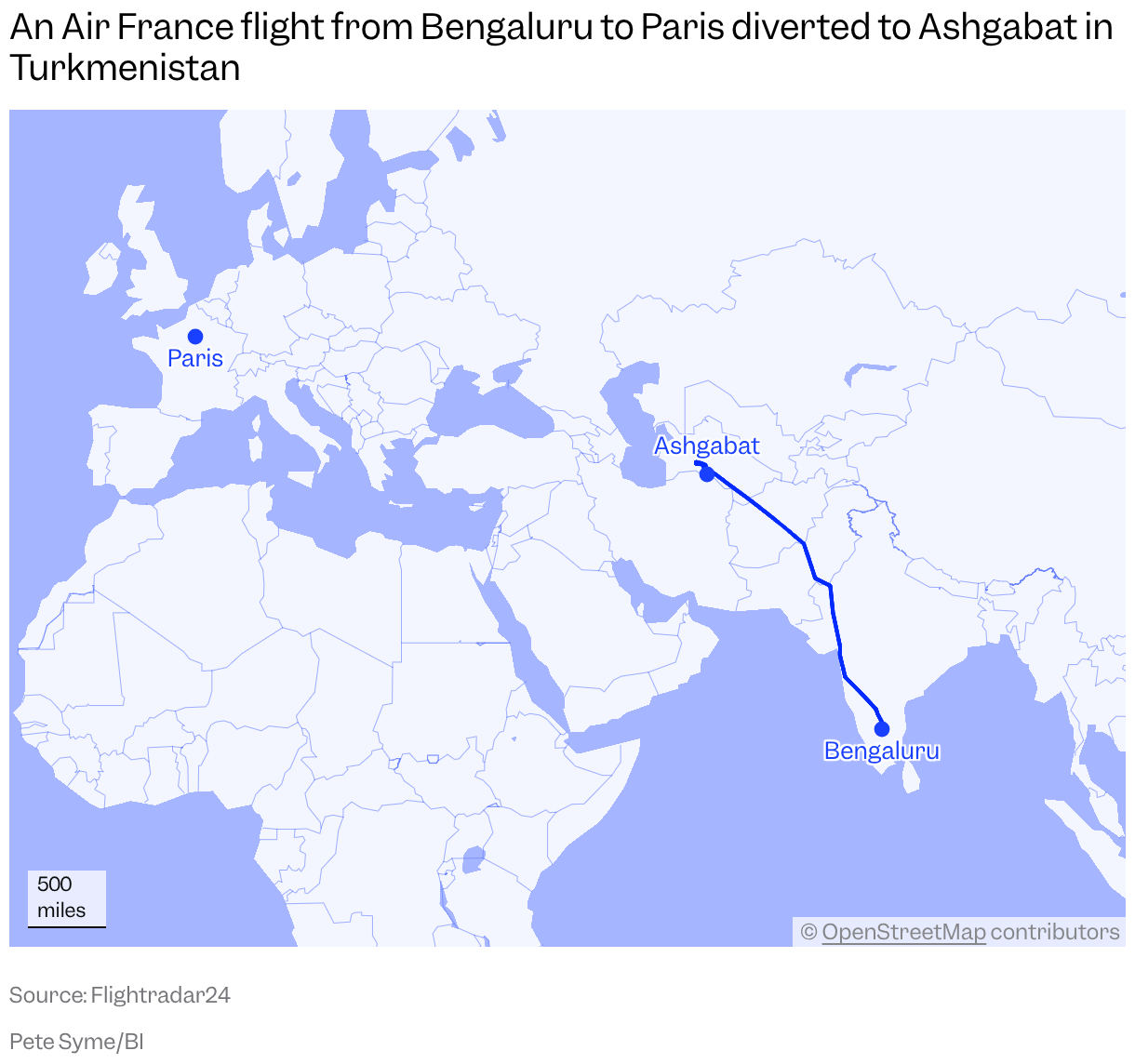
A map of the western hemisphere showing the flight path of Air France 191 which departed Bengaluru and diverted to Ashgabat.

Passengers flying to Paris spent 21 hours stranded in the remote nation of Turkmenistan

Air France passengers were delayed by nearly two days after they were diverted to Turkmenistan.

Monday’s Flight 191 was already running 21 hours late when it departed Bengaluru, India, shortly after 11 p.m., according to data from Flightradar24. It was supposed to land in Paris about 10 hours later.

However, four hours into the journey, the Boeing 777 started descending. It made a U-turn to land in Ashgabat, the capital of Turkmenistan, a sparsely populated nation in Central Asia.

Registered as F-GSPI, the jet is 26 years old. The cause of the diversion has not been confirmed, though The Independent reported that the plane suffered an engine issue.

Passengers then had to wait nearly another whole day to continue their journey to Paris. Turkmenistan is ruled by what Human Rights Watch has described as a totalitarian, hereditary government and is one of the world’s most politically secluded countries.

Air France did not respond to a request for comment sent by Business Insider.

Given that the flight departed from India, there were a number of Indian nationals on board, who were hosted by the nation’s consulate in Turkmenistan. It is unclear where the majority of the passengers on the flight stayed during their time in Ashgabat.

Ultimately, a new aircraft was dispatched to collect the passengers. Flight-tracking data shows another Air France Boeing 777 left Paris on Tuesday morning and arrived in Ashgabat after a five-hour flight.

It spent about three hours on the ground before departing Turkmenistan shortly after 1 a.m. That’s nearly 22 hours after the passengers first arrived there.

The plane then landed in the French capital at 3:23 a.m. on Wednesday. Along with the departure delay, that’s 43 hours later than passengers initially expected to get there.

Flight-tracking data appears to show that the original plane is still on the ground in Ashgabat as of Thursday morning, three days after it landed there.

This wasn’t the first time that Air France has sent a plane to rescue stranded passengers.

In May 2024, one of its Boeing 787s was flying from Paris to Seattle when a burning smell was detected in the cabin.

The pilots declared an emergency and diverted to Iqaluit, the capital of Canada’s Nunavut territory. A different flight was canceled so a Boeing 777 could take the passengers to New York.


Source link

Amazon-allows-visa-workers-stranded-in-India-to-work-remotely.jpeg

Amazon allows visa workers stranded in India to work remotely with restrictions. Here’s what they can’t do.

Amazon is allowing employees who are stranded in India because of visa delays to work remotely there until early March, according to an internal memo viewed by Business Insider.

The catch: They’re not allowed to code, make strategic decisions, or interact with customers.

Amazon is one of many American companies scrambling to adapt to the Trump administration’s rapid-fire changes to the H-1B visa program, including a mandate that consular officers must review visa applicants’ social media posts before issuing visas. The additional screening has delayed processing, and some embassies and consulates have rescheduled visa appointments by several months, leaving some employees stranded outside the country.

The delays have prompted Google, Apple, Microsoft, and other companies to issue travel advisories in recent weeks, warning US employees with visas to avoid international travel to prevent extended stays outside the US.

Amazon allows employees traveling abroad for visa renewals to work remotely for up to 20 business days, an exemption from the normal requirement that they work in their office five days a week. Now, any Amazon employee in India as of December 13 and who awaits a rescheduled visa appointment may work remotely until March 2, according to the memo, which was posted to Amazon’s internal HR portal on December 17.

The permission to work remotely comes with a long list of constraints. Employees working remotely from India are barred from coding of any kind, including troubleshooting and testing. They cannot work from or visit Amazon buildings. And they cannot negotiate or sign contracts.

“All reviews, final decision making, and sign offs should be undertaken outside India,” the memo says.

The memo also said that “in compliance with local laws, there are no exceptions to these restrictions.”

The memo does not provide guidance for employees whose visa appointments have been rescheduled beyond March 2, 2026, or for those stranded in a different country. Some US embassies and consulates have rescheduled appointments as far out as 2027.

Amazon did not immediately respond to a request for comment from Business Insider.

For employees in technical roles, the restrictions raised questions about what work they can actually perform.

“Seventy to eighty percent of my job is coding, testing, deploying, and documenting,” one Amazon software engineer told Business Insider.

A State Department spokesperson in December told Business Insider that the purpose of the social media reviews is to use “all available tools” to flag visa applicants who are inadmissible, including those who pose a risk to national interests.

The delays pose a particular challenge for Amazon, which is among the largest users of the H-1B program. During the 2024 government fiscal year, Amazon filed 14,783 certified H-1B applications, including 23 for Whole Foods, according to Business Insider’s analysis of publicly available data from the Department of Labor and US Citizenship and Immigration Services.

Read the full memo below:

H-1B/H-4 Visa Appointment Postponement Issue – December 17, 2025

Temporary Remote Work Authorization

Effective immediately, impacted employees who were in India as of December 13, 2025, and are awaiting their rescheduled visa appointment may work remotely until March 2, 2026. You must follow all current limitations on remote work activities, including restrictions against coding. See the FAQs below for details.
We continue to monitor developments closely and will provide further updates as more information becomes available. In the meantime, if you need additional support please reach out by asking Aza or contacting MyHR Live Support to be connected to an HR expert. You and your household also have 24/7 access to a wide range of support and resources through Resources for Living.

Employee Guidance

The remote work grace period is subject to the same activity restrictions (listed below) as all current remote work guidance in India. In compliance with local laws, there are no exceptions to these restrictions. If you have questions, please work with your manager and HRBP to determine what activities you can engage in while abroad, based on these guidelines:
  • Do not code. This includes troubleshooting, testing, or documentation.
  • Do not work from or visit an Amazon building or site. All work must be remote from a residential address or other non-Amazon location.
  • Do not give the impression of authority to bind any Amazon entity or appoint an agent authorized to bind any Amazon entity to any contract or agreement.
  • Do not undertake any strategic business decisions, business planning, product management/development, and/or business development type activities.
  • Do not negotiate any contracts, sign/execute or otherwise conclude any contracts, or secure any orders, either in the approval tools and/or DocuSign (or via any other method).
  • Do not render any services to any customer (resident or otherwise) or to any Amazon entity in the country where the employee is remotely working, or otherwise perform any activity that directly benefits an Amazon entity in the country where remote working is taking place.
  • Do not perform any activity relating to directing, controlling, or supervising or facilitating the day-to-day operations of any Amazon local entity or employee of an Amazon local team in the country where the employee is working remotely.
  • Do not make hiring decisions for any Amazon entities in India.
  • Do not perform any activity related to managing any customer/partner/vendor relationship, such as discussing specific contract terms, pricing negotiations, placing orders, accepting orders, or soliciting sales.
  • All employment-related matters should continue to be decided by the respective legal employing entity, i.e. the Amazon U.S. entity.
  • All reviews, final decision making, and sign offs should be undertaken outside India.
  • AWS employees are expected to adhere to the AWS Operating Guidance whilst working remotely, the same way they would follow the guidance during normal times.

Have a tip? Contact Pranav Dixit via email at pranavdixit@protonmail.com or Signal at 1-408-905-9124. Use a personal email address, a nonwork WiFi network, and a nonwork device; here’s our guide to sharing information securely.


Source link