

From-strangers-to-lovers-How-this-startup-is-simulating-the.jpeg

From strangers to lovers: How this startup is simulating the ‘meet-cute’ with AI

It’d be nice to meet someone the old-fashioned way: Passing by them on the street, meeting at a restaurant, or sharing an exchange at a party.

However, apps dominate the modern dating experience, replacing kismet meet-cutes with scrolling and DMs.

222, a startup focused on relationship building with the help of AI, thinks it can bring back the spontaneity of making a new friend — or falling in love.

“We’re trying to get as close as possible to you walking into someplace with other people there, and connection just naturally happens,” CEO Keyan Kazemian told Business Insider.

At a high level, 222 matches people with strangers for experiences like dinner or a night out after they take a robust personality quiz, using machine learning models trained by its team and open-source AI models.

“When you walk in, all of those people are people we predict you’re going to be able to have a good conversation with, and you’ll like,” COO Danial Hashemi said.


222 app description

222 launched its app in 2024 and has since added more features.

222/Screenshot/Apple


When 222 launched in 2021, it began as a dinner series in Los Angeles for young adults emerging from the COVID-19 pandemic, helping them meet new people. Then the project grew into a company. It was accepted into Y Combinator, raised capital, moved to New York City, and launched a mobile app to spur in-real-life (IRL) socializing.

While people who join 222 are often new to a city, Kazemian said, today they’re pretty evenly split along why they’re using the platform: they’re either looking for new friends or potential romantic connections.

Since putting out its app in 2024, the 222 experience has evolved. It’s no longer just about meeting strangers, having a fun night, and forming new relationships.

“We’re very focused on going beyond that,” Kazemian said.

The platform is now digging deeper into connecting people after the first encounter that 222 initiates. It’s helping plan follow-up hangs with friends and kindling a romantic connection by setting people up on a date if the feeling is mutual.

Simulating the meet-cute

After a 222 experience, the platform follows up to ask attendees whether they want to hang out or go on a date with anyone they met.

Once two people say they’d like to go on a date, “we fully set up the next date for them,” Hashemi said — reservation and all.

“If you think about just before dating apps, before all this stuff, how would people meet each other?” Hashemi said. “It would be you’re in the same physical space with no preconceived notions of who this person is going to be.”

Hashemi said that some of the “joy” of navigating how you feel about someone new in your life has “gone away because of dating apps.”

Meeting in a way that feels more organic, such as a social gathering or through friends, has staying power. A 2025 survey of 7,000 US adults by health company Hims found that 77% of Gen Z met their partners IRL. Even Partiful, the Gen Z replacement for Facebook Events, is getting in on the IRL event-to-dating pipeline.


222 ofice

At 222’s New York City office, they have a prop newspaper called “The Serendipity Times” on display.

Sydney Bradley/Business Insider


222 thinks AI can make the meet-cute more accessible.

What 222’s founding team has zeroed in on is “labeled data,” Kazemian said, which comes from its users’ feedback after they meet people.

The startup knows its first pairings may not be the ultimate match, which is why it encourages its subscribers — who pay $22 a month — to try multiple experiences. Its AI, in return, can curate better matches from 222’s network.

There are layers of factors that contribute to that, 222’s CTO Arman Roshannai said, such as similar music tastes or hometowns.

“The signal that we’re training on is after you meet this person, you spend two hours getting dinner with them, and then you hang out for a few hours afterwards, were you guys actually a good match for each other?” Roshannai added.

Kazemian added that training on this proprietary data from user feedback is a “painstakingly difficult and long process,” but gives the startup a “technical moat” to stand out from some competitors.

AI’s new role in relationships

222 isn’t the only startup — or public company — betting that AI can improve how we connect.

Several startups have launched with this premise and are raising millions, pitching matchmaking solutions that use AI to set people up. Meanwhile, Bumble, Tinder, and Facebook Dating are testing the AI waters and reimagining the swipe. Hinge’s founder recently left the Match Group-owned dating app to build an AI dating alternative.


222 office

The startup’s new office is in the buzzy NYC SoHo neighborhood.

Sydney Bradley/Business Insider


After raising another $10.1 million from venture capital investors in 2025 — bringing the startup’s total raised to $13.7 million — 222 is doubling down on hiring and expanding its product with tools that keep relationships going.

222’s next undertaking is to provide avenues for its users to reach their “next offline moment” together, so they can deepen those relationships.

The startup wants to be in the business of both creating relationships and maintaining them.

“They need to show up at the same place together,” Kazemian said, be it a hangout, a date, or a restaurant reservation. “We can help them figure out what that place is.”




Source link

I-bunked-with-3-strangers-in-a-shared-cabin-on.jpeg

I bunked with 3 strangers in a shared cabin on an overnight train in Europe. I’ll never do it again.

  • I spent 11 hours in a shared cabin on an overnight train from Vienna to Venice, Italy.
  • For less than $100, I got a bunk in a room of six beds with three other people.
  • I’ve traveled overnight on Amtrak, but in private rooms. I didn’t adjust well to the shared space.

My ride from Vienna to Venice, Italy, in October 2022 was bumpy, cramped, and awkward.

During a two-week trip through four European countries, I spent 11 hours bunking with three strangers in an overnight sleeper train.

While it was my first time traveling in a sleeper car in Europe, I’d spent 60 hours on overnight Amtrak trains in the 20-square-foot roomette and 45-square-foot bedroom accommodations, where I had private rooms.

I thought an overnight train would be the best way to travel through Europe so that I could explore more during the day. But the rough ride made sleeping hard, and I didn’t feel rested when I got to Venice.

I booked my ride with the Austrian Federal Railway’s OBB Nightjet.

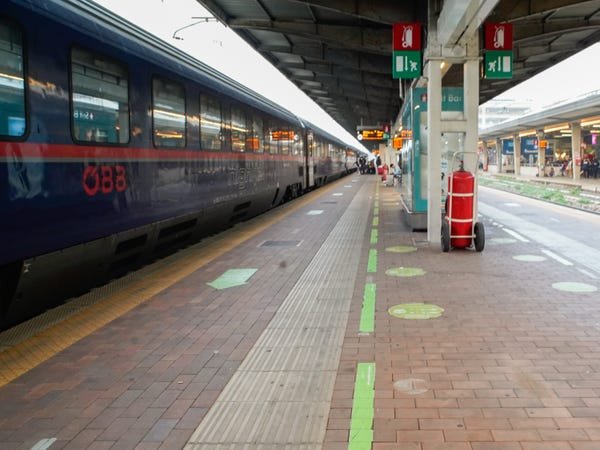
The OBB Nightjet train as it arrives in Venice in 2022.

Joey Hadden/Business Insider

OBB Nightjet — a rail line that operates overnight routes between Austria, Italy, France, and the Netherlands — can go as fast as 143 miles per hour.

Nightjet trains have regular assigned seats, couchette cars (seats that fold out into couches in shared cabins), and sleeper cars with bunks of four or six, which is what I booked. Some routes have private cabins, but mine didn’t.

This overnight leg of my European train trip, which came with breakfast, cost $44 with a Eurail pass. Without the pass, the ticket would have been about $84.


The author's Eurail pass on a European train.

The reporter’s Eurail pass on a European train.

Joey Hadden/Business Insider

To travel by train, I bought a Eurail pass for $477, which gives access to most European trains for a set number of days. Some trains require only a Eurail pass, while others, including overnight trains, incur an additional discounted fare.

My journey began in Austria’s Wien Meidling train station.


The station where the Nightjet took off from

Inside the Wien Meidling train station in Austria.

Joey Hadden/Business Insider

I arrived about an hour and a half before my 9:35 p.m. train so I’d have plenty of time to find the platform.

The departure screens said my train was going to Zurich. At the information desk, I learned that, unlike Amtrak, the train’s cars detach at various stations to go to different locations.


A train car on the Nightjet

Train car number two on the Nightjet.

Joey Hadden/Business Insider

I’d need to board my assigned train car; each has a number.

I paid $10 to wait for my train in OBB’s lounge.


Inside the OBB Lounge

Inside the OBB Nightjet lounge at Wien Meidling train station.

Joey Hadden/Business Insider

The lounge is free for OBB first-class passengers traveling during the day and costs about $10 for all other OBB passengers. Since I didn’t see any empty seats in the rest of the station, I paid for it.

I was surprised to find I was the only one inside the lounge since the rest of the station was full of people. There were plenty of tables and chairs available.

The lounge served complimentary refreshments and snacks, from coffee to nuts and seeds.


refreshments in the OBB lounge

Refreshments in the OBB Nightjet lounge at Wien Meidling train station.

Joey Hadden/Business Insider

It was a smaller selection than I’ve seen at Amtrak’s Metropolitan Lounge, which I’ve visited in New York, but I wasn’t hungry, so I just got a water bottle.

I went to the platform about 20 minutes before my train’s 9:35 p.m. departure.


Platform where the train takes off in Austria

The train platform the reporter used at Wien Meidling train station.

Joey Hadden/Business Insider

When the train arrived, I didn’t have time to check the car number before boarding. I just went to the closest car and asked an attendant for help.

Inside the sleeper cars, I saw narrow, dimly lit corridors full of small cabins with bunk beds.


The corridor inside the Nightjet train

A corridor inside an OBB Nightjet sleeper car.

Joey Hadden/Business Insider

An attendant led the way to my shared cabin.

My room had six bunks and a large window with a curtain. During my leg of the journey, one traveler was already there when I boarded, and two others arrived within an hour.


Inside the author's shared Nightjet cabin.

The reporter gets settled inside her shared cabin.

Joey Hadden/Business Insider

Two got off around 5 a.m., and the other stayed past my stop.

At 74 square feet, it felt like a tight space — especially with everyone’s luggage around. There was space for bags above the beds, but not enough for everyone.

I couldn’t imagine six people squeezing in there.

While my cabin was assigned, the beds were first-come, first-served.


A view of the top bunks from the train's bottom bunk

A view of the top bunks from the reporter’s bottom bunk.

Joey Hadden/Business Insider

Since I’ve experienced more bumps on higher bunks on Amtrak trains, I chose a bottom bunk.

The train provided bed sheets and a pillow.


Bunks inside the Nightjet train

Sheets for the beds inside the cabin.

Joey Hadden/Business Insider

Although they weren’t as soft and cozy as the sheets on Amtrak trains, they were better than nothing.

Temperature and shared lighting controls were above the curtained door to enter the room.


The curtains and controls in the Nightjet bunk

The door to the cabin with dials to control temperature and lighting above.

Joey Hadden/Business Insider

My fellow passengers and I agreed to turn off the lights once everyone was settled into bed.

There was an outlet and a tiny nightstand on the side of each bunk, as well as night lights above the bed. Without curtains around each bunk, I thought I had no privacy.


Lights and outlets on the Nightjet

Lights and outlets in the Nightjet cabin.

Joey Hadden/Business Insider

I longed for a way to close off my bunk for more personal space.

Other passengers in the room said hello to one another upon arrival, but otherwise, the room was quiet.


Inside the shared cabin.

Inside the shared cabin.

Joey Hadden/Business Insider

Some of us watched our devices, while others went right to sleep.

Before bed, I used one of the two bathrooms for everyone in my sleeper car. I thought it was a typical train bathroom with a toilet and a sink.


The bathroom inside the Nightjet train

A bathroom inside the sleeper car.

Joey Hadden/Business Insider

According to Nightjet’s website, only private sleeper cabins come with a shower.

When I was ready for bed, I watched TV before going to sleep. The bed was stiff and uncomfortable, in my opinion.


The author watches TV at night from her bunk.

The reporter’s view from her bed in the evening.

Joey Hadden/Business Insider

I woke up several times during the night to other travelers entering and exiting the room, or due to the bumpiness of the train.

An attendant woke me up with breakfast at 8 a.m., about 20 minutes before my stop in Venice. I got two rolls of bread with butter, jam, and coffee to eat in my bunk.


Morning breakfast on the Nightjet train

The reporter’s view with her breakfast in the morning.

Joey Hadden/Business Insider

There was no café car or common area on board for passengers.

When I got off the train in Venice, I was exhausted from the lack of sleep. I thought it made my first day in the city less enjoyable.


Outside of the Nightjet train as it arrives in Venice

The OBB Nightjet arrives in Venice.

Joey Hadden/Business Insider

“Offering our passengers a high level of travel comfort is an important concern for us,” a representative for OBB Nightjet told Business Insider. “We are constantly working on improvements to our product and also take into account the requirements of our customers.”

While sometimes it’s about the journey, not the destination, in this case, I’d rather arrive feeling refreshed so I can enjoy where I’m going. So, a year later, I booked a Nightjet private cabin to get from Venice to Vienna. That ride was far more comfortable, and I slept easily with no strangers in my cabin.


Source link

A woman in glasses wearing a blue dress standing in front of a bush.

I took my 5-year-old to the wrong birthday party. It taught me a lesson about the grace of strangers.

My son, Bobby, had always been a shy person. When he started kindergarten, I was hoping he’d make a lot more friends.

I was delighted when I saw an Evite in my inbox from a mom inviting him to a classmate’s 6th birthday party. The little boy’s name was Nathan.

The event took place at a retro slot-car raceway, where you raced tiny, electric-powered replicas of full-size cars on narrow tracks with “grooves,” known as “slots.”

Neither of us had been to one before, and we were excited to accept the invitation. I was also looking forward to finally meeting the other parents.

I didn’t buy a physical gift

I didn’t know anyone, partly because Bobby attended a school in a different suburb, about five miles from ours.

He took the bus, so my husband and I never did pick up or drop off. We worked in the city, so there was no waiting at the school gate and chatting with fellow moms and dads.

Nathan’s mother asked people to give half the money we’d have spent on gifts to an animal shelter. She’d use the other half to buy something big that he really wanted.

I ignored red flags

I was relieved that I didn’t have to go out of my way to purchase a present, so I donated $20 online.

As a result, Bobby and I arrived, empty-handed, at the slot-car venue at 11 am on a rainy Sunday morning. The hostess greeted us at the door.

“Is that Nathan?” I asked, pointing to the child I assumed was her son. The boy had a giant rosette on his sweater. “You mean, Oliver,” she replied. It was the first red flag that I ignored.

My son had a lot of fun

I’ve always been forgetful and apologized profusely. Bobby and I sat down by the racetrack and grabbed his remote control. A dad showed us how to work the cars.

Time went by, and Bobby had a lot of fun. He didn’t interact much with the other children, and they didn’t interact much with him either. I thought nothing of it because he was often withdrawn in busy settings.

I introduced myself to many of the parents. They talked animatedly in groups and clearly knew each other well. Still, they included me by asking me how Bobby liked the teacher.


A group of children at a slot-car racing track.

The author’s son, far left, thoroughly enjoyed himself at the party.

Courtesy of the author.


“Oh yes, he loves her,” I told one of the moms, mentioning the teacher’s name. She looked puzzled. It was another red flag, but I didn’t see it waving right in front of my face.

I spotted a large pile of presents on a table nearby. Wasn’t it odd, I thought, that so many guests bought gifts when Oliver’s mom had wanted us to make donations instead? Still, the penny didn’t drop.

It was time to cut the birthday cake. I helped hand out the slices. I wanted to leave a good impression. One mom said how nice it was of me. I joked that I was expecting a tip. She laughed politely.

Something was off

We left 15 minutes later. “Did you have a good time?” I asked Bobby. He nodded,

Fast forward a week, and I looked through my email and clicked on the Evite from Nathan’s mom. I intended to write down her number and see if her son would be interested in a playdate.

“Come to Nathan’s 6th birthday celebration,” the invitation said. I thought it was Oliver’s party. Something was off. I looked at the date. Nathan’s slot-car racing took place at 11 am the previous Saturday, not 11 am the previous Sunday. We missed his party by 24 hours.

Worse, we’d shown up at the wrong party. Most of the kids were much bigger than Bobby. Now I knew why.

We had crashed a party

I recalled the moment when Oliver cut his cake. I was fairly certain there were more than six candles on top.

No wonder there were so many presents on that table. No wonder the woman looked at me strangely when I mentioned the teacher’s name.

I cringed. What on earth had Oliver’s mom thought of me? I was the bonkers party crasher who showed up uninvited with their kid. I didn’t even bring a gift. What if the other parents gossiped about me and sniggered behind my back? It was mortifying.

My negative reaction shifted

After I called Nathan’s mom to apologize for missing his party, I took a breath and reflected on what had happened. It was actually quite amusing. My negative reaction shifted. Bobby thoroughly enjoyed himself, which was a promising outcome for someone so shy.

The hostess might have wondered who the heck I was, but she was too considerate to ask and embarrass me in front of people.

Everyone at the party had been warm, kind, and full of goodwill. It didn’t matter who I was. They welcomed me with open arms. Those strangers taught me a lesson in grace.


Source link

I-rang-in-2025-on-a-solo-trip-Now-Id.jpeg

I rang in 2025 on a solo trip. Now, I’d happily celebrate every New Year’s Eve abroad and surrounded by strangers.

As the crowd cheered among the explosive crackle of fireworks, upbeat dance music, and cries of Feliz Ano Novo,” a surge of gratitude coursed through my body.

It was New Year’s Eve 2024, and I was hugging and cheering with new friends I had met just hours before.

Earlier that year, I’d spent two months gallivanting around London, Berlin, Amsterdam, Rome, Florence, and Prague solo. Although I loved returning home to San Francisco, it didn’t take long for my wanderlust to set in again.

I knew my thirst for adventure could only be quenched by revisiting Europe. I missed the walkable cities, the slower lifestyle, and the abundance of fresh food.

I decided I’d spend mid-December to mid-January abroad. After doing tons of research on the best cities for solo travelers, I settled upon Lisbon as my monthlong home base.

To avoid the holiday rush and the inevitable spike in prices and crowds, I left San Francisco on December 7 and made plans to head home about a week after New Year’s Day.

Lisbon was the perfect early holiday destination — and I got to connect with other solo travelers


The writer posing in front of a Lisbon landscape.

I connected with other solo travelers who became my companions for New Year’s Eve.

Chelsia Durkee


The first two weeks of my trip were a dream come true.

I loved spending my afternoons checking out bookstores (Livraria Bertrand is worth it), getting lost in the alleyways, taking in the vibrant art scene, and even trekking up a grueling hill to get to my local market.

Since I arrived early in the month before peak tourist season, I felt like I was experiencing Christmas markets and festivities alongside locals.

As December 31 approached, I began to crave some more companionship. So, I logged onto Facebook and searched for Girl Gone International’s Lisbon group.

An online community for women traveling solo, Girl Gone International had resources I’d utilized in the past. This was my first time scrolling through one of its Facebook groups in search of friends, though.

To my surprise, I stumbled upon tons of posts from other solo travelers, all hoping to find New Year’s companions. One in particular caught my attention: a post that said “I’m getting the girls together for a New Year’s celebration” with a link to a WhatsApp group.

She had a dog in her profile photo. What could go wrong?

That’s how I found myself eating steak and sipping Douro Valley wine at a table with eight strangers.

We all came from different countries and backgrounds: the Netherlands, Serbia, and South Africa, to name a few. We quickly bonded over our shared love of travel and the palpable energy of the night.

After dinner, a few other travelers from the Facebook group joined us. We squeezed our way into the crowds to the Praça do Comércio, the main square in Lisbon. The square was packed like sardines, and we held hands so we wouldn’t lose each other.

One of them held up a sign to make sure stragglers could see us. Amid the excitement, I witnessed the most spectacular fireworks display of my life.

My solo New Year’s celebration helped me connect with my values


The crowds celebrating the New Year in Lisbon.

Celebrating the New Year in Portugal was a once-in-a-lifetime experience.

Chelsia Durkee


After that epic night, the real magic of serendipitous connection took place.

I stayed in touch with two solo travelers and one local for the remainder of my trip. We met several other times to explore restaurants, visit parks, and even take a day trip to see castles in Sintra.

I believe that starting the year in a new country — and with new friends — softened my approach to achieving my goals. In the past, I felt pressured to set certain resolutions: Become fit, work harder, or be a certain way.

Instead of focusing on external validation or achieving rigid goals, though, I started the year with a focus on what actually brings me joy: adventure, global community, and authenticity.

I made new friends, too. Our short-lived connections empowered us to become vulnerable quickly, and I opened up in a refreshing way.

Ironically, it took leaving my country to remember that I am never truly alone.

Though this year’s New Year’s Eve will look a little different — I plan to spend the night locally with friends and family — I would happily ring in the New Year again with strangers in a foreign country.

No matter where I find myself in the world, I’m excited to continue bridging the gap between stranger and friend.


Source link

An-88-year-old-worked-5-days-a-week-at-a-supermarket.jpeg

An 88-year-old worked 5 days a week at a supermarket. Then strangers raised almost $2 million so he could finally retire.

Before December, Ed Bambas was among the sizable swath of older Americans still working with retirement nowhere in sight. Then, he met content creator Samuel Weidenhofer.

Weidenhofer, who has 12 million followers across social media, set up a GoFundMe fundraiser for Bambas on Monday to help him leave his job at a Detroit supermarket and retire.

“I’m opening a fundraiser to help Ed live the life he deserves to finally give him some relief, comfort and the peace of mind that comes from knowing he can enjoy his later years without constant struggle,” Weidenhofer wrote on GoFundMe.

The fundraiser had a $1 million goal. As of Sunday, over 65,000 people have donated, reaching a total of almost $2 million.

In a video shared to Weidenhofer’s social media accounts, Bambas said he’s an 88-year-old veteran who works at the supermarket five days a week, eight hours a day. Bambas said he retired from General Motors in 1999, but lost his pension after the company went bankrupt in 2009.

Bambas told Weidenhofer that his wife, who died seven years ago, had been sick around the time his pension stopped. Without his pension, Bambas had to re-enter the workforce.

Nearly 550,000 Americans 80 and older are still working, according to 2023 US Census data.

As part of Business Insider’s “80 over 80” series, reporters interviewed nearly 200 workers over 80 — in addition to conducting surveys and receiving emails — in an effort to understand why.

While some older Americans are driven by a personal desire to work, others take on jobs to combat financial insecurity. Some workers over 80 told Business Insider that they use their income to supplement their Social Security and other retirement payments. They fear that without the income, they can’t afford the cost of living.

Weidenhofer shared a video of Bambas receiving his GoFundMe check on Friday.

“It’s something dreams are made of,” Bambas said in the video.

Bambas also thanked everyone who donated to the fundraiser.

“I cannot express in any words how thankful I am to all the people,” he said.


Source link