
Jack Newsham's face on a gray background.

Polymarket let people bet on when Iran would strike Israel. A journalist who covered the war got death threats.

An Israeli journalist said Polymarket users tried to bribe him and threatened to kill him after he reported that an Iranian missile had struck Israel earlier this month.

Polymarket later condemned the harassment and said the conduct violated its rules.

“We’ve banned the accounts for all involved & will pass their info to the relevant authorities,” the company wrote on X.

Emanuel Fabian, a military correspondent for The Times of Israel, wrote this week that the harassment began with emails pressing him to revise a blog post saying a missile hit an area roughly 500 meters from homes in Beit Shemesh, a small city in central Israel.

The initial outreach, written in Hebrew, was polite, Fabian wrote. “Regarding your Times of Israel report that described today’s launch as an ‘impact’ — Beit Shemesh Municipality and MDA (Magen David Adom) later corrected their reports to clarify that what fell was an interceptor fragment, not a full missile,” the first email said, referring to an Israeli emergency-response service.

Follow-up messages from others were more insistent. “I have an urgent request regarding the accuracy of your report on the missile attack on March 10. I would really appreciate a response if possible,” read one.

Fabian wrote that he stood by the reporting, citing Israeli military information and video of a large explosion that, in his view, was inconsistent with interceptor debris.

What followed, he said, was a pressure campaign that spilled across email, X, Discord, WhatsApp, and backchannel outreach through another journalist.

Fabian described repeated requests to change the wording of his report, which he believed was intended to influence the resolution of a Polymarket market tied to whether Iran struck Israel on that date. He said some messages — which didn’t explicitly mention Polymarket, but came from Polymarket users or seemed bizarrely hung up on his blog post — escalated into explicit threats.

“If you do not correct this by 01:00 Israel time today, March 15, you are bringing upon yourself damage you have never imagined you would suffer,” read one.

Fabian wrote that he went to the police and provided evidence.

Polymarklet didn’t answer questions from the Times of Israel about the details of the investigation. Representatives for Polymarket didn’t immediately respond to Business Insider’s request for comment.

Advocates for prediction markets have said they encourage honesty by requiring users to put their money where their mouth is. Shayne Coplan, Polymarket’s founder, has said that people in the Middle East can use military-strike markets to decide whether they want to sleep near a bomb shelter.

The nitty-gritty details of contracts and how they are resolved can lead to contentious arguments. People on Polymarket who wagered on whether Iran would strike Israel by March 10 still haven’t gotten paid, as the contract appears to remain in dispute. Polymarket, which is legally based in Panama, uses a complex, crypto-based process to resolve disagreements.

Fabian isn’t the first person to say they were targeted by prediction market users. The NCAA has cited concerns with prediction markets, reporting that 36% of Division I men’s basketball players said they had been harassed by “someone with a betting interest.”

In January, the organization called for a pause on college sports-related betting prediction market betting until the Commodity Futures Trading Commission, which regulates the platforms, “implements appropriate regulations.”

Polymarket was valued at $9 billion last year and is seeking a $20 billion valuation in talks with investors, The Wall Street Journal reported earlier this month. The company and its competitor, Kalshi, have poured millions of dollars into marketing online, on TV, and in real life, even giving people free groceries in New York City.

The largest chunk of activity on both platforms is betting on sports in a manner that competes with companies like DraftKings, BetMGM, and other traditional sportsbooks. The second-biggest category is speculating on cryptocurrency prices.

Business Insider has previously reported that Polymarket has drawn scrutiny from US lawmakers over concerns about manipulation, insider trading, and the difficulty of investigating crypto-based bets.

Sen. Chris Murphy and Rep. Greg Casar announced Tuesday that they will introduce the “Bets Off Act,” which would ban certain prediction market trades, including terrorism, war, and assassinations.

The attacks on Iran are only one of several geopolitical flashpoints that have been accompanied by concern about the prospect of people with insider information cashing in. One Polymarket user made several hundred thousand dollars correctly betting on the US operation to remove Venezuela’s leader, Nicolas Maduro.



Source link

F-15E-Strike-Eagles-deployed-during-Operation-Epic-Fury-can-fly.jpeg

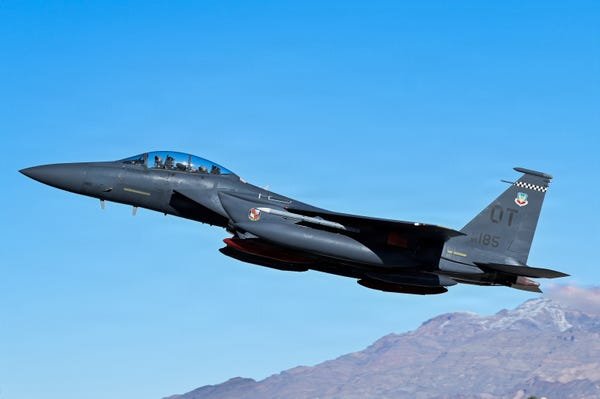
F-15E Strike Eagles, deployed during Operation Epic Fury, can fly 2.5 times the speed of sound. Take a closer look.

  • The US Air Force deployed F-15E Strike Eagles during Operation Epic Fury against Iran.
  • The fighter jets are designed for air-to-air and air-to-ground combat in all weather, day or night.
  • Kuwait mistakenly shot down three F-15E Strike Eagles in a “friendly fire” incident, CENTCOM said.

F-15E Strike Eagles, fighter jets designed for air-to-air and air-to-ground combat, are usually a dominating force in the skies.

When three F-15E Strike Eagles were mistakenly shot down by Kuwait during Operation Epic Fury, it brought renewed attention to one of the Air Force’s fastest, most versatile aircraft.

Here’s a closer look at the F-15E Strike Eagle, an advanced aircraft the US is using to destroy Iran’s missile arsenal and drone bases from the skies above Iran.

The F-15E Strike Eagle has been in service in the US Air Force for nearly 40 years.

An F-15E Strike Eagle at Nellis Air Force Base in Nevada. 

U.S. Air Force photo by Airman 1st Class Jasmine Thomas

The first F-15A model flew in 1972, and the first F-15Es were produced in 1988, according to the US Air Force.

It’s the fastest crewed aircraft in the US Air Force.


An F-15E Strike Eagle flies through the sky.

An F-15E Strike Eagle during an exercise at Gando Air Base in Gran Canaria, Spain. 

U.S. Air Force photo by Staff Sgt. Elizabeth Davis

The air-to-air and air-to-ground attack aircraft can fly at 1,875 miles per hour, or 2.5 times the speed of sound.

The F-15E Strike Eagle’s high thrust-to-weight ratio enables it to accelerate during vertical climb.


An F-15E Strike Eagle.

An F-15E Strike Eagle in flight. 

U.S. Air Force photo by Staff Sgt. Tylin Rust

The high thrust-to-weight ratio also allows the F-15E Strike Eagle to execute tight turns without sacrificing speed. It has two Pratt & Whitney F100 engines, each producing over 23,000 pounds of thrust.

Another distinguishing capability is the plane’s head-up display, which projects flight and tactical information directly on the windscreen.


The head-up display on a C-17 Globemaster III.

The head-up display on a C-17 aircraft. 

U.S. Air National Guard photo by Tech. Sgt. John Linzmeier

Pilots can track and attack targets, check the status of weapons, and see other tactical and flight information without taking their eyes off the windscreen.

The fighter jet also includes a low-altitude navigation and targeting infrared for night (LANTIRN) system.


The underside of an F-15E Strike Eagle.

The underside of an F-15E Strike Eagle. 

U.S. Air Force Photo by Airman 1st Class Olivia Gibson

The LANTIRN system allows the planes to fly in any weather and attack ground targets at low altitudes. The system consists of two pods, a navigation pod and a targeting pod, mounted under the plane.

F-15E Strike Eagles can carry both nuclear and conventional weapons.


Loading an AIM-120 missile onto an F-15E Strike Eagle

US Air Force crew members load an AIM-120 missile onto an F-15E Strike Eagle aircraft at Mountain Home Air Force Base in Idaho. 

Airman 1st Class Donovin Watson/366th Fighter Wing

Its armament includes an internally mounted 20-millimeter gun with 500 rounds of ammunition, AIM-9 Sidewinder missiles, and AIM-120 AMRAAMs, an acronym for the radar-guided Advanced Medium-Range Air-to-Air Missiles.

The F-15 also regularly carries ground attack weapons like the Joint Direct Attack Munition, or JDAM, a kit that adapts an unguided munition into a “smart” bomb with fins and GPS guidance.

F-15E Strike Eagles are flown by a pilot and a weapons systems officer.


The cockpit of an F-15E Strike Eagle.

The cockpit of an F-15E Strike Eagle. 

U.S. Air Force photo by Airman 1st Class Aidan Martínez Rosiere

The weapon system officer sits directly behind the pilot, and closely manages the plane’s sensors and weapons.

Two variants of the F-15 are single-seaters: the F-15A and F-15C.

The planes can fly 2,400 miles without refueling, and can be refueled in flight.


An F-15E Strike Eagle receives in-flight refueling from a KC-135 Stratotanker.

An F-15E Strike Eagle receives in-flight refueling from a KC-135 Stratotanker during an exercise over the Atlantic Ocean. 

U.S. Air Force photo by Senior Airman Cody J. A. Mott

F-15E Strike Eagles have a fuel capacity of 35,550 pounds.

The fighter jets can be refueled in flight by KC-135 Stratotanker aircraft, which Boeing developed from its “Dash 80” prototype in the 1950s.

KC-135s were also deployed to Israel as part of Operation Epic Fury. One crashed in western Iraq on Thursday, killing six US service members. United States Central Command said the circumstances of the crash were under investigation, but it “was not due to hostile fire or friendly fire.”

Each F-15E cost $31.1 million to produce in 1998, according to US Air Force figures. That would be around $62.3 million when adjusted for inflation.


F-15E Strike Eagles at Travis Air Force Base in California.

F-15E Strike Eagles parked at Travis Air Force Base in California. 

U.S. Air Force photo by Kenneth Abbate

Newer F-15 models cost around $100 million, The Wall Street Journal reported.

The newest version of the aircraft is the F-15EX Eagle II, which features more advanced controls and upgraded engines.

On March 1, Kuwait’s air defenses mistakenly shot down three American F-15Es during Operation Epic Fury in what US Central Command described as a “friendly fire incident.”


F-15E Strike Eagles in the Middle East.

F-15E Strike Eagles at an undisclosed base in the Middle East. 

U.S. Air Force photo by Senior Airman Jared Brewer

All six crew members ejected safely. The incident is under investigation.

“Kuwait has acknowledged this incident, and we are grateful for the efforts of the Kuwaiti defense forces and their support in this ongoing operation,” CENTCOM said.


Source link

Photos-show-damage-to-Dubai-luxury-tourist-hotspot-after-Iranian.jpeg

Photos show damage to Dubai luxury tourist hotspot after Iranian strike

  • The US and Israel launched Operation Epic Fury against Iran on Saturday.
  • Iran’s retaliation involved strikes across six Gulf nations.
  • Photos taken during and after the strikes showed damage to a luxury hotel in Dubai and other spots.

The attacks launched by the US and Israel on Iran escalated on Saturday, with retaliatory strikes hitting nations across the Gulf.

Hours into what the Trump administration is calling Operation Epic Fury, Iran responded with attacks on more than six countries, from Dubai to Bahrain. Iran said it targeted bases that host US forces in the Middle East.

Satellite pictures also show extensive damage to Iranian Supreme Leader Khamenei’s residence. Khamenei was killed on Saturday, though it is still unclear if he was at the Tehran compound when it was struck.

Intercepted missiles were seen streaking across the sky in Dubai, a tourist hotspot, and their debris appeared to spark fires and other issues. Fairmont’s famous luxury property on the Palm was hit.

Chaos was also abound at airports, amid mass flight cancellations as planes scrambled to clear the airspace over Iran.


Source link

Matthew Loh Headshot

Ukraine says its own Flamingo missiles flew nearly 900 miles to strike Russian Iskander factory

Ukrainian President Volodymyr Zelenskyy said on Wednesday that his country had struck a Russian military industrial plant with locally made cruise missiles that flew nearly 900 miles to reach their target.

Ukrainian officials earlier reported that the missile strike on Saturday had hit a plant in Votkinsk, an industrial town in Russia’s Udmurt Republic, some 860 miles from the Ukrainian border.

“We carried out precise strikes with Flamingo missiles at a range of 1,400 kilometers,” Zelenskyy said at a press conference in Kyiv. “I believe this is truly a success for our industry.”

Such an attack would be one of the longest-range strikes carried out so far by the Flamingo, which is touted as one of the star products in Ukraine’s local defense manufacturing scene. Kyiv has been aggressively trying to expand its weapons industry as a complement to Western supplies and as a future export sector.

The Flamingos’ target, the Votkinsk plant, manufactures some of Russia’s key munitions, such as ballistic missiles for the Iskander system and the submarine-launched Bulava missile.

Russia has not officially confirmed that the factory was hit, but Alexander Brechalov, the governor of the Udmurt Republic, said on Saturday that an unspecified facility in the region had been attacked and three people were sent to hospital.

Brechalov did not say if the Flamingo was used, but warned against drone threats over the region.

Ukrainian open-source groups later published satellite images that appeared to show damage to one of the workshops at the Votkinsk factory, with a gaping hole in its roof and signs of fire damage.

That evening, Kyiv had unleashed a large wave of drones and missiles into Russia in one of its biggest ever long-range attacks.

Russia’s defense ministry said that it shot down 77 Ukrainian drones on Saturday, but did not mention any Ukrainian missile threats.

Zelenskyy declined to say how many missiles or drones Ukraine launched in total on Saturday.

“There were interceptions by Russian air defense, there were also missiles that were not intercepted, and there were direct hits,” Zelenskyy said. “But the most important thing is that all the missiles that were launched all reached the target.”

Kyiv has often compared the Flamingo to the US-manufactured Tomahawk, saying that the Ukrainian turbofan-powered missile is much cheaper to make per unit and has a longer range of 1,900 miles.

The ground-launched Flamingo, however, takes up to 40 minutes to prepare for launch.

Ukraine is also still trying to build up its arsenal of the missile, with reports from last October saying that its manufacturer, FirePoint, hoped to produce up to seven a day by the end of 2025.

Kyiv said earlier this month that manufacturing had been affected by a recent Russian strike, with Zelenskyy warning that Ukraine had to “work on increasing quantity” of the Flamingo.

“We had certain technical problems because one large production line was destroyed as a result of a missile strike. They have already relocated and resumed production,” Zelenskyy had said at the time.


Source link

Headshot of Ben Shimkus

Skeptical of the ‘SaaSpocalypse’? Bill Gurley says you should channel your inner Warren Buffett and strike

Bill Gurley has some suggestions on how you might invest in the so-called SaaSpocalypse if you believe the companies still have value.

Software-as-a-Service stocks have stumbled to start 2026. Investors worry that new AI generative tools — particularly Claude Code’s latest app-building update — could become direct competitors with legacy SaaS giants like Salesforce, Atlassian, and DocuSign.

Appearing on CNBC’s Squawk Box, Gurley, the longtime Benchmark general partner, acknowledged the concerns and compared it to another disruptive moment in tech.

“Right after Facebook went public, there was a concern about this mobile transition, and their stock went from $42 to like $18. That was fear of a technology disruption,” he said.

Still, Gurley emphasized that today’s SaaS fears feel unusually widespread.

“I’ve never seen a disruption that had this much anxiety and go across so many companies,” he said.

Yet he noted that even AI-native companies aren’t abandoning traditional software vendors. Anthropic, which makes the Claude chatbot, uses tools from Workday and Salesforce, he said.

“They’re paying for these things,” he said.

If the stocks continue to fall, Gurley suggested that investors who believe in the SaaS companies channel Warren Buffett, who has long argued that moments of panic are the perfect time to buy.

“You shouldn’t be blogging about what’s wrong with the prices,” he said. “You should be quiet and picking them up off the floor.”

He’s worried about circular investment


A person walks on a pathway toward AMD's glass-filled offices. There is a gray sign outside that says the company's name

AMD and Meta just announced a deal on Tuesday morning. Gurley said he is worried about the deal’s structure.

Justin Sullivan/Getty Images


Gurley expressed concern about the increasing circularity of deals between AI companies and the firms building their massive physical infrastructure.

“This is a little bit odd that we got started this way from the very beginning,” he said, referring to early transactions between Microsoft and OpenAI that involved cloud credits flowing back into Microsoft’s Azure business.

There’s a fresh example of intertwined AI and infrastructure agreements on Tuesday morning: Meta and Advanced Micro Devices announced a deal in which Meta would buy six gigawatts of computing power from the chipmaker.

The arrangement could also result in Meta owning up to 10% of AMD’s stock.

Gurley said he once described similar AI and infrastructure deal structures to ChatGPT without naming the companies involved.

“It spit out words like Enron and WorldCom,” he said. “All I did was describe the structure of the deals. I didn’t say which companies they were.”

Gurley said he doesn’t think regulators will step in to fix the circularity issue.

“When it comes undone — and it will come undone one day for reasons we can talk about — I think people are going to point these things and say they shouldn’t have existed,” he said.

AI as ‘jet fuel’

For workers worried about AI’s impact on their jobs, Gurley was far more optimistic.

He called AI “jet fuel” for people passionate about their work (something he has also said on X), and argued that the tools can dramatically accelerate skills and productivity.

“You can learn faster than you could have ever learned at any point in history right now,” he said. “You can fire this thing up and get it on your side.”

Even in an era of sweeping technological disruption, Gurley said he wouldn’t choose a different path if he had to start all over again.

“If we lived in a society where all jobs paid the same, I would have still done venture capital,” he said. “I just had so much fun being a part of it.”

Gurley didn’t respond to a request for comment from Business Insider.


Source link

Aditi Bharade

Medium says employees can join Friday’s strike against ICE

Online publisher Medium has told its employees that they are free to take Friday off to participate in a nationwide immigration strike.

Medium’s CEO, Tony Stubblebine, said in a series of messages in the company’s general Slack channel that he had “started the week in my own head and heart” over the situation in Minneapolis. Protests have broken out in the state after the fatal shootings of Renee Good and Alex Pretti.

“But also it gives me hope to see people across the country stand up and push back,” he said in the messages, which he cross-posted on Threads on Thursday. He added that he wanted to support his employees’ participation in the Friday strike.

Stubblebine did not mandate his staff to attend the strike or take time off from work, saying they were free to take as much time off on Friday as they wished. Medium is a publishing company based in San Francisco.

“Sometimes it feels awkward to navigate being both on-mission and on-money,” he wrote, but added, “our business thrives when the country thrives.”

Stubblebine said that, in addition to letting his employees attend the strike, Medium would publish strike-related content in its newsletter on Friday, such as “Survival Guide To Police Encounters During Protests in Staff Picks.”

Activists, unions, and some celebrities have called for a nationwide strike on Friday to protest the shootings. They are encouraging Americans to have a blackout day on January 30, with no work, no school, and no shopping.

The strike calls for the removal of ICE officers from cities nationwide. Celebrities like Pedro Pascal, Hannah Einbinder, Ariana Grande, and Jamie Lee Curtis have shared information about the strike on their social media accounts.

Other executives have also spoken out against ICE. A group of more than 60 executives of Minnesota-based companies, including Target, Cargill, and General Mills, called for peace and de-escalation in an open letter on Sunday.


Source link