A-British-citizen-in-Dubai-says-he-still-feels-safe.jpeg

A British citizen in Dubai says he still feels safe despite the Iran strikes

This is an as-told-to essay based on a conversation with Charlie Lovett, a British citizen in Dubai who runs a used-car marketplace. Iran has launched retaliatory strikes at sites in the United Arab Emirates after being attacked by the US and Israel. This story has been edited for length and clarity.

I have British parents and am a British citizen, but a large chunk of my life has been spent here in Dubai.

My dad’s job brought us here, so I did all my schooling here from age 3 to 18. I moved back to London for university and worked there for a few years. In the last couple years, I set up a business in the UAE, so I am back here quite a lot.

It was very surreal when everything started on Saturday.

I had some friends around, and we knew what was happening in Iran, but I didn’t think much about canceling or changing plans, which is a testament to how safe I felt here. I live in a high-rise on the Palm Jumeirah and was sitting on my balcony when I could hear a few bangs in the area.

Initially, it was quite scary and very unsettling, but very quickly, I turned to government sources about what was going on. If you live here or have lived here for a long time, you understand that it is a safe place to live and that measures are in place to protect you. There’s been a big difference in reactions between people who live here and people who are visiting.

Growing up in Dubai instilled a strong sense of safety

Before the other day, I had never heard a missile here.

Still, having grown up here, I have a deep-rooted, subconscious sense of safety that has built over time.

There is a lot of trust here within the community and in the government. Half the time, we don’t even lock our doors. The other day, I went for a run and didn’t want to carry my car keys, so I just left them in the car. You don’t have to worry about these things here. It’s the small things you notice growing up here, as a kid, being able to play outside for hours without a parent.

You also get an understanding of how the government operates. It’s very structured and organized. You feel like you’re in safe hands. For instance, during COVID, everything was handled very well.

There are protocols in place, and people here are really good at following them. If you’re told not to go into the office, for example, people don’t really kick up a fuss about that. They just crack on.

On all the official government channels, you can see almost a live breakdown of everything that’s happening and an explanation as to what’s going on — like that the sounds aren’t necessarily missiles landing, they’re just being intercepted. The government also sent out iPhone notifications, all translated into both English and Arabic.

Right now, for people who live here, I think the consensus is it’s just business as usual. Everyone’s quite calm.

It already feels normal again. There’s the occasional loud sound, but that’s mostly subsided in the last few days. There’s a mall right next to me where I work and shop, and it’s been packed. There are people out and doing things and just going about their day. I was just out for dinner with my dad.

There’s a lot of conflicting information going around

If you’re not from here or if you’re here on holiday, I get that it would be very different. You’re in an unfamiliar environment, you don’t know how things work, and you don’t necessarily have family or friends around.

I also think some people may be scrolling online or seeing rumors, rather than following the official channels. I think there’s been a lot of mixed reporting, which can also confuse things.

I’ve got family and friends in the UK, and my girlfriend’s there at the moment, so they’re seeing what’s being reported in British media and what’s surfacing online. So there’s this huge discrepancy in what’s actually happening and what’s being shared in certain places.

I got here just over two weeks ago. I’m trying to leave, not because I’m evacuating, but because I’m trying to make it to the Barcelona marathon. It’s just a matter of finding a flight that’ll get me there in time. Afterward, I’ll return here when I can.

For people who live here — about 90% of whom are expats — the thought of this happening wasn’t even in our minds until last week. But even then, it has not shifted our perspective. A lot of people feel more comfortable staying here than they would going back to their home countries.



Source link

Amazon-says-3-data-centers-damaged-by-drone-strikes-in.jpeg

Amazon says 3 data centers damaged by drone strikes in Middle East

Amazon said three of its data centers in the Middle East were damaged by drone strikes due to the US-Iran conflict in the region.

Two facilities in the United Arab Emirates sustained direct hits, while a third facility in Bahrain was damaged by a drone strike “in close proximity,” the company said in an update on its AWS cloud service dashboard on Monday afternoon.

“These strikes have caused structural damage, disrupted power delivery to our infrastructure, and in some cases required fire suppression activities that resulted in additional water damage. We are working closely with local authorities and prioritizing the safety of our personnel throughout our recovery efforts,” the company added in the update.

Have a tip? Contact this reporter via email at ekim@businessinsider.com or Signal, Telegram, or WhatsApp at 650-942-3061. Use a personal email address, a nonwork WiFi network, and a nonwork device; here’s our guide to sharing information securely.


Source link

I-flew-to-Dubai-for-my-30th-birthday-Now-Im.jpeg

I flew to Dubai for my 30th birthday. Now I’m stranded 8,000 miles from home and terrified after the US strikes on Iran.

This as-told-to essay is based on a conversation with Shanice Day, a 30-year-old stylist based in Houston, who is stuck in Dubai after traveling there to celebrate her birthday with a friend. It’s been edited for length and clarity.

I came to Dubai with one of my best friends. We left Texas on February 23 and arrived in Dubai early on the 24th, the day of my 30th birthday.

The hotel staff gave me a cake, roses, and drinks. They even sang “Happy Birthday.” It was wonderful. Every time I told someone it was my birthday, they made me feel special.

February 28 was meant to be the last full day of my birthday trip to Dubai. That was when the Iranian strikes started. Since then, we’ve been trying to get back to the US, but we’ve hit so many roadblocks.

I planned my birthday trip to Dubai about 5 months ago

I had planned this trip for my best friend and me about five months ago. We usually travel everywhere together. We decided that this time, Dubai would be a good place to go for such a big birthday. I’d always wanted to visit the Middle East.

At the start of our trip, we did a lot of cultural things. We visited a mosque, the Miracle Garden, and the beaches. We really indulged ourselves and tried so many different kinds of food.

Dubai is a beautiful city. Everyone here is very kind, and in my first few days, I felt the safest I’d ever felt. I never expected anything like this would happen here.

The final day of my trip

On Saturday, the 28th, I was shopping at the Dubai Mall. My best friend stayed behind to go to the beach at our resort.

When I went into a store, I asked the clerk if I could come back before my flight. He told me I might not be able to, and I didn’t understand why. I checked my phone and immediately saw that the US and Israel had struck Iran. My best friend called me and told me that I needed to get back to the resort.

I was shaken up by the strike in Dubai

We’re staying at a five-star hotel in the Jumeirah Beach Residence area. It’s not too far from the Fairmont The Palm, which caught on fire during an Iranian air attack on Saturday night. I didn’t see the smoke, but I heard the sounds from the air-defense systems.

In the US, we don’t hear things like that. It really shook me up. A lot. It felt like an out-of-body experience.

Sunday in Dubai felt very eerie. On Monday, we went out just to get a bite to eat, but the energy still felt off. I think people are trying to make the best of the situation, but the mood has shifted.

We broke down in tears when our flights from Dubai were canceled

Our flight was meant to depart on March 1 at 5.30. The night before, we were notified that it had been canceled. We broke down in tears. We’re 8,000 miles away from our family and friends. We don’t know when this will be over. We didn’t know how we were going to get out.

We immediately started looking for any way out. When we realized we couldn’t find one, our hearts broke. We were devastated and scared. I’m very spiritual, so we both started to pray.

My friends and family back in Texas are concerned about us. I had to tell my immediate family that I don’t know when we’ll make it home.

I feel traumatized and am hesitant to travel overseas right now

I’m trying to see the positive now: We’re still in Dubai, and we’re still safe. Our hotel has taken precautions to make us feel at home, but it’s still very traumatic.

I’ve been traveling since I was 14. I love experiencing different cultures, but this has been overwhelming. I’d say that traveling overseas will not be at the top of my priority list after this.

I’ll probably get therapy after this experience. I know it’s going to take me a while to build up the courage to travel again.

All I want is to get home to my dog, my cat, my mom, and my friends, and honestly, I even miss my job as a personal stylist.

I love Dubai, but I want to be home and at ease

My friend, who is watching my cat and dog while we’re away, FaceTimed me with my pets. I got to see my babies. I just want to see them again. I just want to feel normal again.

I’m not at ease, and I don’t think I will be until I cuddle up with my animals again.

But despite all this, I still love Dubai.

Do you have a story to share about leaving or trying to leave the United Arab Emirates? Contact this reporter at jzitser@businessinsider.com.


Source link

Satellite-photos-capture-devastation-at-Iranian-Supreme-Leader-Khameneis-residence.jpeg

Satellite photos capture devastation at Iranian Supreme Leader Khamenei’s residence after US and Israeli strikes

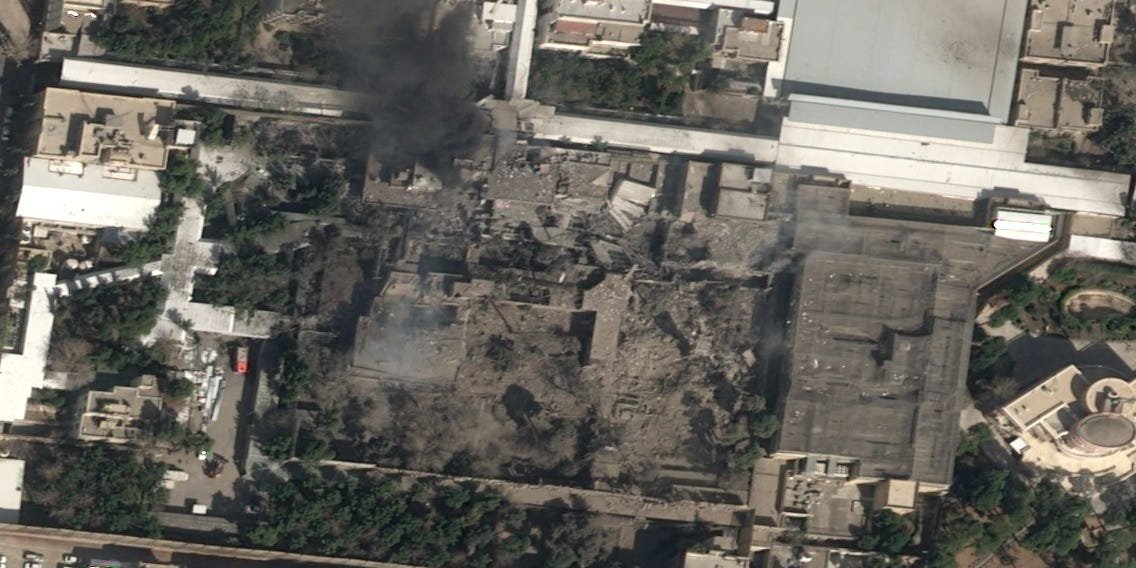
Satellite images captured after Saturday’s US and Israeli strikes on Tehran show that the residence of Iran’s supreme leader, Ayatollah Ali Khamenei, sustained severe damage.

The photos, provided to Business Insider by Airbus, show several collapsed buildings inside a compound in Tehran, which is known to be one of Khamenei’s main residences.

It’s unclear if the Iranian leader was present at the time of the strikes, though the US, Israel, and Iran all said that he was killed on Saturday.

It’s also not yet clear if it was Israel or the US that carried out this particular strike. Representatives for the Pentagon and Israel Defense Forces declined to comment on the hit when asked by Business Insider.


The burning roofs of several buildings can be seen in this satellite image over Tehran.

A cropped photo of the Leadership House in Tehran after the Saturday strikes.

Pléiades Neo (c) Airbus DS 2026


One of the heavily damaged buildings in the compound, at the bottom left of the image, is the House of Leadership, which is known as Khamenei’s office and principal place of residence.

In the images, smoke appears to be rising from its roof. Much of the compound has been obliterated, with felled trees and several more smoking buildings.

The large structure to the right of the compound is the Imam Khomeini Hussainia, a place of worship used by Iranian leaders for religious ceremonies and political speeches.

It’s unclear whether this larger building was also attacked, but what looks like debris can be seen on its roof.

A satellite image taken a year earlier shows the complex included at least six buildings, all of which are now damaged by the strikes.


An image taken in February 2025 shows an overhead view of the Leadership House.

This image from February 28, 2025, shows the complex a year before the strike.

Screenshot/Google Earth


A wider-angle view from another satellite image taken on Saturday appears to show that the strike was largely confined to Khamenei’s compound, which is located in the heart of the Iranian capital.


Ruined buildings can be seen in this wider shot of Khamenei's compound in Tehran.

Smoke rises from Khamenei’s residence in a wider shot of the compound.

Pléiades Neo (c) Airbus DS 2026


The compound’s neighboring buildings appear to be intact.


A wider shot of the Tehran neighborhood shows the Leadership House complex last year.

This Google Earth image was taken on February 28 in 2025.

Screenshot/Google Earth


In a video address after the attacks began, President Donald Trump told Iranians to “take over your government.”

“It will be yours to take. This will be, probably, your only chance for generations,” Trump said.

The US and Israel began their attacks on Saturday morning local time, hitting Tehran and several other Iranian cities in what has been one of the largest strike campaigns in recent years.

The full outcomes of these strikes are still being assessed, and much remains unclear about Tel Aviv and Washington’s exact objectives behind the attacks.

Meanwhile, Iran has responded by firing dozens of ballistic missiles and drones at its neighbors, saying it is targeting US military bases.

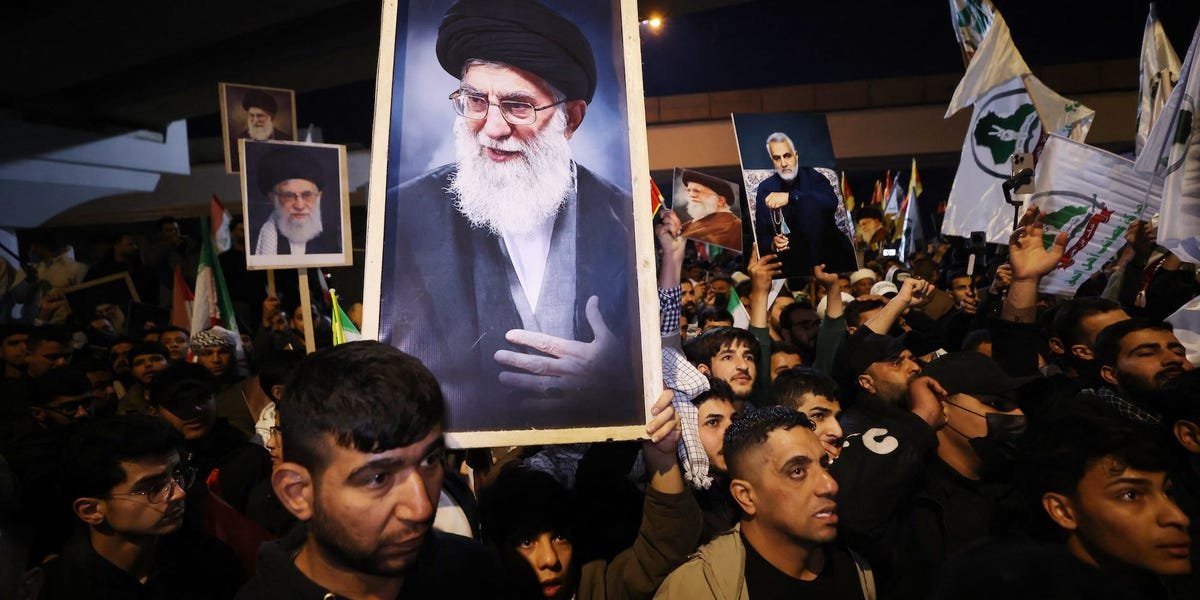
Khamenei had been in power in Iran for almost 40 years as a powerful religious leader in Shia Islam, becoming the country’s ultimate authority in government and the military.

It remains to be seen how his death will impact the fate of Iran’s military, society, and government structure.

February 28, 2026: This story was updated to reflect the death of Khamenei, as confirmed by the US, Israel, and Iran.


Source link

Air-travel-has-been-thrown-into-chaos-with-cancellations-diversions.jpeg

Air travel has been thrown into chaos with cancellations, diversions, and airspace closures after strikes on Iran

Some of the world’s most congested airspace has been disrupted by the US and Israel’s strikes on Iran.

Iran, Iraq, Kuwait, Bahrain, and Qatar have all closed their airspaces. Dubai International Airport, the world’s busiest airport for international traffic, has suspended all flights until further notice.

A video shared by Flightradar24 showed airplanes deserting the region on Saturday morning.

Data from the aviation analytics firm Cirium shows that about 970 of the roughly 3,400 scheduled flights to the region have been canceled as of 11:00 p.m. Central European time. Factoring in outbound cancellations, that number is closer to 1,900.

The three major Middle Eastern airlines — Qatar Airways, Etihad Airways, and Emirates — operate major hubs that connect passengers to destinations around the world, creating a massive ripple effect of disruptions.

Qatar canceled nearly 60% of its flights on Saturday, Emirates canceled 65%, and Etihad canceled 50%, per Cirium. They’ve pre-emptively canceled hundreds more on Sunday.

Dubai International Airport — the world’s busiest megahub for international traffic — was damaged by an apparent missile strike on Sunday morning, local time. It’s unclear how that could further impact operations even if the airspace opens back up.

A Cirium spokesperson said these carriers collectively carry 90,000 transiting passengers through their hubs daily — not including those destined for the Middle East.

Major airline disruption

Even for flights that don’t land in the region, it’s a key corridor for flying between Europe and Asia. Some flights appeared to re-route over Saudi Arabia. Other airlines were avoiding the region altogether.

Detours are costly for airlines: They have to pay for extra fuel, labor, and any associated passenger compensation. And it’s possible mass diversions could overwhelm certain airports.

In a post on X, Emirates said it was temporarily suspending all flights to and from Dubai, its home base. That’s equal to about 500 flights a day, according to Cirium.

Emirates urged customers to check their flight statuses before visiting the airport. “We are actively monitoring the situation and engaging with relevant authorities,” the airline added.

Qatar Airways said all flights to and from the country were suspended until at least midnight UTC, or 7 p.m. ET. It also expects delays when usual operations resume.

Doha’s Hamad International Airport advised passengers “not to proceed to the airport.” Additional staff were deployed there to help passengers affected by the disruption, the airline said.

Etihad Airways, which is based in Abu Dhabi, said all departures and arrivals to the city were suspended until 2 p.m. local time Sunday.

Kuwait’s civil aviation ministry said a drone attack left some airport employees with minor injuries and damaged a passenger terminal.

Saudia said flights to and from affected airports were canceled until at least Tuesday.

Diversions and flights to nowhere

For those already in the air during the strikes, many flights diverted to other nearby airports or turned back to their origins.

Flightradar24 shows an Emirates flight from Orlando to Dubai diverted to Istanbul in a 14-hour flight to nowhere. A Qatar flight from New York to Doha crossed the Atlantic but then diverted to Rome after about 10 hours in the air.

An American Airlines flight from Philadelphia to Doha had flown for more than six hours when it turned around over Ireland and started heading back across the Atlantic Ocean, flight-tracking data showed. It looks like the total flight-to-nowhere will last about 13 hours.

An Air Canada flight from Toronto to Dubai was over the Mediterranean Sea before U-turning. Passengers appear to face a total journey time of 10 hours.

In a video statement posted to Truth Social on Saturday morning, President Donald Trump vowed to destroy Iran’s missile program and navy, and ensure that the country can “never” have a nuclear weapon.

There is likely more disruption to emerge. When Iran launched strikes on a US air base in Qatar last June, more than 160 flights were diverted.

Similar cancellations and reroutes happened in February 2022 when Russia invaded Ukraine, and again in April 2025 amid rising tensions between India and Pakistan.

Air India, for example, had to reroute flights around Pakistani airspace last year, requiring some long-haul services between India and Europe and North America to add a fuel stop in Vienna.

Some airlines, like Finnair, still fly the long way around Russia on certain long-haul treks rather than canceling the service altogether.


Source link

Trump-says-Iranian-Supreme-Leader-Ayatollah-Khamenei-was-killed-during.jpeg

Trump says Iranian Supreme Leader Ayatollah Khamenei was killed during strikes on Iran

Iran’s Supreme Leader Ayatollah Ali Khamenei was killed during the massive joint US-Israeli strikes on the country, President Donald Trump said in a Truth Social post on Saturday.

“Khamenei, one of the most evil people in History, is dead,” Trump wrote. “He was unable to avoid our Intelligence and Highly Sophisticated Tracking Systems and, working closely with Israel, there was not a thing he, or the other leaders that have been killed along with him, could do. This is the single greatest chance for the Iranian people to take back their Country.”

Khamenei, 86, was in power for almost 40 years, and his reign was marked by high tensions with the US and the West more broadly, as well as a recent brutal crackdown on Iranians protesting high inflation. Tensions with the US have centered on Iran’s longstanding support for terrorism and its pursuit of nuclear weapons.

In recent weeks, as the US urged Iran to make a new nuclear deal, the American military has been building up its forces in the Middle East. The buildup has been accompanied by heated rhetoric and warnings from both Washington and Tehran.

Missiles struck several high-value targets in and around Tehran, including Khamenei’s compound near Tehran and his offices in the capital. Khamenei’s location during the strikes was previously unknown.

During President Donald Trump’s video statement announcing the start of “major combat operations” against Iran on Saturday morning, the president called for Iranian citizens to “take over your government.” He said, “This will be probably your only chance for generations.” Trump has recently made similar comments in favor of regime change in Iran.

Separately, Israel has repeatedly issued threats against Khamenei. In June 2025, after joint US-Israeli strikes on Iran, Israel’s Defense Minister Israel Katz said Khamenei “cannot continue to exist,” calling him a dictator. Other Israeli officials, like Prime Minister Benjamin Netanyahu, have made similar statements.

Khamenei became Supreme Leader in 1989, acting as the ultimate authority across all branches of the Iranian government and the military. Khamenei was also the country’s religious leader and was granted the title of ayatollah, a title for high-ranking clerics in Shia Islam, Iran’s official state religion.

His death marks a major upheaval amid US combat operations against Iran, which both the US and Israel said was aimed at eliminating imminent threats to Americans and Israelis. The American operation, called “Epic Fury,” has involved a mixture of land, air, and sea assets, including Tomahawk missiles, High Mobility Artillery Rocket Systems, and drones.

It remains to be seen how Khamenei’s death will affect the fate of the Iran’s regime, which is bolstered by the hardline Revolutionary Guard Corps and a vast internal security force.

Iran’s retaliatory strikes targeted US bases across the region, with US assets and partner forces, including Qatar and the United Arab Emirates, involved in air defenses.


Source link

Sinéad Baker's face on a grey background

The US shared a new video of its strikes on Iran showing it launching missiles and blowing up targets

New US video footage shows elements of its strikes on Iran, including the launching of missiles and fighters and the destruction of multiple targets.

The footage shared by US Central Command on Saturday shows destroyers firing missiles at sea and carriers launching combat aircraft. It also shows repeated strikes on Iranian military targets. It said its forces are “delivering an overwhelming and unrelenting blow.”

It did not specify exactly what was hit, or attribute each attack to the US or Israel, which jointly took part in the operation, dubbed Operation Epic Fury on the American side and Roaring Lion on the Israeli side.

It said the operation, which started Saturday morning, involved precision munitions launched from the air, land, and sea, and said it “involves the largest regional concentration of American military firepower in a generation.”

A US official also told Business Insider that the US launched Tomahawk cruise missiles from warships and that ground forces used the High Mobility Artillery Rocket System, or HIMARS. Other weapons were also employed.

The Israel Defense Forces said that it used around 200 fighters in what it described as “the largest military flyover in the history of the Israeli Air Force,” adding that the jets dropped hundreds of munitions “targeting approximately 500 objectives, including aerial defense systems and missile launchers, in a number of locations in Iran, simultaneously.”

Israel has also released footage showing an attack on missile launchers at a remote site in Iran.

US Central Command said attacks were intended to “dismantle the Iranian regime’s security apparatus, prioritizing locations that posed an imminent threat.” President Trump vowed to destroy Iran’s missile program and other military capabilities and said that the aim was for Iran to “never” have a nuclear weapon. He called on Iranian forces to surrender or face “certain death.”


Grey smoke plume in a blue sky over buildings

: Smoke rises after Iran launched a missile attack in Bahrain.

Stringer/Anadolu via Getty Images


CENTCOM said targets included “Islamic Revolutionary Guard Corps command and control facilities, Iranian air defense capabilities, missile and drone launch sites, and military airfields.”

Strikes have been reported across Iran, including at military sites and the residence of Iran’s supreme leader. Satellite imagery showed a burning Iranian warship in the aftermath of the initial strikes.

Iranian officials said that at least 85 people were killed at a girls’ elementary school, and the Iranian Red Crescent humanitarian group told the BBC that 201 people had been killed in the country.

After the start of the US and Israeli strikes, Iran launched counterattacks against Israel and against multiple nearby nations, many of which have bases that host US forces and are US allies. Those nations reported many successful interceptions, but also some damage. Details about Iran’s attacks are still emerging, and attacks may continue.

CENTCOM said that its forces had successfully defended against hundreds of Iranian missile and drone attacks. It said there was damage to US military facilities, but that it was minimal and did not impact operations.

Bahrain said the headquarters of the US Navy’s 5th Fleet, located in the country, was hit by an Iranian missile attack, without giving details on the extent of any damage.

Iran’s strikes also targeted Kuwait, the United Arab Emirates, Qatar, and Jordan. Some countries reported injuries from falling debris, including Kuwait, which said that three armed forces members had minor injuries from shrapnel from the interception of drones and ballistic missiles. The United Arab Emirates said one person was killed by falling debris in its capital, and four people were injured and taken to the hospital after an incident in a part of the city of Dubai that is known for luxury hotels.

Iran’s Foreign Minister Abbas Araghchi called the US and Israeli strikes “wholly unprovoked, illegal, and illegitimate.” Iran has vowed further action, and Israel has hinted that its actions so far only represent the beginning of its operation. The US has indicated the same.

Flights have been cancelled across the region, and multiple countries have closed their airspaces, resulting in major disruption for what is one of the world’s busiest flight routes.


Source link

Satellite-images-show-an-Iranian-warship-burning-pierside-after-US.jpeg

Satellite images show an Iranian warship burning pierside after US and Israeli strikes

New satellite imagery shows an Iranian warship burning pierside following widespread US and Israeli airstrikes.

The imagery, collected Saturday by US spatial intelligence firm Vantor and obtained by Business Insider, shows some of the initial aftermath of the joint US and Israeli attack on Iran, a major combat operation against Tehran after the collapse of talks on nuclear weapons.

The Vantor images show a frigate burning at the Konarak naval base in southern Iran. A large billow of smoke can be seen rising from the wounded vessel.


Overview of a burning vessel at Iran's Konarak naval base on February 28.

A frigate on fire at Iran’s Konarak naval base.

Satellite image ©2026 Vantor.


In a close-up image, two other frigates are seen sitting nearby, appearing unscathed.

Trump said earlier in his video message announcing the US campaign, Operation Epic Fury, that the US military was “going to annihilate” the Iranian navy, as well as the country’s other military capabilities.

Trump said the goal was to ensure that Iran can “never” have a nuclear weapon. The president also urged Iranian citizens to “take control” in the aftermath of US operations.

“This will be, probably, your only chance for generations,” he said.


A burning frigate at Konarak naval base in Iran.

A close-up of a burning frigate at Konarak.

Satellite image ©2026 Vantor.


War analysts at the Institute for the Study of War think tank said on Saturday that there had been unconfirmed reports of strikes on Iranian naval assets.

“An Israeli OSINT [open source intelligence] account reported strikes on the IRGC Navy frigate Jamaran,” ISW said. “There are also unverified reports of strikes on the IRGC Navy Imam Ali Navy Base in Chabahar, Sistan and Balochistan Province.”

Other images collected by Vantor show drone launch activity at two nearby airbases in Konarak. After the initial attacks by the US and Israel, Iran launched retaliatory missile and drone strikes at US military bases around the region in Bahrain, Qatar, the United Arab Emirates, Kuwait, Jordan, and Saudi Arabia.


Drones dispersed at an airbase in Iran on February 28.

Drones dispersed at an airbase in Konarak.

Satellite image ©2026 Vantor.


Iran has also launched multiple barrages at Israel, including missiles and drones, and said it was carrying out an “extensive drone offensive operation” against its longtime foe.

US strikes on Iran included a mix of weapons such as Tomahawk cruise missiles, High Mobility Artillery Rocket Systems, drones, and undisclosed standoff weapons designed for long-range strikes outside the reach of enemy air defenses.

In response to retaliatory attacks from Iran, various air defense weapons have been active, including the MIM-104 Patriot surface-to-air missile and Terminal High Altitude Area Defense, or THAAD, batteries.


Drones dispersed and a runway blocked at the Konarak drone strip.

Drones dispersed on a blocked runway.

Satellite image ©2026 Vantor.


Saturday’s strike is the second time in less than a year that the US has launched a strike campaign against Iran. In June 2025, US forces targeted Iranian nuclear facilities. In the weeks prior to the most recent attack, the US built up a massive force presence in and around the Middle East.


Source link

Trump-says-US-has-started-major-combat-operations-against-Iran.jpeg

Trump says US has started ‘major combat operations’ against Iran as strikes hit Tehran

President Donald Trump announced early Saturday that the US had begun “major combat operations in Iran.”

“Our objective is to defend the American people by eliminating imminent threats from the Iranian regime, a vicious group of very hard, terrible people,” he said in a video statement posted on Truth Social.

The US and Israel carried out airstrikes against Iran on Saturday, following months of tensions between Tehran and Washington.

The Israeli government first announced the airstrikes, which were carried out in broad daylight, as “preemptive.”

“The government of Israel has carried out a preemptive strike against the Islamic Republic to eliminate threats against the country of Israel,” Israeli Defense Minister Israel Katz said in a statement carried by government channels.

“As a result, a missile and drone attack against Israel and its civilian population is expected in the near future,” he added.

A US official confirmed to Business Insider that American forces were involved, adding that the strikes were ongoing.

Footage circulating on social media appeared to show explosions and plumes of smoke in Iran.

The attack marks the second time that the Trump administration has taken military action against Iran. In June 2025, the US bombed the country’s nuclear facilities as part of Operation Midnight Hammer, and Trump said at the time these had “obliterated” Iran’s nuclear sites.

This new round of strikes comes on the heels of negotiations between the US and Iran, part of the Trump administration’s efforts to pressure Tehran into a deal that would severely limit its nuclear and military capabilities. It also follows the withdrawal of Western diplomats from several Middle East countries.

In recent weeks, as Trump has issued repeated threats and warnings to Iran, pushing it to make a deal, the US has built up a large military footprint in the Middle East and nearby European waters.

The Pentagon has surged hundreds of fighter jets, aerial refueling tankers, reconnaissance planes, support aircraft, and warships into the region.

One complicating factor has been public resistance from US allies to operations against Iran. The UK barred the US from using its nearby bases, and Jordan said its bases couldn’t be used for attacks on Iran, despite imagery showing the US has shifted cargo planes and F-35 stealth fighters to one of its bases.

The significant US naval presence on station or taking up position in the area includes at least two aircraft carriers, more than a dozen guided-missile destroyers, and three littoral combat ships, which are designed for near-shore operations.

The two aircraft carriers — USS Abraham Lincoln and USS Gerald R. Ford — are each equipped with dozens of embarked fighters, electronic attack jets, early warning planes, and helicopters. The Lincoln’s air wing includes F-35 stealth fighters.

On Friday, a day after the Trump administration’s negotiations with Iranian officials in Geneva, White House official Dan Scavino posted a photograph on social media of eight B-2 Spirit stealth bombers on a runway, suggesting these aircraft could be used to strike Iran again.

This story is breaking. Please check back for updates.


Source link

Supreme-Court-strikes-down-swath-of-Trumps-tariffs-—-but.jpeg

Supreme Court strikes down swath of Trump’s tariffs — but he has other options

The Supreme court struck down a chunk of President Donald Trump’s sweeping tariff policy on Friday, finding a new limit to the expansive presidential powers he has sought.

The 6-3 decision centered on the tariffs Trump justified under the International Emergency Economic Powers Act, a national security law that allows the president to regulate economic activity during emergencies.

Those IEEPA-justified tariffs have been one of Trump’s most powerful weapons in his efforts to renegotiate trade agreements around the globe. They include Trump’s so-called “Liberation Day” tariffs, announced in April, which are at least 10% on nearly every country in the world.

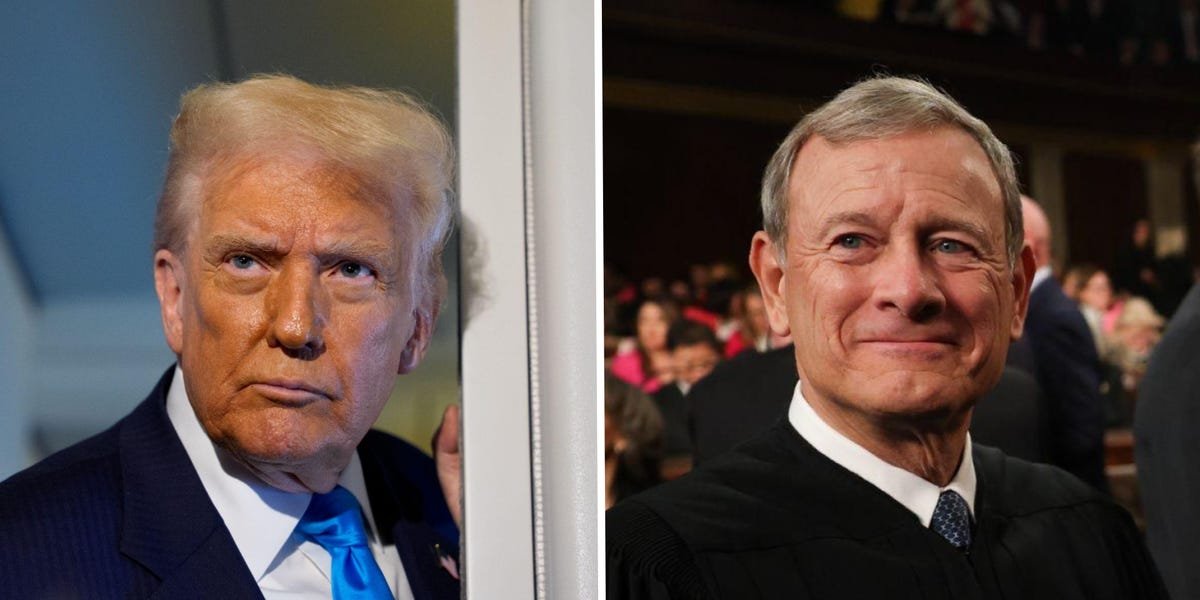
The Trump administration’s use of the law went too far, wrote Chief Justice John Roberts in the majority opinion. Trump would need a distinct law from Congress “to justify his extraordinary assertion of the power to impose tariffs,” he wrote.

“What common sense suggests, congressional practice confirms,” he wrote. “When Congress has delegated its tariff powers, it has done so in explicit terms, and subject to strict limits.”

The Supreme Court’s decision comes as the United States trade deficit is shrinking, largely due to the Trump administration’s tariffs, which are taxes on imported goods. It shrank to $29.4 billion in October, the lowest figure since 2009, according to recently published Commerce Department data.

Two groups of businesses filed lawsuits challenging Trump’s authority to impose tariffs through IEEPA. The Supreme Court combined their cases and put it on the fast track, holding oral arguments at the beginning of its November term.

IEEPA, a Carter-era law, gives presidents the power to “regulate” importation in times of emergency. The Trump administration claimed that it included the ability to impose tariffs — a position no other president has taken.

Lawyers representing the businesses argued that Congress has been clear about taxation and tariff powers in other laws, and would have been clear if IEEPA were meant to confer those powers to the president.

During oral arguments, most judges expressed skepticism about the Trump administration’s arguments. Justice Neil Gorsuch, whom Trump appointed to the bench in his first term, said taxes were “part of the spark of the American Revolution” and should get careful treatment.

“The power to reach into the pockets of the American people is just different,” Gorsuch said. “And it’s been different since the founding.”

The Supreme Court’s ruling does not affect the tariffs that Trump has imposed using other laws, and Trump still has the power to issue additional tariffs using those laws.

But his administration has favored IEEPA because of its perceived flexibility. The other laws that allow presidents to impose tariffs without explicit Congressional approval have limits — including built-in expiration dates and caps on the amount taxed. They also make it more difficult to target particular countries, rather than certain industries.

This is a breaking story. Please check back for updates.


Source link