
Im-an-American-who-studied-at-universities-in-China-The.jpeg

I’m an American who studied at universities in China. The Chinese system was cheaper and set me up for success after graduation.

I’ve done something quite rare: I’m an American who attended college in both the US and China.

I completed my undergraduate degree in political science at a state university in New York and studied abroad in Wuhan, China, during the summer of 2015. Ten years later, in 2025, I returned to Shijiazhuang, China, while completing my second graduate degree in global health, interning at a medical university.

Experiencing Chinese universities at two distinct points in my life, a decade apart, gave me a rare view of how the system operates and how it has evolved.

I didn’t meet any Americans studying in China most recently

During my first trip, I was in a group of about 30 American college students. The second time, I was the only person from my cohort to go.

Since the pandemic, the number of US students in China has dropped, according to NPR. In fact, I didn’t meet a single American in the three months I was in the country most recently.

Both times, I met lots of African students, though. They were heavily invested in and integrated into the Chinese learning and working systems.

I’ve noticed China sets the international students I met up for success

Many of the international students I talked to in the US told me how hard it was to integrate and find a pathway to work after school in New York.

In China, I noticed there’s a pathway for international students who want to stay, particularly those who have developed strong Mandarin skills.

The Chinese government and universities are actively trying to entice international students to come to the country, while also investing in ways to retain graduates.

Campus life looks very different from what I experienced in the US

The internet firewall in China can make research difficult, and I’ve seen doctors smoking in classrooms between lectures.

Student life also reflects a different set of norms. There is low tolerance for drugs and alcohol on many Chinese campuses. After class, I saw friends playing badminton rather than drinking beer.

Technology and security are also visible on campus. Students on the campuses I studied entered by scanning their faces and were tracked by cameras.


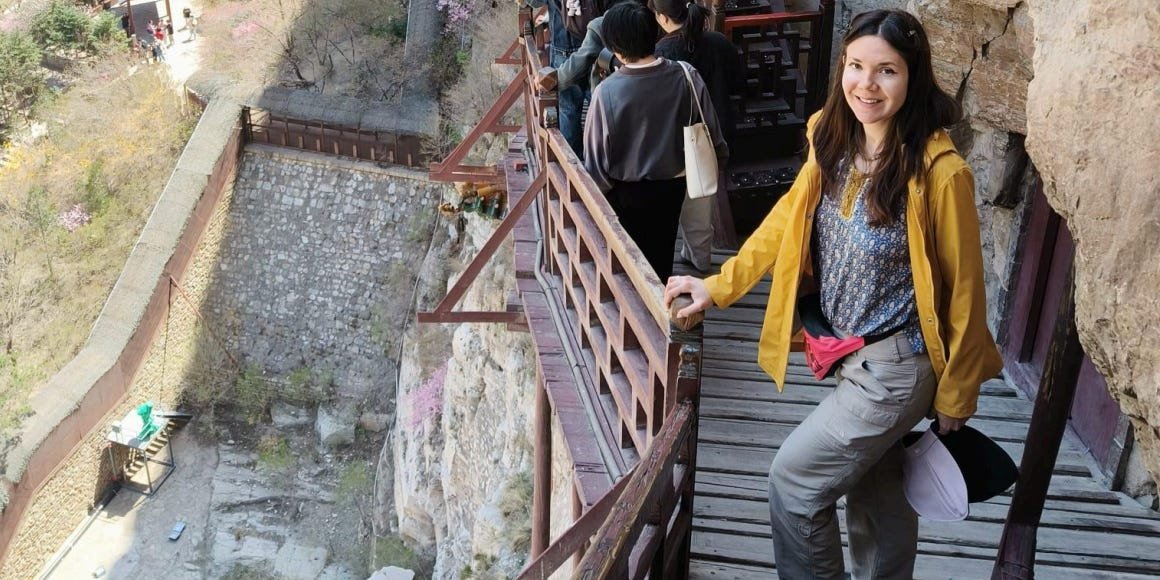
catherine work surronded by students in China

The author worked with many Chinese students.

Courtesy of Catherine Work


Politics also felt more openly present in academic life. Most of the professors and physicians I worked with were active members of the Communist Party and often wore pins on their lapels to signify it.

As one local friend put it, “having one state party means policies don’t change every four years,” which, in their view, can create a certain level of stability for universities.

Chinese universities are far cheaper and more specialized

The two universities I studied at in China didn’t have the fancy sports facilities most American colleges do, but many students I met weren’t going into debt to study either.

Tuition in China is subsidized by the government, especially at public universities. That means it’s relatively affordable compared with many Western countries.

Housing and food costs are also inexpensive in my experience. I was eating a healthy lunch on campus for $1 a day. My American campus used to sell a single banana for $1.05 in 2015.

I also spent a year taking general courses in America. While I loved taking a class on Bollywood as a political science major, the specialization offered by many Chinese universities helped better prepare me for the real world. I also saved money by not taking general courses while in China.

Studying in both systems changed how I think about education

I didn’t just earn my degrees in multiple countries; I learned about the culture of education. I learned how the government impacts who can study what and if they will be successful.

I’ll always be partial to the American scholastic mentality of questioning everything and forming opinions, rather than the rote memorization I saw in China, but I’d prefer not to be launched into the working world with so much student loan debt.

I hope more Americans can form their own opinions of China’s educational system, which has rapidly evolved and will only continue to grow in its unique way.


Source link

Microsoft-says-Anthropics-products-can-stay-on-its-platforms-after.jpeg

Microsoft says Anthropic’s products can stay on its platforms after lawyers ‘studied’ the Pentagon supply chain risk designation

Microsoft said Anthropic’s AI tools aren’t going anywhere on its platforms despite the Pentagon blacklisting the startup.

The Pentagon on Thursday formally told Anthropic that “the company and its products are deemed a supply chain risk, effective immediately.” Defense Secretary Pete Hegseth has said the designation effectively bars companies with defense contracts from doing business with Anthropic.

Anthropic has said it plans to challenge the decision in court.

The designation follows a dispute between the AI startup and the Pentagon over how its Claude models could be used. Anthropic has said it will not allow its technology to be deployed for mass domestic surveillance or fully autonomous weapons.

A Microsoft spokesperson told Business Insider on Thursday that the company’s “lawyers have studied the designation and have concluded that Anthropic products, including Claude, can remain available to our customers.”

Claude will still be available to customers through platforms such as M365, GitHub, and Microsoft’s AI Foundry, except for the Department of War, the spokesperson said in a statement.

“We can continue to work with Anthropic on non-defense related projects,” it added.

Microsoft has deepened its ties with Anthropic in recent months. In November, the companies said that Anthropic would spend $30 billion on Microsoft’s Azure cloud services, while Microsoft agreed to invest up to $5 billion in the startup.

Microsoft also said in September that it was integrating Anthropic’s models into Microsoft 365 Copilot alongside systems from OpenAI.

The Anthropic-Pentagon saga

In a statement published on Thursday evening, Anthropic CEO Dario Amodei said the company is in talks with the Defense Department even as it is preparing for court.

“I would like to reiterate that we had been having productive conversations with the Department of War over the last several days, both about ways we could serve the Department that adhere to our two narrow exceptions, and ways for us to ensure a smooth transition if that is not possible,” Amodei wrote.

However, Emil Michael, a Department of War official, said in a post on X following Amodei’s statement that negotiations are off the table.

“I want to end all speculation: there is no active @DeptofWar negotiation with @AnthropicAI,” Michael wrote.

Amodei also offered an apology in his statement after The Information reported that he had privately blasted the White House in a memo to staff after talks with the Pentagon fell apart.

In the memo, Amodei wrote that the administration disliked his company because he had not offered “dictator-style praise to Trump.”

“Anthropic has much more in common with the Department of War than we have differences,” Amodei said on Thursday.


Source link

Im-an-American-who-studied-abroad-at-Zhejiang-University-in.jpeg

I’m an American who studied abroad at Zhejiang University in China. It was unlike anything I experienced back in the US.

In the spring of 2013, I was a sophomore at Tufts University in Massachusetts, soon to declare a dual major in international relations and Mandarin Chinese.

Despite my lofty aspirations to travel the world as a diplomat, my academic career so far had taken me a whopping 25 miles north of my hometown. That’s why my university’s study abroad program in China appealed to me.

Once I heard the tales of adventure from the 2012 program’s freshly minted graduates, I eagerly applied. That summer, with an acceptance letter in hand, I set off to enroll at Zhejiang University.

Zhejiang University was unlike anything I had experienced

Upon landing in Shanghai, my American classmates and I were piled into a minibus for the two-hour drive south to the garden city of Hangzhou — capital of Zhejiang Province and home to Zhejiang University (affectionately referred to by locals as ZheDa).


outside the international campus of Zhejiang University.

The author attended the international campus of Zhejiang University.

Courtesy of Zhejiang University


After settling into the dorm, which was a single room with a private bathroom, we were welcomed by our professors with a banquet at the college’s canteen — an establishment which was far better than the standardized cafeteria fare that I’d come to know back in New England.

In our dormitory building, for the equivalent of $2 at the time, one could acquire a filling meal any time of the day — from rice porridge and steamed buns in the morning to stir-fried vegetables and sweet and sour pork tenderloin in the evening, all cooked fresh to order.

Zhejiang University was massive and spread across multiple campuses throughout the city. Fortunately for us newcomers, our group at the University’s International College was tucked into a leafy hillside on the historic Yuquan campus, offering a slice of Chinese university life at an approachable scale.

Classes were rigorous and worldly

As the sweltering days of summer transitioned into an osmanthus flower-scented autumn, I settled into a new school year. Each morning consisted of four hours of intensive language instruction, followed by at least a few more hours of homework and self-study in the afternoon.

In addition, each week we’d attend one three-hour lecture on Chinese Peasant History with our advisor, who drew heavily from his own experiences as an academic sent to the countryside during Mao’s Cultural Revolution.

I also had a three-hour lecture on the Chinese Legal System with a professor who’d argued many cases within China’s rapidly evolving court system.

American students were very different than the Chinese students

While my application to enroll in Zhejiang University was relatively quick and painless, the road to admission for most of ZheDa’s domestic student population was comparatively long and grueling.

From an early age, they’d studied for hours at school, followed by hours at buxiban (cram schools), preparing to ace China’s notoriously difficult standardized exams, such as the Gaokao. Of the millions who sit for the Gaokao each year, only the highest scorers earn spots in China’s most prestigious schools, such as Peking, Tsinghua, and Zhejiang universities.

Unsurprisingly, the academic work ethic that carried students to Zhejiang University did not fall off after admission. While most of my international classmates would study long hours during the week, we would take Friday nights and weekends off to travel within China. But many local students, however, rarely engaged in such frivolous pursuits and were more likely to be studying in the library on a Friday or Saturday evening.

As exams marked the end of my semester at ZheDa in December 2013, I personally experienced the exacting academic standards that my Chinese classmates were intimately familiar with. While I did pass all of my classes, a minor error in pronunciation or a stroke askew in a written character, mistakes that my Chinese professors back at Tufts may have overlooked, were marked down harshly by my professors at Zhejiang University.

The university is now the best in the world

When scrolling Instagram in January 2025, I saw a familiar sight in a post from The New York Times — a statue of Mao Zedong standing before Laohe Hill and a familiar library, waving to the students on a verdant Yuquan Campus. Reading on, I was proud to learn that my study abroad alma mater had been named the most productive research university in the world by Leiden Rankings, outpacing even my hometown juggernaut, Harvard.

I cannot say that I am shocked by this development. My semester at ZheDa showed me a culture of academic rigor on a scale few American universities can match, drawing from an academic talent pool far larger than in the US.

My time at ZheDa forced me out of my comfort zone and exposed me to an academic world significantly different from that in which I’d been educated, and I believe I am a more open-minded learner for it.


Source link