
World-War-II-museum-ships-suddenly-feel-less-like-history.jpeg

World War II museum ships suddenly feel less like history after a US submarine sank an Iranian warship

For Brian Auer, the operations manager at Historic Ships in Baltimore, the video of a US Navy submarine sinking an Iranian warship this week looked strikingly familiar.

“I saw the footage of that Iranian frigate getting torpedoed, and it looks like any picture I see from World War II of a similar attack happening,” he told Business Insider of the video released by the Department of Defense on Wednesday.

Before this week’s attack in the Indian Ocean, the last confirmed US Navy submarine to sink an enemy ship in combat was the USS Torsk, a World War II submarine that sank two Japanese vessels in 1945 before becoming part of the museum that Auer manages.

Since 1945, large-scale battles between warships have been rare. As naval warfare reemerges as a key strategy in Operation Epic Fury against Iran, museum ships that saw combat in World War II are finding new relevance, showing not just how naval war was fought, but how it might look today. Suddenly, the floating museums feel a lot less like history.

“Those of us who work on museum ships don’t like war,” Ryan Szimanski, the curator at Battleship New Jersey in Camden, New Jersey, told Business Insider. “In many cases, we work here to try and teach people about how awful wars were.

“However, the fact that the United States has fought a naval action — one of the first ones since World War II — is making museum ships like us relevant and part of the public discussion in a way that we haven’t been.”

Museum ships offer immersive experiences


Battleship New Jersey in Camden, New Jersey.

Battleship New Jersey in Camden, New Jersey.

Talia Lakritz/Business Insider


There are around 75 World War II-era museum ships open to the public across the US. These decommissioned battleships, submarines, destroyers, aircraft carriers, and other vessels offer visitors the chance to climb aboard and explore the interiors themselves.

Guided tours, often led by Navy veterans with firsthand experience serving on similar vessels, take visitors through combat areas, such as torpedo rooms, gun turrets, and command centers.

Battleship New Jersey, for example, offers a rare look into Tomahawk cruise missiles as the first surface warship to carry them in 1982. The long-range missiles have also been used to sink Iranian ships during Operation Epic Fury.


The combat engagement center on board the USS New Jersey, which features a Tomahawk Weapons System.

The combat engagement center on board the USS New Jersey features a Tomahawk Weapons System.

Talia Lakritz/Business Insider


“Because those are contemporary systems, to be able to see a Tomahawk missile, to be able to see Tomahawk missile launchers in a museum — there’s only a handful of museum ships like us that you could come and see to get that experience,” Szimanski said.

Some ships even offer sleepover experiences where guests can eat meals in the crew’s mess and spend the night in sailors’ bunks.

“It is highly unlikely that the average person will get the chance to visit an active-duty Navy ship,” Szimanski said. “So to experience the conditions, to see what it’s like to serve on a warship, particularly one that has seen combat, visiting a museum ship is your best chance.”

‘Remarkably similar’ to modern Navy ships


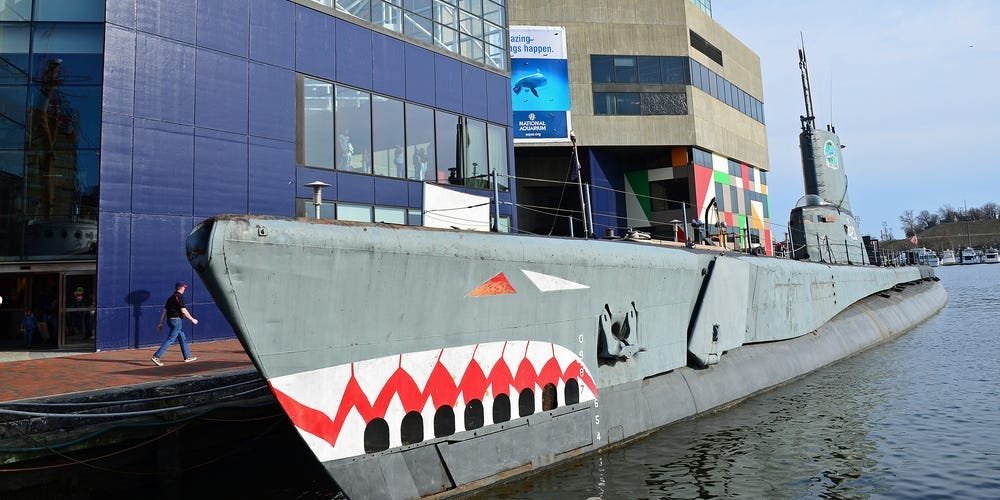
The USS Torsk in Baltimore.

The USS Torsk submarine in Baltimore.

Vacclav/Shutterstock


While some technologies and configurations found in World War II submarines may be outdated, many aspects of how they operate remain the same.

“It’s important to remember that the Navy, the military, all of us, operate in a world governed by laws of physics, and so there are some things that are just never going to change in how submarines work,” Auer said. “If you walk through a modern Ohio-class, ballistic missile submarine, you’re going to find things that are exactly the same, or done exactly the same way, on the USS Torsk. And what we can really show is where those things were first done, and why they were done that way, and why they are still done that way.”

Modern submarines still appear “remarkably similar” to their museum counterparts, Szimanski said. The layout of submarines hasn’t changed all that much since World War II. They largely still have the same spaces to eat, sleep, and fire torpedoes.

Auer says that when he leads tours of the USS Torsk for active-duty sailors, he often gets the response, “Huh, we’re still doing it this way.”


The forward torpedo room inside the USS Torsk submarine.

The forward torpedo room inside the USS Torsk.

Pixel Doc/Shutterstock


The biggest differences can be found in the ships’ capabilities, Hugh McKeever, the shipboard education manager at the Independence Seaport Museum in Philadelphia, told Business Insider.

Diesel-powered submarines like the USS Becuna, which sank 3,888 tons of shipping in World War II before arriving at the Independence Seaport Museum, had to spend most of their time on the surface with only about 12 hours’ worth of oxygen at a time. Today’s nuclear-powered submarines operate with an unlimited fuel supply and can stay submerged for upward of six months.

“As far as going out to sea, their ability is pretty much limited only by food,” McKeever said.

Overall, World War II-era submarines are less antiquated than one might assume. Some even still work. The USS Torsk’s sister ship, the USS Cutlass, was commissioned in 1945, sold to Taiwan in 1973, and remains operational as part of the Republic of China Navy.

“These boats, to us, are so outdated that they’re museums, but for the rest of the world, they’re relatively advanced,” Auer said. “They’re still very capable of doing the function they were originally designed for. So, were they implemented by some foreign threat, they would be a threat.”

Floating museums find new relevance


The USS Becuna, a World War II submarine, is part of the Independence Seaport Museum in Philadelphia.

The USS Becuna, a World War II submarine, is part of the Independence Seaport Museum in Philadelphia.

Talia Lakritz/Business Insider


For ship museum curators, the resurgence of naval battles in the US war with Iran underscores the contemporary relevance of World War II museum ships and the battle stars they earned. McKeever, for one, anticipates getting more questions about torpedoes as the summer tourist season ramps up.

“For the US as a maritime power, the economic prosperity of the country is tied to the sea and the Navy,” McKeever said. “Our museum vessels represent that constant need for change and growth as a country.”

After all, as Szimanski noted, it was just days ago that no active US Navy ships had ever sunk an enemy warship — the only Navy ships that had fought a naval battle were all museum ships. Despite some rust and peeling paint, it seems they still have a lot to teach us.


Source link

I-toured-the-USS-Lionfish-a-Balao-class-submarine-that-rescued.jpeg

I toured the USS Lionfish, a Balao-class submarine that rescued downed pilots in World War II. Take a look inside.

  • The USS Lionfish was commissioned in 1944 and earned one battle star for service in World War II.
  • It sank a Japanese submarine, rescued the crew of a B-29 bomber, and served as a training submarine.
  • The Balao-class submarine is now a museum docked at Battleship Cove in Fall River, Massachusetts.

The World War II submarine USS Lionfish was part of America’s “Silent Service.”

Despite comprising less than 2% of all US Navy vessels during World War II, submarines like the USS Lionfish sank 55% of Japanese vessels in battle.

This once-fearsome vessel is now a 311-foot-long museum exhibit, allowing the public to learn about its top-secret wartime operations.

Take a look inside the USS Lionfish.

Commissioned in 1944, the USS Lionfish earned one battle star for service during World War II.

The USS Lionfish at sea in an undated photo.

Arkivi/Getty Images

Over the Balao-class submarine’s two war patrols, she sank a Japanese submarine, destroyed a schooner, and rescued the crew of a downed American B-29 bomber.

The USS Lionfish was recommissioned for the Korean War, serving from 1951 to 1953.

From 1960 to 1971, the USS Lionfish served as a reserve training submarine, teaching crew members to operate similar vessels.

Since 1973, the USS Lionfish has been on display at Battleship Cove, a maritime museum in Fall River, Massachusetts.


The USS Lionfish.

The USS Lionfish.

Talia Lakritz/Business Insider

Tickets to Battleship Cove cost $25 per adult. I visited the museum in January to take a closer look at the retired submarine.

The first stop on my self-guided tour was the forward torpedo room, where 16 torpedomen slept and worked.


The forward torpedo room on board the USS Lionfish.

The forward torpedo room.

Talia Lakritz/Business Insider

The forward torpedo room featured six torpedo tubes, each storing a torpedo, and 10 reloads. The 16 crew members slept alongside the torpedoes on pull-out bunks, remaining ready to fire at all times.

Behind the torpedo room was officers’ country, which included the officers’ pantry.


The officers' pantry on board the USS Lionfish.

The officers’ pantry.

Talia Lakritz/Business Insider

In the officers’ pantry, meals for the higher-ranking crew members were reheated and plated on Navy china. They ate the same food as the rest of the sailors, but in a fancier setting.

Officers used the wardroom for dining, working, and relaxing.


The wardroom on board the USS Lionfish.

The wardroom on board the USS Lionfish.

Talia Lakritz/Business Insider

It could also serve as an operating room in medical emergencies.

Junior officers slept in a room with four bunks.


The junior officers' quarters on board the USS Lionfish.

The junior officers’ quarters.

Talia Lakritz/Business Insider

Officers enjoyed more privacy on board than enlisted men.

Senior officers had even more privacy in a room with a triple bunk.


The senior officers' quarters on board the USS Lionfish.

The senior officers’ quarters.

Talia Lakritz/Business Insider

The submarine’s second-in-command, known as the executive officer, slept in this room.

The commanding officer slept in the only private room on board the submarine.


The commanding officer's stateroom on board the USS Lionfish.

The commanding officer’s stateroom.

Talia Lakritz/Business Insider

The commanding officer’s stateroom featured a small desk that functioned as a private workspace.

Chief petty officers slept five to a room in their quarters.


The chief petty officers' quarters on board the USS Lionfish.

The chief petty officers’ quarters.

Talia Lakritz/Business Insider

Chief petty officers served as liaisons between the officers and the crew. This room was also colloquially known as the “goat locker” since the more experienced officers were affectionately nicknamed “old goats.”

In the ship’s office, an administrator known as the yeoman handled all of the ship’s paperwork.


The ship's office on board the USS Lionfish.

The ship’s office.

Talia Lakritz/Business Insider

Personnel files, orders of supplies, and other administrative tasks were the yeoman’s domain.

Equipment in the control room managed the submarine’s depth, speed, steering, and navigation.


The control room on board the USS Lionfish.

The control room.

Talia Lakritz/Business Insider

The commanding officer issued orders from the control center or the conning tower located directly above. The USS Lionfish’s conning tower wasn’t open to the public, but I did get to look inside one while touring another Balao-class submarine, the USS Becuna.

Communications and covert operations were handled in the radio room.


The radio room on board the USS Lionfish.

The radio room.

Talia Lakritz/Business Insider

The USS Lionfish was equipped with sonar, or “sound navigation and ranging,” to listen for enemy ships in the surrounding waters.

Chefs prepared meals for the submarine’s 80 crew members in the main galley.


The main galley on board the USS Lionfish.

The main galley.

Talia Lakritz/Business Insider

The galley prepared four meals a day: breakfast, lunch, dinner, and midnight rations known as “mid-rats.”

The crew’s mess was an all-purpose room where sailors ate, lounged, and played games.


The crew's mess on board the USS Lionfish.

The crew’s mess.

Talia Lakritz/Business Insider

Frozen and refrigerated food was stored in compartments underneath the floor.

The bunks have been removed from the crew’s berthing during ongoing restoration work.


The crew's berthing on board the USS Lionfish.

The crew’s berthing.

Talia Lakritz/Business Insider

Other Balao-class submarines held 35 or 36 bunks in this space.

The USS Lionfish featured two engine rooms, each containing two diesel engines.


The forward engine room on board the USS Lionfish.

The forward engine room.

Talia Lakritz/Business Insider

Each engine room was responsible for half of the ship’s electric and propulsion power.

In the maneuvering room, switches controlled the flow of electricity to the submarine’s generators.


The maneuvering room on board the USS Lionfish.

The maneuvering room.

Talia Lakritz/Business Insider

While surfaced, the submarine’s four diesel engines powered its generators, which in turn powered the ship’s motors. While submerged, storage batteries powered the motors.

My tour ended with the after torpedo room at the back of the submarine.


The after torpedo room on board the USS Lionfish.

The after torpedo room.

Talia Lakritz/Business Insider

Around 13 enlisted men worked and slept in the after torpedo room, which featured four torpedo tubes.

The USS Lionfish remains unique among World War II submarines.


The USS Lionfish docked at Battleship Cove in Fall River, Massachusetts.

The USS Lionfish docked at Battleship Cove in Fall River, Massachusetts.

Talia Lakritz/Business Insider

Over 50 submarines underwent a Greater Underwater Propulsive Power 1-A, or “GUPPY,” modernization after World War II. However, the USS Lionfish remained as it was.

Museum staff and volunteers are working to restore the USS Lionfish and preserve its original configuration. Even in frigid temperatures, I saw volunteers holding tools and walking carefully around the deck’s open panels, revealing the complex mechanics beneath.


Source link