

Pentagon-responds-to-Anthropic-suit-arguing-the-company-is-a.jpeg

Pentagon responds to Anthropic suit arguing the company is a ‘substantial risk’ to national security

The US government is urging a federal judge to reject Anthropic’s bid to reverse its status as a supply chain risk.

In a court filing Tuesday, lawyers for the Department of Defense said federal agencies acted lawfully when they moved to phase out Anthropic’s technology after the company refused to agree to contract terms allowing “any lawful use” of its AI by the military. The Pentagon said that the company poses a national security risk.

The dispute centers on a broader clash between the military’s use of AI and the contractual safety limits it sets with the tech providers.

Anthropic, which builds the Claude AI model, sued the government after President Donald Trump ordered government agencies to stop using Anthropic’s technology, and the Department of Defense labeled the company a “supply chain risk,” effectively barring it from holding federal contracts. The company argued the move was unlawful retaliation tied to its safety policies.

The government, in turn, said it is simply exercising its authority to choose vendors — and that Anthropic’s restrictions and behavior made it an unacceptable partner for national security work.

Representatives for the Department of Defense did not immediately respond to requests for comment from Business Insider.

According to the filing, the conflict escalated after Anthropic declined to modify its usage policies, which restrict certain applications like weapons development and surveillance. Officials said those limits could give a private company undue influence over military operations and decision-making.

The government also argued that Anthropic’s role as the developer and maintainer of its AI systems creates inherent risks. Because such systems require ongoing updates and tuning, officials warned the company could “subvert the design and/or functionality” of its tools or alter performance during critical operations.

“We are reviewing the government’s filing and look forward to presenting our response to the court,” the company said in a statement. “As we shared last week, seeking judicial review does not change our longstanding commitment to harnessing AI to protect our national security, but this is a necessary step to protect our business, our customers, and our partners.”

Anthropic has argued that the actions violate its First Amendment rights and due process protections. However, the government pushed back, arguing the dispute is about commercial conduct — not protected speech — and that agencies are free to decide “those with whom [they] will deal” in procurement.

The filing also dismisses Anthropic’s claims of irreparable harm, describing potential business losses as “speculative” and arguing that any damages could be addressed through contract remedies.

A hearing on Anthropic’s request for a preliminary injunction is scheduled for March 24 in federal court in San Francisco.


Source link

The-fight-with-Iran-shows-high-intensity-modern-wars-hinge-on.jpeg

The fight with Iran shows high-intensity modern wars hinge on having a substantial air defense arsenal

The US and Israel’s fight with Iran shows just how key air defenses have become in higher-intensity modern wars, conflicts increasingly defined by long-range missile and drone attacks.

The conflict, which killed Iran’s Supreme Leader, has been heavily focused on air defenses, either knocking them out to permit air operations or leaning hard on them to shield bases from retaliatory strikes.

The US and Israel said their strikes focused on Iran’s air defenses and missile launch sites, and US and partner forces in the countries attacked in response relied on a mix of air defenses to fend off Iranian weapons.

Kuwait, home to installations like Ali Al Salem Air Base that hosts US troops, reported on Sunday that it had faced 97 ballistic missiles and 283 drones. Defeating this kind of barrage demands deep air defense arsenals.

When air defenses fall short

US Central Command on Saturday said the strikes on Iran aimed to “dismantle the Iranian regime’s security apparatus” and prioritized locations “that posed an imminent threat,” listing Iranian air defense capabilities, missile and drone launch sites, and military airfields as targets.


Black and white aerial footage shows a large aircraft on tarmac with the word 'Unclassified' written on the top in large, neon-green letters

US Central Command shared footage of strikes on Iranian targets, including Iranian air assets.

US Central Command/X


The Israel Defense Forces said that they had “dismantled the majority of the aerial defense systems in western and central Iran” and are “paving the way towards establishing aerial superiority over the skies of Tehran.”

On Saturday, Israel used around 200 jets to drop hundreds of bombs on 500 targets on Saturday, including Iran’s air defense systems and missile launchers.

Having insufficient air defenses can leave a country severely vulnerable in a war of ranged strikes by creating a permissive environment for enemy airpower, as well as munitions, to find their targets, be they military installations or senior leadership. Over the past day, Iran has suffered serious losses to both.

Air defenses matter in a missile fight

Air defenses have been critical for the US and its allies this weekend.

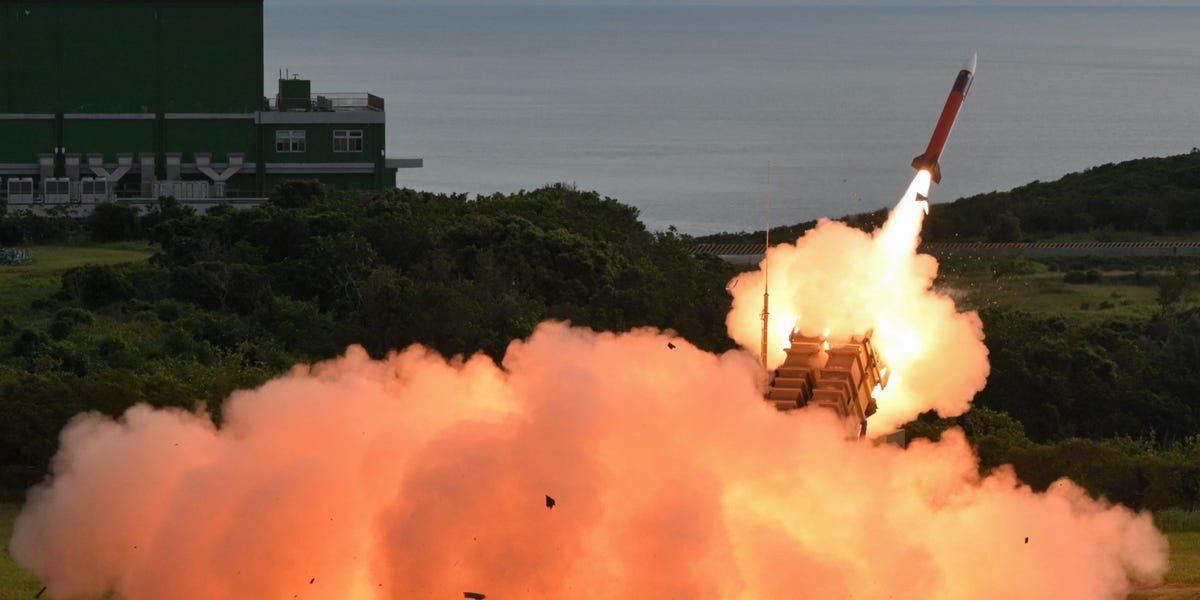
CENTCOM said it was able to defend against hundreds of Iranian missile and drone attacks, with no casualties. A US official told Business Insider that US-made MIM-104 Patriot surface-to-air missile systems and Terminal High Altitude Area Defense, or THAAD, batteries were used to protect the Middle East from Iran’s retaliatory strikes. Warship-launched interceptors and aircraft were also involved, as they’ve been in other engagements involving big Iranian missile barrages.

Nations attacked by Iran, countries like Qatar, the United Arab Emirates, and Bahrain, said they were largely able to intercept Iran’s missiles, sometimes stopping entire waves. Details are still emerging, but damage appears minimal. Casualties, likewise, have been extremely limited thus far, at least compared to what they might have been otherwise.


Smoke rises in the sky after blasts were heard in Manama, Bahrain, February 28, 2026.

Some of Iran’s retaliatory strikes were successful, but countries reported intercepting entire waves of attacks with air defenses.

Stringer/REUTERS


That was only day one though. Iran has a large missile arsenal, and it has pledged to continue its attacks. Continued large barrages will put tremendous strain on air defense arsenals.

Along with other current and potential conflicts, Iran is yet more evidence that much of modern war has become ranged missile fights. If you don’t have good air defenses, you may very well lose.

This is a very different way of war compared to the fights against terrorists and insurgencies that the US and its allies waged for decades in the Middle East.

More would be needed for higher-end threats

China and Russia both field substantial missile arsenals that they are continuing to expand. The West is aware, but the war in Ukraine, where Russia bombards Ukrainian cities nightly with massive mixes of missiles and drones, has been a real wake-up call.

Ukraine has been developing its own air defenses while seeking additional options from partners. Each barrage is extremely demanding. In one engagement, Ukraine expended nearly $100 million in interceptors fighting off Russian attacks.

Much of the West has allowed air defense arsenals to atrophy, but there are significant new investments in air defense across the NATO alliance.

The NATO chief pledged a fivefold increase in air defenses, driven by the alliance’s increased spending. Established manufacturers are increasing production, and new systems are being created. President Donald Trump wants his Golden Dome missile defense system to protect against complex attacks from Russia and China.

But air defense systems and their missiles are expensive and time-consuming to make, and the industry is struggling to keep up with increasing demand, even with companies boosting output.

Mick Ryan, a retired Australian major general and strategist with a focus on future war, said that the heavier demand could cause new problems. Patriot interceptor missiles are critical to Ukrainian defenses, but are in heavy demand at present in the Middle East,” he wrote on Saturday.

Russia, he said, will want to “exploit any temporary Ukrainian capability gaps while American attention and production capacity focuses on Iran.”

The US will also need to maintain a strong air defense posture in both Europe and the Pacific as well, even as it fights Iran.

Ryan warned that concentrating US missile defense assets in the Middle East could degrade its deterrence in the Pacific: “Every carrier in the Gulf, every squadron in Europe, every missile defence battery protecting Middle Eastern countries represents capacity unavailable for containing Chinese expansion.”


Source link