I’ve done something quite rare: I’m an American who attended college in both the US and China.
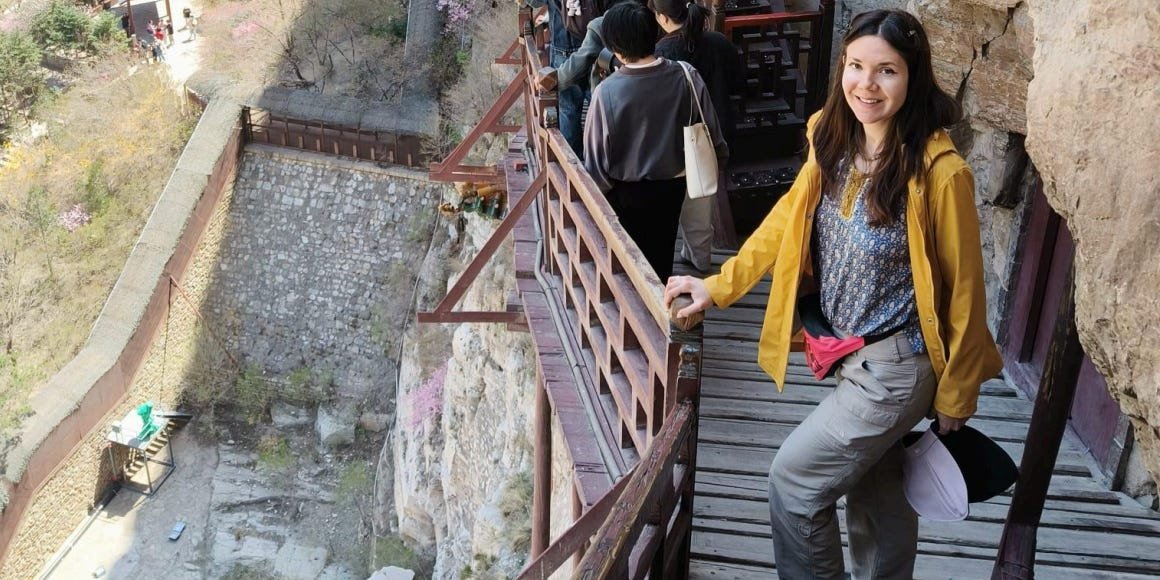
I completed my undergraduate degree in political science at a state university in New York and studied abroad in Wuhan, China, during the summer of 2015. Ten years later, in 2025, I returned to Shijiazhuang, China, while completing my second graduate degree in global health, interning at a medical university.
Experiencing Chinese universities at two distinct points in my life, a decade apart, gave me a rare view of how the system operates and how it has evolved.
I didn’t meet any Americans studying in China most recently
During my first trip, I was in a group of about 30 American college students. The second time, I was the only person from my cohort to go.
Since the pandemic, the number of US students in China has dropped, according to NPR. In fact, I didn’t meet a single American in the three months I was in the country most recently.
Both times, I met lots of African students, though. They were heavily invested in and integrated into the Chinese learning and working systems.
I’ve noticed China sets the international students I met up for success
Many of the international students I talked to in the US told me how hard it was to integrate and find a pathway to work after school in New York.
In China, I noticed there’s a pathway for international students who want to stay, particularly those who have developed strong Mandarin skills.
The Chinese government and universities are actively trying to entice international students to come to the country, while also investing in ways to retain graduates.
Campus life looks very different from what I experienced in the US
The internet firewall in China can make research difficult, and I’ve seen doctors smoking in classrooms between lectures.
Student life also reflects a different set of norms. There is low tolerance for drugs and alcohol on many Chinese campuses. After class, I saw friends playing badminton rather than drinking beer.
Technology and security are also visible on campus. Students on the campuses I studied entered by scanning their faces and were tracked by cameras.
The author worked with many Chinese students.
Courtesy of Catherine Work
Politics also felt more openly present in academic life. Most of the professors and physicians I worked with were active members of the Communist Party and often wore pins on their lapels to signify it.
As one local friend put it, “having one state party means policies don’t change every four years,” which, in their view, can create a certain level of stability for universities.
Chinese universities are far cheaper and more specialized
The two universities I studied at in China didn’t have the fancy sports facilities most American colleges do, but many students I met weren’t going into debt to study either.
Tuition in China is subsidized by the government, especially at public universities. That means it’s relatively affordable compared with many Western countries.
Housing and food costs are also inexpensive in my experience. I was eating a healthy lunch on campus for $1 a day. My American campus used to sell a single banana for $1.05 in 2015.
I also spent a year taking general courses in America. While I loved taking a class on Bollywood as a political science major, the specialization offered by many Chinese universities helped better prepare me for the real world. I also saved money by not taking general courses while in China.
Studying in both systems changed how I think about education
I didn’t just earn my degrees in multiple countries; I learned about the culture of education. I learned how the government impacts who can study what and if they will be successful.
I’ll always be partial to the American scholastic mentality of questioning everything and forming opinions, rather than the rote memorization I saw in China, but I’d prefer not to be launched into the working world with so much student loan debt.
I hope more Americans can form their own opinions of China’s educational system, which has rapidly evolved and will only continue to grow in its unique way.
After we stopped traveling full-time, our 11-year-old daughter, Brooklyn, became obsessed with her bedroom.
She wanted to repaint it. Rearrange it. Add shelves, plants, posters, and end tables to organize her art supplies. She asked for candles and incense (and permission to burn them).
She pushed back when my wife and I asked her to keep her clothes picked up — not out of laziness, she explained, but because the artist in her liked how it felt to leave things wherever they landed.
At first, this “new normal” bugged me. The requests and pushback felt endless, even erratic, as if we were chasing some moving target of comfort that she would never reach.
Then one night, I walked past her room and was drawn by the scent of vanilla drifting through the crack in the door. Curled up on her bed under a throw, a small reading light on and the warm glow of candlelight around her, she sat reading a hardcover copy of “The Count of Monte Cristo.”
And it finally clicked: After years spent in airports, hotels, and temporary spaces, this was the first place within her control that she could count on staying the same.
At first, a life of travel made sense for our family
My wife and I began traveling the world with our three kids in 2020, at a time when structure had already fallen apart for most families.
School was remote. Routines were fractured. The future felt unpredictable. Travel, oddly enough, felt grounding.
If our kids were going to spend their days on screens anyway, why not replace textbooks with real places? Why not let geography, culture, and shared experience do some of the teaching?
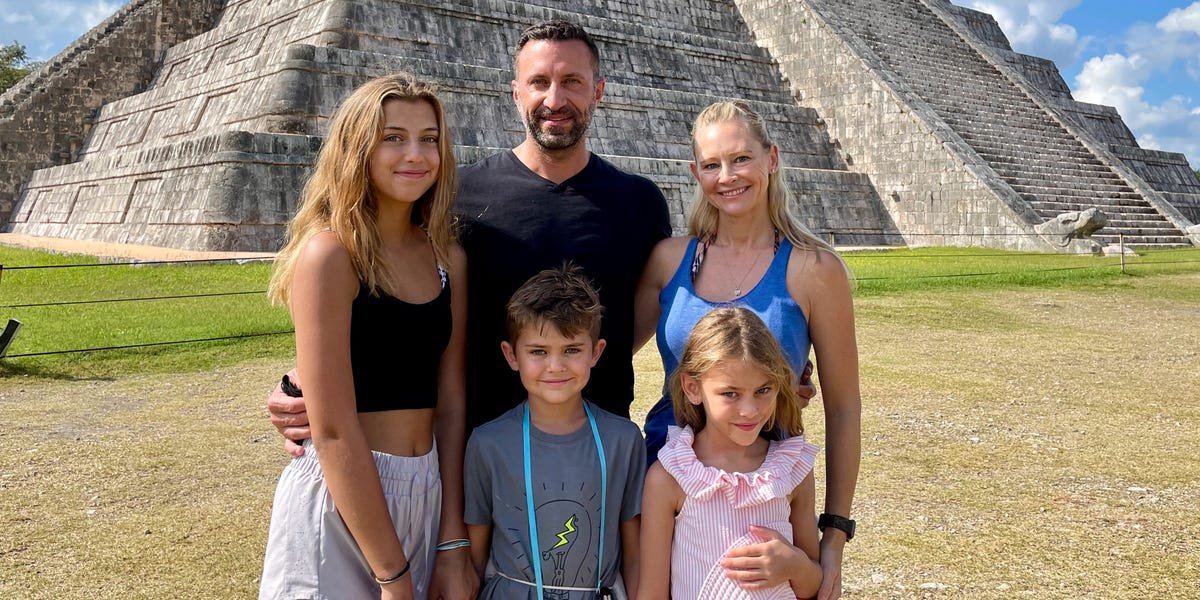
A snapshot of our family’s travels to Abu Dhabi.
Phil Lockwood
Almost immediately, we began documenting our journey on a new YouTube channel. It was a new direction for the entire family, and the excitement was universal. Our kids even started their own channels and began producing their own episodes.
We juggled the challenges of highlighting the far-flung places we were visiting, the mistakes we were making, and the logistics of pulling off long-term travel as a family of five. Friends and family started watching.
Then strangers, too. Our audience grew into the thousands somewhat slowly, then into the hundreds of thousands surprisingly fast. Soon, we’d reached over half a million YouTube subscribers.
Sharing everything online felt natural at the time. It gave structure to our travels and, through ad revenue and brand sponsorships, helped offset the high costs. And it felt useful—like we were showing other families what was possible if they were willing to step outside the usual script.
Our family in Antarctica.
Phil Lockwood
In those early years, it felt like so many high-profile family YouTube channels were presented as success stories — adventurous, tight-knit, and inspirational. I didn’t see as much public skepticism, and some darker stories of family vloggers (like Ruby Franke’s) that would later dominate headlines hadn’t yet come to light.
So, at the time, we didn’t see ourselves as taking a risk — we saw ourselves as joining a small but growing group of households who were filming and sharing their lives publicly before the downsides were so widely discussed, documented, and understood.
For a while, it worked. Or, at least it appeared to. The kids were curious. We were together. We saw parts of the world that most families only talk about. And all five of us were enjoying building something meaningful together.
There were real benefits: closeness, adaptability, and perspective. Our kids learned how to navigate unfamiliar places and unfamiliar people. We learned to function as a family without the usual scaffolding of schedules and routines.
What we didn’t yet understand was what those benefits might be trading against.
As time went on, the cracks began to show — and coming home didn’t repair them all
Not all of our kids experienced the lifestyle the same way.
As our youngest and most adventurous, Colt thrived on the endless variety. Reagan, my oldest from a previous marriage, enjoyed the journey, but eventually chose to return to in-person school, and we adjusted our travel around her schedule with her mom. Brooklyn, though, gradually stopped enjoying it altogether.
There wasn’t a dramatic breaking point. It was a slow accumulation: long-haul flights at odd hours, constant activity, museums and cultural experiences designed for adults, not kids. Plenty of stimulation, but very little continuity.
A moment from our time in Abu Dhabi.
Phil Lockwood
What I didn’t fully appreciate was how much childhood depends on repetition — seeing the same faces, returning to the same places, building friendships that deepen rather than reset with new people every few weeks.
Other nomadic families we met reassured us that this was normal. They told us our kids would grow more worldly, more mature, even more interesting than their peers. That any awkwardness later would be a sign of depth, not loss.
And I wanted to believe that. But as Brooklyn pulled further away from the lifestyle — showing little enthusiasm for new destinations, frustration with red-eye flights, and no desire to highlight her experiences in our episodes — it became harder to ignore the possibility that what we thought was enriching had become simply exhausting for her.
The hardest part wasn’t wondering what she wanted: She was clear that she’d rather be back home, back in school, and back to occasional family vacations. The hardest part was realizing that submitting to her desires would require dismantling a life we had just spent years reorganizing everything around.
Eventually, though — and after five full years of constant travel —we made the decision to stop. We returned to the house that we’d kept in Denver. Reagan graduated and headed to college. Brooklyn enrolled in in-person high school, while Colt chose to continue online for the flexibility. Our pace slowed, and the constant motion ended.
And yes —things got easier. The kids seem more independent than ever. Life feels calmer. There’s a structure where there used to be constant negotiation.
Our family posing in India.
Phil Lockwood
Still, the relief I feel is mixed with doubt.
Brooklyn still carries some resentment about not settling down sooner. She’s now trying to build friendships in a neighborhood where other kids grew up side by side for years. She missed that stretch of middle school — the inside jokes, shared routines, and the quiet accumulation of belonging. I sometimes wonder whether the introversion I see now is simply adolescence, or whether years without steady peer relationships reshaped her in ways we can’t fully undo.
Did the benefits of those experiences outweigh the costs? Did we assume that anything lost along the way would simply return? Or are we just seeing a normal adjustment after an unusual childhood?
I don’t have clean answers. I’ve only accepted that good intentions don’t guarantee harmless outcomes — and that parenting decisions made confidently at the time can look very different in hindsight.
I don’t regret our choice — just parts of the execution
I’m glad we traveled. I’m glad our kids have seen the world. I’m also glad we stopped. I don’t regret the journey my wife and I took our children on, but I no longer assume it was unquestionably right.
If I could do it again? I’d prioritize putting down roots earlier — fewer destinations, more seasons in one place, more chances for the kids to build friendships that weren’t constantly interrupted.
And I’d question whether sharing our adventures online was necessary at all.
We visited Chiang Rai, Thailand.
Phil Lockwood
There’s a difference between traveling with kids and building a childhood around constant motion — especially when that motion is public.
We still travel, but only a few times a year, mostly around school breaks. Colt still loves going. Brooklyn hasn’t joined a trip since we settled back down; my sisters stay with her when we leave.
Recently, though, she’s started talking about ancient Greece and asking what it would take to see the ruins in person — but we’re careful not to read too much into that since interest isn’t always the same as readiness.
And if there’s one thing I’ve learned, it’s this: parenting decisions don’t come with clean verdicts. They come with trade-offs.
Sometimes the most honest stories aren’t about success or failure — they’re about realizing, long after the decision has been made, that you’re still not entirely sure where the line really was.
I thought I was on track — until the year everything fell apart.
Just weeks into January 2023, I was blindsided by an unexpected breakup. In the months that followed, I moved through my days on autopilot, watching the year continue to unravel.
That May, I was laid off from my job coordinating large conferences and corporate travel. I took a position at a family-run wedding business that was building out its travel department. I told myself things were starting to look up.
But between a 90-minute commute, sitting at a desk all day, and performing mundane tasks not listed in my job description, I began to spiral instead of heal.
Almost every day, I’d retreat to my car at lunchtime and break down in tears, overwhelmed by how unhappy I was.
The “American dream” began to feel like a trap
Since I was a kid, I’d treated success like a checklist built from American expectations I absorbed through school, TV, and social media. It seemed simple enough: Stay in line with peers, get married before turning 30, and buy a big house to raise a family in.
It was becoming clear that this narrative might not align with the life I wanted for myself.
Later that same year, I dealt with a toxic roommate, a serious health scare in my family, and a car accident. Then, just days before the New Year, I got one final surprise: another layoff. This time, however, I felt relief.
Walking out of that office for the last time allowed me to stop chasing a version of success I knew would never satisfy me.
Distance changed the pressure I was living under
As 2024 began, I set a clear goal for myself to sublet my apartment, sell my belongings, and board a one-way flight to South Korea by April 15. My plan was to begin an eight-month journey across Asia and Australia. After four months of careful planning, I boarded that flight.
Starting the trip with a friend in Seoul made the beginning — and the 15-hour flight over — feel safe and manageable. When she boarded her flight back to the US, and I headed off to Thailand alone, that distraction disappeared. I was officially left alone with my own thoughts.
Early on in Southeast Asia, I questioned what I was doing and where it would all lead. I cried in hostels and had panic attacks on the back of motorbikes. My anxiety was triggered by the blasting music of Bangkok’s Khao San Road and Ho Chi Minh City’s endless traffic.
Strum escaped the pressure she’d been living under while traveling through the mountains in northern Vietnam.
Provided by Macie Strum
The more I took note of my surroundings, the less the world around me matched the urgency in my head.
As I traveled the Ha Giang Loop in Northern Vietnam by motorbike, I realized that my idea of success was built upon a level of pressure that didn’t exist up in these Vietnamese mountains. Local life didn’t revolve around strict deadlines and productivity scales. Instead, it centered on routine, family, and staying present each day.
As I moved through each country, I connected with travelers of every age and background, many of whom were unemployed, exploring new paths, working online, or simply figuring things out as they went. Some were meticulous planners; others lived day to day.
In the jungles of Malaysian Borneo, I met a fellow American who was also redefining her life after a heavy breakup. I remember the first night we met, we talked for hours about life, expectations, and the fear of what would come next.
We ended up traveling together to Kuala Lumpur, meeting again in Penang, and later in Bali. Seeing her in so many different places reminded me how many others were navigating the same uncertainty.
It reframed my view of travel — not as a break from real life, but as an active part of it. For the first time, uncertainty no longer felt like failure.
She’s building her career in Sarajevo, Bosnia and Herzegovina.
Provided by Macie Strum
I’ve redefined success
When that trip came to an end, I felt no pull toward the life I’d left the year before.
I returned to the US briefly, but chose to keep traveling to explore what alternative versions of success could look like for me.
In 2025, that decision took me to 17 European countries. As I explored, I found myself falling in love with one of the continent’s most misunderstood regions: the Balkans.
Today, I live in Sarajevo, Bosnia and Herzegovina, building a career as a freelance journalist without sacrificing my ability to travel. While the life I’m creating may not match the version of success I was raised with, it’s more aligned with how I want to live: flexibly, deliberately, and with purpose.
While I don’t know exactly what comes next, that no longer scares me the way it once did.
Do you have a story to share about living abroad? Contact the editor at akarplus@businessinsider.com.
This as-told-to essay is based on a conversation with Troy Smothers, a US Marine veteran sergeant who now runs American Made Freedom, a nonprofit that assists Ukrainian troops with fiber-optic drones. Business Insider verified his military records and deployment to Ukraine with the Department of Defense.
The following has been edited for clarity and brevity.
I was a standard infantry corporal in the Marines when I was sent to Odesa, Ukraine, in 2005.
There were perhaps 100 of us, and our clear role was to teach infantry tactics, such as leap and bound alternating movements, sectors of fire, and calling for artillery fire.
This was NATO doctrine. Because 20 years ago, the Ukrainians were indoctrinated by Soviet tactics that just throw people at their enemy like human meat waves.
Every time Matthew publishes a story, you’ll get an alert straight to your inbox!
Stay connected to Matthew and get more of their work as it publishes.
The roles are somewhat reversed now. Now the West is trying to learn how Ukrainians are fighting, and how they’ve turned what little they had into formidable weapons.
Even two decades ago, I noticed the same mindset among them that’s been the key to Ukraine’s strength today.
I was only in Ukraine for about three weeks in 2005, but my time training with the soldiers there left a similar impression on me.
We knew that Ukraine’s military budget was, let’s just say, underfunded. Everything they had was Soviet-era equipment comparable to the stuff that the US had decommissioned 20 years earlier.
We asked ourselves what we were doing sitting in their old Russian-made helicopters.
Helicopters commonly leak hydraulic fluid. However, when we boarded the helicopters in Ukraine, there were puddles of fluid in the cracks on the floor of the aircraft.
Definitely, nobody smoked near those things.
Most of the Ukrainians’ equipment was old, but it was a testimony to how they worked with what they had.
‘We’ll make it work’
Since the full-scale war started in 2022, I’ve been traveling to Ukraine for months at a time, showing new fiber optic spools to drone manufacturers so they can build and improve unjammable drones. We’re testing out designs that are used on the battlefield today.
You see that same “this is all that we have, so we’ll make it work” determination in Ukraine now. The Ukrainians are getting some great kit from Europe and the US, but it clearly still isn’t enough to win.
Out of necessity, they took toy hobby drones and turned them into cutting-edge military equipment.
We don’t fight that way in the US. If something breaks, we typically order a replacement part or return it.
In Ukraine, they open up the part and repair it. Salaries there are much lower, so their people are more used to repairing electronics or appliances on their own. If a mobile phone breaks, they’ll open it up and start soldering.
Because of this, they had a greater army of people who were electronically knowledgeable, enabling them to bring in an immediate solution in the war.
That isn’t culturally ingrained in the American military or our people. Of course, we would adapt in the same situation, but could we have done it as quickly as the Ukrainians did, transforming toys and parts bought from China’s Alibaba into something that the entire world is now watching today?
Here’s an example of their DIY ingenuity. The Ukrainians have a contraption nicknamed a “mustache” on their first-person-view drones, which is essentially two rigid copper wires protruding in front.
When the drone flies into its target, these wires touch and send a signal to the blasting cap — like turning on a light switch — in the attached explosive to trigger the detonation. The mustache’s safety device is a simple, 3D-printed pin that gets pulled out when you launch the drone.
I’ve bought and used dozens of these while developing fiber-optic drones, and one mustache costs just $12 to $15. In the US, to get a similar piece of equipment, you’d spend $400 to $500, even at scale.
Most of these Ukrainians were just regular people living their lives until they were forced by the invasion to start killing Russians. But if anything, they’ve had an incredible advantage in finding solutions, sometimes because their uncle or friend might have run a repair or electronics business.
We were down there 20 years ago to bring the Ukrainians up to NATO standards. Today, I can see how much they can teach us about innovation. It’s humbling.
In the era of America’s “Great Flattening,” one longtime executive still believes that middle management has an important role to play.
Speaking in a Monday episode of Yahoo Finance’s “Opening Bid” podcast, Jamba Juice’s former CEO, James D. White, said companies should not lose sight of the fact that humans and company culture drive bottom-line growth.
And White said that middle managers are crucial for driving a good company culture.
“It’s really hard to drive culture into an organization if you’re not focused on the middle management of the organization,” he told host Brian Sozzi.
White said one reason for this is because most workers report to middle management.
“If that part of the organization doesn’t have the tools, hasn’t bought into the mission and vision, and they’re not being appropriately rewarded or invested in, you don’t have the best chance of getting that message into the heart of the organization,” White said.
White was the CEO of Jamba Juice from 2008 to 2016 and has held executive roles in Gillette, Coca-Cola, and Nestlé Purina. He now sits on the board of directors for several consumer companies, including Cava Group and Simply Good Foods.
White’s advice contrasts with that of other executives, who have sworn by a flat company hierarchy.
In recent years, companies like Microsoft, Meta, Amazon, Intel, and Google have all slashed their middle management head count in the name of efficiency. But it’s not just Big Tech: retail giants like Walmart have followed suit.
And in November, Keily Blair, the CEO of OnlyFans, said her company was making $7 billion in annual revenue with a staff count of only 42.
She said her company thrives from having only “incredibly senior talent” and “incredibly hungry junior talent.”
“We do not have that sort of squidgy layer of middle management in the middle, because nobody’s ever had a really good middle manager in my experience,” Blair said in the interview during a Web Summit technology conference in Lisbon.
Kate Winslet turned 50 this year and says her definition of success has changed.
Speaking to Newsweek in an interview released on Tuesday, the “Titanic” actor spoke about aging and what it’s been like to reach this milestone in her life.
“I think that women get more interesting as we grow older. I think that we’re more involved in life. We have so much more experience,” Winslet told Newsweek.
She added that turning 50 “feels fantastic” and that she’s looking forward to what the coming years will bring.
“When we grow up, and we think about what we want to be when we’re older, I never imagined any of this,” Winslet said.
As a result, she said she has come to view success in a very different way.
“Success, actually, for me more these days is more about pulling it off, being a decent person. You know, being able to take care of people, having time for friends, also learning how to be OK with not being busy all the time,” she said.
Winslet said there’s value in learning to slow down.
“I think it’s important to remind ourselves that sometimes being OK just in stillness and in our own company,” she said.
She said she doesn’t know how to meditate, but it’s something she should learn.
Winslet isn’t the only Hollywood star who has reflected on how turning 50 has changed her perspective.
During a “Today” show appearance in November 2024, Lauren Sánchez Bezos said she didn’t think she would have so much to look forward to in life after turning 50.
“When I was 20, I thought, ‘Oh my gosh, life is over at 50.’ Let me tell you: It is not, ladies. It is not over,” she said.
In January, Chelsea Handler told Parade that she was feeling “pretty into myself” as she turned 50.
“My life is exactly what I hoped it would be — it’s more than I hoped it would be. I had no idea what the possibilities were or that I could live a life like this and feel so free,” Handler said.