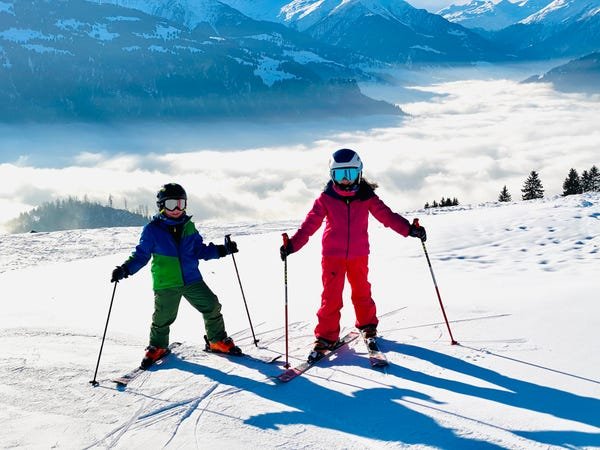
Ive-raised-my-3-kids-across-Switzerland-Australia-and-the.jpeg

I’ve raised my 3 kids across Switzerland, Australia, and the US — each culture has taught me valuable parenting lessons

  • Raising kids across 3 countries — the US, Australia, Switzerland — changed how I approach parenting.
  • It opened my eyes to how different cultures empower children to reach their full potential.
  • My kids learned early independence in Switzerland and the power of preparation in Australia.

Parenting my children across Australia, Switzerland, and the US showed me how deeply culture shapes the way we raise our children.

In Australia, I didn’t fully recognize how much my parenting was influenced by my suburban Sydney lifestyle until we moved abroad.

When my family moved to Switzerland, I noticed the way the Swiss promote child autonomy, empowering their kids from a young age — and when I adopted that mindset, my children thrived.

After moving to the United States, I learned a different parenting lesson about the true value of community and strong support networks, which strengthened my children’s sense of belonging.

Each country offered unique perspectives on parenting, but they taught me the same thing: Raising children isn’t about choosing one philosophy.

Instead, it’s about treating my experiences as a “cultural buffet,” trying new methods, keeping what works, and leaving the rest behind.

In Switzerland, independence is promoted from an early age.

In Switzerland, independence is a big deal for kids.

Naomi Tsvirko

When I first moved to Switzerland from Australia, I was stunned to see 5-year-olds in high-visibility vests walking to school alone, without adult supervision.

When I asked my Swiss neighbor about this, she shrugged and said, “Children can do amazing things when you let them.”

I started to give my children more responsibility and even let them walk to the local park and bakery without me. I realized they were ready, and they loved the freedom.

Living there also taught me the importance of letting children be a little uncomfortable.


Kids standing on stones next to woman near water

We no longer hesitate to play in the rain or a bit of snow.

Naomi Tsvirko

I remember dropping my kids off at a school playground early one rainy morning in Switzerland. The teacher stood outside, wearing her raincoat, calmly watching the children play in the rain.

In Australia, rainy days were usually spent indoors, but in Switzerland, life continues outdoors in almost any weather.

At first, my son looked up at me, unsure whether to join in. His teacher encouraged him to play, and before long, he was running around like everyone else.

That was when I really understood that common saying: “There’s no such thing as bad weather, only ill-prepared people.” Swiss parents approach tough situations not by avoiding discomfort, but by preparing children to handle it.

Australia showed me it’s important to prepare children for the road rather than trying to control it.


Kids smiling with woman in front of purple hydrangeas

My kids learned a lot in Australia.

Naomi Tsvirko

In Australia, helicopter parenting is widely frowned upon. When I worked as a teacher, I quickly learned that parents who hovered over their children didn’t just limit independence, they undermined confidence.

One of the hardest parts of parenting has been learning to step back and let my children take age-appropriate risks, trusting that they can handle them.

That parenting lesson was cemented when my 3-year-old daughter identified a venomous redback spider in our bathroom. She closed the door and informed me right away.

Her preschool had taught her how to recognize dangerous Australian spiders and what to do when they encountered them. It wasn’t fear-mongering, but survival training — a reminder that we can’t control the road ahead, but we can prepare our children to navigate it.

I also learned that being laid-back can help kids build confidence.


Kids smiling wearing leis

Australians can seem laid-back, but that’s not the same as apathy.

Naomi Tsvirko

Australians are laid-back by nature, but that doesn’t translate to apathy when it comes to parenting.

We care deeply for our children, but we’re also aware that even subtle parental anxiety can be picked up by them.

When my son was 2 years old, he started swimming lessons. His teacher gently asked me not to sit too close to the pool as she noticed that he kept looking at my face before trying anything new.

She was right. I seemed nervous, and he was even hesitant to put his head underwater.

I realized that I had to control my reactions when my children faced new challenges, otherwise my anxiety would become theirs, turning curiosity into fear instead of confidence.

Our time in the US has shown me how much competition builds confidence.


Family in NY rangers jerseys standing next to subway train

My kids have gotten more comfortable with competing in sports.

Naomi Tsvirko

For many years, I avoided entering my children in competitions because I didn’t want them to feel pressured to be the best at something.

However, after moving to the United States, my perspective shifted. Doing well in a competitive environment built my kids’ confidence, and losing helped build resilience.

My two older children first learned to play ice hockey in Switzerland, but it wasn’t until we moved to the US that they were exposed to higher-level competition. I’m grateful for their hockey coaches who mentored them and challenged my own assumptions about competition along the way.

Later, my daughter was able to represent our country at an international level. What surprised me the most wasn’t the achievement itself, but how much confidence she gained simply from being comfortable with competition.


Source link

Davos-updates-Trump-lands-in-Switzerland-as-speech-hype-builds.jpeg

Davos updates: Trump lands in Switzerland as speech hype builds

It’s all eyes on President Donald Trump at Davos.

Business Insider will be in the room when he speaks. We’ll share real-time updates on what he says and how World Economic Forum attendees react.

After an issue with Air Force One, Trump landed in Switzerland on a replacement plane just after 12:30 p.m. local time, and is scheduled to speak at 2:30 p.m.

Follow along here for real-time updates, reaction, and on-the-ground commentary from Business Insider’s staff in Davos.


Source link

Ive-lived-in-Switzerland-for-5-years-Here-are-the.jpeg

I’ve lived in Switzerland for 5 years. Here are the 6 biggest mistakes I see first-time visitors make over and over.

  • After living in Switzerland for five years, I’ve watched tourists make a lot of the same mistakes.
  • Don’t try to see too many places in one trip, and try visiting some smaller mountain villages.
  • Become at least a little familiar with the local languages and book your train tickets in advance.

Though I’m a US citizen, I’ve spent the past five years living in Switzerland.

As a semi-recent transplant, I know there’s much more to this amazing country than what visitors typically come to see. It’s one best experienced thoughtfully and authentically — not by mindlessly racing through “Top 10 ” lists.

In terms of mistakes tourists make, here are a few things I suggest you know — and avoid — before visiting Switzerland for the first time.

You’ll probably regret only visiting the Instagram-popularized spots.

Lucerne is incredible, but it’s not the only great place to visit in Switzerland.

Peter Shaw/Getty Images

Zermatt, Lauterbrunnen, Interlaken, and Lucerne are popular, jaw-dropping locations, but they’re not the only spots worth visiting in Switzerland.

Instead of only seeing the few places on every tourist’s list, consider branching out to smaller, lesser-visited ones for at least a day trip. Fortunately, many are easily accessible by public transportation out of some of the area’s main hubs.

For example, close to Interlaken are the mountain villages of Frutigen, Kandersteg, and Adelboden, which offer gorgeous alpine views combined with fewer crowds and more authentic experiences.

Don’t assume the dining-out culture and prices will be what you’re used to back home.


Vegetables on plate

Eating out in Switzerland can be expensive, but I’ve found the prices to be justified.

Ashley Franzen

In Switzerland, dining out can seem expensive — in part because the cost of production, labor, and relevant service charges are typically already included in the price of the meal.

Personally, I find the prices easier to stomach when I remember you’re often paying for high-quality, regional fare, and restaurant staff here are typically earning a fair wage.

And although tipping servers 15% to 20% of a bill is standard practice in places like the US, it’s not the norm here. If you enjoyed the meal and the service, it’s customary to round up a few francs or leave a tip between 5% and 10%.

Make your train reservations in advance.


Train tour sign in Switzerland

Not making reservations in advance could mean missing out on some special experiences.

Ashley Franzen

Switzerland is a popular travel destination throughout the year, and its major attractions can fill up quickly — especially seats on our world-famous scenic routes.

If you plan on riding the Glacier Express or Bernina Express, book your train tickets as far in advance as possible.

However, don’t fret if you realize it’s too late to book a seat on a scenic route. You’ll be just fine on our “regular” trains, which tend to run faster, not book up as quickly, and still offer beautiful views.

Speaking of trains, don’t get fined for sitting in the wrong class.


First-class train car in Switzerland

Make sure you follow your ticket.

Ashley Franzen

When traveling by train, it’s important to double-check your ticket class and location. (And, if you have a paper ticket, get it validated.)

Signage indicating first or second class can be found both outside and inside each car. Oftentimes, the class is also noted on the headrests of the seats themselves.

Ticketing agents on board will not hesitate to issue an on-the-spot fine for tourists seated in the wrong class. In addition to a fine of about 100 francs, you’ll also have to pay the difference in price for the ticket.

Also, pay attention to where your seats are before entering each car so you won’t have to lug an oversized suitcase through the entire train.

Switzerland is small, but I don’t advise trying to cram everything into a short trip.


Snowy mountain views on way to St Moritz

While in Switzerland, take your time to experience the culture and stunning views.

Ashley Franzen

Switzerland is one of the smallest countries in Europe, at about 16,000 square miles. However, I’ve seen tourists mistakenly assume they can just zip through and see everything it has to offer in just three or four days.

For example, Zurich may seem close to Geneva on a map, but they are actually about three hours apart by train. Sure, you could also opt for a one-hour flight — but my point is that trying to see so many cities in a short period won’t allow you to truly get a feel for each.

Travel is about experiencing a place, not just visiting to check it off a bucket list. If you’ve only got a week in Switzerland, I suggest you limit yourself to exploring two or three cities instead of trying to cram six or seven single-night stays in new places into your itinerary.

Become at least a little familiar with the local languages and commonly used symbols.


Recycling bins in Switzerland

The Swiss take recycling seriously.

Ashley Franzen

Switzerland is composed of 26 cantons, and each of these administrative regions has its own distinct culture, government, and history. They also don’t all speak the same languages.

Although you’ll find English speakers throughout the country — especially in popular tourist areas — Switzerland actually has four official languages: German, French, Italian, and Romansh.

It’s helpful to learn a few basic greetings in those major languages and ensure you use them in the appropriate region.

Also, it’s handy to become familiar with some of the commonly used symbols — especially when it comes to trash cans.

The Swiss are conscientious recyclers, so take a beat to look up the symbols printed on the bins before tossing something in them if you are confused. Your mindfulness will be appreciated


Source link