
OpenAI-owns-techs-favorite-talk-show-Will-its-rivals-still.jpeg

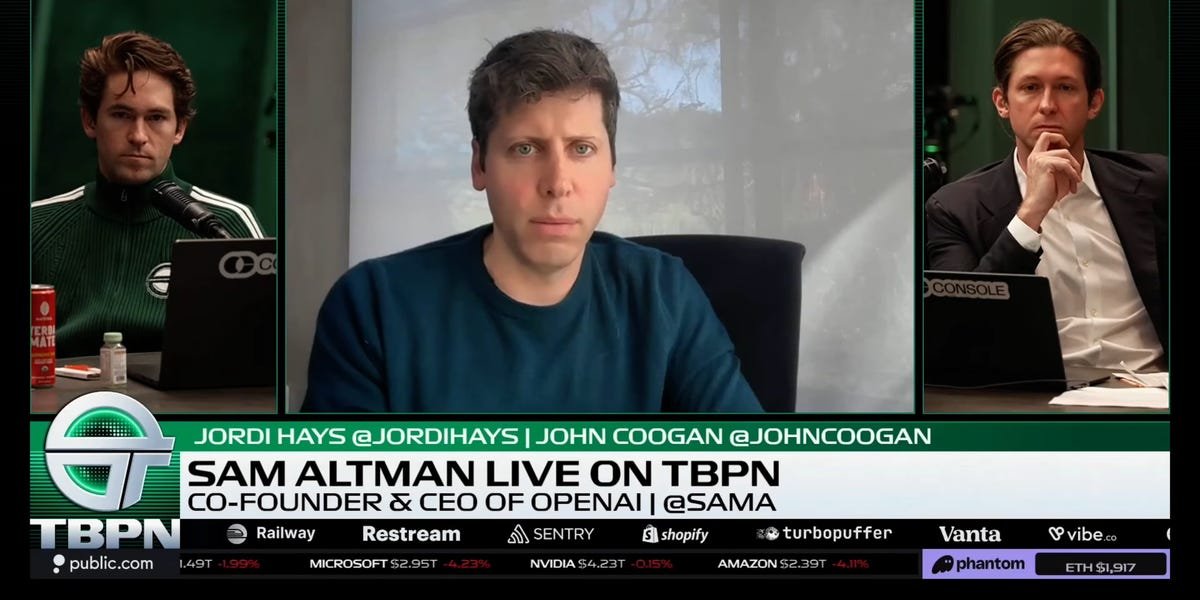
OpenAI owns tech’s favorite talk show. Will its rivals still show up?

OpenAI wants to control the narrative. Literally.

The AI giant bought TBPN, the tech industry’s hottest talk show, in a deal so shocking that one of its hosts joked it wasn’t a belated April Fool’s joke.

A good chunk of you might be asking, “TBP what?” You’re not wrong for wondering. As popular as the weekday, three-hour show is, it’s also intensely focused on tech. (That’s on purpose. John Coogan, one of the cohosts, recently talked about TBPN being intentionally niche.)

Within that specific group, it is huge. Dubbed “SportsCenter” for Silicon Valley, it’s basically a must-watch for tech bros. Hence why people are freaking out about one of the biggest tech startups buying one of the industry’s most popular shows.

BI’s Peter Kafka has some great analysis on why the deal makes sense. For a company that’s thinking in trillions of dollars, spending a few hundred million (terms weren’t disclosed, but that’s the number being floated) to nab your industry’s most influential show makes a lot of sense.

And it’s not just getting a show. It’s a direct line to the people shaping the industry it’s looking to dominate.

(We’ve also got some more takes on the news from other smart people around the interwebs.)

Questions are swirling about whether this OpenAI-version of TBPN can retain its magic.

TBPN hosts Coogan and Jordi Hays have said they will maintain editorial independence from OpenAI. But TBPN will also assist OpenAI with marketing and communications outside the show, potentially blurring the lines between coverage and promotion.

Still, it’s not like TBPN is looking to break big scoops or investigations like “60 Minutes.” Coogan and Hays are both former tech founders who are unabashedly pro-tech. That formula has helped them court the biggest names in the industry, and is unlikely to change under the new regime.

What will be interesting to see is how many of those big names are willing to come on now that the show is backed by their competition. Will Mark Zuckerberg welcome TBPN back to Meta’s headquarters now that his rival Sam Altman is signing their checks? What about executives from Anthropic or Google?

OpenAI competitors will need to ask themselves: Is reaching the audience TBPN holds worth helping a rival you’re actively fighting for market share?

What does seem inevitable is that we’re about to get A LOT of TBPN copycats, writes BI’s Sydney Bradley, Dan Whateley, and Lucia Moses.

Livestreaming talk shows were already on the rise. OpenAI shelling out for TBPN only adds fuel to that fire. And in an industry known for imitation, other AI giants might snap up their own version of TBPN.

An influx of new shows could just water down the market, though. SportsCenter was largely successful because it was the only place to watch sports highlights. That changed with social media, and was the beginning of the end of SportsCenter’s era of dominance.

TBPN may be at the center of tech conversation right now. The question is how long any one show can stay there.



Source link

Greenlanders-say-Trumps-talk-of-buying-the-island-crossed-a.jpeg

Greenlanders say Trump’s talk of buying the island crossed a line

If Greenlanders weren’t concerned by President Donald Trump’s threats to annex the territory in his first term, many of them are now.

In the days since the United States’ surprise raid into Venezuela, there’s been a renewed focus on Trump’s interest in the island, sparking fear among locals.

“I don’t know what he’s able to do. Most of me is trying to tell myself, ‘Don’t worry, everything’s going to be fine,’ but still I’m worried,” Tupaarnaq Kreutzmann Kleist, a sheep farmer in South Greenland, told Business Insider’s Sarah Andersen on Tuesday.

Casper Frank Møller, CEO and cofounder of Greenland tourist company Raw Arctic, echoed Kleist’s concerns, saying that he and many of his peers are worried about how the situation may affect their finances.


Casper Frank Møller on a boat with mountains in the background.

Casper Frank Møller, CEO and cofounder of Raw Arctic.

Raw Arctic


“We’ve made investments into developing our tourism aspects of our company, and it comes with risk now because of the geopolitical situation and the threats by Trump, so of course, yeah, we’re all really worried,” he told Business Insider on Tuesday.

In a statement to Business Insider on Tuesday, White House press secretary Karoline Leavitt confirmed that Trump and his team are discussing a range of options to pursue Greenland, including “utilizing the US Military.”

A US takeover feels more realistic than ever

Trump’s had his sights set on the Arctic island, a semi-autonomous territory of Denmark, since his first term in office. He has argued that Greenland’s location makes it strategically important, as the melting of Arctic ice opens up new shipping routes and intensifies competition with Russia and China. The island is also rich in critical minerals and already hosts a key US military base, which American officials say is vital to missile defense and Arctic security.

When Trump initially raised the topic of buying Greenland in 2019, Greenlandic influencer and engineer Qupanuk Olsen told Business Insider she and other locals thought it was a joke, and said she still didn’t take it seriously when Trump resurfaced talks in late 2024.


Qupanuk Olsen sitting at table.

Qupanuk Olsen is one of Greenland’s most prominent influencers.

Mark Adam Miller


That changed when Donald Trump Jr. visited Nuuk in January 2025. “That’s when we realized that Trump’s words were no longer just words,” Olsen said in June. “They are real, and he means what he says.” Business Insider wasn’t able to reach Olsen this week for a follow-up.

In the wake of the raid on Venezuela, Møller said on Tuesday that Trump’s threats to annex Greenland feel “much more realistic that it will actually happen” than when he spoke with Business Insider in January 2025.

A country dividing

US interest had at least one positive effect, Olsen said in June: It pushed Greenlanders to think more seriously about their place in the world and the need to speak for themselves.

“It was such a huge wake-up call for everyone in Greenland because suddenly we needed to have an opinion whether we still want to stay under Denmark, whether we should become independent, or whether we should become a state under the United States,” she said. “We certainly had options. So those options were helpful in the beginning for the independence movement.”


Tupaarnaq Kleist in a blue shirt at a kitchen table in her home.

Tupaarnaq Kleist is a sheep farmer in Greenland.

Mark Adam Miller


That mindset may be shifting. Kleist said she’s worried that “we as the local indigenous Greenlandic people are slowly going against each other now,” she told Business Insider on Tuesday. Some want to stand with America, others with Denmark, she said. Ultimately, though, the dream is for Greenland to become its own independent country, she added.

“We want Greenland to be the Greenlanders, and we’re not for sale. We are not to be taken over,” Møller said.

Naaja Nathanielsen, Greenland’s minister of natural resources, business, energy, justice, and gender equality, said in June that she sees much of the American administration’s interest in Greenland as an opportunity for collaboration. But she said the way Trump is going about it is wrong.


Naaja Nathanielsen in black shirt in office setting.

Naaja Nathanielsen is Greenland’s minister of natural resources, business, energy, justice, and gender equality.

Mark Adam Miller


“I think if we take the temperature down a bit and de-escalate the conflict level and the rhetoric, I think we can, in agreement with each other, find many paths forward that are mutually beneficial for both the US and for us,” Nathanielsen said in June. “But we don’t appreciate being talked about as a commodity, as something you can buy or sell or acquire or take. That is, of course, offensive to all people.”

In an email on Tuesday, Nathanielsen told Business Insider that she stands by what she said in June.

“The people of Greenland find the current situation unsettling, and it causes a great deal of anxiety,” she wrote. “We will continuously promote the idea of alliances and partnerships over colonialism. We have had our share of that.”

The debate heats up

Denmark, Trump has argued, is not doing enough to safeguard Greenland. “We need Greenland from the standpoint of national security,” Trump told a group of reporters on Air Force One on Sunday.

The same day, Denmark’s Prime Minister Mette Frederiksen urged the US in a statement to “stop the threats against a historically close ally.” Frederiksen has previously rejected Trump’s suggestions outright, telling him that Greenland is not for sale and that any idea of annexation is “absurd.”

Frederiksen has warned that any US military action against Greenland would severely damage NATO unity, raising questions about whether the alliance could withstand such a conflict between allies.

On Tuesday, major European leaders, including those from France, Germany, the UK, Italy, Spain, Poland, and Denmark, released a joint statement defending Greenland. “Greenland belongs to its people,” the statement said. “It is for Denmark and Greenland, and them only, to decide on matters concerning Denmark and Greenland.”


Source link

I-spent-a-year-interviewing-and-listening-to-over-50.jpeg

I spent a year interviewing and listening to over 50 tech leaders talk about AI. Here are the 4 biggest lessons.

I’ve listened to and interviewed more than 50 tech leaders this year, from executives running trillion-dollar firms to young founders betting their futures on AI.

Across boardrooms, conferences, and podcast interviews, the people building our AI future kept returning to the same four themes:

1. Use AI, because someone who understands AI better might replace you

This is the line I heard most often. Nvidia CEO Jensen Huang has said it multiple times this year.

“Every job will be affected, and immediately. It is unquestionable. You’re not going to lose your job to an AI, but you’re going to lose your job to someone who uses AI,” he said at the Milken Institute’s Global Conference in May.

Other tech leaders echoed his view, with some saying that younger workers may actually have an edge because they are already comfortable using AI tools.

OpenAI CEO Sam Altman said on Cleo Abram’s “Huge Conversations” YouTube show in August that while AI will inevitably wipe out some roles, college graduates are better equipped to adjust.

“If I were 22 right now and graduating college, I would feel like the luckiest kid in all of history,” Altman said, adding that his bigger concern is how older workers will cope as AI reshapes work.

Fei-Fei Li, the Stanford professor known as the “godmother of AI,” said in an interview on “The Tim Ferriss Show” published earlier this month that resistance to AI is a dealbreaker. She said she won’t hire engineers who refuse to use AI tools at her startup, World Labs.

This shift is already showing up in everyday roles. An accountant and an HR professional told me they’re using AI tools, including vibe coding, to level up their skills and stay relevant.

2. Soft skills matter more in the AI era

Another consensus I’ve heard among tech leaders is that AI makes soft skills more valuable.

Salesforce’s chief futures officer, Peter Schwartz, told me in an interview in May that “the most important skill is empathy, working with other people,” not coding knowledge.

“Parents ask me what should my kids study, shall they be coders? I said, ‘Learn how to work with others,'” he said.


salesforce peter schwartz

I interviewed Salesforce’s chief futures officer, Peter Schwartz, in May.

Lee Chong Ming/Business Insider


LinkedIn’s head economist for Asia Pacific, Chua Pei Ying, also told me in July that she sees soft skills like communication and collaboration becoming increasingly important for experienced workers and fresh graduates.

As AI automates parts of our job and makes teams leaner, the human part of the job is starting to matter more.

3. AI is evolving fast — and superintelligence is coming

As the year went on, the stakes around AI’s future began to feel bigger and more real. Tech leaders increasingly spoke about chasing artificial general intelligence, or AGI, and eventually superintelligence.

AGI refers to AI systems that can match human intelligence across a range of tasks, while superintelligence describes systems that surpass human capabilities.

Altman said in September that society needs to be prepared for superintelligence, which could arrive by 2030. Mark Zuckerberg established Meta’s Superintelligence Labs in June and said that the company is pushing toward superintelligence.

These leaders don’t want to miss the AI moment. Zuckerberg underscored that urgency in September, saying he would rather risk “misspending a couple of hundred billion dollars” than be late to superintelligence.

Some tech leaders, such as Databricks CEO Ali Ghodsi, argued that the industry has already achieved AGI. Others are more cautious. Google DeepMind’s cofounder, Demis Hassabis, said in April that AGI could arrive “in the next five to 10 years.”

Even when tech leaders disagree on timelines, they tend to agree on one thing: AI progress is compounding.

I saw this acceleration from the outside as a user. New tools are rolling out at a dizzying pace — from ChatGPT adding shopping features and image generation to China’s “AGI cameras.”

Things that would have felt magical in January now feel normal.


LingGuang

I tried Ant Group’s vibe coding app LingGuang’s AGI camera last month.

Lee Chong Ming/LingGuang


4. The human needs to be at the center of AI

Many leaders also circled back to the need for human control amid AI acceleration.

Microsoft AI chief Mustafa Suleyman said superintelligence must support human agency, not override it. He said on an episode of the “Silicon Valley Girl Podcast” published in November that his team is “trying to build a humanist superintelligence,” warning that systems smarter than humans will be difficult to contain or align with human interests.

Anthropic CEO Dario Amodei has been blunt about the risks AI poses if it’s misused.

While advanced AI can lower the barrier to knowledge work, the risks scale alongside the rewards, Amodei said on an episode of the New York Times’ “Hard Fork” published in February.

“If you look at our responsible scaling policy, it’s nothing but AI, autonomy, and CBRN — chemical, biological, radiological, nuclear,” Amodei said.

“It is about hardcore misuse in AI autonomy that could be threats to the lives of millions of people,” he added.

Geoffrey Hinton, often referred to as the “godfather of AI,” said in August that as AI systems surpass human intelligence, safeguarding humanity becomes the central challenge.

“We have to make it so that when they’re more powerful than us and smarter than us, they still care about us,” Hinton said at the Ai4 conference in Las Vegas.


Source link