
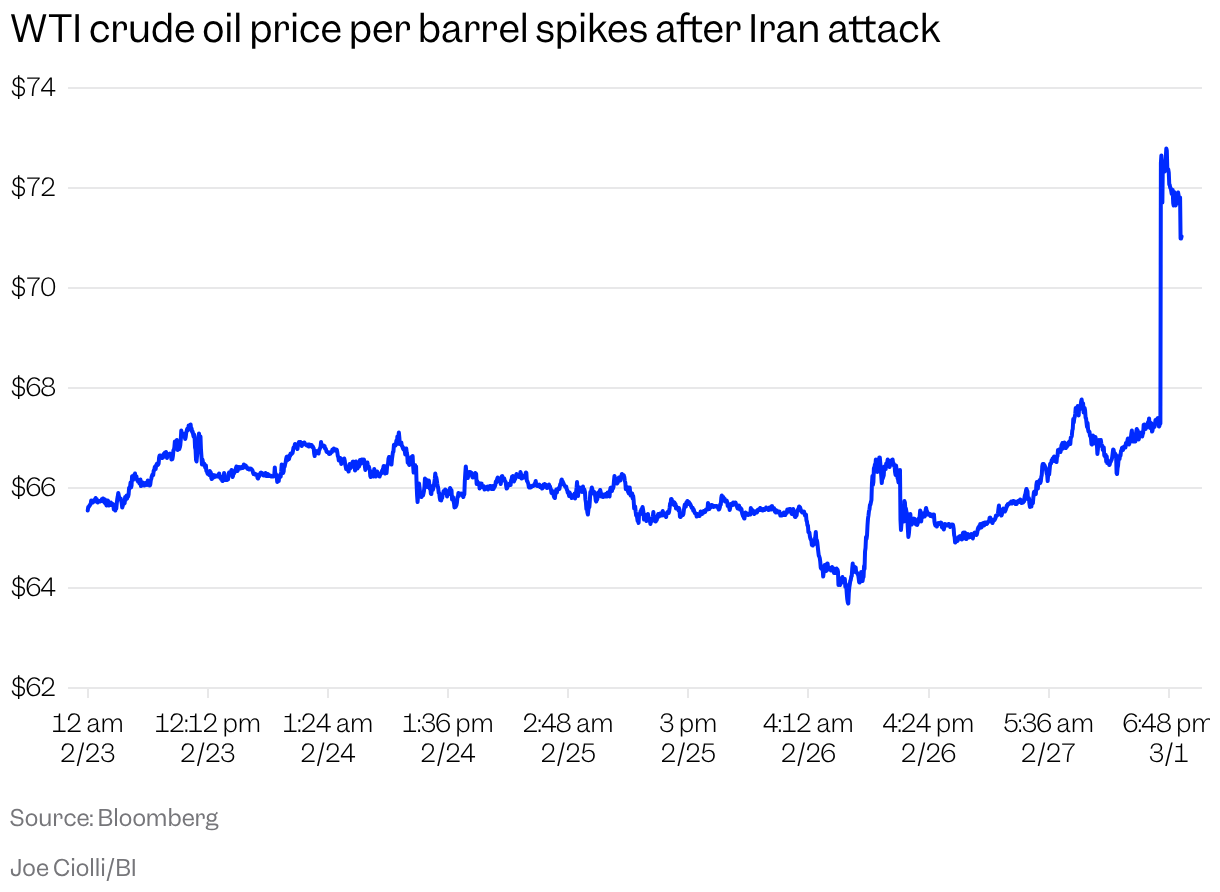
Line chart

The Middle East crisis isn’t just about tankers — oil output could be forced offline next

Oil traders are bracing for disruptions to the Strait of Hormuz after the US and Israel struck Iranian targets over the weekend, putting at risk the waterway that carries about one-fifth of the world’s oil.

A longer disruption would shift the risk onshore, because storage tanks across the Gulf can only be filled for only so long.

If the conflict drags on and export routes remain blocked, producers could be forced to halt production as storage fills up, Daan Struyven, the head of oil research at Goldman Sachs, said on Goldman Sachs’ “Exchanges” podcast published Monday. This could send prices sharply higher.

“If the Strait of Hormuz is closed for a very long time, you cannot draw inventories forever, and the market may have to rebalance by incentivizing prices to such high levels that you generate demand destruction,” Struyven added.

Oil prices are already sharply higher this year on the back of heightened geopolitical risks.

International benchmark Brent and US West Texas Intermediate crude oil futures are 3% and 2.4% higher at around $80 and $73 per barrel, respectively, in early trade on Tuesday. Both grades are up about 30% this year.

The Middle East accounts for about one-third of the world’s seaborne crude.

“Gulf producers do have storage capacity, pipelines, and tanker alternatives, but these are not unlimited,” wrote Chris Weston, the head of research at Pepperstone, in a Tuesday note.

“With the Strait of Hormuz temporarily constrained, the longer the disruption persists, the greater the risk that additional facilities and infrastructure across the Gulf region may be forced offline,” Weston added.

JPMorgan analysts have also warned that if the strait is effectively closed for more than 25 days, storage constraints could push major Middle East producers to suspend output altogether.

‘A supply shock of historic proportions.’

Iran’s Revolutionary Guards said on Monday that the Strait of Hormuz is closed and they will attack any ship trying to cross the waterway.

Major lines are rerouting or suspending services and adding war-risk fees, while some marine insurers have canceled war-risk cover for vessels operating in and around Iranian waters.

Apart from oil, Qatar’s state-owned energy company has halted liquefied natural gas production after reported damage to facilities, underscoring how quickly disruptions can spill beyond crude into wider energy markets.

The macro consequences could be severe, wrote analysts at ING on Monday, as even a partial disruption to the Hormuz would produce “a supply shock of historic proportions.”

However, because the US is a major oil producer, higher oil prices benefit shale producers and improve the domestic energy industry.

Still, inflation could tick up for American consumers, so “that balance is politically awkward to explain and economically insufficient to compensate for the broader damage,” wrote ING analysts.


Source link

Fighting-with-Iran-has-spread-to-tankers-at-sea-Ships.jpeg

Fighting with Iran has spread to tankers at sea. Ships are coming under fire around the busy Strait of Hormuz.

Deadly fighting in the Middle East has spread to tankers around the strategic Strait of Hormuz, with multiple ships coming under fire on Sunday, opening up a new front in the conflict.

The Palau-flagged oil tanker Skylight (IMO 9330020) was “targeted” a few miles north of the Khasab port in Oman, the country’s Maritime Security Center said, adding that the 20-person crew was evacuated. At least four people were injured.

An official with Operation Aspides, the European Union’s counter-Houthi mission, told Business Insider that Omani authorities carried out the rescue operations.

The US Treasury Department sanctioned Skylight and more than two dozen other “shadow fleet vessels” in December for illegally moving Iranian oil.

No one claimed responsibility for the attack, but the Gulf Cooperation Council said it condemned the “brutal Iranian attacks” targeting the Duqm port in Oman and “an oil tanker off its coast.”

The incident marked the first time that a ship had come under fire since the US and Israel began a strike campaign against Iran on Saturday morning. Tehran has retaliated by launching missiles and drones across the Middle East.

The United Kingdom Maritime Trade Operations, an element of the Royal Navy, has reported at least two additional attacks off the coast of Oman. Two vessels were struck by an “unknown projectile,” it said.


A cargo ship is pictured off the coast of the city of Fujairah, in the Strait of Hormuz in the northern Emirate on February 25, 2026.

Multiple ships came under attack near the Strait of Hormuz on Sunday.

Photo by Giuseppe CACACE/AFP via Getty Images


Iran has a history of carrying out attacks against ships near the Strait of Hormuz, including with its Shahed one-way attack drones, which have gained notoriety as Russia uses them extensively in Ukraine. Its proxies have also attacked commercial vessels.

The incidents underscore the new risk to shipping near the Strait of Hormuz. The narrow body of water between Iran and Oman is one of the world’s most important global trade routes, with about 20% of the world’s daily oil supply passing through it.

On Saturday, an Operation Aspides official said that ships had received radio transmissions from the Iranian Islamic Revolutionary Guard Corps (IRGC) stating that vessels were barred from entering the Strait of Hormuz.

However, the UKMTO said on Sunday that “no official closure of the Strait of Hormuz has been formally communicated to the maritime industry through recognized maritime safety channels.”

It said that the maritime safety situation in the region remained “highly volatile,” with the ongoing fighting creating an “elevated threat to commercial shipping.” Britain warned that vessels could face military miscalculation and electronic interference.

Some vessels are avoiding the Straight of Hormuz, with international shipping companies suspending transits until further notice. Marine traffic trackers showed a significant drop in traffic through the strait after the US and Israeli strikes began on Saturday.

Iran previously threatened to shut the Strait of Hormuz in retaliation for any attacks or moves it deemed hostile by the US. A full blockade, or even a sufficiently dangerous environment to deter enough ships from traveling through, could send oil prices soaring.

Israel and Iran continued to trade strikes into Sunday. Retaliatory fire from Tehran has targeted more than half a dozen other Middle East countries, including bases hosting US troops across the region.


Source link