FedEx-and-UPS-charged-fees-for-collecting-tariffs-Now-customers.jpeg

FedEx and UPS charged fees for collecting tariffs. Now, customers want that money back.

Another legal fight over tariffs is brewing — this time, over the fees shipping services such as FedEx and UPS charge to handle the duties.

After the Supreme Court ruled many of President Donald Trump’s tariffs unconstitutional last month, some companies sued the federal government seeking refunds. Some, like FedEx, said publicly that they would pass along any tariff refunds that they get to businesses and consumers who ultimately paid them.

The tariffs themselves aren’t the only charges customers got stuck with, though. Shipping services, including FedEx and UPS, also tacked on brokerage fees and other charges to the tariff bills they sent customers.

A half-dozen recent lawsuits filed by customers against shipping companies are seeking refunds for those fees, too.

The lawsuits argue that the shipping companies never should have charged the fees in the first place, and that the shippers, not the government, owe the customers. In some cases, the fees totaled as much as the cost of the tariffs themselves.

The shippers “made the decision to assess that additional fee,” John Yanchunis, an attorney at Morgan & Morgan, a firm that filed a lawsuit against FedEx over tariffs and brokerage fees, told Business Insider.

The plaintiff in Yanchunis’ lawsuit, a South Florida resident who ordered a pair of tennis shoes from Germany with a declared value of $140, received a $36 bill from FedEx. The bill included $21 in now-unconstitutional tariffs and $15 in “FedEx’s customs brokerage and duty advancement fees,” according to the complaint.

Yanchunis said that his case aims to get compensation independent of FedEx’s lawsuit over the tariffs themselves. “Why should consumers have to wait for Federal Express or any other company to battle it out with the government?” he said.

At least five similar lawsuits, most seeking class-action status, have been filed against either FedEx or UPS since the Supreme Court’s ruling last month.

A FedEx spokesperson did not comment on whether the company plans to refund brokerage fees for shipments subject to the tariffs. The spokesperson pointed to a February statement in which the company said, “if refunds are issued to FedEx, we will issue refunds to the shippers and consumers who originally bore those charges,” though it did not mention related fees.

A UPS spokesperson did not respond to a request for comment.

FedEx and UPS could face questions about costs in court

For average consumers, the fees became apparent this past summer when Trump ended the de minimis loophole, which had allowed shipments valued at less than $800 to enter the US duty-free. Consumers began receiving tariff bills from UPS and FedEx for international shipments containing everything from wine from Italy to camera lenses from Japan.

Some customers told Business Insider that UPS also charged them late fees and threatened to send their bills to collections as they attempted to correct errors, such as incorrect tariff rates.

Some of the lawsuits against FedEx and UPS argue that, like the tariffs themselves, the companies never had standing to collect the brokerage fees.

“Even if FedEx refunds the void duties, the brokerage fees remain unlawful charges for which there was no lawful basis,” the complaint in Yanchunis’ lawsuit reads.

While the US government has collected $133 billion in IEEPA tariffs — those that were ruled unconstitutional — it’s not clear how much shipping services such as FedEx and UPS have collected in fees.

UPS said in its annual report filed earlier this year that, despite having to adjust to the tariffs, the company “achieved revenue growth of 3.4%” in its supply chain solutions business, “driven, in part, by brokerage results.” Its brokerage business also contributed to the company’s operating profit, according to the report.

Deciding how much of the brokerage fees companies like FedEx and UPS might have to pay back would be tricky, said Adam Hanover, managing director of restructuring and dispute resolution at advisory firm CohnReznick.

Courts handling the lawsuits might have to decide how much of the brokerage fees were the companies’ actual costs and how much they took as profit, Hanover said. FedEx and UPS pay their own in-house brokerage teams, which handle many of the tariffed shipments, for example.

FedEx cited “customs-related brokerage fees due to the removal of the de minimis exemption” as a factor that increased its operating expenses in recent quarters, according to the company’s quarterly filing.

“You can really go down a rabbit hole on this one,” he said.

Patrick Penfield, professor of supply chain practice at Syracuse University’s Whitman School of Management, said that FedEx’s $15 charge on the shoes in Yanchunis’ case seems “somewhat excessive” for such a low-value consumer good. FedEx says it charges either $15 or 2% of an item’s value, whichever is greater, for shipments valued at less than $800.

The lawsuits are likely to determine whether those fees actually were excessive — and how much consumers could get back.

“FedEx is entitled to some money, but I think it was a little bit too much money,” Penfield said.

Do you have a story to share about tariffs? Contact this reporter at abitter@businessinsider.com or via encrypted messaging app Signal at 808-854-4501. Use a personal email address, a nonwork WiFi network, and a nonwork device; here’s our guide to sharing information securely.

Source link

Dan Whateley

Netflix’s Ted Sarandos says he asked Trump not to pursue movie tariffs. Here’s what he proposed instead.

Netflix co-CEO Ted Sarandos doesn’t think tariffs are the right way to boost US movie and TV production — and he thinks he’s gotten through to President Donald Trump on the issue.

“He has brought up tariffs for the movie and television industry many times, and I’ve hopefully talked to him the way out of them,” Sarandos said in a new interview with POLITICO, which, alongside Business Insider, is part of the Axel Springer Global Reporters Network.

Trump has been keen on using tariffs to encourage more filming in the US. In May, he announced on Truth Social a plan to impose a 100% tariff on films produced outside the US. He hasn’t implemented it so far.

Trump’s plan to add tariffs on foreign movies stemmed from a desire to slow production declines in Hollywood and other areas of the US that “are being devastated” by filming incentive programs abroad, he wrote in his May announcement on Truth Social.

Los Angeles production work has been dropping off for years, and the city’s media professionals are feeling the pain. Overseas filming hubs like London have been courting production work by offering big cost-saving incentives.

Sarandos said he’d prefer the US use similar tax incentives to bring filming back home.

“Healthy incentive programs attract a lot of production, and you’ve seen a lot of them move from California to Georgia to New Jersey,” Sarandos told POLITICO. “Having the incentives versus tariffs is much better.”

The tariff structure for a movie, which isn’t a physical good, isn’t entirely clear. A White House spokesman said in a statement shortly after Trump’s announcement that “no final decisions on foreign film tariffs” had been made and that the administration was “exploring all options to deliver on President Trump’s directive to safeguard our country’s national and economic security while Making Hollywood Great Again.”

A fee on foreign productions could become very expensive for Netflix, which has released a slate of international films and TV shows over the years, including “All Quiet on the Western Front,” “Squid Game,” and “Adolescence.”

Netflix’s global reach and its ability to turn a South Korean or German drama into a global hit have been key differentiators for the company, which is expected to spend as much as $20 billion on content this year.


Source link

Judge-clears-path-for-refunds-on-Trump-tariffs-ruled-unlawful.jpeg

Judge clears path for refunds on Trump tariffs ruled unlawful by the Supreme Court

  • A Supreme Court ruling recently struck down President Donald Trump’s IEEPA tariffs.
  • A federal judge on Wednesday said companies are entitled to benefit from that ruling.
  • US Customs must recalculate duties on imports, disregarding Trump’s IEEPA tariffs, per court order.

A federal trade judge on Wednesday cleared the path for refunds on President Donald Trump’s tariffs, applied through the International Emergency Economic Powers Act, after the Supreme Court recently struck them down.

In the ruling, Judge Richard K. Eaton of the US Court of International Trade said that US importers who were subject to those tariffs are “entitled to the benefit” of the Supreme Court ruling.

Eaton also ordered the US Customs and Border Protection — the agency responsible for collecting import duties — to “liquidate” import entries without regard to the tariffs Trump imposed through the IEEPA, a national emergency law that gives a president broad authority to regulate economic transactions.

The judge is essentially ordering the government agency to calculate the final bill for certain shipments entering the US as if the IEEPA tariffs never applied. Any accounting on goods that have already been calculated, or “liquidated,” but are not legally final, needs to be redone without the duties, the judge ordered.

Importers generally have 180 days after goods are liquidated before the accounting is legally finalized.

The move is another blow to the Trump administration, which sought to raise government revenue through taxes on imports. Trump applied double-digit tariffs through an executive order on nearly every country in April 2025, calling it “Liberation Day.”

On February 20, the Supreme Court struck down, in a 6-3 ruling, Trump’s IEEPA duties, stating that the national emergency law does not give the president the ability to unilaterally impose tariffs. The ruling made no explicit mention of refunds.

In the Wednesday order, Eaton indicated he will serve as the sole judge overseeing cases involving refunds of IEEPA duties.

The exact dollar figure for refunds remains unclear. The Penn Wharton Budget Model estimates that the tariff reversals could generate up to $175 billion in refunds.

Spokespeople for the White House and CBP did not immediately return a request for comment.


Source link

FedEx-says-itll-refund-tariffs-to-customers-if-it-gets.jpeg

FedEx says it’ll refund tariffs to customers if it gets money back from the Trump administration

  • FedEx says it will refund customers for tariff charges if its own efforts to get a refund succeed.
  • On Monday, FedEx sued the Trump administration in trade court seeking a refund.
  • An exact timeline or process for refunds remains unclear after last week’s Supreme Court ruling.

FedEx says it will give you a refund if you used its shipping service and paid President Donald Trump’s unconstitutional tariffs — that is, if the company itself gets a refund from the government.

Days after the US Supreme Court ruled against many of Trump’s tariffs, FedEx filed a lawsuit against the Trump administration seeking a refund of the tariffs it had paid on behalf of customers.

If that effort is successful, the company said, it plans to pass that money on to the businesses and people it charged for those duties.

“Our intent is straightforward: if refunds are issued to FedEx, we will issue refunds to the shippers and consumers who originally bore those charges,” FedEx said in a statement on its website.

Right now, there’s no timeline or process for handling refunds, FedEx said, adding that it’s waiting “on future guidance from the government and the court.”

Rival UPS, which had not revealed plans to seek tariff refunds as of Friday, did not immediately respond to a request for comment from Business Insider.

FedEx is one of many companies suing the Trump administration to recover some or all of the tariffs they paid.

Many US consumers have been hit directly by tariffs through international shipments carried by services like UPS and FedEx, Business Insider previously reported.

Some individual customers and businesses have had packages held up at customs for weeks, or tried to dispute tariff charges they say were incorrectly calculated, including at a 200% rate for Russian aluminum.

Do you have a story to share about tariffs? Contact this reporter at abitter@businessinsider.com or via encrypted messaging app Signal at 808-854-4501. Use a personal email address, a nonwork WiFi network, and a nonwork device; here’s our guide to sharing information securely.


Source link

Kavanaugh-in-dissent-Bad-policy-or-not-Trumps-tariffs-were.jpeg

Kavanaugh in dissent: Bad policy or not, Trump’s tariffs were ‘clearly lawful’

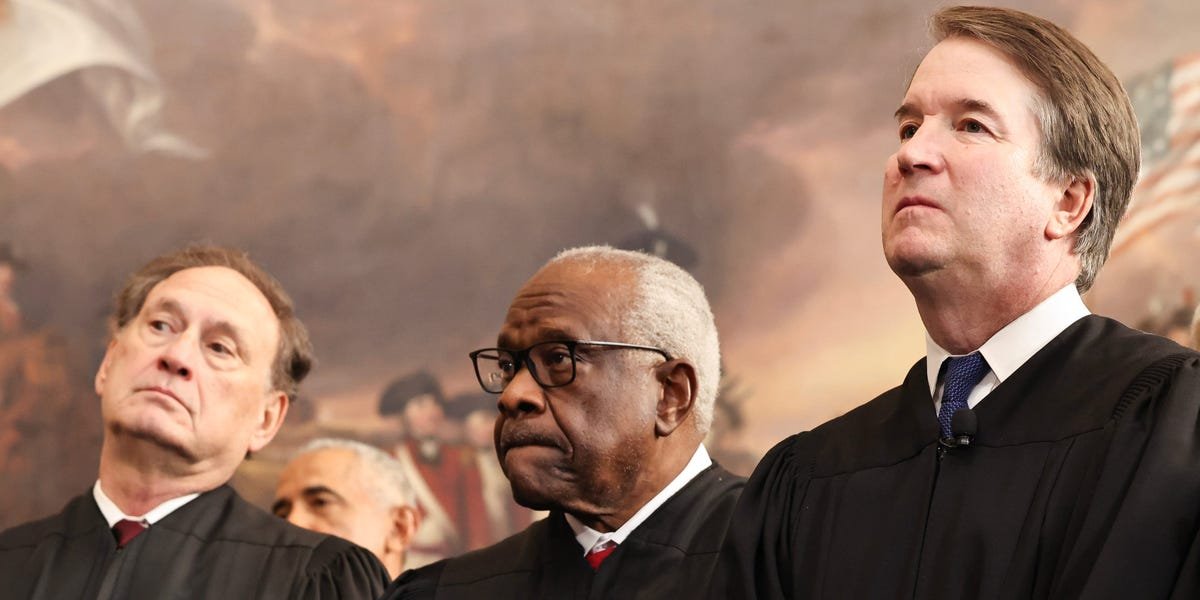
Three conservative justices of the US Supreme Court — Brett Kavanaugh, Clarence Thomas, and Samuel Alito — broke with the majority Friday, arguing that President Donald Trump had clear authority to impose his sweeping tariff policy.

The three dissenting justices said the president’s tariffs were perfectly legal under the 1970-era law Trump used that says presidents can “regulate” importation in the case of emergencies.

“The tariffs at issue here may or may not be wise policy,” Kavanaugh wrote. “But as a matter of text, history, and precedent, they are clearly lawful.”

The three justices also noted that the majority 6-3 decision is silent on how to return billions of dollars in tariffs that have already been collected.

That process “is likely to be a ‘mess,'” as was acknowledged at oral arguments, Kavanaugh wrote in a lengthy dissent that Thomas and Alito joined.

The two dissents differed with the majority on two fronts: Trump’s bypassing of Congress in imposing tariffs, and the legality of the president’s invocation of the International Emergency Economic Powers Act, or IEEPA.

In the dissent written by Kavanaugh, the justices argued that presidents have “commonly” imposed tariffs to regulate imports throughout American history.

Interpreting IEEPA to exclude tariffs “creates nonsensical textual and practical anomalies,” Kavanaugh wrote. As with quotas and embargoes, tariffs are a “traditional and common tool to regulate importation,” he said.

“It does not make much sense to think that IEEPA allows the President in a declared national emergency to, for example, shut off all or most imports from China, but not to impose even a $1 tariff on imports from China,” Kavanaugh wrote.

Reversing the tariffs may be an exercise in futility, Kavanaugh added. Even without IEPPA, “numerous other federal statutes authorize the president to impose tariffs and might justify most (if not all) of the tariffs at issue in this case,” Kavanaugh wrote.

In a separate dissent, Thomas tackled the constitutional question, arguing that the Constitution allows Congress to delegate tariff authority to the president.

“Historical practice and precedent confirm that Congress can delegate the power to impose duties on imports,” he said.


Source link

Supreme-Court-strikes-down-swath-of-Trumps-tariffs-—-but.jpeg

Supreme Court strikes down swath of Trump’s tariffs — but he has other options

The Supreme court struck down a chunk of President Donald Trump’s sweeping tariff policy on Friday, finding a new limit to the expansive presidential powers he has sought.

The 6-3 decision centered on the tariffs Trump justified under the International Emergency Economic Powers Act, a national security law that allows the president to regulate economic activity during emergencies.

Those IEEPA-justified tariffs have been one of Trump’s most powerful weapons in his efforts to renegotiate trade agreements around the globe. They include Trump’s so-called “Liberation Day” tariffs, announced in April, which are at least 10% on nearly every country in the world.

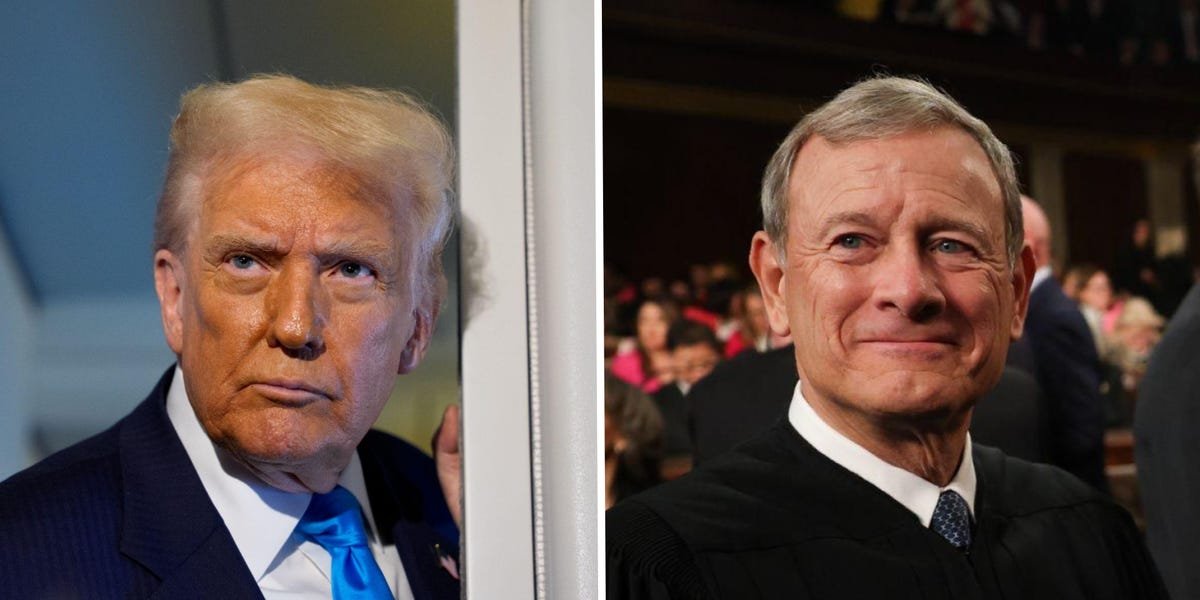
The Trump administration’s use of the law went too far, wrote Chief Justice John Roberts in the majority opinion. Trump would need a distinct law from Congress “to justify his extraordinary assertion of the power to impose tariffs,” he wrote.

“What common sense suggests, congressional practice confirms,” he wrote. “When Congress has delegated its tariff powers, it has done so in explicit terms, and subject to strict limits.”

The Supreme Court’s decision comes as the United States trade deficit is shrinking, largely due to the Trump administration’s tariffs, which are taxes on imported goods. It shrank to $29.4 billion in October, the lowest figure since 2009, according to recently published Commerce Department data.

Two groups of businesses filed lawsuits challenging Trump’s authority to impose tariffs through IEEPA. The Supreme Court combined their cases and put it on the fast track, holding oral arguments at the beginning of its November term.

IEEPA, a Carter-era law, gives presidents the power to “regulate” importation in times of emergency. The Trump administration claimed that it included the ability to impose tariffs — a position no other president has taken.

Lawyers representing the businesses argued that Congress has been clear about taxation and tariff powers in other laws, and would have been clear if IEEPA were meant to confer those powers to the president.

During oral arguments, most judges expressed skepticism about the Trump administration’s arguments. Justice Neil Gorsuch, whom Trump appointed to the bench in his first term, said taxes were “part of the spark of the American Revolution” and should get careful treatment.

“The power to reach into the pockets of the American people is just different,” Gorsuch said. “And it’s been different since the founding.”

The Supreme Court’s ruling does not affect the tariffs that Trump has imposed using other laws, and Trump still has the power to issue additional tariffs using those laws.

But his administration has favored IEEPA because of its perceived flexibility. The other laws that allow presidents to impose tariffs without explicit Congressional approval have limits — including built-in expiration dates and caps on the amount taxed. They also make it more difficult to target particular countries, rather than certain industries.

This is a breaking story. Please check back for updates.


Source link

Nathan Rennolds

Trump threatens Canada with 100% tariffs over Beijing trade deal: ‘China will eat Canada alive’

President Donald Trump on Saturday threatened to impose 100% tariffs on all Canadian goods and products exported to the US should Ottawa make a trade deal with China.

In a post on Truth Social, Trump warned Canadian Prime Minister Mark Carney, whom he called “Governor Carney,” against making a “drop off” deal with Beijing or face the levies.

“If Governor Carney thinks he is going to make Canada a ‘Drop Off Port’ for China to send goods and products into the United States, he is sorely mistaken,” Trump wrote.

“China will eat Canada alive, completely devour it, including the destruction of their businesses, social fabric, and general way of life,” he added.

Carney made an official visit to China last week — the first by a Canadian leader since 2017 — meeting with Chinese leader Xi Jinping to discuss economic and trade opportunities between the two countries.

In a joint statement following the meeting, Ottawa and Beijing said they had committed to expanding bilateral trade and investment, as well as building cooperation in areas such as energy and agriculture.

Carney also announced that Canada would now allow up to 49,000 Chinese electric vehicles into the Canadian market on the “most-favoured-nation tariff rate of 6.1%.” In return, he said Canada expected China to lower tariffs on Canadian canola seed to around 15% by March 1.

Trump had initially said that the deal was what Carney “should be doing” and that it was “a good thing for him to sign a trade deal.”

Trump’s changing tone comes days after Carney delivered an impassioned speech at the World Economic Forum in Davos, where he opined on the changing face of global politics since Trump’s election.

“We are in the midst of a rupture, not a transition,” Carney, who did not explicitly name Trump, said, adding that “middle powers must act together because if we’re not at the table, we’re on the menu.”

Trump did not miss the opportunity to snap back at Carney during his own speech at Davos, saying the prime minister “wasn’t so grateful.”

“Canada lives because of the United States. Remember that, Mark, the next time you make your statements,” he added.


Source link

Kelsey Vlamis's face on gray background.

US tariffs are paid almost entirely by Americans, a German study finds

A favorite tool of President Donald Trump has been costing Americans, according to new study.

The brunt of US tariffs — 96% — have been paid by US buyers, research from the Kiel Institute for the World Economy, a German think tank, found, while about 4% of the tariff burden was paid by foreign exporters.

“American importers and consumers bear nearly all the cost,” the researchers said of the tariffs.

The study, published Monday, said that the $200 billion increase in customs revenue that the US government raised in 2025 was a “tax paid almost entirely by Americans.”

The research contradicts Trump’s messaging that tariff costs would not be paid by Americans, but by other countries and overseas exporters. The president’s aggressive tariff policy launched last year placed additional duties on dozens of trade partners, including China, India, and the European Union.

The Kiel Institute study examined more than 25 million shipment records, worth nearly $4 trillion, between January 2024 and November 2025. The researchers found that there was a “near-complete pass-through” of the tariffs.

“US import prices rise nearly one-for-one with tariffs, while trade volumes contract,” the study said.

The findings echo other research that has found Americans are paying for tariffs, including from Harvard Business School and The Budget Lab at Yale. Analysts at Deutsche Bank and Bank of America also said last year that Americans were the ones paying for the tariffs.

The Kiel study said American importers and wholesalers are first hit by the tariff cost, followed by manufacturers and retailers, all of which must choose whether to absorb the tariff or pass it on to their customers. American consumers are then hit by increased prices, both on imported goods or American-made products that use foreign inputs. There’s been more limited availability of goods in the US, the researchers found.

Trump has continued to use tariffs, saying on Saturday that he would impose additional tariffs on Denmark and other European countries unless they agree to a deal that would transfer Greenland to the US.

Many of Trump’s tariff policies could also be undone. The Supreme Court is expected to rule soon on the legality of a host of Trump’s tariffs that were instituted under an emergency national security law. Trump has said the US would be “screwed” if the tariffs are overturned.


Source link

Trump-says-the-US-will-impose-up-to-25-tariffs.jpeg

Trump says the US will impose up to 25% tariffs on Denmark and other European countries until they hand over Greenland

  • Trump says the US will impose new tariffs on European countries until Denmark hands over Greenland.
  • The president said the tariffs would start at 10% and increase to 25%.
  • Trump has repeatedly used tariffs as leverage on what he calls national security issues.

President Donald Trump has turned to his favorite form of leverage in his fight to annex Greenland.

Trump said on Saturday he would impose a 10% tariff on Denmark, which controls Greenland, as well as Sweden, Norway, France, Germany, the United Kingdom, the Netherlands, and Finland, unless they agree to a deal to hand over Greenland to the United States.

The president said he would raise those tariffs to 25% in June if they did not comply. All of those countries have already been paying a 10% tariff rate since Trump’s Liberation Day levies went into effect in August 2025.

“This tariff will be due and payable until such time a deal is reached for the complete and total purchase,” he said in a Truth Social post. Trump’s threat comes as world leaders and CEOs gather in Davos, Switzerland, for the World Economic Forum. The president is expected to address the conference on Wednesday.

Trump has had Greenland on his mind since his first term, but has ramped up the rhetoric since the US raid in Venezuela that netted Nicolás Maduro.

The president says US control of Greenland is a national security issue.


Source link