
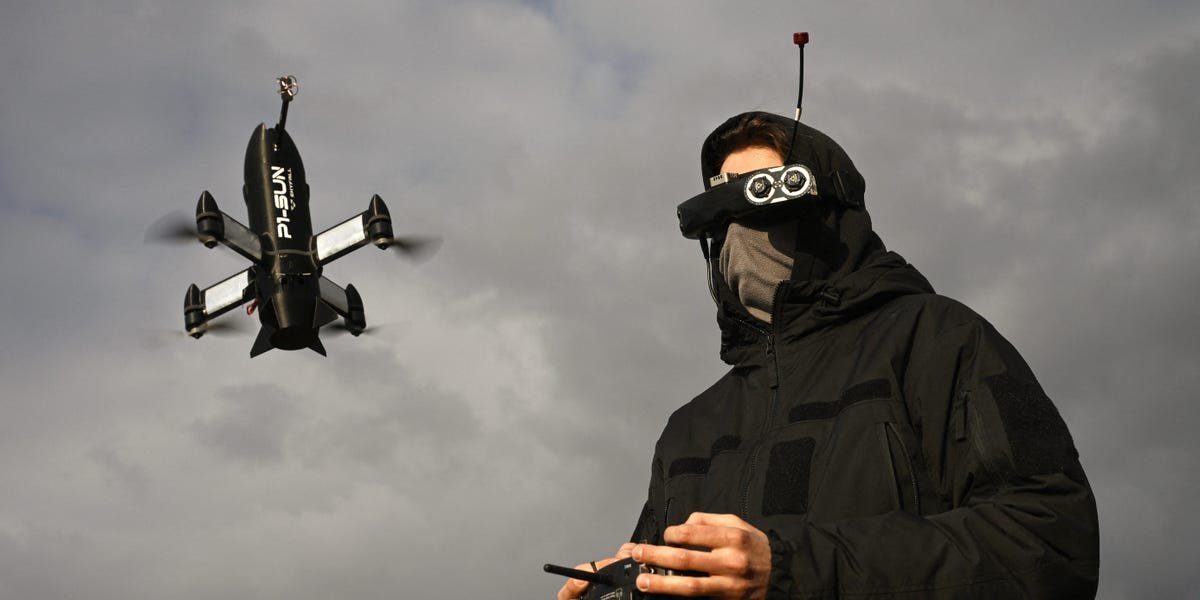
Shahed-killing-interceptor-drones-may-look-simple-but-building-them-to.jpeg

Shahed-killing interceptor drones may look simple, but building them to keep up with the threat isn’t easy

Cheap, lightweight, and built for mass production, interceptor drones may look simple.

They aren’t. And keeping them relevant against evolving threats is anything but easy.

Ukraine is making these inexpensive Shahed-killers at scale — it says up to roughly 2,000 a day — and demand is rising globally as militaries look beyond multimillion-dollar missiles to confront cheap, mass drone attacks.

Drone makers told Business Insider that these systems are deceptively complex, and small tweaks to their designs can make a life-or-death difference.


An Iranian Shahed-136 on display.

An Iranian Shahed-136 is on display in Tehran. These loitering munitions are now used both by Iran and Russia. 

Morteza Nikoubazl/NurPhoto via Getty Images


To stop a Shahed, an interceptor drone must be stable, fast enough to catch its prey, and maneuverable enough for a human pilot to hit a flying target. It also has to be low-cost and suitable for mass production.

One variant in Kyiv’s arsenal is the Sting, a first-person-view drone developed by the Wild Hornets that costs about $2,000 per unit, a fraction of the cost of the Russian one-way attack drones they chase, estimated to cost at least $20,000 each.

Early 2024 versions of the drone struggled to match the Shahed’s roughly 115 mph speed.


The view from a Ukrainian interceptor drone moments before it struck a Shahed drone.

The view from a Ukrainian interceptor drone moments before it struck a Shahed drone. 

Viktor Lysenko/BI


A ‘constant balancing act’

Upgrading an interceptor to maintain relevance is a “constant balancing act,” a Wild Hornets representative told Business Insider, speaking on the condition of anonymity to discuss sensitive defense projects.

“Building an individual motor, sensor, or frame is relatively straightforward,” they said. “The challenge is making everything work together quickly, accurately, and reliably in a real environment.”

A larger battery allows a drone to fly for longer, but it weighs it down. Larger propellers increase thrust but can make it cumbersome. Stronger motors overheat. More complex software adds lag. Every gain potentially creates a tradeoff.


Two Ukrainian crew members of an interceptor squad prepare a Sting drone from within a truck.

An interceptor crew prepares a Sting drone from their civilian vehicle. 

Wild Hornets


And the threat continues to evolve. Newer, jet-powered versions of Shaheds are increasingly appearing in Russia’s attacks. Some are armed with missiles, while others are equipped with automatic systems to evade interceptor drones.

More recently, Ukraine has warned that Russia is now exploring another Iranian-designed turbojet drone, the Karrar, that reportedly flies at speeds of up to 370 mph.

Kyiv will need new solutions, Serhii “Flash” Beskrestnov, a drone expert advising Ukraine’s defense ministry, warned in a February statement to drone manufacturers.

“All the enemy’s bets will be on speed,” he said.

The iconic ‘bullet’ shape

Most interceptor drones share a similar physical design: a teardrop- or bullet-shaped frame with four propellers at the base.

The same design shows up in civilian speed-record drones.


Bell tinkers with the Peregreen V4 in a workshop.

Bell’s Peregreen V4 drone also uses a bullet shape with four propellers. 

Screenshot via YouTube/Luke Maximo Bell


South African hobbyist Luke Maximo Bell, maker of the Guinness World Record’s fastest quadcopter to date — it reached 408 mph during a straight flight in December 2025 — has been trying to break drone speed records since at least 2023.

He told Business Insider that the teardrop design is common because it’s the “classic aerodynamic shape” for reducing drag. The cross-section of a commercial airliner’s wings, for example, is shaped like a teardrop.

Instead of the overall design concept, most drone makers obsess over the finer features such as the thickness and length of the quadcopter’s arms, the sharpness of its nose, and the length of its tail.

“It’s very small optimizations,” said Bell.

Changing the gap between the propellers can massively increase thrust output or efficiency, he said, while power imbalances can cause drones to overheat and catch fire.

As hobbyists like Bell push the physical limits of what these systems can do, he said hundreds of Ukrainians have reached out to him and his father, who makes drones with him, about building similar tools for war. Bell said he’s sticking to his YouTube channel.

“I guess it’s a bit scary that we can do all of that just from like, a garage, essentially,” he said.

Building drones for armed conflict

In Ukraine’s military drone industry, civilian models often serve as inspiration for manufacturers, said Egor Tereschenko, the head of sales at the Ukrainian drone motor company Motor-G.

But building drones as interceptors comes with additional requirements.

“For civilian record-breaking, you just optimize the drone for speed and nothing else,” Tereschenko told Business Insider. Ukrainian officials said in December that his firm’s motors allowed an interceptor to reach a major speed milestone of 248.5 mph.

Unlike civilian drones, an interceptor drone has to carry explosives, which increases its weight. And as the quadcopter approaches a target like a Shahed, it needs enough power left over for a final burst of speed to catch its quarry. Many interceptors also require software to help the human pilot lock onto a target.


Interceptor drone parts are stacked on shelves.

Interceptor drones of the 3rd Army Corps Interception Squadron are stacked on shelves. 

Ed JONES / AFP via Getty Images


Right now, the typical Ukrainian interceptor drone flies at about 220 mph, he said.

The main issue manufacturers face now is figuring out how to keep pushing these drones without overheating them, Tereschenko added.

“The motor or some wiring or the computer unit — something will give out because you are running insane amounts of power, producing a lot of heat in a very compact, fragile, and sensitive system,” he said.

Beyond a prototype design

While top speed and maneuverability are key, customers ultimately look for reliability in interceptor drones.

“A slightly slower drone that works every time is usually more valuable than a very fast one that fails occasionally,” said Jiri Janousek, a representative for the Czech drone manufacturer TRL Drones. The company makes two fixed-wing interceptor drones being used in Ukraine.


A jet-powered interceptor drone sits on a launch platform in an open field.

Czech firm TRL Drones makes a jet-powered interceptor drone launched from a sling. 

TRL Drones


They also need to be scalable. Countries want to buy interceptor drones in bulk, so they need to be easy to manufacture and upgrade.

Janousek said that while interceptors can be partially built with off-the-shelf parts, core elements such as their structure and control systems must be built from the ground up.

“Making one prototype is relatively easy, but making a system that can be produced repeatedly with the same performance and reliability is much harder,” he said.



Source link

Armed-with-longer-range-missiles-a-top-Russian-fighter-jet-is.jpeg

Armed with longer-range missiles, a top Russian fighter jet is posing a bigger threat, analyst says

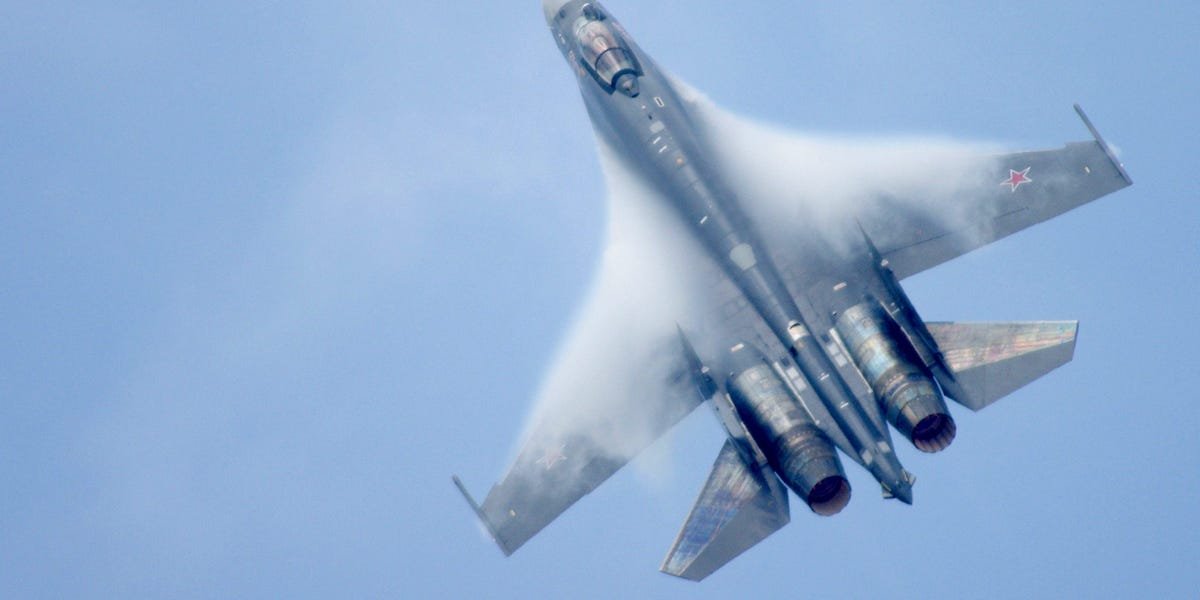
Russia’s Su-35 fighter jets are increasingly flying with longer-range air-to-air missiles that make them a potentially greater threat to NATO air operations, a leading airpower expert assessed in a recent report.

Justin Bronk, a researcher at the UK-based Royal United Services Institute, said in his assessment of Russian air power that regularly arming Su-35 and Su-30SM2 jets with R-37M missiles “has significantly contributed to increasing the threat that they can theoretically pose to NATO air operations.”

The R-37M missile, which NATO calls the RS-AA-13, is “much more capable at long range” than the R-77-1 missiles the Su-35 had previously relied on, Bronk told Business Insider in a discussion of his recent report.

R-77-1 missiles have a range of about 62 miles, while R-37M missiles are understood to have a range of around 200 miles. Real-world kills at range depend on a mix of factors, but reach still matters.

Bronk told Business Insider that the longer-range R-37M missiles had been “very much a specialist weapon” for a limited selection of Russian jets. But “now you see absolutely routine employment” of the weapon on Russia’s Su-35S.

The Su-35 fighter is “the primary air superiority aircraft for the Russians,” he added. The jet is key for Russia’s air force, with the UK Ministry of Defence in 2023 describing it as Russia’s “most advanced combat jet in widespread service.”

Bronk told Business Insider that for the NATO alliance, the regular arming of Su-35s and Su-30SM2s with the R-37M is “a problem” because it puts “more credible long-range air-to-air missiles at play from the Russian side.”

Those missiles used to be contained within a smaller part of the force, mainly Russia’s MiG-31s. Now, Bronk said, having them on more jets “is obviously a significant growth in the potential threat that they can pose to NATO aircraft in a direct conflict.”


A grey fighter jet in a light blue sky with fire visable in its two engines

The R-37M was previously concentrated on Russia’s MiG-31 jets.

Mikhail Svetlov/Getty Images


Additionally, he said, Russia’s Su-35 crews are “generally more highly selected, better trained, more capable than the crews on the MiG-31s.” Russia’s better pilots tend to fly its top jets, and those will be the pilots operating these missiles.

Having them routinely carry long-range air-to-air missiles, rather than the “really pretty limited” R77-1 that they used to carry, Bronk said, “is a significant shift.”

A missile with a longer reach

The R-37M’s combat effectiveness has been spotlighted by Russia’s full-scale invasion of Ukraine, which began in February 2022.

Late that year, a RUSI report said the R-37M, combined with Russia’s MiG-31BM interceptor aircraft, was proving to be “highly effective and difficult for Ukrainian pilots to evade due to its speed, very long range, and specialized seeker for low-altitude targets.”

At that time, it said Russia was just starting to put them on Su-35S jets.

A newer report from RUSI in November highlighted how much more the R-37M missile was being used, saying that this missile “in particular, has been used to destroy several Ukrainian aircraft at long range,” including one kill recorded at more than 109 miles.

“This is significantly beyond the engagement range of most NATO air-to-air munitions,” the report said. But it also said that the missiles’ success was “heavily determined by Ukraine’s lack of effective radar warning receivers,” something NATO has fielded far more robustly across its air forces.

The Su-35 threat

Making the Su-35 more powerful is a big move for Russia. In 2022, analysts at the RAND Corporation described the Su-35 as Russia’s “signature heavy fighter.”

Ukraine has shot down multiple Su-35s in its fight against Russia’s invasion, but Bronk said that despite reported losses, the fleet has “marginally increased since the start of the full-scale war.”

He estimated that in late 2020, Russia had about 90 Su-35s. Between eight and 10 have been lost in combat or accidents, he said, but 55 to 60 new aircraft have since been delivered — leaving Russia with roughly 135 to 140 Su-35s overall, a net increase despite the attrition.

Bronk’s analysis was based on interviews with Western air forces and ministries, data from Ukraine’s armed forces, and open-source information.

He said that the Russian air force has gained so much valuable combat experience against Ukraine that its air force is now “a significantly more capable potential threat for Western air forces than it was in 2022.”

He said that in air-to-air combat, where Russian aircraft take on Western ones, the West still has a strong advantage, but longer-range air-to-air missiles complicate the picture.

And any fight would not only be in the air. The West would face not only Russia’s air force but also its vast ground-based air defense network, which the war has also made more formidable.

Bronk told Business Insider that Su-35 crews are typically “much better at working with the ground-based air defenses,” meaning the jets can operate more effectively under the umbrella of Russian surface-to-air missile systems and are therefore “more credible as an air-to-air threat.”

He said that the improvement of those ground-based defenses throughout the war — combined with the fielding of more powerful missiles on Su-35s that are increasingly integrated with them — is one reason why Russian airpower “represents a greater threat to Western air power capabilities in Europe” than it did before the full-scale invasion.


Source link

Taylor Rains

Trump’s threat to ‘decertify’ Canadian planes is a safety risk

President Donald Trump’s threat to “decertify” Canadian-made aircraft — the backbone of many US carriers’ regional jet fleet — is a threat to aviation safety, industry watchers said Friday.

The president also doesn’t have the authority to unilaterally declare planes unworthy to fly in the US, Henry Harteveldt, an aviation industry authority and president of Atmosphere Research Group, told Business Insider. That authority belongs to the FAA.

The trade spat — another in a continuing back-and-forth between Trump and Canada — comes after Canada hasn’t fully certified newer US-made Gulfstream jets to fly in its skies. (It has certified older models.) Gulfstream planes are used almost exclusively by private aviation companies, governments, and the ultrawealthy.

Trump said on Thursday night, in a Truth Social post, that he would “decertify” Canada-made Bombardier jets until Canada approved the Gulfstream models. He also threatened a 50% tariff on “any and all” Canadian aircraft sold in the US until the situation was corrected.

Bombardier said in a statement that it’s in contact with the Canadian government. The FAA referred Business Insider to the White House. A White House official said decertification would not immediately affect aircraft already in operation; it would apply only to new deliveries.

That would be a relief for US airlines like American, Delta, and United, whose regional affiliates operate Bombardier CRJ aircraft to cities across the country.


SkyWest crj700.

Regional carrier SkyWest, operating on behalf of the Big 3 and Alaska Airlines, is the largest operator of Canadian-made planes. It has 238, per Cirium.

Fabrizio Gandolfo/SOPA Images/LightRocket via Getty Images


Still, any move to decertify these more than 2,000 passenger airliners and private jets — part of almost 5,550 Canadian-made aircraft and helicopters certified in the US, according to Cirium — could trigger thousands of flight cancellations a day. A 50% tariff would likely raise airline ticket prices.

Aviation analysts said Trump’s threat posed a safety risk in itself.

“Anything that intrudes on the turf of safety regulators coming from politics, trade issues, or personal grievances is a very, very bad idea,” Richard Aboulafia, managing director of the aviation consultancy AeroDynamic Advisory, told Business Insider.

Aboulafia said aircraft certification is intentionally non-political for a reason: Regulators are meant to evaluate risk, not respond to trade threats. Once certification becomes a political weapon, trust in the system erodes for manufacturers, operators, and the flying public, he contended.

Why is the Gulfstream certification delayed in Canada?

In Canada’s case, the delay in certification is likely not obstructionism but the result of independent regulatory decisions.

For the Gulfstream G700 and G800, Canada hasn’t completed its own certification, while the FAA has granted Gulfstream a temporary exemption from certain fuel‑icing rules designed to ensure aircraft engines and systems operate safely in extreme cold.

The FAA waiver means Gulfstream has until the end of this year to meet those requirements — meaning the aircraft is operating under essentially conditional certification in the US, despite being allowed to be delivered.

These waivers are not unusual and are typically granted to allow new aircraft to enter service while completing certain technical tests and paperwork, rather than because the planes are unsafe.

Still, history shows what can sometimes go wrong when thorough certification and safety protocols are deprioritized. The most consequential example was the Boeing 737 Max, which suffered two fatal crashes in 2018 and 2019 due to systemic design issues, killing 346 people.

More recently, in early 2024, a door plug separated on another 737 Max due to quality-control issues at Boeing’s Washington factory, further exacerbating scrutiny of production and certification. No one died in that incident.

Part of the reason the 737 Max issues slipped past regulators is that, for decades, global authorities often relied on reciprocal approvals, effectively rubber-stamping each other’s certifications to speed aircraft to market.

The Max disasters exposed the risks of that approach. Today, regulators — including those in Canada — are expected to conduct their own full assessments rather than automatically rely on approvals from foreign authorities.

The FAA itself is taking extra precautions before certifying the Boeing 737 Max 7 and 10, as both aircraft have technical problems that could lead to engine overheating. Boeing initially asked for a waiver but rescinded it amid the scrutiny.


Source link

Under-threat-Ukraines-drone-schools-are-going-to-great-lengths.jpeg

Under threat, Ukraine’s drone schools are going to great lengths to stay off Russia’s radar

The leaders of several drone schools training Ukraine’s operators for the fight against Russia say they’re targets and they have to act accordingly — tightly protecting information and even moving around.

Throughout its invasion of Ukraine, Russia has launched huge drone and missile barrages at factories, training sites, and civilian infrastructure across the country, often far from the fighting in the east, straining Ukrainian defenses and serving as a constant reminder that nowhere in the country is completely safe.

Drones are prolific on the battlefield in Ukraine. Operators are priority targets. It stands to reason the schools training them for war would be too. Officials from three drone schools told Business Insider that they take steps to avoid getting hit.

Tetyana, a Ukrainian veteran who goes by the call sign “Ruda” and is now the head of R&D for Dronarium, a drone training school with sites in Kyiv and Lviv, said that it must follow strict safety rules because “the entirety of Ukraine is not safe, missile-wise, drone-wise.”

Dmytro Slediuk, head of the education department at Dronarium, told BI the safety measures, including not disclosing publicly exactly where its training centers are located and also changing their location “from time to time,” are necessary to prevent Russia from interfering with its training

To keep certain location data from getting out, the school doesn’t allow photos and videos that might reveal where its facilities are based.

The school has been mentioned by Russia’s military bloggers, influential pro-war accounts that often circulate operational details and commentary to large audiences. Though they are typically in favor of the war, they are also sometimes critical of Russia’s performance and dispute some of its defense ministry’s claims.


Two figures stand in an open field beside a launcher with a grey winged drone in the air

Drone schools say they’re targets for Russia.

Ivan Antypenko/Suspilne Ukraine/JSC “UA:PBC”/Global Images Ukraine via Getty Images


Rybar, a media outlet with 1.5 million Telegram subscribers, listed Dronarium as an example of Ukraine’s drone training efforts. The UK has sanctioned Rybar, initially presented as a milblogger but actually a partially Russian government-sponsored information warfare operation, and the US has offered up to $10 million for information.

Tetyana said Russian outlets have been writing about the school since 2022, the year Russia started its full-scale invasion. “As long as they write and talk about us, it means that they are afraid of us,” she said. But it also means that they’re on Russia’s radar.

She said the school and its attendees strictly adhere to a set of critical cybersecurity rules, and said there are also general safety rules in place. “When the air raid siren is on, all training activities, all the work, everything gets suspended, and we deconcentrate and get into safe shelters.” She said no one is complacent.

Vitalii Pervak, CEO of another training school, Karlsson, Karas & Associates, said that safety steps are crucial because “the Russians are constantly hunting for places where military personnel gather.”

Ukrainian officials have confirmed that Russia has hit some Ukrainian military training sites, killing personnel. It’s the kind of thing air defenses can try to prevent, but Ukraine has suffered shortages throughout the war. Ukraine has also successfully hit Russian bases and gatherings of Russian personnel.

The key is to prevent Russia from gaining sufficient knowledge of the school to target it. Its steps include “everyone who works at KK&A, including the cleaners,” having to do a polygraph security interview.

He said they don’t share any information about the location of the training center or about the appearance of the instructors or cadets.

“Some of our employees may have relatives or acquaintances in occupied territories who could be tortured by Russians for indirect contact with someone who opposes Russia,” Pervak said. “This secrecy also protects the instructors and cadets themselves, as well as their relatives, from attacks by Russian agents.”

He said that while the added security “hinders publicity to some extent — good things should be spoken about loudly — war dictates its own conditions. We are well aware that failing to observe the principles of secrecy may result in the death of staff or cadets.”

Viktor Taran, the CEO of the Kruk Drones UAV training center, said that “Russia is interested in destroying us.”

“Thanks to God and air defence, we’re still operating.”


Source link