The era of American travel chaos might not come to a close anytime soon, as a potential deal to fund the Department of Homeland Security — and Transportation Security Administration workers’ paychecks — appears to be falling apart.
Republican members of the House’s Freedom Caucus are signaling they won’t move forward with a proposal to fund DHS, potentially lengthening a shutdown that began on February 14.
Early Friday morning, the Senate voted to move forward with a proposal to end the partial shutdown that’s currently preventing TSA workers from getting paid. The Senate-approved proposal excludes funding for immigration operations and came as Congress prepared to depart on a scheduled recess Friday evening. For that legislation to become law — and get TSA workers paid — it needs to be passed by the House.
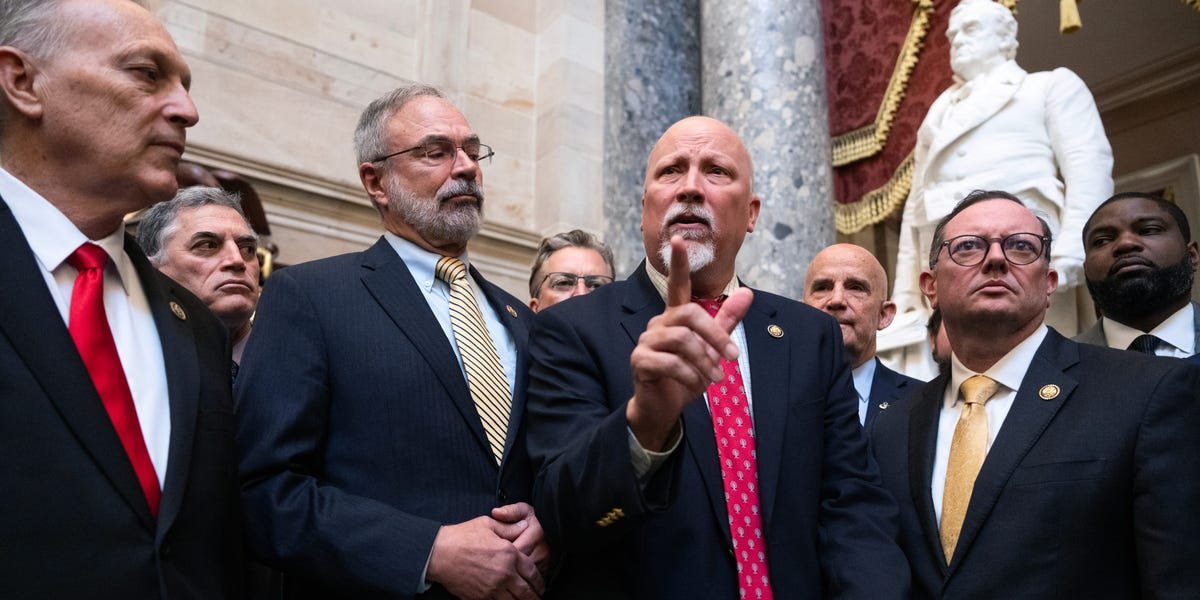
“Could the Senate be any more lazy than to send to us a bill that doesn’t do the job and then leave town?” Rep. Chip Roy, a Republican from Texas and member of the House Freedom Caucus, said at a press conference. “So we’re going to stand up and say no to that. We’re going to send back a bill that’s responsible to the American people.”
This is a developing story, check back for updates.
This story is available exclusively to Business Insider
subscribers. Become an Insider
and start reading now. Have an account? .
I paid $180 to ride in business class from NYC to Washington, DC, on the new Amtrak Acela train.
The train had modern amenities, like 5G WiFi, high-tech bathrooms, and ergonomic seating.
Despite upgrades, the high price outweighed the benefits of traveling in business class.
I’ve spent 26 hours riding the rails in business class around the world. My most recent Amtrak trip was the best business-class experience I’ve ever had in the US — but it still wasn’t worth the price tag.
In September 2025, I booked a business-class ticket from New York City to Washington, DC, on the Amtrak NextGen Acela train for $180.
The three-hour ride felt extremely comfortable and a tad luxurious. In the end, though, I couldn’t see myself splurging for it again.
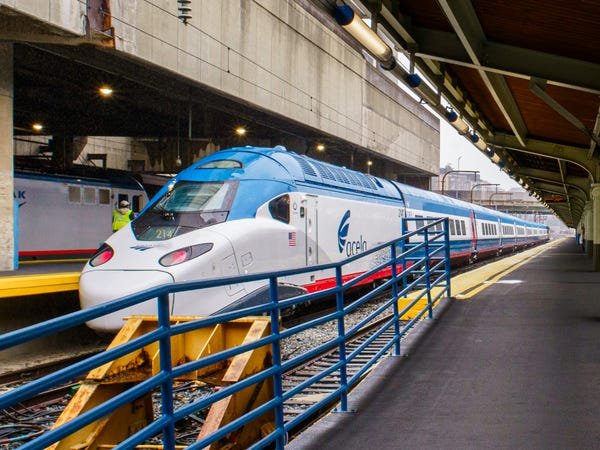
I rode from New York City to Washington, DC, on the Amtrak NextGen Acela train.
The exterior of the Amtrak NextGen Acela train. Joey Hadden/Business Insider
The Amtrak Acela is an express service between Boston and Washington, DC. The train line introduced a new fleet on the route in August 2025, known as NextGen Acela.
In addition to being the fastest Amtrak train with a top speed of 160 miles per hour, the NextGen Acela has modern interiors and high-tech amenities.
I booked a business-class ticket for $180.
A brochure on the train. Joey Hadden/Business Insider
The Amtrak Acela trains only have two classes — business and first. I booked my business-class ticket for $180.
Out of curiosity, I looked at the pricing for coach seating on the regional Amtrak train, which is 30 minutes slower than the Acela. It was $40.
When I arrived at Penn Station in NYC, I sat on the floor to wait for my train.
The line to board the author’s train. Joey Hadden/Business Insider
My train was scheduled to leave at 10 a.m., but there was a 90-minute delay. Since I was stuck at the station for longer than anticipated, I briefly considered going to the Metropolitan Lounge, an elevated space overlooking the train hall with cozy seating and complimentary refreshments.
First-class passengers and those traveling in sleeper accommodations can get into the lounge for free, but other Amtrak riders have to pay $50 to access it.
Since I’d already splurged on the business-class ticket, I decided to skip the lounge and head to the standard waiting room instead, but it was full. I finally settled for a seat on the floor against the wall until it was time to board.
Since I wasn’t in first class, I didn’t get priority boarding.
Passengers board the train. Joey Hadden/Business Insider
When I got in line to board, I was reminded that business class is just a standard ticket on the Amtrak Acela. Unlike business-class rides I’ve taken that also had coach seating, this trip didn’t include the perk of priority boarding.
The business-class car had a sleek, modern look.
Inside the business-class car. Joey Hadden/Business Insider
Retractable window shades, exposed overhead bin space, informative screens, and ergonomic seats made the car feel like a step up compared to business-class Amtrak trains I’ve booked in the past.
The seat was much more comfortable than most I’ve booked on Amtrak trains.
The author’s business-class seat. Joey Hadden/Business Insider
Soft, cushy, spacious, supportive — these are the words that popped into my head when I settled into my business-class seat. A reclining function and footrest made the ride even more comfortable.
Power outlets, USB ports, and a reading light were all conveniently located on the side of the seat. In front of me was a tray table and a fold-out cupholder.
I spent most of the ride streaming YouTube videos.
The author watches music videos. Joey Hadden/Business Insider
Most Amtrak trains I’ve been on have had WiFi, but in my experience, the connection has typically been too weak for much more than a Google search.
I was stoked when the NextGen Acela’s 5G WiFi was fast enough to stream YouTube videos without any issues. I passed the time by watching live sessions of my favorite bands.
The bathroom was spacious and clean with modern touches.
Inside the business-class bathroom. Joey Hadden/Business Insider
I’ve learned to set the bar low for train bathrooms. Stocked toilet paper, soap, and paper towels are not a given. Cleanliness and extra space aren’t either. In my experience, some business-class bathrooms are no different from those in coach.
So I was ecstatic when I stepped inside the lavatory on the NextGen Acela. The automatic door opened into a spotless space that felt big enough for two people to do jumping jacks simultaneously.
I found it aesthetically pleasing too, with bold red accents and trendy touches, from the shelf to the mirror.
I also appreciated the touchless water, soap, and dryer functions on the sink.
Although it was much more comfortable than sitting in coach, I didn’t think a business-class ticket was worth the high price point.
A coach car on another Amtrak train. Joey Hadden/Business Insider
“Amtrak travelers always have their preference,” an Amtrak representative wrote in an email to Business Insider. “If they want to experience these premium trains with enhanced amenities, they can. Or, if they prefer convenient and affordable downtown-to-downtown service up and down the Northeast Corridor, Northeast Regional trains offer a comfortable and enjoyable way to travel throughout the Northeast Corridor and points beyond.”
The next time I take an Amtrak train, I’ll miss the cozy seat, elevated bathroom, high-speed WiFi, and shorter travel time. Still, these perks weren’t enough for me to consider Acela’s business class to be worth more than quadruple the price of a coach ticket.
It’s been over 30 years since Americans have had the chance to watch their national soccer team play on their home turf.
They’ll get another chance next year, but it’ll cost them.
Fans could pay over $2,700 for a ticket to watch the USA’s first match in the 2026 FIFA World Cup against Paraguay, which is scheduled to take place in June at SoFi Stadium in Inglewood, California.
That far exceeds the estimated ticket prices included in the original joint bid submitted by the United States, Canada, and Mexico to host the World Cup.
FIFA, which sets ticket prices, says it is using variable pricing to determine ticket costs, and “may adjust ticket prices throughout the sales phases based on a review of demand and availability for each match.”
The organization said it isn’t using dynamic pricing — when ticket prices change in real time based on demand and other factors — for the 2026 World Cup. In addition to third-party sites like StubHub, which sell tickets, FIFA offers a resale and exchange marketplace for fans.
FIFA launched its third phase of ticketing last week. Soon after the portal opened, fans took to social media, expressing shock over what they described as steep prices.
World Cup tickets are divided into four categories, with Category 1 selling the most expensive tickets and Category 4 the cheapest options.
Ticket prices for the USA’s match against Paraguay on June 12.
As of Saturday, there are no available Category 4 tickets for the USA’s opening match against Paraguay on June 12. Instead, the cheapest ticket is selling for $1,120 under Category 3. The most expensive ticket costs $2,735, followed by $1,940.
The most expensive ticket for Mexico’s opening match against South Africa costs $2,355, and Canada’s opening matchcosts $2,170. Neither of those matches is offering Category 4 tickets.
As the tournament continues, ticket prices drop but are typically still far above original estimates.
When the USA faces off against Australia on June 19, the most affordable ticket is $265, while the most expensive is selling for $700. When the USA plays on June 25, fans will have to pay between $910 and $340.
Those prices are a far cry from what the United States, Canada, and Mexico estimated in their bid to host the tournament. The countries submitted a combined bid — dubbed the “United bid” — and were selected in 2018.
The Ticket Pricing Summary Table in the United bid book.
In their pitch, the countries estimated that a Category 1 ticket for an opening match would cost $774, followed by $614 for Category 2, $320 for Category 3, and $60 for Category 4.
Tickets for the final match were estimated to cost between $1,550 and $128. Under FIFA, the current final match prices — held at MetLife Stadium in New Jersey — start at $4,185. The most costly ticket is $8,680.
Despite the hefty price, fans eager to snag tickets in this phase can purchase them now until January 13.
The 23rd edition of the tournament will take place this summer in 16 cities across North America. The first game kicks off on June 11, and teams will play until the final match on July 19.