F-15E-Strike-Eagles-deployed-during-Operation-Epic-Fury-can-fly.jpeg

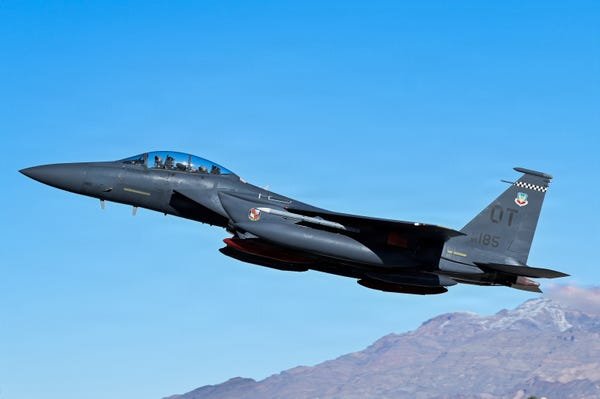
F-15E Strike Eagles, deployed during Operation Epic Fury, can fly 2.5 times the speed of sound. Take a closer look.

  • The US Air Force deployed F-15E Strike Eagles during Operation Epic Fury against Iran.
  • The fighter jets are designed for air-to-air and air-to-ground combat in all weather, day or night.
  • Kuwait mistakenly shot down three F-15E Strike Eagles in a “friendly fire” incident, CENTCOM said.

F-15E Strike Eagles, fighter jets designed for air-to-air and air-to-ground combat, are usually a dominating force in the skies.

When three F-15E Strike Eagles were mistakenly shot down by Kuwait during Operation Epic Fury, it brought renewed attention to one of the Air Force’s fastest, most versatile aircraft.

Here’s a closer look at the F-15E Strike Eagle, an advanced aircraft the US is using to destroy Iran’s missile arsenal and drone bases from the skies above Iran.

The F-15E Strike Eagle has been in service in the US Air Force for nearly 40 years.

An F-15E Strike Eagle at Nellis Air Force Base in Nevada. 

U.S. Air Force photo by Airman 1st Class Jasmine Thomas

The first F-15A model flew in 1972, and the first F-15Es were produced in 1988, according to the US Air Force.

It’s the fastest crewed aircraft in the US Air Force.


An F-15E Strike Eagle flies through the sky.

An F-15E Strike Eagle during an exercise at Gando Air Base in Gran Canaria, Spain. 

U.S. Air Force photo by Staff Sgt. Elizabeth Davis

The air-to-air and air-to-ground attack aircraft can fly at 1,875 miles per hour, or 2.5 times the speed of sound.

The F-15E Strike Eagle’s high thrust-to-weight ratio enables it to accelerate during vertical climb.


An F-15E Strike Eagle.

An F-15E Strike Eagle in flight. 

U.S. Air Force photo by Staff Sgt. Tylin Rust

The high thrust-to-weight ratio also allows the F-15E Strike Eagle to execute tight turns without sacrificing speed. It has two Pratt & Whitney F100 engines, each producing over 23,000 pounds of thrust.

Another distinguishing capability is the plane’s head-up display, which projects flight and tactical information directly on the windscreen.


The head-up display on a C-17 Globemaster III.

The head-up display on a C-17 aircraft. 

U.S. Air National Guard photo by Tech. Sgt. John Linzmeier

Pilots can track and attack targets, check the status of weapons, and see other tactical and flight information without taking their eyes off the windscreen.

The fighter jet also includes a low-altitude navigation and targeting infrared for night (LANTIRN) system.


The underside of an F-15E Strike Eagle.

The underside of an F-15E Strike Eagle. 

U.S. Air Force Photo by Airman 1st Class Olivia Gibson

The LANTIRN system allows the planes to fly in any weather and attack ground targets at low altitudes. The system consists of two pods, a navigation pod and a targeting pod, mounted under the plane.

F-15E Strike Eagles can carry both nuclear and conventional weapons.


Loading an AIM-120 missile onto an F-15E Strike Eagle

US Air Force crew members load an AIM-120 missile onto an F-15E Strike Eagle aircraft at Mountain Home Air Force Base in Idaho. 

Airman 1st Class Donovin Watson/366th Fighter Wing

Its armament includes an internally mounted 20-millimeter gun with 500 rounds of ammunition, AIM-9 Sidewinder missiles, and AIM-120 AMRAAMs, an acronym for the radar-guided Advanced Medium-Range Air-to-Air Missiles.

The F-15 also regularly carries ground attack weapons like the Joint Direct Attack Munition, or JDAM, a kit that adapts an unguided munition into a “smart” bomb with fins and GPS guidance.

F-15E Strike Eagles are flown by a pilot and a weapons systems officer.


The cockpit of an F-15E Strike Eagle.

The cockpit of an F-15E Strike Eagle. 

U.S. Air Force photo by Airman 1st Class Aidan Martínez Rosiere

The weapon system officer sits directly behind the pilot, and closely manages the plane’s sensors and weapons.

Two variants of the F-15 are single-seaters: the F-15A and F-15C.

The planes can fly 2,400 miles without refueling, and can be refueled in flight.


An F-15E Strike Eagle receives in-flight refueling from a KC-135 Stratotanker.

An F-15E Strike Eagle receives in-flight refueling from a KC-135 Stratotanker during an exercise over the Atlantic Ocean. 

U.S. Air Force photo by Senior Airman Cody J. A. Mott

F-15E Strike Eagles have a fuel capacity of 35,550 pounds.

The fighter jets can be refueled in flight by KC-135 Stratotanker aircraft, which Boeing developed from its “Dash 80” prototype in the 1950s.

KC-135s were also deployed to Israel as part of Operation Epic Fury. One crashed in western Iraq on Thursday, killing six US service members. United States Central Command said the circumstances of the crash were under investigation, but it “was not due to hostile fire or friendly fire.”

Each F-15E cost $31.1 million to produce in 1998, according to US Air Force figures. That would be around $62.3 million when adjusted for inflation.


F-15E Strike Eagles at Travis Air Force Base in California.

F-15E Strike Eagles parked at Travis Air Force Base in California. 

U.S. Air Force photo by Kenneth Abbate

Newer F-15 models cost around $100 million, The Wall Street Journal reported.

The newest version of the aircraft is the F-15EX Eagle II, which features more advanced controls and upgraded engines.

On March 1, Kuwait’s air defenses mistakenly shot down three American F-15Es during Operation Epic Fury in what US Central Command described as a “friendly fire incident.”


F-15E Strike Eagles in the Middle East.

F-15E Strike Eagles at an undisclosed base in the Middle East. 

U.S. Air Force photo by Senior Airman Jared Brewer

All six crew members ejected safely. The incident is under investigation.

“Kuwait has acknowledged this incident, and we are grateful for the efforts of the Kuwaiti defense forces and their support in this ongoing operation,” CENTCOM said.


Source link

A headshot of Insider's Pete Syme

Here’s how to check TSA wait times before your flight

Air travel is facing disruption due to long lines at airport security checkpoints.

Sunday and Monday saw hourslong waits at several airports, as Transportation and Security Administration officers missed their first full paycheck since the partial shutdown began.

At Houston’s Hobby Airport, travelers were warned to expect security lines stretching up to three hours. Delays were also reported at New Orleans, Atlanta’s Hartsfield-Jackson, and Miami International.

A political dispute over federal funding for the Department of Homeland Security has led to TSA officers working without pay.

Airport operations had largely avoided major disruption until Sunday, when some staff did not show up to work.

While disruption seems to have moderated on Tuesday, travelers are being advised to arrive early and allow extra time to clear security, as wait times can shift depending on staffing levels and peak travel periods.

Here’s how you can stay prepared

One simple way to monitor conditions is to check the website of the airport you’re flying from.

Many airports, including major hubs like Atlanta, Houston, JFK, Newark, Philadelphia, Dallas-Fort Worth, and Denver, post live wait times on their websites.

These can also provide more specific insights. For example, DFW’s website shows the wait times at each checkpoint.

On Tuesday morning, all these airports had average wait times of under 30 minutes.

Most US airports also frequently update their own websites with travel advisories for passengers. For instance, on Tuesday morning, Houston Airports, which manages both Houston Hobby and George Bush International, has a notice telling travellers to arrive early.

You can also use the MyTSA mobile app. It provides estimated wait times in 15-minute intervals based on average checkpoint data.

It should be noted that the app says it sometimes uses historical data if the live data cannot be retrieved. The TSA also says it is not “actively” managing its sites during the partial shutdown, and so the app may not always be updated.

Alternatively, flight-tracking websites like Flightradar24 and FlightAware can also give insights into airport conditions.

FlightAware has a “Misery Map” which shows flight delays at airports around the country, which could be affected by the security lines.

Flightradar24 also shows the average delay for departing flights if you select an airport.

TSA PreCheck lanes remain open nationwide, though the agency has warned they could be suspended at individual airports if staffing shortages worsen.


Source link

I-moved-13-times-over-15-years-to-advance-my.jpeg

I moved 13 times over 15 years to advance my career. I would never wish this on anyone.

Figure skating has long been a big part of my life. At 15, I convinced my school district to override attendance so I could pursue my then-competitive figure skating career. I then scheduled college classes around training.

Three undergraduate apartments and two graduate dorms later, I found a great place to live in New York City on Bleecker and Thompson for three years. I worked as a private figure skating coach at the Wollman and Chelsea Piers ice rinks. At 25, I enrolled at UCLA as a postdoctoral fellow and snagged a place in the Venice Canals. I loved it for two years. I then completed another postdoc for 1 year in San Diegothen returned to the East Coast for my first faculty position. Philadelphia turned me into a professor in developmental psychology.

I moved back to New York City for my 10th move to the West Village, but I wasn’t there long. I moved again to be closer to the train hall, and by then, entering my 30s and my third year of tenure-track, I just wanted to be home.

Happy but out of fuel, my 12th move was back to Southern California, and it was also my fourth across the coast.

With every move, packing felt heavier, and hiring movers didn’t lighten the load. The sight of boxes became demoralizing.

Moving so frequently lost its excitement

Every new city, I’d think: new cafés, new restaurants, and new yoga studios! But once I actually settled in, I only started to miss the spots and familiar faces I’d left behind.

Every time I’d, again, go out frolicking, eating, meeting, and socializing, a cloud of impermanence would steam from the back of my head.

I became confused about how much to invest in new relationships. I wondered if I should connect deeply with new people, if it was likely I’d be moving again sometime soon.

Sometimes, my location kept me far from my family

In the middle of grad school, I remember standing on a street corner and receiving an unexpected phone call: My father had died. I was far from home at that moment.

Even though I was often on the East Coast, my family frequently visited, especially my uncle and auntie.


Anahid S. Modrek's moving truck filled with boxes

The author had to pack up her life several times.

Courtesy of Anahid S. Modrek


When I moved back to California this most recent round, my uncle started to battle ALS and stopped visiting because of the staircase up to my space. After about a year, I received a phone call that my uncle was headed to the ICU; his fight with ALS was over. I’ll never live somewhere that isn’t wheelchair accessible again.

My final, most recent move (No. 13) was deliberate: downtown Culver City, behind the Museum of Jurassic Technology, where my grandfather Hagop Sandaldjian’s standing exhibition is. He died after I was born, and it was a way of connecting with him.

Moving was worth it for my career

This all started with decisions made when I was 15. I’m 35 now.

I did what I had to do in academia to maintain momentum. I don’t have regrets, per se. I wanted to experience it all.

Academia was an intellectual pursuit and an adventure that came with losses I didn’t expect. Ice eventually melts, and soil soaks up the water. That’s how roots grow.

Academia brought me back home, but it was a drive to maintain momentum developed as an athlete that kept me moving until my feet landed right where I wanted. Now up for early tenure, I feel like I’m just getting started.


Source link

I-graduated-from-college-6-years-ago-and-have-already.jpeg

I graduated from college 6 years ago and have already moved 10 times. I never thought my post-grad life would be this unstable.

Growing up with limited money, I always viewed college as a safety net, an investment that would set me up for immediate success. I started saving for tuition in high school, worked full-time in college to avoid student loans, earned straight A’s, and did all I could think of to guarantee financial success.

I felt financially secure for a short time, but everything changed when I graduated. The stability I once felt walking around my safe college town vanished almost overnight, and I was completely unprepared.

Since graduating over six years ago, I’ve moved 10 times while navigating rent increases, job changes, and the financial realities of being a young adult.

I thought life after college would be stable, but I was wrong

It took 10 months to find a job after graduating. When I finally did, I moved out of my childhood bedroom only to live temporarily with friends, and then back with my parents, recovering from the embarrassment of not being able to afford housing on my entry-level salary.

After a few months and a decent raise, I tried again. I moved into an apartment with my boyfriend (now husband) and got a dog. Since then, we’ve lived in four different apartments, moving back in with family between each one.

I’ve changed addresses so many times that my GPS has given up on me. Rising rent, post-pandemic inflation, pay cuts, unexpected debt, and even a lost tax payment forced us back home multiple times. We were fortunate to have family to fall back on, but the repeated setbacks never felt easy.


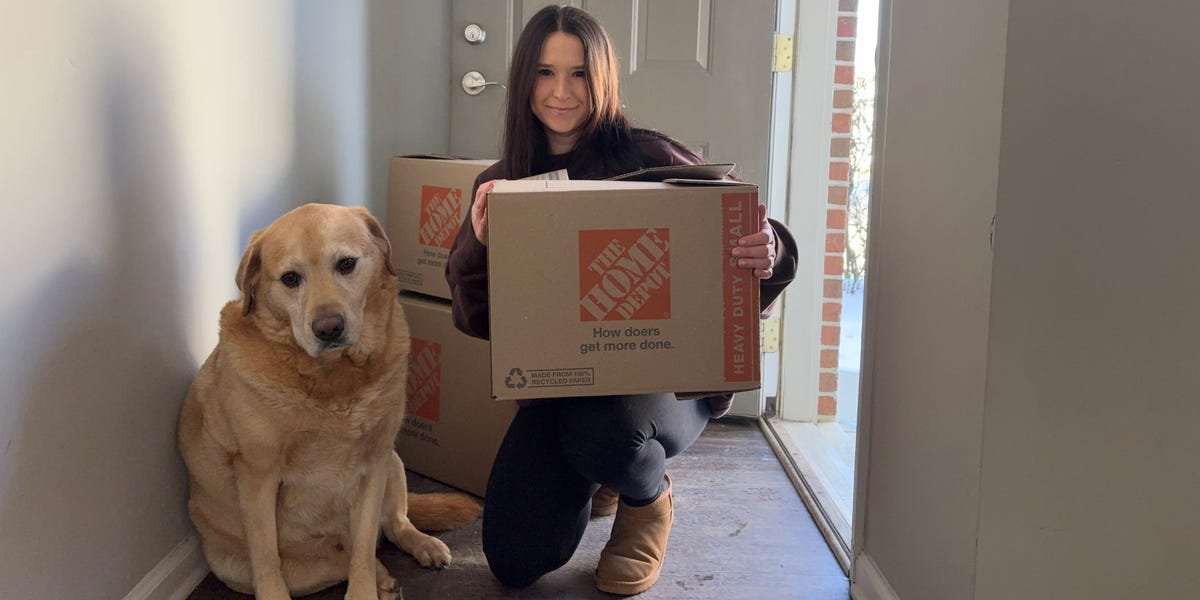
Erin Wetten and her dog unpacking moving boxes

The author has faced many financial struggles since college.

Courtesy of Erin Wetten


Over six years later, I’m still not “settled” in the way I imagined. Each move taught me to handle setbacks with a little more confidence, yet, as someone who was so used to being prepared, I still felt like I was losing my sense of self.

I began to understand the emotional toll of feeling like a failure

I’ve spent my whole life measuring my self-worth in numbers — my SAT score, GPA, and items on my résumé. I planned my entire future in spreadsheets, bit my nails until they bled, and spent nights before big tests throwing up, even after weeks of studying.

That was me: an anxious, overachieving mess who crumbled at the thought of even a small failure.

Postgrad life quickly humbled me, teaching me that no amount of spreadsheets or A’s could protect me from the real world.

Every time I moved into a new apartment, I told myself, “This is it. I’ll save up, and the next move will be into a house of my own.” But it still hasn’t worked out that way. I’ve been forced to decide: Do I let that feeling drag me down, or accept that instability is a part of life and choose to enjoy the journey?

I had to find a ‘home’ within myself.

In my 20s, I’ve learned that life rarely unfolds the way we imagine, no matter how meticulously we plan. When I crossed the stage in cap and gown six years ago, I pictured a steady job, a white picket fence, and a stress-free existence waiting for me on the other side. I thought fulfillment would come from checking the right boxes in the right order, as I had always done.

Instead, I’ve never felt more fulfilled than I do now that I’ve thrown out the checklist altogether and stopped viewing life like a syllabus.

Over time, the weight of starting over lightened, and I learned to feel at home within myself, even as my physical space kept changing. Rather than feeling sorry for myself, I sought opportunity in each new set of blank walls, finding comfort and purpose from within.

My life hasn’t followed the simple, straightforward path I once expected, and I’ve come to believe that is for a reason. As someone with a Type A personality who was once consumed by anxiety over the smallest things, more rules and timelines weren’t what I needed. I needed freedom from my own expectations, and in my case, that meant getting knocked down enough times to finally loosen my grip on perfection.

No matter how many times I have to move or start over, I know I’ll be OK. I’m no longer chasing a timeline or striving for a perfect grade in life. I’m building a life that feels like mine, and letting its ups and downs shape me for the better.


Source link

Why-Berkshire-Hathaways-New-York-Times-bet-is-a-fitting.jpeg

Why Berkshire Hathaway’s New York Times bet is a fitting end to the Warren Buffett era

Warren Buffett’s Berkshire Hathaway bought one new stock in his last quarter as CEO: The New York Times Company. It’s a fitting final bet for the Buffett era.

The famed investor’s conglomerate scooped up around 5.1 million shares of the newspaper publisher, securing a stake worth $352 million at December’s close, a Tuesday filing revealed.

The position’s small size points to one of Buffett’s two investment managers at the time — Ted Weschler and the since-departed Todd Combs — making the purchase.

Read all about it

Buffett is a lifelong lover of newspapers. He delivered 500,000 papers as a teenager running multiple routes, and for years, he challenged shareholders to best him at newspaper tossing during Berkshire’s annual meetings.

He went from throwing newspapers to owning dozens of publishers, including The Buffalo News and The Omaha World-Herald. He was close friends with the late publisher of The Washington Post, Katharine Graham, and one of the paper’s biggest financial backers.

By 2010, the billionaire stock picker was openly worried about declining circulation and advertising revenues for newspapers.

During Berkshire’s 2010 meeting, he recalled looking at the circulation of major titles such as the San Francisco Chronicle, and said it “blows your mind how fast people are dropping it.”

“The world has really changed, in terms of the essential nature of newspapers,” he said.

In 1965 or 1970, there was “probably nothing looked more bulletproof than a daily newspaper where the competition had melted away,” he continued. “But it’s a form of distributing information and entertainment that has lost its immediacy in many cases.”

Buffett pointed out that people no longer rely on papers to find out how their stocks were performing, or whether their sports team won. The resulting decline in circulation made newspapers less attractive to advertisers, he noted.

“And so you get this chicken and egg thing that the newspaper becomes less valuable as the advertisers float away, and the advertisers float away as the subscribers diminish,” he said.


Warren Buffett newspaper toss

Warren Buffett made the newspaper toss a fixture at Berkshire Hathaway’s shareholder meetings.


Rick Wilking/Reuters


Despite his concerns, he acquired 28 daily papers in the early 2010s.

“Charlie and I believe that papers delivering comprehensive and reliable information to tightly-bound communities and having a sensible Internet strategy will remain viable for a long time,” Buffett wrote in his 2012 letter to shareholders. “Charlie” referred to his late business partner, Charlie Munger.

“Newspapers continue to reign supreme … in the delivery of local news,” he added.

Buffett struck a far more bearish tone in 2019, telling Yahoo Finance that he expected only a few national titles, such as The New York Times, to survive, while the rest would “disappear.” He also bemoaned the demise of the newspaper ad business.

“It went from monopoly to franchise to competitive to … toast,” he said.

Berkshire’s surprise return

Buffett offloaded Berkshire’s newspapers to publisher Lee Enterprises in 2020. Given his long history in the newspaper business and eventual exit from it, it’s striking to see Berkshire return with its recent stock purchase.

One reason was undoubtedly The New York Times’ recovery in recent years. It grew revenues by 9% to $2.8 billion and its net income by 17% to $344 million last year, as subscription revenues rose 9% and advertising revenues jumped 12%.

A key driver was the paper’s addition of 1.4 million digital-only subscribers, which lifted its total subscriber count to 12.78 million as of December 31.

The publisher’s stock price has already seen some of the benefits. After collapsing from over $50 in mid-2002 to below $5 in early 2009, it has surged roughly 15-fold — including 50% in the past year — to trade at a record high of $74 at Tuesday’s close.

The shares gained another 3% in Wednesday’s premarket, perhaps marking one of the final cases of the “Buffett Effect,” where other investors mimic his buys and sells, moving markets.

The publisher’s comeback might explain why Buffett and his team decided to revisit one of his favorite industries so soon after turning the page.


Source link

Sales-reps-at-11-billion-AI-startup-ElevenLabs-have-to.jpeg

Sales reps at $11 billion AI startup ElevenLabs have to bring in 20 times their base salary, or they’re out — VP says

At $11 billion AI startup ElevenLabs, the message to sales reps is simple: Hit 20x your base salary, or you’re out.

Speaking on the 20VC podcast on Friday, Carles Reina, VP of sales at the voice-cloning startup, talked through its “ruthless” quotas.

“So if I pay you $100,000 a year, your quota is $2 million. That’s it. If you don’t achieve your quota, then you’re going to be out, right?” Reina said. “And we’re ruthless on that end.”

ElevenLabs — which was recently valued at $11 billion after closing a $500 million funding round — operates in micro-teams of five to ten people each, according to CEO and cofounder Mati Staniszewski, who spoke on a separate 20VC podcast episode in September.

Reina said he prefers to operate in smaller teams that hit their quotas, and pay them more.

Small teams have become a growing trend in tech, with AI startups touting their ability to scale with far fewer employees by working alongside AI agents.

LinkedIn cofounder Reid Hoffman wrote in January that a team of 15 people using AI can rival a team of 150 who aren’t.

Meanwhile, Mark Zuckerberg said on a Meta earnings call in July that he has “gotten a little bit more convinced around the ability for small, talent-dense teams to be the optimal configuration for driving frontier research.”

Reina said the “ruthless” quota has been successful at ElevenLabs, saying on the 20VC podcast that more than 80% of reps hit their sales quota.

ElevenLabs did not respond to a request for a comment.

He added that the firm compensates both the account executive and customer success manager if they upsell a company within the first 12 months.

“I’m paying double, but I don’t care,” Reina said. “It makes perfect sense because then I have these two people busting their ass to make sure that they actually can make more money, which is fantastic for me as a company.”

The push for higher performance isn’t limited to AI startups.

In April, Google said it was restructuring its compensation structure to increase rewards for top performers. “High performance is more important than ever,” Google’s head of compensation told staff at the time.


Source link

Ive-visited-Las-Vegas-several-times-—-the-best-part.jpeg

I’ve visited Las Vegas several times — the best part of every trip is less than an hour outside the city

“One time is enough.”

That’s what I’d heard countless times about visiting Las Vegas before making the trip myself. I’d always wanted to go, if only to have that once-in-a-lifetime experience.

Turns out, one time wasn’t enough. I’ve been five times now, and I have no doubt there will be a sixth. The nightlife and gambling aren’t what keep me coming back, though.

These days, I skip the casinos and explore nature instead — and one of my favorite places is about 45 minutes outside the city: Valley of Fire State Park.

There was no turning back once I found a side of Vegas I didn’t know I was missing


Atlatl Rock in Valley of Fire

Valley of Fire has some incredible sandstone formations.

Erin Sanchez


In 2013, I went to Vegas to celebrate surviving grad school with a couple of friends.

Being first-timers, we wanted to see everything the Las Vegas Strip had to offer. About 28,000 steps and a midday shoe change later, we felt we’d seen all we could in a single day.

That first trip was a whirlwind of neon lights and shirtless men dancing on tabletops (they don’t call it “Sin City” for nothing). It was fun, but I wondered if there was even more to experience in the area beyond the sensory overload of the Strip.

Flying into Las Vegas from Seattle, I’d noticed the rugged, desert mountains surrounding the city. Those same mountain ranges also caught my eye from the mayhem of the Strip.

A couple of years later, when I returned to the city with my husband, I’d finally get to see them up close.


Arch rock in  Valley of Fire

Valley of Fire State Park looks otherworldly.

Erin Sanchez


After a day on the Strip, the two of us decided to get out of the city and visit the Valley of Fire. We didn’t know much about the park, but the impressive Google images and proximity were enough to convince us to check it out.

We rented a car, then headed northeast of Las Vegas and found ourselves in a sea of sand and rocky red outcroppings within an hour.

After paying a small entry fee, the booth attendant gave us a detailed map and tips for avoiding heatstroke. Then, we spent the entire day exploring the geologic wonders of the Mojave Desert.


Petroglyphs on Atlatl Rock

We even spotted markings on some of the rocks in Valley of Fire State Park.

Erin Sanchez


The 40,000-acre recreation area had awe-inspiring sandstone formations, ancient petroglyphs, and hiking trails with Instagram-worthy photo ops around every corner.

Besides roaming the richly saturated — often gravity-defying — petrified sand dunes, we also spotted lizards scurrying across the trails and hordes of adorable ground squirrels in the picnic areas.

Out here, I didn’t hear the constant dinging from slot machines, the mashup of strangers’ conversations, or the evangelists along the Strip admonishing passersby through megaphones.

I found everything I was looking for in a weekend getaway: sun, serenity, and spectacular scenery. Now I make it a point to escape to the Valley of Fire whenever I visit Las Vegas.

Vegas can be the perfect getaway, though maybe not in the way you might expect


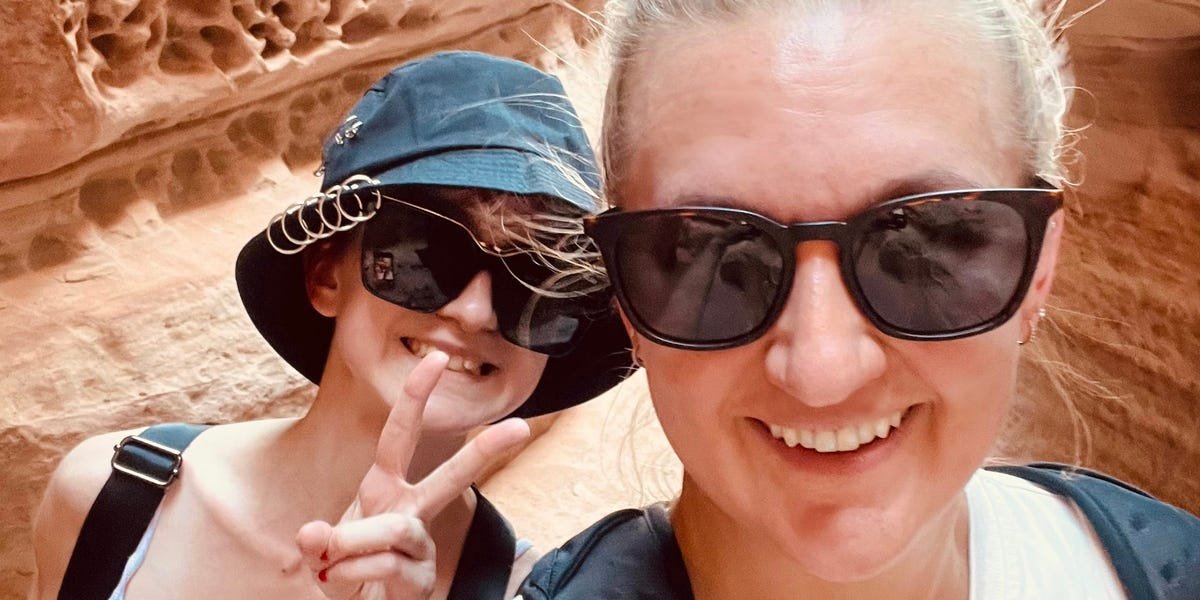
Author Erin Sanchez standing among red rocks in Valley of. Fire

I’ve now visited the Valley of Fire State Park several times.

Erin Sanchez


One time in Vegas might be enough for some people, but not for me.

In addition to offering endless food and entertainment options, the city has no shortage of beautiful nearby spots for nature lovers and outdoor adventurers.

For those of us on the West Coast, Vegas is the perfect destination for a quick trip. It’s just a short flight away, and you can find great deals on resorts, especially when you travel during the less crowded summer and winter months.

If you’re looking to add more than Valley of Fire State Park to your desert itinerary, you can also easily make day trips to places like the Hoover Dam and Red Rock Canyon.

And as for whether I’m already planning my next trip — you can bet on it.


Source link

Sam-Altman-says-OpenAI-has-gone-code-red-multiple-times.jpeg

Sam Altman says OpenAI has gone ‘code red’ multiple times — and they’ll do it again

“Code red” isn’t a one-off at OpenAI.

CEO Sam Altman said on an episode of the “Big Technology Podcast” published Thursday that the company has entered emergency mode multiple times in response to competitive threats — and expects to continue doing so as rivals close in.

“It’s good to be paranoid and act quickly when a potential competitive threat emerges,” Altman said.

“My guess is we’ll be doing these once maybe twice a year for a long time, and that’s part of really just making sure that we win in our space,” he added.

Altman said that OpenAI had gone “code red” earlier this year when China’s DeepSeek emerged. DeepSeek shocked the tech industry in January when it said its AI model matches top competitors like ChatGPT’s o1 at a fraction of the cost.

OpenAI entered “code red” earlier this month, about two weeks after Google released its latest AI chatbot, Gemini 3. The model drew widespread praise after its release in November, with Google touting it as its most advanced model to date. Altman reportedly told staff in an internal Slack memo that OpenAI would prioritize ChatGPT while pushing back other product plans.

Altman said in the podcast episode that Google’s Gemini 3 did not have “the impact we were worried it might.”

“But it did — in the same way that Deepseek did — identify some weaknesses in our product offering strategy, and we’re addressing those very quickly,” he added.

Since OpenAI entered “code red,” the company has moved quickly to ship new upgrades and features.

Last week, it rolled out a more advanced AI model aimed at improving ChatGPT’s performance across professional work, coding, and scientific tasks. OpenAI also unveiled a new image-generation model earlier this week.

Altman said the company will not be in code red “that much longer.”

“Historically, these have been kind of like six- or eight-week things for us,” he added.

The state of “code red” has also been a precedent for other tech companies. In 2022, Google declared an internal “code red” after ChatGPT’s debut. The search giant was lagging in consumer AI, despite having funded much of the research that made the AI boom possible.


Source link