
I-moved-to-a-resort-town-in-the-Italian-Alps.jpeg

I moved to a resort town in the Italian Alps 8 years ago. Living here has perks, but it’s no vacation.

When people ask why I settled in the Aosta Valley, they often assume I fell in love with a local or that I’m a ski bum. What actually happened was I fell in love with the region.

I first discovered Courmayeur, my new hometown, in 2018. I had just turned 40, my marriage had ended, and I’d left my job in Edinburgh.

Unmoored, exhausted, and heartbroken, I knew I needed to step outside my comfort zone. An Italian road trip with my rescue dog, Annie, felt like the perfect way to shake things up.

My mom joined us for the first leg. An avid hiker, she suggested we stop for lunch in her favorite mountain town in the Italian Alps. As much as I loved the relaxed, authentic vibe, I never imagined that eight years later, I’d be living here year-round.

Every time I returned to Courmayeur, it felt like coming home


The writer standing in a creek in the summertime.

I ended up staying in Courmayeur longer than I expected. 

Gemma Johnstone


I spent the rest of my road trip exploring Italy, then headed back up north and spontaneously stopped in Courmayeur again for a quick visit.

A few days turned into two weeks — and then turned into a few months, after I found a short-term, low-season rental and decided to stick around. Then, I extended my three-month lease to a yearlong one.

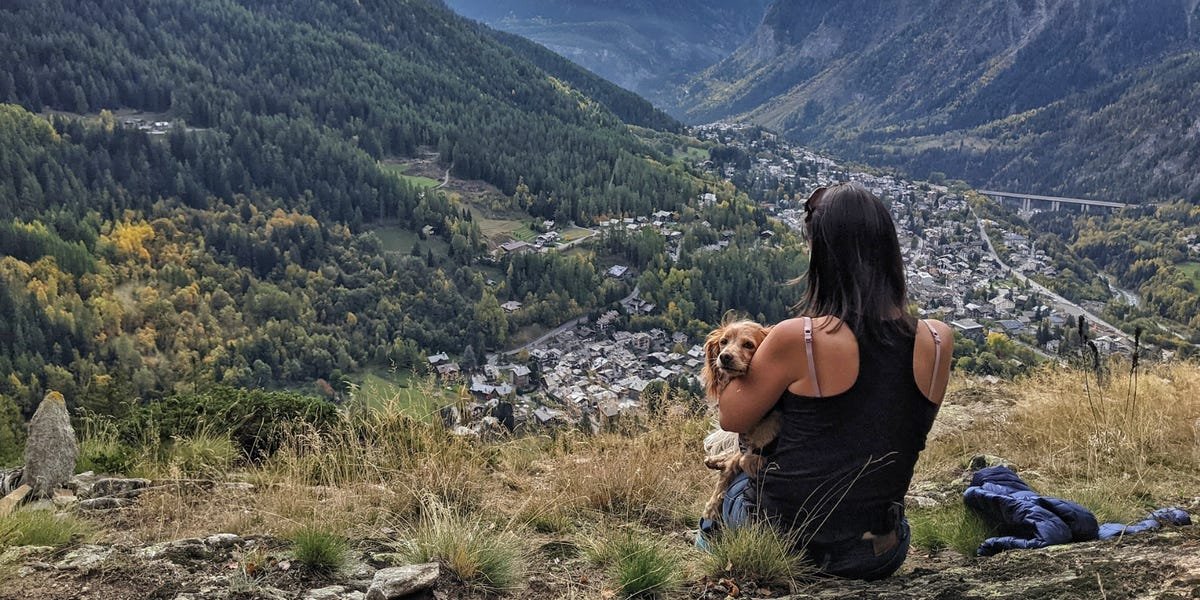
The peace, blue skies, and stunning scenery kept me here. I loved that, within minutes of stepping outside on a daily dog walk, I could be immersed in secluded nature with breathtaking views.

Plus, despite being surrounded by tranquil trails, the town is conveniently well-connected. It’s just a few hours away from Milan, Turin, and Geneva, making it easy for my much-missed friends and family to visit and for me to explore other parts of Europe.

Almost a year into my stay in Courmayeur, I took a short trip back to Scotland. I still wasn’t sure where I wanted to settle down long-term.

However, when I drove back into Courmayeur, I immediately felt such an overwhelming sense of being home that I began the process of securing residency.

Italian Alpine life comes with challenges no one posts about


The writer and her dog sitting on a rock in the mountains, overlooking a town.

Living in the Alps is very different from visiting. 

Gemma Johnstone


During that first year, I realized that living in this picture-postcard Alpine resort year-round is very different from vacationing here.

Courmayeur’s population, which is typically around 3,000, swells significantly during the peak ski and summer seasons, and living in a tourist destination has its downsides. I don’t love the traffic-clogging narrow lanes, and the scarcity and high cost of apartment rentals.

During the low season, the town feels deserted. Suddenly, there are swaths of shuttered second-home chalets and closed restaurants. It’s a change of pace that I appreciate, but for those who thrive in a bustling environment, it could feel jarring.

Then there’s the language barrier. My Italian has been embarrassingly slow to improve, and even basic interactions felt intimidating to begin with.

Locals were always polite and helpful — and many working in the tourism industry speak English — but I understandably had to prove myself before I was fully embraced by the close-knit mountain community.

The cost of living is also a consideration; my winter energy bills, for instance, are much higher than I was used to in Scotland. I’m lucky to work from home, but I know seasonal workers who have struggled with long hours, limited days off, and low pay.

Living here is still so worth it for me


The writer and her dog sitting in the snow, looking out at a snow-capped mountain in the Alps.

Courmayeur isn’t perfect, but it was exactly what I needed. 

Gemma Johnstone


Despite the challenges, I don’t regret my decision to stay in Courmayeur.

Living here has confirmed how much I value nature, community, and calmness over status or city life. Moving doesn’t solve every problem, of course, but the right place gave me the space I needed to work through mine.

I find it grounding to live where the seasons dictate the rhythm of life. Of course, there’s skiing in the winter, but in the spring and fall, I help my neighbors with potato and apple harvests. In the summer, I hike to mountain refuges and swim in glacial lakes.

My community here is a mix of lifelong locals and a few expats, and they’ve all expanded my worldview. I admire the dedication and passion of hotel workers, lift operators, and mountain guides, and I love watching burned-out city slickers rediscover their joy for life here.

I’ve learned that life in the mountains of Italy can bring gorgeous nature, a slower pace, and a great community. However, it also requires a pile of patience, flexibility, and honesty about your reasons for moving here. I’ve seen people relocate here — and leave — when their expectations didn’t match the reality.

For me, though, staying in Courmayeur was just what I needed. Life here isn’t perfect, but every time I step onto a mountain trail above the village with my dog, I feel a steady, uncomplicated contentment.



Source link

I-visited-popular-spots-like-Tokyo-and-Kyoto-during-my.jpeg

I visited popular spots like Tokyo and Kyoto during my trip to Japan, but my favorite stop was a town I’d never heard of

Visiting Japan has been on my bucket list for a long time, and I finally booked a trip after relentless pleas from my children — and reading about how the US dollar is strong against the Japanese yen.

To simplify planning, I booked a family tour through Intrepid Travel. Unsurprisingly, the tour went to Tokyo and Kyoto, popular tourist destinations that draw many visitors (including my family) to Japan.

However, the tour also brought us to some places I may not have found on my own, including the quaint, quirky mountain town of Hakone.

Visiting the town, which is southwest of central Tokyo and about a 90-minute railway ride away, turned out to be my favorite part of the trip.

We loved the town’s famous hot springs


Author Jamie Davis Smith and son smiling next to red door with windows

Our trip was complete with incredible views.

Jamie Davis Smith


Hakone is full of onsens, or natural hot springs, heated by geothermal activity happening beneath Japan. During my visit, I got to experience several types of onsens — and I still dream of sitting in their soothing waters.

First, I tried a bucolic onsen overlooking the mountains, which were lush and green when I visited during the summer. Lounging in a naturally fed hot spring from the top of a mountain allowed me to slow down, relax, and appreciate the beauty of Japan outside of its big cities.

I also tried a traditional onsen, which was segregated by gender and required visitors to disrobe completely. As an American, I’m not used to bathing naked with strangers, but I didn’t want to miss this quintessential Japanese experience.

Although I didn’t stay long, it was eye-opening to see how this tradition, so different than my own, quickly helped me feel more comfortable in my own skin. This is something I would not have experienced if I had not gone to Hakone.

Finally, my kids and I tried a series of themed onsens at Yunessun, a hot-spring theme park, which was one of the quirkier experiences I have had while traveling.

There, I hopped into an onsen shaped like a ramen bowl, complete with blow-up toppings. My kids joked that we were experiencing what it felt like to be cooked on a stovetop.

I also got to try unique baths, including one filled with coffee and another containing wine. My skin felt smooth and soft when I left.

Our trip featured some unique activities, including a visit to a mind-blowing sculpture garden


Woman smiling in rainbow square structure

The whole family had a blast at the Hakone Open-Air Museum.

Jamie Davis Smith


Although my children don’t always share my affinity for looking at paintings and sculptures, they agreed to accompany me to the Hakone Open-Air Museum.

Beyond its gates, we found larger-than-life interactive sculptures unlike anything we’ve seen at traditional art museums.

As we walked through the museum’s gardens, we hopped through rainbows, climbed to the top of a stained-glass tower, and walked underground to peek up at the sky from below.

My children even swung on colorfully knitted balls hanging from an elaborate net, seemingly suspended from the sky.

Near the exit of the gardens, I sat and soaked my feet in a hot-spring footbath while gazing out at the surrounding forest. I wish that every large attraction had something similar at the end.


Child standing in diamond rainbow sculpture

There were some fun photo opportunities at the Hakone Open-Air Museum.

Jamie Davis Smith


Fortunately, there were many other unique and fun things for us to do in Hakone.

While there, I ate one of the town’s famous black eggs, which had been transformed from their original white after boiling in a sulfur-rich hot spring. Legend has it that eating one of these adds seven years to your life — I devoured every morsel.


Hand holding black egg

Hakone is famous for its hard-boiled black eggs.

Jamie Davis Smith


We also got a glimpse of Mt. Fuji from the Hakone Tozan Railway and rode on a pirate ship to get a fantastic view of Hakone’s bright-red Torii Gate standing in a lake.

Hakone was a wonderful stop on our trip, and I’d happily return


Child standing next to boat in water

We saw so much in Hakone.

Jamie Davis Smith


During our time in Hakone, we stayed in a ryokan, a type of traditional Japanese inn, and were able to explore a lot of the relatively small town on foot.

Along the way, we wound through mountain roads dotted with small restaurants and shops, a welcome reprieve from the heat of the bigger cities we had visited earlier in our trip. We even took some time to hike along Hakone’s lush forest paths.

Although it’s easy to see the appeal of Japan’s bigger cities like Tokyo, Kyoto, and Osaka, if I ever return to the country, I would spend more time in Hakone and seek out other small towns.


Source link

My-wife-and-I-let-go-of-our-dreams-and.jpeg

My wife and I let go of our dreams and left New York City. We moved to a small town so we could be closer to my in-laws.

Two years before our son was born, my partner, Liv, and I moved to New York City to immerse ourselves in the city that never sleeps. She was working full-time and pursuing a master’s degree at Columbia, while I was figuring out what it meant to be human after I quit my tech job.

We dreamed of the community and opportunity that awaited us in that glorious place of concrete and glass. After the loneliness COVID brought, I fantasized that we’d meet other adults who shared enough of our values to create a tight community in New York City, one that was more than just friends.

But everything changed after our son was born.

We moved to New York City to live our dream life

My sister-in-law, her boyfriend, and a handful of friends already lived in New York City. The region’s high population density came with the promise of new close relationships.

Within six weeks, we sold our house in suburban Maryland and moved into a New York City apartment, sight unseen.

Living in NYC is like gripping life’s volume knob with both hands and cranking it up past the breaking point. The city offers an unmatched variety of sights, sounds, smells, tastes, and feelings to the privileged people who can afford it.

Some nights over the next year, I sat on our windowsill, admiring the twinkling cityscape teeming with life. I was making new friends, but I wasn’t seeing a path to the fantastical relationships with other adults that I thought would come easily.

The question of whether or not to expand our biological family also hung heavily in my mind.

After an errand to the Financial District, I shared a transformative conversation with a tourist couple from rural Germany. We talked about their children, and I revealed my ambivalence about having my own.

The man’s response was warm and adamant: Having children is the best. There’s never going to be a right time. Just do it.


a view of the new york skyline

The author’s frequent meditation spot, overlooking Brooklyn and Manhattan.

Courtesy of Zachary Fox Photography


We hugged, took a selfie, and parted ways. Six months later, having learned countless lessons from the city and its people, Liv was pregnant with our first child.

Our priorities shifted after the birth of our son

Shortly after our son was born and I became a stay-at-home dad, our family reached a decision point. We could not afford to live in New York City and enjoy our preferred lifestyle. We needed more space and more help.

A house in my in-laws’ neighborhood was put up for sale at an attractive price. Liv’s desire burned for this home and the comfort of neighbor-parents, but I was unconvinced. Leaving my community and moving to Slower Lower Delaware felt like a massive downgrade.

As our son’s eyes opened and he began to crawl, my priorities shifted toward my growing family. Whenever my mother-in-law trekked up to the city to help with childcare, I felt rested and loved. If we moved, her love and nurturing spirit would be just down the road.

I chose to be excited about the move, focusing on the reasons it felt good, like the familial help, lower financial pressure, and quieter calm.

We bought the house and moved after our son’s first birthday.

An unexpected step toward a dream come true

I am fortunate enough to both love and like my family, including the family I inherited from Liv. With this type of love comes a web of commitment to the well-being of all members of our system. Societal norms make the depth of this commitment far more accessible to family than it is to friends.

In an alternate universe, there’s a version of myself whose hyperlocal community consists of friends and family, where our children have sprawling chosen families and roam freely between homes. In this imaginary village, shops and services are walkable, and what we make transcends money. I thought we might make this happen in New York City. Maybe it can for others, but it didn’t for me.

Perhaps that idealized universe is actually this one, only set a few years in the future. The open-door policy we happily share with my in-laws is a part of the dream made real.


Source link

Ive-lived-in-the-UK-for-over-20-years-—theres.jpeg

I’ve lived in the UK for over 20 years —there’s just one town I always dream about moving to and love to visit

Our family’s first trip to Windermere changed everything.

​Sitting on the bank of a stream with my feet dipped in its cold, clear water, surrounded by trees budding for spring — even with the baby kicking away inside me at eight months pregnant, I felt a kind of bliss that’s hard to put into words.

​The only sounds were the distant mooing of cows and the occasional squeals of our toddler’s laughter at the nearby bed and breakfast.

​I had no doubt in my mind that our four-hour drive from Northampton was worth it.

Since that trip nearly two decades ago, we’ve been to this small English town in the Lake District many times. Each visit only confirms there’s no place like Windermere — and I still dream of moving here someday.

​The town feels like its own secret world, but it’s still well-connected and home to top-notch food and attractions


TRain driving through fall foliage in lake district

A train driving through the Lake District in the fall.

by Andrea Pucci/Getty Images


Tucked between rolling fells (grassy hills) and England’s largest lake of the same name, the town of Windermere feels like its own world.

​Home to fewer than 10,000 residents, it’s small enough to cross on foot yet expansive in feel.

The surrounding hills and lake feel quietly confident. They soften the skyline and set a slower pace, making it clear this isn’t a place built for rushing.

All of this gives Windermere a wonderfully quiet, oasis-like rhythm.

Despite feeling removed from the hustle and bustle, it’s surprisingly well-connected and close enough to reach without much fuss.

It’s a short drive from cities like Lancaster and Carlisle. By train, it’s three hours from London, an hour and a half from Manchester, and two or three hours from Edinburgh.

It’s also in the county of Cumbria, which has something for everyone, whether you want to partake in watersports and hiking, visit Scafell Pike (England’s highest mountain and a war memorial), try local specialties like sticky toffee pudding and Cumberland sausage, or just seek out some serenity.


Tall green mountains, peaceful lakes in lake district

Fleetwith Pike and Buttermere in the English Lake District.

WhitcombeRD/Getty Images


Over the years, some of our most cherished Lake District moments have come from serene walks and hikes around the lakes and fells of Windermere and nearby towns, as well as leisurely cruises and visits to the world-famous Beatrix Potter attractions.

And though many of its local cafés have small-town charm, this area has serious food cred, too. The Lake District is home to several Michelin-starred restaurants.

Even so, unlike busier hot spots, Windermere has retained its identity and sense of self. It is protective of its pace, its peace, its essence.

People here seem to look out for each other. They don’t just nod as they pass; they stop to chat and remember people’s names.

By 5:30 p.m., many shops and cafés close, while a handful of restaurants, pubs, and the local Sainsbury’s stay open late. Even at night, the town feels safe and calm, especially compared to larger cities.

I dream of living here someday

Many places are lovely to visit, but Windermere feels like somewhere that meets you exactly where you are, offering something for every stage of life.

After all these years, I still sometimes feel that same stillness I felt on our very first trip when I was sitting by the water and realizing we’d found somewhere special.

Each visit has marked a different chapter in our family’s lives, from being pregnant with a toddler in tow to returning with teenagers who now set their own pace.

Somehow, though, Windermere has grown with us, and I often wonder what it might feel like if we stayed a little longer. After all, there’s something comforting and restorative about living where nature is such a big part of daily life.

When I imagine where I’d call home in the UK, it’s not London, Birmingham, Manchester, or even Northampton, where we live now.

It’s Windermere … maybe once the children have grown up.


Source link

James Faris headshot

Bari Weiss fielded tough questions from CBS News staffers about political bias and the network’s future at a town hall

CBS News employees put top editor Bari Weiss in the hot seat during an all-hands meeting on Tuesday, asking about her vision and standards for the nearly century-old broadcast network.

The first question in the Q&A part of her town hall asked how she would respond to criticism that CBS News is turning into “a right-wing network” under her leadership.

“I’m here to do one thing. It’s not to be a mouthpiece for anybody. It’s simply to be a mouthpiece for fairness and the pursuit of truth,” Weiss said at the all-hands meeting, according to a recording obtained by Business Insider.

Weiss, who became the editor in chief of CBS News in October after Paramount Skydance CEO David Ellison bought her opinion site The Free Press, asked staffers to examine the coverage since her appointment.

“There’s a lot of noise out there, but I would just urge anyone who suggests that to look at our work and judge for yourself,” she said.

Weiss was then asked how the network’s news-gathering standards had changed since she took over.

“I don’t think our standards have changed,” she said, adding that the network was “in very capable hands” regarding editorial standards.

Weiss said she ‘was not pressured’ to hold the ’60 Minutes’ segment

Weiss caused a stir in December for a late-hour decision to delay a “60 Minutes” segment about the Trump administration deporting migrants to the CECOT prison in El Salvador. Critics questioned her commitment to hard-hitting journalism and wondered whether Paramount leadership was influencing editorial decisions at CBS News — a notion that Weiss strongly denied on Tuesday.

“I want to just say this as plainly and clearly as possible. I was not pressured by David Ellison or anyone else,” Weiss said during the town hall. Weiss acknowledged that delaying the segment after commercials had already run for it was bad timing.

“I didn’t know the screening schedule for every single thing, that specific logistical nightmare,” she said. “That’s never going to happen again. So please rest assured that nothing of that kind is ever going to happen again. You have my promise.”

That said, she added that “asking for more information” and “trying to go back to a source” for a comment was an editorial policy she wanted to prioritize to build trust with audiences, as she explained in a December memo to employees.

“I felt it was important to do our best to try and get a voice from the administration, and I’m always going to be pushing for that,” Weiss said.

Weiss had little experience in traditional TV before joining CBS News. Instead, she became known in 2020 for her dramatic exit from The New York Times, during which she alleged anti-conservative bias. Her next move, starting The Free Press, turned out to be lucrative when Ellison bought it for $150 million in October.

‘Loving America is not about jingoism’

On Tuesday, Weiss was also asked about her core values, including what one of the new guiding principles for CBS Evening News — “We Love America” — means for journalists.

“Loving America is not about jingoism. It’s not about blind patriotism,” Weiss told employees. “It’s about vociferous defense of the principles and values that have made this country exceptional and that allow us to do the work that we do. And so anyone that disagrees with that, I’d love to have a conversation with you.”

When asked whether “CBS Mornings” would undergo another shake-up, Weiss noted that it had already undergone a major change, with longtime anchor Tony Dokoupil moving to the evening show.

“Speculation about Gayle King seems to be a favorite parlor game of a lot of newspapers and people in this building, and I just want everyone here to know that she’s absolutely beloved and see her long into the future here at CBS,” Weiss said.

A shift to a ‘streaming mentality’

In prepared remarks, Weiss said that CBS News needed to “shift to a streaming mentality immediately” and that if the broadcast network stuck mainly to its linear TV strategy, “we’re toast.”

When asked about staffing or potential layoffs at CBS News, Weiss said that she couldn’t make any promises amid a “tsunami of technological change.”

“I can’t stand up here and tell you that in a moment of incredible transformation that that’s not going to mean transformation of our workforce,” Weiss said. She added that CBS News is “also hiring people to suit that.”

On Tuesday, CBS News announced 19 new contributors to the network, including writers and podcasters like Coleman Hughes and Derek Thompson.

Weiss said that if she didn’t believe digital revenue could eventually replace linear TV revenue, she “wouldn’t be standing here.” She said that linear TV wouldn’t go away, but that revenue would “decline sharply, as will the audience.”

“What winning looks like writ large for this company is building incredible journalism for audiences that are so much bigger than the one that we currently have and are maintaining on linear,” Weiss said. “That’s what winning looks like. It’s really simple.”

Have a tip or thoughts on Bari Weiss’ strategy for CBS News? Contact this reporter via email at jfaris@businessinsider.com or Signal at @jamesfaris.01. Use a personal email address and a nonwork device; here’s our guide to sharing information securely.


Source link

I-moved-to-a-small-beach-town-in-another-country.jpeg

I moved to a small beach town in another country. My new home felt like paradise, but I struggled to belong.

In 2017, I moved from Los Angeles to Panama to teach English.

My first year in the country was filled with excitement. I was based in Panama City, and I found it easy to make friends through the many dance classes and meet-ups.

My social life felt full, and most weekends were spent wandering through Casco Viejo (the downtown area), trying to find the best rooftop bars and underground nightclubs playing a mix of Reggaeton and pop music.

Soon, though, the fast-paced lifestyle, combined with the constant traffic and sweltering heat, became overwhelming. I grew tired of living in a city of millions and craved a slower pace.

So, I relocated to a small coastal town called Playa Venao, which is about 200 miles and a five-hour drive from Panama City.

I hoped I could quickly build a community there as I did in the capital, but it didn’t come nearly as easily to me.

At first, my quieter town felt like paradise


Surfers on beach at sunset

Many parts of Panama have a rich surfing culture.

Kiersten Brown


Although Playa Venao is now more developed, at the time I lived there, it was primarily a handful of hotels, hostels, and homes scattered along the shoreline.

A single road split the town: real estate on one side, jungle and cow pastures on the other. Only a few hundred people called Playa Venao their full-time home.

I was living in a place where there were more trees than buildings. In fact, I could pick and eat papayas, coconuts, and mangos straight from the trees on the property of my rental.

The school I worked at was quite small and, because of our remote location, nature often became our third instructor. Children shared their outdoor play area with centipedes and howler monkeys, and splashed in the nearby stream and waterfall.

Between teaching, I spent my days peacefully walking along the beach and hiking near the river. I was no longer overwhelmed by the sounds of honking horns and revving engines. Instead, I was soothed by the songs of exotic birds.

My social life wasn’t bustling like it was before, though at first, I enjoyed meeting people from all over the world who were in the area on vacation.

But once the novelty of being somewhere new wore off, I started to see the downside of living in a place that felt like paradise.

Unfortunately, I didn’t feel like I fit in with most of the visitors or locals


Waves at Playa Venao

I didn’t have much to say about surfing — a popular topic among tourists.

helivideo/Getty Images


I struggled to find my place in a community that felt largely split between locals and tourists.

I was a bit of an in-between: I’d only been in the country for a year, so I wasn’t a local … but I’d been living in this beach town for a few months, so I wasn’t a tourist, either.

Building community with transient tourists seemed impossible.

Many tourists I met spent their time surfing or talking about surfing, not surprising given Playa Venao’s reputation as one of the best surf spots in the world.

Unfortunately, as a beginner, I couldn’t keep up with the experienced surfers during conversations or out on the water.

Whenever I’d meet someone who had more to talk about than waves, we only had a week or two to get to know each other because they were vacationing where I was living.

I felt I never had time to share more about myself beyond surface-level topics, like work, hobbies, and where I was from. These limited interactions made my relationships feel shallow and made me feel like I didn’t have any real friends.

Over time, the loneliness ate away at me, and I grew tired of reintroducing myself to a new tourist every other week. So, I tried connecting with the locals. This wasn’t an easy task.

The director of the school I was working at had warned me that locals were often closed off to newcomers. I felt it.

One night, I managed to play a game of pool with some locals at a nearby bar. I thought I’d made a breakthrough, but the next morning, the same people who had been friendly the night before wouldn’t give me the time of day — it hurt.

I could understand why a tight-knit community of people who grew up together might be wary of trusting outsiders. However, it was hard being treated like just another visitor in the place I lived.

After weeks of failing to make lasting connections, part of me wanted to call it quits and return to the city. I missed feeling like I belonged and having a calendar filled with dance classes and happy hours with friends.

However, I’d committed to working through the whole school year, and I didn’t want to walk away from the children — some of the only people I had created bonds with.

Finally, one conversation with my mom helped me reevaluate and give my new home another shot.

Focusing on gratitude and living in the moment helped me feel more at home


Cloudy day shot of beautiful Playa Venao

Panama has several famous beaches.

Piero Zanetti/Getty Images


After listening to my sorrows, my mom reminded me that life wasn’t happening to me, it was happening for me.

I needed to embrace each moment, even the not-so-great ones, and treat my situation as an opportunity. So, instead of ruminating on what I lacked, I focused on appreciating more of what I had.

To ease my frustration of not being able to pop over to a movie theater or hop into a nightclub like in the city, I found entertainment within nature.

I’d wake up early to enjoy the colorful sunrises and collect different rocks and shells along the shore. I’d pass the time by going for a swim or setting up my speaker and dancing barefoot in the sand.

Focusing on my internal peace helped me to stop forcing connections, and I allowed them to form naturally.

I stopped viewing relationships as temporary experiences. It didn’t matter if a friendship lasted five days or four months — I cherished every connection made.

Soon, routine visits to the local coffee shop led to casual chats with the barista. I ordered the same dish so often that one day, they wrote out the recipe for it and gave it to me — it kick-started our friendship.

More connections began to blossom as I prioritized attending community events, from kayak races to surfing competitions. As time passed, locals could see that I was consistently making an effort, and perhaps they started to view me as less of a tourist.

Meanwhile, I was forming stronger relationships with the parents of the children I worked with, and they helped advocate for me to the other locals. I’d also started to build a strong connection with my coworker, who became one of my first real friends in the area.

With a little bit of patience and a mindset shift, I eventually found the community I craved and ended up staying in Playa Venao for about a year.

In that time, I learned that sticking through uncomfortable situations — and staying present for both the good and the bad — can lead to unexpected peace and happiness.


Source link